

Inventory Carrying Cost
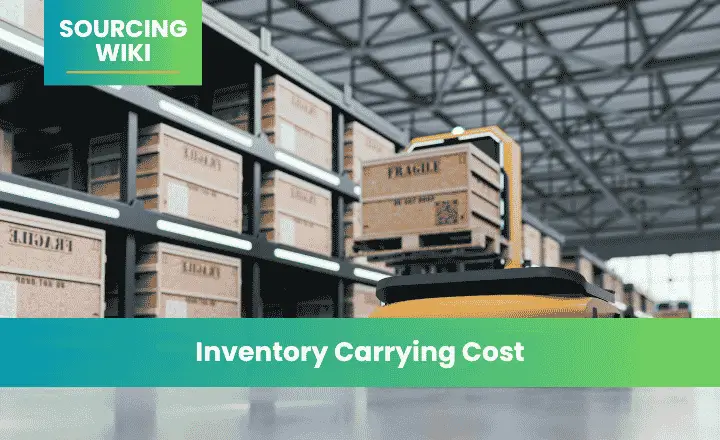
Inventory carrying cost, also called inventory holding cost, is the cost a business incurs from holding inventory over a period of time. It includes more than the purchase price of the products because inventory also consumes warehouse space, capital, insurance, handling resources, and management effort.
Carrying cost is usually expressed as either a monetary amount for a specific period or as a percentage of the inventory value. It is an important consideration when deciding how much inventory to purchase, how frequently to replenish it, and whether larger order quantities actually reduce total purchasing cost.
What Does Inventory Carrying Cost Include?
The exact components vary by business, but inventory carrying cost commonly includes four major areas:
| Cost category | Typical examples |
|---|---|
| Capital cost | Money tied up in inventory and its financing cost |
| Storage cost | Warehouse space, utilities, equipment, and handling |
| Risk cost | Insurance, damage, theft, deterioration, and obsolescence |
| Inventory management | Tracking, counting, administration, and related labor |
Some businesses calculate these costs separately, while others use a carrying-cost percentage to estimate the annual cost of holding inventory.
Inventory Carrying Cost Formula
A basic calculation is:
Inventory Carrying Cost = Average Inventory Value × Carrying Cost Rate
For example, if a company holds an average inventory value of $500,000 and its annual carrying-cost rate is 20%:
$500,000 × 20% = $100,000 per year
The carrying-cost rate is not a universal fixed percentage. It depends on the company's financing costs, warehouse expenses, inventory risk, product characteristics, and accounting approach.
Inventory Carrying Cost Percentage
The carrying-cost percentage represents the annual cost of holding inventory relative to its average inventory value.
A simplified formula is:
Carrying Cost Rate = Annual Inventory Carrying Cost ÷ Average Inventory Value × 100%
For example, if annual inventory carrying costs are $80,000 and average inventory is $400,000:
$80,000 ÷ $400,000 × 100% = 20%
Businesses should define which costs are included before comparing carrying-cost percentages across products, suppliers, or periods.
Why Inventory Carrying Cost Matters
Holding more inventory can provide benefits such as better product availability, protection against demand fluctuations, and fewer replenishment orders. However, excess inventory also ties up working capital and increases exposure to storage costs, damage, obsolescence, and changing demand.
This creates a purchasing trade-off. Ordering larger quantities may reduce the number of purchase orders or improve the unit price, but the additional inventory may remain in storage for longer and increase carrying costs.
For buyers, the relevant question is therefore not simply whether a larger order has a lower unit price. The broader question is whether the purchasing decision reduces total cost after inventory-related costs are considered.
Inventory Carrying Cost and EOQ
Inventory carrying cost is one of the key concepts behind Economic Order Quantity (EOQ).
In the basic EOQ model, ordering cost and holding cost are considered together. Larger order quantities generally increase average cycle stock and therefore increase holding costs, while smaller and more frequent orders can increase ordering costs.
This relationship helps explain why the lowest unit purchase price does not necessarily produce the lowest overall inventory cost.
Inventory Carrying Cost and MOQ
Minimum Order Quantity (MOQ) can have a direct effect on inventory carrying costs.
If a supplier requires a large MOQ, a buyer may need to purchase more units than the current demand requires. The additional units become inventory that must be stored and financed until they are sold or consumed.
For products with slow demand, short product lifecycles, or high obsolescence risk, a high MOQ can therefore create a meaningful inventory cost even when the supplier offers a lower unit price.
Inventory Carrying Cost and Inventory Turnover
Inventory turnover measures how frequently inventory is sold or consumed during a period, while carrying cost measures the cost associated with holding that inventory.
Generally, inventory that remains in stock for longer periods creates greater exposure to carrying costs. However, turnover should not be interpreted in isolation because different products naturally have different demand patterns and inventory requirements.
For buyers managing many SKUs, combining inventory turnover with carrying-cost analysis can help identify products where inventory is consuming significant capital.
Example: Comparing Two Order Quantities
Suppose a buyer can purchase a product at either:
- 1,000 units at $10 each, or
- 5,000 units at $9 each
The second option has a lower unit price, but it requires an additional $40,000 of inventory investment at the time of purchase.
If the additional inventory remains in storage for an extended period, the buyer may incur additional financing, storage, insurance, handling, and obsolescence costs.
The correct purchasing decision therefore depends on expected demand, lead time, MOQ, available storage, carrying cost, and the value of the unit-price reduction—not the unit price alone.
Inventory Carrying Cost in Global Purchasing
For international buyers, inventory carrying costs can become particularly relevant when supplier lead times are long or orders are placed in large batches.
A buyer may increase order quantities to reduce purchasing frequency or meet supplier MOQs, while longer production and transportation lead times can also encourage additional inventory buffers. These decisions should be evaluated together with demand forecasts and replenishment requirements.
For multi-SKU purchasing, buyers can also prioritize high-value or slow-moving products for closer inventory review rather than applying the same inventory policy to every product.
FAQs
Is inventory carrying cost the same as holding cost?
In most inventory-management contexts, the terms are used interchangeably. Both describe the costs associated with keeping inventory over time.
What is a typical inventory carrying cost percentage?
There is no single rate that applies to every business. The appropriate percentage depends on the costs included and the company's products, financing, storage, and inventory risks.
Does carrying cost include the product purchase price?
Usually, the purchase price itself is not treated as a carrying cost. However, the capital tied up in inventory may be included as part of the capital or financing component of carrying cost.
Does higher inventory always mean higher carrying cost?
Holding more inventory generally increases total carrying costs, although the actual impact depends on the inventory value, storage conditions, financing, risk, and length of time the inventory is held.
How does MOQ affect carrying cost?
A higher MOQ can require a buyer to hold more inventory than immediate demand requires, increasing the amount of capital and storage capacity tied up in inventory.
Inventory Carrying Cost for NewBuyingAgent Buyers
NewBuyingAgent helps global buyers source products from China across categories while coordinating purchasing requirements, supplier orders, and production follow-up. Understanding inventory carrying cost can help buyers evaluate order quantities and supplier MOQs based on broader purchasing economics rather than unit price alone.
Key Takeaway
Inventory carrying cost represents the cost of holding inventory over time. It connects purchasing decisions with warehouse capacity, working capital, inventory risk, MOQ, EOQ, and demand planning, making it an important factor when evaluating the real cost of an order.
Related Knowledge Base
Sourcing Practices & Insights: Inventory Carrying Cost
Latest Sourcing Guides



Get Started Today
Let's Turn Your Sourcing Goals into RealityWeChat:+86 15157124615
WhatsApp:+86 15157124615
Address:Building 10 #39 Xiangyuan Road, Hangzhou, China
