Stockout
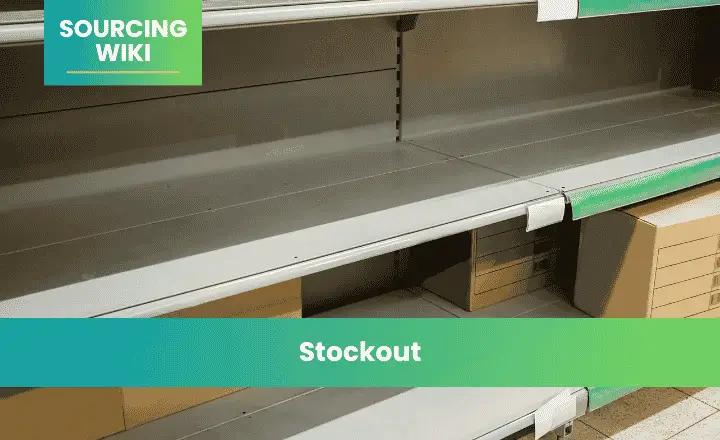
A stockout occurs when a business does not have enough available inventory to fulfill a customer order or meet current demand. In simple terms, the required product is needed, but the business cannot supply it from available stock.
A stockout can occur at different points in a supply chain. A retailer may run out of finished products, a wholesaler may lack inventory for customer orders, or a manufacturer may run out of a critical raw material or component required for production.
Stockout is therefore an inventory availability problem, rather than simply an indication that a product has low inventory.
For example, if a buyer normally holds 1,000 units of a product but receives orders for 1,200 units before the next replenishment arrives, the business has a 200-unit supply shortfall. If those additional units cannot be supplied when required, the situation represents a stockout.
What Causes Stockouts?
Stockouts generally occur when available supply is insufficient to meet demand at the required time. One common cause is demand being higher than expected. A product may sell faster than forecast, a seasonal event may increase demand, or a sudden market change may create an unexpected increase in orders.
Another major cause is replenishment delay. Even when a buyer has correctly identified the need to replenish inventory, a long or unpredictable manufacturing lead time, supplier delay, transportation disruption, or other supply issue can cause new stock to arrive after existing inventory has been exhausted.
Stockouts can also result from inventory planning and data problems. Inaccurate inventory records, unrecorded stock movements, damaged goods, incorrect demand forecasts, or insufficient safety stock can cause the business to believe that more usable inventory is available than actually exists.
For manufactured products, shortages of raw materials or components can create a different type of stockout. A factory may have customer orders but be unable to complete production because an essential input is unavailable.
Stockout vs. Out of Stock
Stockout and out of stock are closely related, but they are often used in slightly different contexts.
Out of stock commonly describes the current availability status of a product. For example, an e-commerce listing may display “Out of Stock” when no units are currently available for purchase.
Stockout is more commonly used as an inventory-management or supply-chain term describing a situation in which available inventory is insufficient to satisfy demand.
In practice, the two terms may overlap. However, “stockout” often emphasizes the operational event or inventory condition, while “out of stock” describes the availability status visible to a customer.
Stockout vs. Backorder
A stockout does not always mean that an order becomes a backorder.
A stockout means that available inventory is insufficient to meet demand.
A backorder occurs when a customer order has been accepted but cannot be fulfilled immediately because the required inventory is unavailable.
For example, suppose a buyer orders 500 units when the supplier has only 300 units available. The supplier may experience a stockout for the remaining 200 units. If the buyer agrees to wait for those 200 units and the supplier records them as an outstanding order, those units become a backorder.
Therefore:
Stockout = insufficient available inventory
Backorder = accepted demand waiting for future fulfillment
The two conditions can occur together, but they describe different aspects of the supply situation.
Stockout vs. Overstock
Stockout and overstock represent opposite inventory problems.
A stockout occurs when available inventory is insufficient to meet demand.
Overstock occurs when inventory exceeds what is reasonably required under the relevant demand and inventory policy.
Neither condition should automatically be treated as the desired opposite of the other. Holding excessive inventory can increase storage and capital costs, while insufficient inventory can result in lost sales, delayed orders, or production interruptions.
Inventory planning therefore aims to maintain an appropriate balance between product availability and inventory investment.
How Stockouts Affect a Business
The most direct effect of a stockout is that a business may be unable to fulfill demand when required. In e-commerce and retail, this can result in a delayed order, lost sale, substitution, or cancellation. In B2B purchasing, a shortage may delay the customer's production or distribution activities.
Stockouts can also create additional operational costs. A buyer may need to place an urgent replenishment order, use a more expensive transportation method, change production plans, or source additional supply from another manufacturing source.
For businesses with recurring products, frequent stockouts may also make demand and inventory planning more difficult because sales data no longer reflects the level of demand that would have occurred if sufficient inventory had been available.
How Is Stockout Risk Related to Lead Time?
Lead time is one of the important variables in stockout risk.
Suppose a buyer has 1,000 units available and normally sells 100 units per day. Under stable demand, the inventory would cover approximately 10 days of demand.
If replenishment requires 20 days, the buyer could run out of inventory before the next shipment arrives.
This simplified example shows why inventory level cannot be evaluated independently from replenishment lead time.
Longer or less predictable lead times generally make inventory planning more difficult because the business needs to cover demand for a longer period while waiting for replenishment.
Stockout and Safety Stock
Safety stock is additional inventory maintained to protect against uncertainty in demand or supply.
For example, if a business normally expects to sell 1,000 units during the replenishment period but demand can vary significantly, it may maintain additional stock as a buffer.
Safety stock does not eliminate stockouts. Unexpectedly high demand, major supplier delays, or other disruptions can still consume the available buffer.
However, safety stock is commonly used as one component of inventory planning to reduce the risk of insufficient inventory.
This creates a useful relationship:
Demand Forecast + Lead Time + Safety Stock → Inventory Replenishment Planning → Stockout Risk
Stockout and Reorder Point
The reorder point (ROP) is the inventory level at which replenishment should be initiated.
A simplified formulation is:
Reorder Point = Demand During Lead Time + Safety Stock
For example, if expected demand during replenishment lead time is 1,000 units and planned safety stock is 200 units:
ROP = 1,000 + 200 = 1,200 units
When available inventory reaches the defined reorder point, the buyer can initiate replenishment before the existing stock is exhausted.
The actual calculation can be more complex when demand and lead time vary.
How Can Stockouts Be Measured?
Businesses can measure stockouts in different ways depending on their inventory-management system and reporting objectives.
One approach is to measure the stockout rate, which can be expressed as the proportion of demand or order opportunities that could not be fulfilled because inventory was unavailable.
For example, if 1,000 order opportunities occur during a period and 30 cannot be fulfilled because of insufficient inventory, a simplified stockout rate would be:
30 ÷ 1,000 × 100% = 3%
The exact definition should be standardized before comparing stockout rates because companies may measure stockouts by orders, units, demand lines, product availability, or time.
Stockout Example
Consider a buyer selling a product with the following conditions:
- Average daily demand: 200 units
- Current available inventory: 2,000 units
- Expected replenishment lead time: 15 days
- Safety stock: 1,000 units
The current inventory covers approximately:
2,000 ÷ 200 = 10 days
However, replenishment requires approximately 15 days.
If demand remains at the expected level and no additional supply is available, the business could run out of inventory before the next replenishment arrives.
This example demonstrates why simply knowing the current inventory quantity is not enough. Buyers need to consider demand, lead time, replenishment timing, and safety stock together.
Stockouts in Manufacturing
Stockouts can occur at the factory level as well as at the finished-product level.
A manufacturer may experience a stockout of:
- Raw materials
- Components
- Packaging materials
- Semi-finished goods
- Finished products
For example, a furniture manufacturer may have sufficient production capacity but lack a required hardware component. The factory may therefore be unable to complete the scheduled order even though other materials and production resources are available.
This is why manufacturing inventory planning needs to consider the availability of critical components, not only finished-goods inventory.
Stockouts and Purchasing Decisions
Stockout information can provide useful feedback for purchasing decisions.
Repeated stockouts may indicate that order quantities, reorder points, safety stock, lead-time assumptions, or demand forecasts need to be reviewed.
For example, if a product repeatedly runs out before replenishment arrives, a buyer may need to examine whether the current MOQ and order frequency are appropriate for actual demand.
However, increasing order quantities is not automatically the correct solution. A larger order may reduce the frequency of replenishment but can also increase average inventory and inventory risk.
The appropriate response depends on the underlying cause of the stockout.
Frequently Asked Questions
What does stockout mean?
A stockout occurs when available inventory is insufficient to fulfill current demand or an order requirement.
What is the difference between stockout and out of stock?
“Out of stock” commonly describes a product's current availability status, while “stockout” is often used to describe an inventory shortage or operational event.
Is a stockout the same as a backorder?
No. A stockout means available inventory is insufficient. A backorder refers to accepted customer demand that is waiting for future fulfillment.
What causes stockouts?
Common causes include unexpected demand, inaccurate forecasts, supplier delays, long or variable lead times, inventory-record errors, insufficient safety stock, and shortages of materials or components.
Can safety stock prevent stockouts?
Safety stock can reduce the risk of stockouts caused by normal demand or supply uncertainty, but it cannot guarantee that a stockout will never occur.
How does lead time affect stockout risk?
When replenishment takes longer, more inventory may be required to cover demand while waiting for new supply. Unpredictable lead times can make the risk more difficult to estimate.
How can stockout rate be calculated?
A simplified stockout rate can be calculated as the number of unfulfilled demand opportunities caused by insufficient inventory divided by total demand opportunities, multiplied by 100%. The exact measurement method should be defined consistently.
How NewBuyingAgent Can Support Replenishment Planning
For buyers purchasing products from manufacturing sources in China, avoiding stockouts requires coordination between demand, order quantities, manufacturing schedules, and replenishment timing.
NewBuyingAgent can coordinate purchasing requirements with manufacturing sources based on the buyer's product specifications, quantities, and purchasing schedules. For recurring products, understanding MOQ, manufacturing lead time, inventory turnover, and order fulfillment can help buyers establish more practical replenishment plans.
NewBuyingAgent's role is to supply products according to the buyer's purchasing requirements and support coordination with manufacturing sources, rather than acting as the buyer's inventory-management system.
Key Takeaway
A stockout occurs when available inventory is insufficient to meet demand when the product is required.
Stockouts can result from unexpected demand, inaccurate forecasts, supplier or production delays, inventory errors, insufficient safety stock, or shortages of critical materials and components.
The risk of stockout is closely connected to demand, inventory levels, replenishment lead time, reorder points, and safety stock. Understanding these relationships allows buyers to evaluate inventory requirements more realistically instead of relying on inventory quantity alone.
Partial Sources
[1] U.S. National Institute of Standards and Technology (NIST), Supply Chain Management and Inventory Concepts. NIST — Supply Chain Resources
[2] SAP, Stockout / Out-of-Stock and Inventory Management Concepts. SAP — Inventory Management
[3] Oracle, Inventory Management and Supply Chain Planning. Oracle — Inventory Management
Related Knowledge Base
Sourcing Practices & Insights: Stockout
Latest Sourcing Guides

Get Started Today
Let's Turn Your Sourcing Goals into RealityWeChat:+86 15157124615
WhatsApp:+86 15157124615
Address:Building 10 #39 Xiangyuan Road, Hangzhou, China