

Factory Capacity
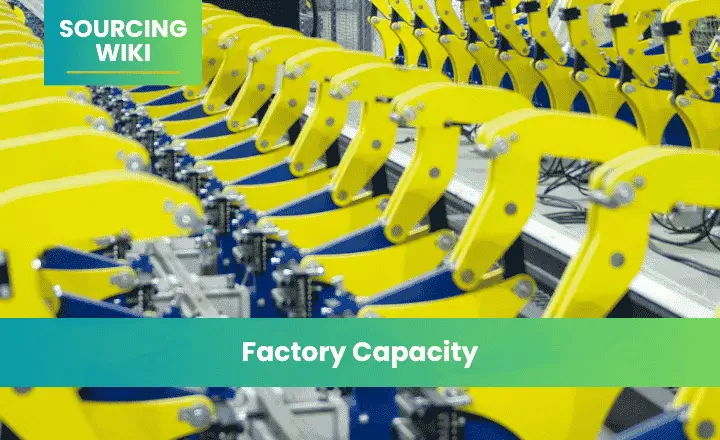
Factory capacity is the maximum amount of production a factory can reasonably achieve with its available production resources under defined operating conditions.
It reflects the factory's ability to produce a particular product or group of products using its available machinery, equipment, labor, production lines, working hours, and other operating resources.
For buyers, factory capacity matters because a supplier may have the technical ability to manufacture a product but still have insufficient available capacity to produce a particular order within the required timeframe.
The World Bank defines full production capacity in its Enterprise Surveys as the maximum level of production an establishment could reasonably expect to attain under normal and realistic operating conditions while using the machinery, equipment, and employees in place.[1]
What Is Factory Capacity?
Factory capacity describes how much a manufacturing facility can produce during a specified period.
Capacity needs to be considered together with:
- Product type
- Production process
- Available equipment
- Number of production lines
- Labor
- Working hours and shifts
- Material availability
- Normal downtime and maintenance
- Production efficiency
Therefore, a factory does not necessarily have one fixed capacity number for every product.
For example, a factory may be capable of producing 100,000 units of one relatively standardized product per month but considerably fewer units of another product requiring more processing, assembly, or manual work.
Factory Capacity vs. Production Capacity
The terms factory capacity and production capacity are often used interchangeably, but their context can differ.
Factory capacity generally refers to the overall production capability of a manufacturing facility.
Production capacity can refer more specifically to the amount of a particular product or production process that can be produced within a given period.
For example:
A factory may have sufficient overall capacity but limited capacity for a specific production line.
For buyers, the second question is often more important: Can this factory produce my required quantity within my required timeframe?
Types of Factory Capacity
Factory capacity can be described in several ways.
1. Theoretical Capacity
Theoretical capacity represents the maximum possible output under ideal conditions, assuming resources are fully utilized without normal operational limitations.
It is mainly useful as a reference point rather than a realistic production commitment.
2. Practical Capacity
Practical capacity considers normal operating conditions, including expected downtime, maintenance, production constraints, and other realistic limitations.
This is generally more useful when assessing what a factory can reasonably produce.
3. Available Capacity
Available capacity refers to the production capability that remains available for additional orders during a specific period.
A factory may have high overall capacity but little available capacity if its production lines are already committed to existing orders.
This distinction is particularly important when buyers need short production lead times.
What Affects Factory Capacity?
Factory capacity is influenced by multiple factors rather than simply the number of machines in a facility.
Machinery and Production Lines
The number, type, speed, and availability of machines can directly affect output.
A production bottleneck may also limit the capacity of the entire manufacturing process even when other production resources are available.
Labor
The number and skill level of workers can affect production output, particularly for labor-intensive products.
Additional shifts may increase output, but this does not necessarily mean that capacity can increase indefinitely.
Working Hours
A factory operating one shift per day may have different practical capacity from the same facility operating multiple shifts.
However, additional working hours may also introduce higher labor costs, maintenance requirements, or other operational constraints.
Product Complexity
Different products require different amounts of production time and resources.
A factory's capacity should therefore be considered in relation to the specific product, not only the facility's total output.
Material Availability
Production capacity cannot be fully utilized if required materials or components are unavailable.
Material shortages can create bottlenecks even when machinery and labor are available.
Maintenance and Downtime
Real production includes equipment maintenance, cleaning, repairs, changeovers, and other periods when production is not running at maximum output.
The World Bank's methodology specifically notes that realistic capacity estimates should account for normal downtime, maintenance, repair, and cleanup.[1]
Factory Capacity Utilization
Capacity utilization measures how much of a factory's available production capacity is actually being used.
A simplified calculation is:
Capacity Utilization = Actual Production ÷ Available Production Capacity × 100%
For example, if a factory can realistically produce 100,000 units per month and is producing 80,000 units, its capacity utilization is:
80,000 ÷ 100,000 × 100% = 80%
The World Bank similarly defines capacity utilization as actual industrial production divided by industrial capacity, expressed as a percentage.[2]
Capacity utilization can help indicate whether a factory has spare production capacity, but it should not be interpreted on its own. A factory with unused capacity may still lack capacity for a particular product, production process, or required delivery period.
Why Does Factory Capacity Matter to Buyers?
Factory capacity can affect several aspects of a purchasing project.
Order Quantity
A factory needs sufficient capacity to produce the required quantity.
Production Lead Time
A supplier with heavily committed production lines may need more time to complete a new order.
Peak-Season Availability
Available capacity can change when a factory receives a large number of orders or experiences seasonal demand.
Order Expansion
If a buyer expects order volume to increase, the supplier's ability to scale production becomes more important.
Production Reliability
A supplier operating close to its practical capacity may face greater scheduling pressure when unexpected orders, equipment problems, or material shortages occur.
Capacity is therefore not simply a question of “How many units can this factory produce?” It is also a question of “How much capacity is available for this order, for this product, at this time?”
How Is Factory Capacity Expressed?
Capacity can be measured using different units depending on the manufacturing process.
| Manufacturing Context | Possible Capacity Measure |
|---|---|
| Consumer products | Units per day/month |
| Garments | Pieces per month |
| Furniture | Sets or pieces per month |
| Metal products | Tons per month |
| Injection molding | Parts per machine/hour |
| Food production | Tons or kilograms per day |
| Assembly operations | Units per production line/hour |
The appropriate measure should match the product and production process.
For example, saying that a factory has “high capacity” provides little useful information without knowing what product, what quantity, and what time period are being considered.
Factory Capacity and Order Planning
When buyers place manufacturing orders, capacity should be considered alongside:
- Required quantity
- Production lead time
- Existing factory commitments
- Production process
- Material availability
- Quality requirements
- Seasonal demand
- Expected future order volume
A supplier may have sufficient total capacity but insufficient available capacity for a particular order.
This is why capacity information is most useful when evaluated together with the buyer's actual purchasing requirements.
Factory Capacity vs. Capacity Utilization
These concepts should not be confused.
| Term | Meaning |
|---|---|
| Factory Capacity | How much the factory can reasonably produce under defined conditions |
| Available Capacity | How much production capacity is currently available for additional work |
| Actual Output | How much the factory is actually producing |
| Capacity Utilization | The proportion of available capacity currently being used |
For example, a factory may have a monthly production capacity of 100,000 units, current output of 80,000 units, and therefore approximately 80% capacity utilization under the stated assumptions.
But if 20,000 units of that capacity are already committed to other orders, the factory may have little or no capacity available for a new buyer's immediate order.
Factory Capacity in Supplier Selection
Factory capacity is one factor that can be considered when assessing whether a supplier is suitable for an order.
However, larger capacity does not automatically mean a better supplier.
A smaller specialized factory may be a better fit for a particular product because it has:
- Relevant manufacturing experience
- Appropriate equipment
- Better product expertise
- Suitable order volumes
- More flexible production arrangements
The objective is to match the required production capacity with the supplier's relevant and available capacity, rather than selecting a supplier simply because its overall output is large.
FAQs
What does factory capacity mean?
Factory capacity is the maximum amount of production a factory can reasonably achieve under specified operating conditions using its available production resources.
How is factory capacity measured?
It can be measured in units per day or month, pieces, tons, production hours, or other units appropriate to the product and manufacturing process.
What is the difference between factory capacity and production capacity?
Factory capacity generally describes a facility's overall production capability, while production capacity can refer to the output capability of a specific product, process, or production line.
What is capacity utilization?
Capacity utilization measures actual production as a percentage of available production capacity.
Does high factory capacity mean faster production?
Not necessarily. A factory may have high overall capacity but have limited available capacity because its production lines are already committed to other orders.
Why should buyers check factory capacity?
Capacity information helps buyers assess whether a supplier can produce the required quantity within the required timeframe and whether the supplier can potentially support future order growth.
NewBuyingAgent and Factory Capacity
When sourcing products from China, factory capacity is one of the factors that can be considered alongside product capability, quotation, order quantity, quality requirements, and production timelines.
NewBuyingAgent works with a broad network of Chinese manufacturing partners and helps buyers source products according to their purchasing requirements. Its model allows buyers to communicate their product and purchasing needs while NewBuyingAgent coordinates supplier sourcing and purchasing activities.
For buyers with changing order volumes or multiple product categories, considering relevant production capability and available capacity can help create a better match between the order and the manufacturing source.
Key Takeaway
Factory capacity describes how much a manufacturing facility can realistically produce under defined operating conditions.
For buyers, the most useful capacity question is not simply how large a factory is. It is whether the factory has sufficient relevant and available capacity to produce the required product, quantity, and order schedule.
Capacity, available capacity, actual output, and capacity utilization are related but different concepts. Understanding these distinctions helps buyers make more informed decisions when evaluating manufacturing sources and planning orders.
Partial Sources
[1] World Bank, Enterprise Surveys — Capacity and Capacity Utilization. Accessed 9 September 2026
[2] World Bank, Global Economic Prospects — Capacity Utilization and Output Gaps. Accessed 9 September 2026
Related Knowledge Base
Sourcing Practices & Insights: Factory Capacity
Latest Sourcing Guides

Get Started Today
Let's Turn Your Sourcing Goals into RealityWeChat:+86 15157124615
WhatsApp:+86 15157124615
Address:Building 10 #39 Xiangyuan Road, Hangzhou, China
