

A 50,000+ factory network can create a lower comparable quote than an Alibaba listing, but only when the product, scope, and evidence are matched. A comparable quote is a price comparison between offers for the same product under the same terms. It is access—not a standing promise that every price will be lower.
The Price Claim Has Four Conditions
A price difference becomes meaningful only after four conditions align. A larger network can make it easier to find additional options, but it cannot turn an unmatched listing into a lower buying cost.
- Hold the brief steady. Product version, quantity, materials, packaging, and destination cannot change from one reply to the next.
- Match the commercial scope. Tooling, delivery term, included work, and responsibility for additions must be named.
- Expose additions. A lower unit number has little value if carton, mold, testing, or other required items sit outside it.
- Check approval evidence. A quote should survive the sample, material, packing, timing, and inclusion checks before it drives a decision.
A Factory Network Changes Access, Not Every Price
Network size changes access, not every price. NewBuyingAgent’s 50,000+ factory-resource network can give a buyer more ways to pursue a defined China purchase, especially where a public listing does not describe the exact product, packing, or delivery responsibility required. It does not establish that every offer obtained through that network will beat an Alibaba price, or that a lower number will remain lower after the full scope is known.
That distinction is practical. A comparable quote is a price comparison of offers covering the same product under the same terms. If one price assumes a standard item, another includes a revised component, and a third leaves packaging open, the difference is a discovery signal—not proof of savings. Treat the network as a route to more relevant access; treat the quote card as the test that makes that access useful.
Alibaba Is Useful for Discovery, Not Final Price Proof
Alibaba is useful when a buyer needs to discover product categories, send a request for quotation, and begin documenting requirements. An RFQ is a request for a supplier quote that states the buyer’s product requirements. Alibaba's form requests product, quantity, detailed requirements, and attachments. Those fields appear on its RFQ form, making the platform a sensible place to test whether a buying brief is understandable, though it does not make the replies comparable by itself.
Platform screening evidence has value too. Verified Supplier assessment reports are open to buyers according to Alibaba. Its Verified Supplier process describes a third-party assessment report. Read it as one input into current product and execution checks, not as a substitute for the exact terms of a live quote. If the buyer already has a China factory relationship and needs local follow-up on that existing relationship, see the existing-factory management path; that is a different need from asking for a new-product offer.
How a Broad Factory Network Can Change the Comparison
Partner identification in China requires vetting and alignment, not network size alone. The U.S. Commercial Service advises buyers entering China to evaluate partners carefully, including their regional and sector fit. A local network matters when it helps put a complete brief in front of relevant factory resources and brings unclear assumptions back into the open. More replies without that discipline simply create more different offers to untangle.
More Reach Is Useful Only After the Brief Is Fixed
ISO guidance says buyers should make needs and expectations clear to suppliers. Its guidance on control of external providers connects purchasing information with customer requirements, approvals, and monitoring or inspection; those are useful reminders that the commercial request has to be explicit before the price can be interpreted. The ISO guidance does not set a price, but it reinforces the operating rule: freeze the version and the needed checks before asking more parties to quote.
A stable brief can be short. It should still state the product drawing or sample reference, quantity and color split, material or performance requirement, packaging, requested delivery term, destination, and timing. If a material grade is “to be confirmed” for one reply but fixed for another, no amount of marketplace or network coverage can make their unit prices a clean comparison.
Comparable Alternatives Matter More Than More Replies
Comparable alternatives matter more than more replies. Scope normalization means using shared requirements and the same quote fields so every reply describes the same offer. It is not a contest to collect the most contacts; it is a way to see whether a price gap remains after the product, quantity, named inclusions, delivery term, and approval evidence are held constant.
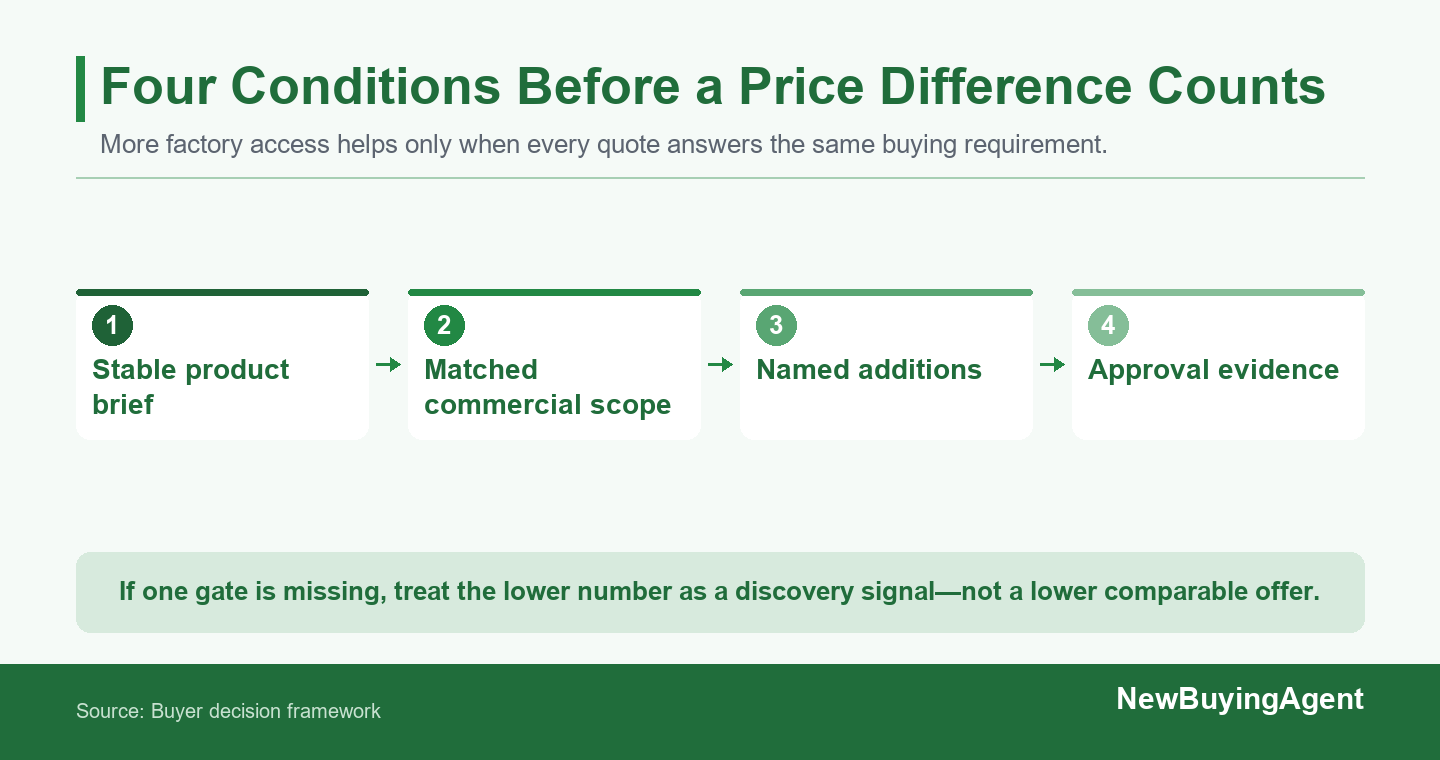
Network access can widen the search. A price difference becomes decision-ready only after all four comparison conditions hold.
That is where a broad network can create real buying leverage. A buyer may use Alibaba to find an early market signal, then use China-side access to obtain another properly scoped response. If the second route surfaces a different production assumption, the result is useful even when it is not cheaper: the mismatch has been found before money or schedule is committed. If two offers do match, their difference deserves attention; if they do not, the next task is clarification rather than negotiation.
Build One Quote Card Before You Compare Suppliers
ISO guidance connects purchasing information with approvals and monitoring or inspection. Put those checks beside the price rather than leaving them for a later message. The same external-provider guidance is useful here because it separates clear buying information from the evidence used to control the result.
Build one card that names product, commercial, and evidence assumptions. Use a revision date or version number so a late adjustment does not quietly mix two purchasing questions. Before comparing factory responses, use the China manufacturing and product guide to frame the product details that deserve to be fixed.
| Card area | What every quote must answer | Why it affects the price |
|---|---|---|
| Product version | Drawing or approved sample reference, dimensions, materials, colors, and performance requirement | A standard version and a revised version are different offers. |
| Quantity and packing | Order volume, carton count, inner packing, marks, and destination-market carton requirements | Pack-out changes material, labor, cube, and damage exposure. |
| Commercial scope | Tooling allocation, testing, included work, payment basis, and the delivery term | For example, FOB is a delivery term that names a named port and the point at which the seller’s export-delivery responsibility is met; it is not interchangeable with every other delivery assumption. |
| Approval evidence | Sample condition, material statement, carton dimensions, lead-time assumption, and named exclusions | Evidence reveals whether the quoted product can actually be approved and shipped as requested. |
Compare the Route, the Evidence, and the Price Together
Use platform RFQ and China-side access as complementary inputs, not automatic price winners. Alibaba’s own RFQ overview presents the channel as a way to collect supplier quotations. That is useful for discovery and initial responses. A local China route becomes more relevant when the product outcome depends on resolving specifications, commercial scope, quality checks, or handoff details that a listing price leaves open.
| Buying question | Alibaba can help with | A local China route can help with | Decision rule |
|---|---|---|---|
| What products are visible? | Category discovery, listings, RFQs, and initial profiles | Access around a defined product need | Use both as inputs; do not treat visibility as proof. |
| Does the price describe the same offer? | Collect a response to the RFQ | Clarify the brief and commercial assumptions locally | Compare only after the card is matched. |
| What supports approval? | Supplier-profile and assessment materials | Product, sample, packing, timing, and handoff evidence for the defined purchase | Approve the product evidence, not a headline number. |
Worked Scenario: A Low Listing Price That Does Not Match the Product
The illustrative 12,000-unit request produces replies with different scope assumptions. Consider a home-organization retailer buying reusable polypropylene storage bins for a seasonal launch. The request is for 12,000 units in two colors, with one molded-lid design and one destination-market retail-carton version. It is a composite buying scenario, not a NewBuyingAgent customer result and not a prediction of a price reduction.
Three Alibaba replies arrive. One low listing describes a standard bin with neither the lid revision nor the retail carton. Another includes the carton but leaves both the resin grade and tooling allocation unnamed. The buyer now has useful market information, but not three interchangeable prices. Those real outcomes should not be confused with this illustrative scope test; buyers who need documented examples can review NewBuyingAgent success stories.
Why the Listing Fails the Comparison
A lower listing is not a lower comparable offer when the product differs. The buyer context is a seasonal retail launch. The order context is a 12000-unit request in 2 colors, with 1 molded-lid design and 1 retail-carton version. Because the replies use different resin descriptions, carton counts, and tooling assumptions, the readiness state is not “choose the cheapest”; it is “make the offers answer the same card.”
One lower listing is based on a standard bin without the requested lid revision or retail carton. A second reply includes the carton but leaves the resin grade and tooling allocation unnamed. Those observations mean the request needs clarification, rather than a quick decision based on the lowest displayed number.
The buyer should hold the apparent saving and issue a revised versioned request. The corrected card names the drawing, resin requirement, color standard, carton count, tooling allocation, delivery term, and sample checks. That single document prevents a standard product, an unfinished pack-out, and a complete retail-ready offer from being treated as the same purchase.
Proceed only when the sample, material statement, carton dimensions, lead-time assumption, and quote inclusions all match the agreed card. The verification gate comes before approval, so the lower number remains only a clue about where to ask the next question until those checks are complete. This illustrative example is not a NewBuyingAgent client case and does not predict a price reduction.
Use China-Side Support When the Product Outcome Needs More Than Search
NewBuyingAgent is a one-stop China sourcing agent for global buyers. When a buyer has a defined product specification, quantity, target price, destination, and timing, NewBuyingAgent can use local resources to source and supply the product, coordinate cost negotiation, follow up production, support quality control, and help with logistics. For that defined-product route, see how NewBuyingAgent supplies products from China. This is not a promise of a buyer-facing factory list or a lowest price. In fact, Alibaba’s sourcing-agent guidance specifically cautions buyers to understand cost structure and avoid guaranteed-lowest-price claims.
Existing-factory management is relevant only when a supplier relationship already exists. For an existing relationship, use management support to follow the already-established supply chain rather than recasting that task as a new sourcing exercise. For a new product need, the useful question is whether the buying brief is ready for a China-sourced product offer.
Send a Comparison-Ready Brief Before You Ask for More Quotes
Prepare five core inputs before requesting a comparison-ready quote. They are the product drawing or reference sample, quantity and color split, material and packaging requirements, target price and delivery term, and destination with timing. Add the approval evidence you will need, such as a sample condition, carton dimensions, or a named lead-time assumption. That preparation does not bind a factory or agent, but it gives every response the same commercial question to answer.
Before sending the request, review the card with the person who owns the product decision and the person who owns freight or delivery coordination. Confirm which costs belong in the offer, what document will prove the materials and pack-out, and what change would require a new version of the card. This brief review is often where an appealing unit price stops being ambiguous and becomes either a real option or a clear mismatch.
Then ask one practical question: if every inclusion on the card is held constant, does the lower number still stand? If you are ready to turn a defined purchase need into a China-sourced product offer, Submit product requirements to NewBuyingAgent with those details.
Frequently Asked Questions
The FAQ does not turn a network or platform into a guaranteed price route. The same comparison rule applies in every case: a price can support a buying decision only when the offer, responsibilities, and approval evidence match.
Does a 50,000+ factory network guarantee the lowest price?
No. A larger network can create more credible quote opportunities, but it cannot guarantee the lowest price for every product or order. It may reveal a better-matched route to an offer, but the buyer still needs the same version, scope, additions, delivery terms, and evidence before treating a difference as savings.
Is Alibaba still useful when I use a China sourcing agent?
Yes. Alibaba remains useful for product discovery, RFQs, supplier profiles, and verification materials when you treat those inputs as screening evidence rather than final price proof. Use it to develop and test the requirement, then compare any resulting offers against one fixed buying card and retain the version history for later clarification.
What makes two China factory quotes comparable?
Two quotes are comparable only when the product version, quantity, materials, packaging, tooling, delivery term, inclusions, and evidence requirements describe the same commercial offer. If one of those elements is missing or different, ask for clarification before using the unit-price gap in a negotiation or approval decision, and issue the same revised card to every responder.
When is China-side sourcing support worth considering?
Consider China-side sourcing support when a defined product purchase needs local factory resources, product and QC capability, cost negotiation, or delivery coordination beyond a platform search. It is most useful when the buyer can provide a clear product need and needs the final offer to connect product scope with execution evidence.
NewBuyingAgent
Related Resources

Get Started Today
Let's Turn Your Sourcing Goals into RealityWeChat:+86 15157124615
WhatsApp:+86 15157124615
Address:Building 10 #39 Xiangyuan Road, Hangzhou, China
