

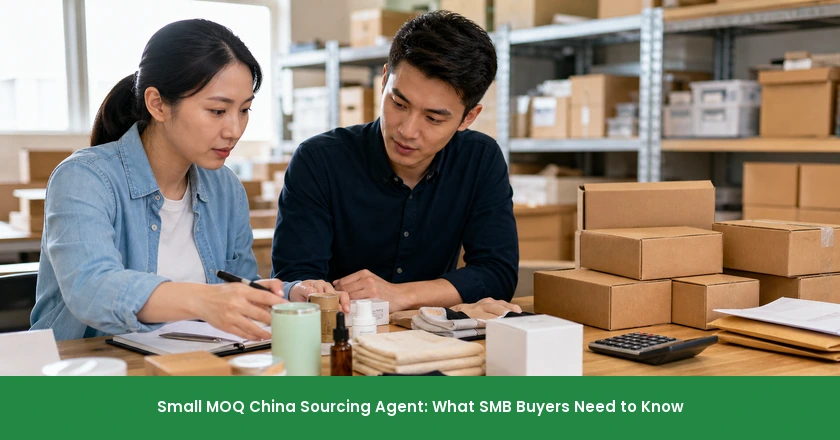
Small MOQ sourcing from China is attractive because it lets a buyer test demand before committing too much cash. It is also risky because a lower order quantity can raise unit cost, limit customization, reduce factory attention, and leave less room for rework. For SMB buyers, the question is not simply "Can I order less?" The better question is "Can I order enough to learn without losing control over quality, payment, and delivery?"
Small-order sourcing is one buyer scenario, not the whole definition of NewBuyingAgent's audience. NewBuyingAgent serves global buyers across profiles. For SMB buyers testing a product, its value comes from local China factory resources, product/QC capability, flexible payment support, and a practical quote-to-supply path that can protect price, quality, and timing without forcing blind inventory bets.
Key Takeaways
- Small MOQ is a risk-control tool, not a magic discount: it can protect cash flow but often raises unit cost and limits customization.
- Buyers should define the learning goal: test market demand, validate packaging, confirm quality, or prepare for a larger reorder.
- Payment and logistics terms matter as much as unit price: advance payment, Incoterms, carton volume, and customs data can change the real cost of a low-volume order.
- NewBuyingAgent is most useful when small MOQ is tied to a larger sourcing path: the first order should create evidence for better product, quality, and delivery decisions.
Small MOQ Is About Learning Speed and Cash Discipline
MOQ is the minimum quantity a seller is willing to sell in one order. NetSuite's inventory guide explains MOQ as the fewest units a business will sell in one transaction, often because very small orders are not profitable at manufacturing or wholesale level. For buyers, MOQ is not only a number. It is a cash-flow, storage, quality, and market-testing decision.
Small MOQ helps when the buyer needs proof before scaling. A new brand may want to test color, packaging, channel response, customer reviews, or return rates. A retailer may want to validate a seasonal item before giving it more shelf space. A platform seller may want to check whether the product survives fulfillment and customer use. The first order should therefore be designed to answer a clear question, not merely to feel safer.
Cash flow is central. The U.S. Small Business Administration's finance guidance emphasizes that businesses need to track assets, liabilities, equity, and costs. Inventory is an asset, but unsold inventory can trap cash. If a buyer uses all available cash to meet a factory's high MOQ, it may have less money for photography, advertising, inspection, freight, duties, storage, or customer support.
For small MOQ projects, NewBuyingAgent can help the buyer turn product specs, quantity, target price, destination, and timing into a practical China-sourced product plan. The value is not only finding a lower minimum. It is deciding whether the smaller order still protects product quality, packaging, compliance evidence, and reorder potential.
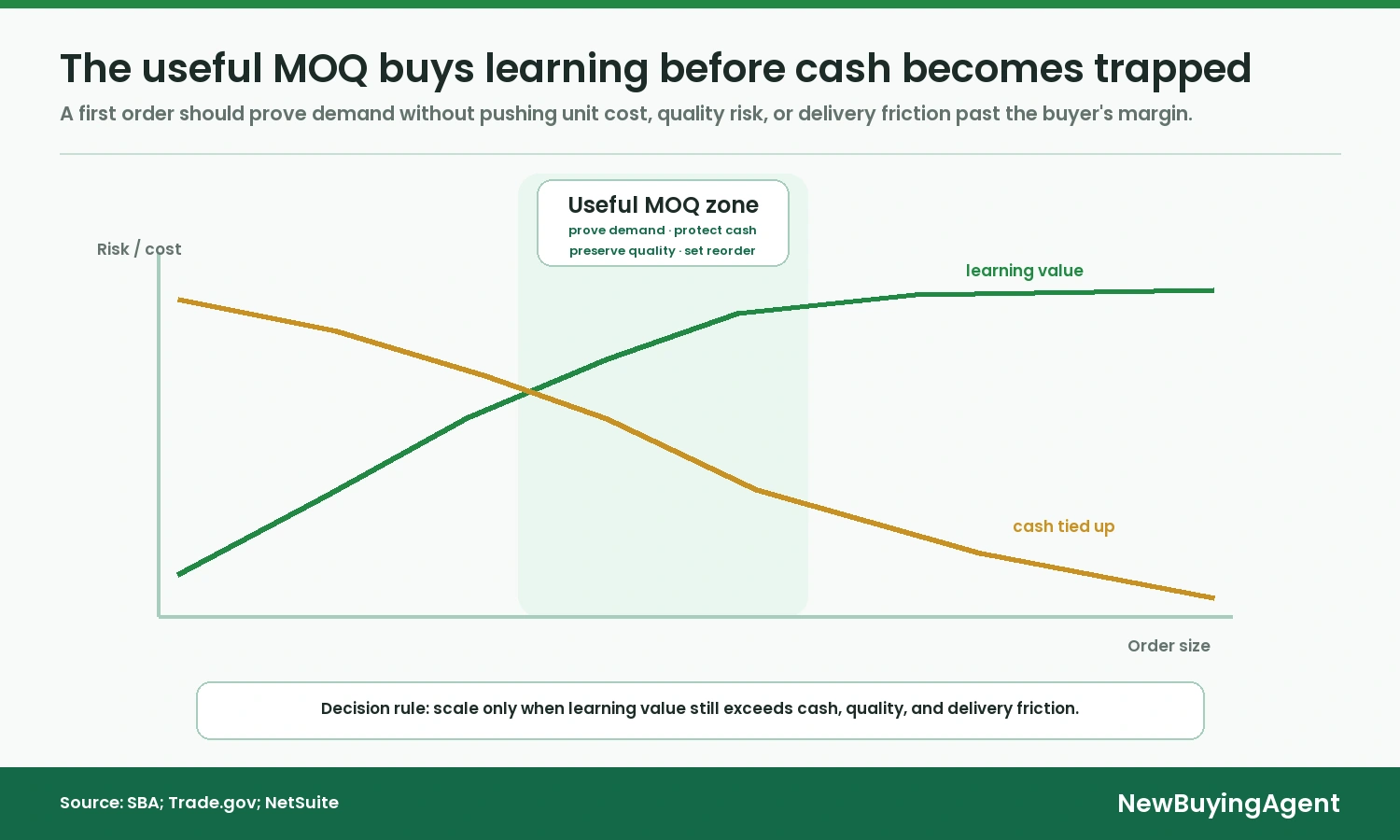
Small MOQ works when the first order buys useful learning without pushing unit cost, quality risk, or delivery friction beyond the buyer's margin.
What SMB Buyers Should Check Before Requesting Small MOQ
1. The Real Purpose of the First Order
A small MOQ order should have a clear learning purpose. If the buyer wants to test demand, the order should be large enough to produce meaningful sales feedback. If the buyer wants to validate quality, the order should include the final material, packaging, label, and accessory set. If the buyer wants to prepare for retail onboarding, the order should prove carton marks, barcodes, compliance files, and repeatability. Different goals require different order sizes.
The buyer should avoid asking for the lowest possible MOQ before defining the product version. A factory may agree to a tiny quantity only by using available material, generic packaging, or limited customization. That can be acceptable for early testing, but it may not prove the final product. The sourcing agent should explain what the small order can and cannot validate.
2. Unit Cost, Setup Cost, and Customization Limits
Small MOQ usually changes the cost structure. Tooling, material purchase, dyeing, printing, packaging, labor setup, and inspection cost may be spread across fewer units. The quote may look expensive compared with a high-volume order, but that does not mean it is wrong. It may reflect the cost of learning. The question is whether the learning is worth the premium.
A good sourcing agent should break down which parts of the product are flexible at small quantity. Color may be flexible if stock material exists. Packaging may be limited if the buyer cannot meet print minimums. Logo placement may be possible by sticker, hangtag, laser mark, or heat transfer instead of full custom tooling. The agent's job is to protect the buyer from paying for customization that the order size cannot support responsibly.
3. Payment Terms and Buyer Cash Exposure
International payment terms can create risk for both sides. Trade.gov's methods of payment guidance explains that exporters want payment early while importers prefer to delay payment until goods are received, and it describes tools such as cash in advance, letters of credit, documentary collections, open account, and consignment. For small MOQ buyers, the practical point is simple: the payment term must match trust, order size, and evidence.
NewBuyingAgent's flexible payment support and case experience can matter here, but the buyer should still ask what payment is tied to: sample approval, production start, inspection, shipment, or delivery. A smaller order should not become careless just because the dollar amount is lower. The payment schedule should still encourage correct product execution.
4. Compliance and Platform Readiness
Small MOQ does not remove compliance responsibility. CPSC's Online Sellers' Safety Guide is aimed at businesses that make, import, or sell consumer products online and points sellers toward safety and compliance resources. If the product is a children's item, electrical item, textile, cosmetic accessory, food-contact item, or outdoor product used near flame, the buyer should ask what evidence is needed before listing or importing.
Testing can feel expensive when the first order is small. That is why buyers should identify the risk category early. A low-volume test order may be reasonable for low-risk accessories, but not for products where safety, labeling, or claims are central to sale. The sourcing agent should help decide whether to test now, simplify the product, change the claim, or delay launch until the buyer can support the required evidence.
5. Reorder Path and Factory Cooperation
The first small order should make the second order easier. That means preserving sample version, material details, packaging files, labels, carton data, inspection notes, and supplier communication history. A low MOQ is weak if the factory cannot repeat the product or if the first batch uses temporary materials that will disappear before reorder.
Buyers should ask the sourcing agent what changes at the next order level. Which unit cost improves? Which customization options open? Which packaging choices become available? Which production lead time changes? Which quality controls should be added? A good small MOQ plan has a clear bridge from test order to scaled reorder.
6. Inspection Cost and Release Rules
Small MOQ buyers sometimes skip inspection because the order value feels too low. That can be a false economy. The inspection plan should match the product's risk, not only the order size. A simple accessory may need photos, carton checks, and a basic final inspection. A product with safety, battery, child-use, food-contact, or performance claims may need stronger testing or staged checks even when the first order is small.
The sourcing agent should define what happens if defects are found. Will the factory rework goods, replace parts, provide credit, or hold shipment? Who approves the release decision? Which defects are acceptable for a test order and which defects destroy the market signal? Without a release rule, the buyer may accept a weak batch just to avoid delay, then learn the wrong lesson from customer feedback.
The Small MOQ Trade-Off Table
| Decision | Small MOQ advantage | Hidden risk to control |
|---|---|---|
| Use stock materials | Lower entry quantity and faster sample-to-order path | Final product may not match future customized version |
| Simplify packaging | Avoids high print minimums and reduces first-order cash pressure | Retail or platform presentation may be under-tested |
| Accept higher unit cost | Protects cash while testing demand | Margin may look worse unless the buyer treats it as learning cost |
| Plan a reorder threshold | Turns the first order into a controlled market test | No benefit if the buyer fails to preserve product and quality records |
Shipping, Classification, and Labeling Still Matter
A small order can still become expensive if logistics are not planned. ICC Incoterms 2020 clarify cost, risk, and obligations between buyer and seller. CBP tips for new importers and exporters recommend understanding policies and procedures before importing. The WCO Harmonized System overview also shows why product classification is not an afterthought.
Low-volume buyers should pay attention to carton dimensions, barcode needs, customs description, product material, origin marking, and receiving rules. GS1 barcode standards matter when products enter retail, ecommerce, or warehouse systems. A sourcing agent should help keep product identity, packaging, and shipping files aligned so the first order does not create avoidable receiving friction.
Where NewBuyingAgent Fits for Small MOQ Buyers
NewBuyingAgent is most valuable when the small-MOQ decision is connected to product fit, quality evidence, payment structure, and reorder logic. Buyers provide the product requirements, expected quantity, target price, destination, and timing. NewBuyingAgent can then use local China factory resources, product/QC capability, AI-driven product analysis, and flexible payment support to prepare a sourcing path that fits the buyer's learning goal.
For a market test, that may mean using available materials, simplified packaging, and a clear reorder threshold. For a retailer-ready launch, it may mean accepting a higher first quantity because packaging, testing, and repeatability matter more. For buyers with existing China suppliers, NewBuyingAgent can support production follow-up, QC evidence, and logistics coordination so the first small order produces a cleaner next order.
A useful small-MOQ inquiry should include the buyer's stop-loss rule. For example, the buyer may decide to reorder only if defect rate, customer feedback, ad cost, and delivery timing stay inside an acceptable range. That rule helps NewBuyingAgent shape the first order around evidence rather than wishful thinking. It also helps the buyer avoid scaling a product only because the first shipment arrived, or abandoning a product before the test was large enough to teach anything reliable.
The practical next step is to separate "minimum possible quantity" from "minimum useful quantity." A minimum possible order may only prove that a factory can ship something. A minimum useful order proves demand, packaging, quality, and reorder logic. That is the difference a sourcing agent should help the buyer see before paying a deposit.
Frequently Asked Questions
What is a good MOQ for a first China order?
A good first MOQ is the smallest order that still proves the buyer's real question. If the goal is demand testing, the quantity must support enough sales feedback. If the goal is quality validation, it must use final materials, packaging, and labels. The right number depends on product type, customization, factory setup cost, and reorder plan.
Can a sourcing agent always lower MOQ?
No. A sourcing agent can often find practical options, but some MOQs exist because of material purchase, tooling, printing, labor setup, or production efficiency. A good agent explains which requirements can be adjusted and which cannot. Sometimes the better answer is simplified packaging, stock material, or a staged order plan rather than forcing an unrealistic minimum.
Is small MOQ more expensive per unit?
Usually yes. Smaller orders spread setup, sampling, material, packaging, and inspection costs across fewer units. That higher unit cost may still be worthwhile if the order protects cash and creates useful market learning. Buyers should judge the first order by learning value and future reorder potential, not only by first-order margin.
How does NewBuyingAgent support small MOQ sourcing?
NewBuyingAgent helps buyers turn a small-order idea into a realistic China-sourced product path. The team can assess whether the product, packaging, quality evidence, payment terms, and delivery timing still make sense at the desired quantity. For SMB buyers, that means the first order can become a controlled test rather than a blind inventory bet.
NewBuyingAgent
Related Resources

Get Started Today
Let's Turn Your Sourcing Goals into RealityWeChat:+86 15157124615
WhatsApp:+86 15157124615
Address:Building 10 #39 Xiangyuan Road, Hangzhou, China
