

A supplier's lowest unit price can be the wrong price to buy. The extra quantity may consume cash, occupy warehouse space or outlast the selling season before its discount pays back. When comparing price breaks by MOQ tier, start with the demand you need to serve, then calculate what each feasible ordering pattern costs over that same period.
A Lower Unit Price Is Only the Start of the Saving
A higher MOQ tier saves money only when its purchase and inbound savings exceed the extra inventory costs it creates. Compare it with the next viable tier, not just the smallest order on the quotation. The right choice also needs to fit your available cash, stock capacity and confidence in demand; a positive spreadsheet result alone does not make a commitment affordable.
- Confirm eligibility: establish the qualifying quantity, product variants and price formula.
- Equalize demand: compare the same purchasing period and accepted product, not different invoice totals.
- Count incremental exposure: distinguish routine carrying costs from additional stock losses.
- Read the commitment: smaller shipments do not necessarily mean a smaller purchase obligation.
The illustrative calculation below shows why this matters: moving from 3,000-unit to 6,000-unit lots produces 1,800 USD in goods savings and 400 USD in inbound savings, but adds 1,375 USD in carrying costs. That leaves only 825 USD before downside; a further 1,200 USD incremental stock loss turns the advantage into a 375 USD disadvantage.
Check What Quantity Actually Unlocks the Price
MOQ, price-break thresholds and order multiples are different conditions and must be confirmed before comparing offers. MOQ means minimum order quantity: the smallest order the supplier accepts for the specified offer. A discount threshold may sit above that minimum, while a carton or production multiple can force you to round the order upward before either price is available.
Ask the supplier to show the total goods amount at each proposed quantity. Under an all-unit discount, reaching the threshold changes the price of the whole qualifying order. Under incremental pricing, only units within the lower-priced band receive that rate. The same tier labels can therefore produce different totals.
Stripe's tiered-pricing documentation distinguishes volume pricing applied to the whole quantity from graduated pricing applied within each tier. That software-billing example explains the arithmetic distinction, not what a Chinese factory must offer. Your supplier's written quotation needs to settle which formula applies.
Also establish whether the threshold applies per purchase order, production run, SKU or agreed annual volume. A forecast is not automatically a qualifying purchase. If a quoted rate depends on annual shipments, identify whether the discount appears on each invoice or arrives later as a rebate. Record quotation validity, currency, quantity tolerance and the treatment of accepted overproduction. Otherwise, an attractive tier may disappear when the actual order is entered.
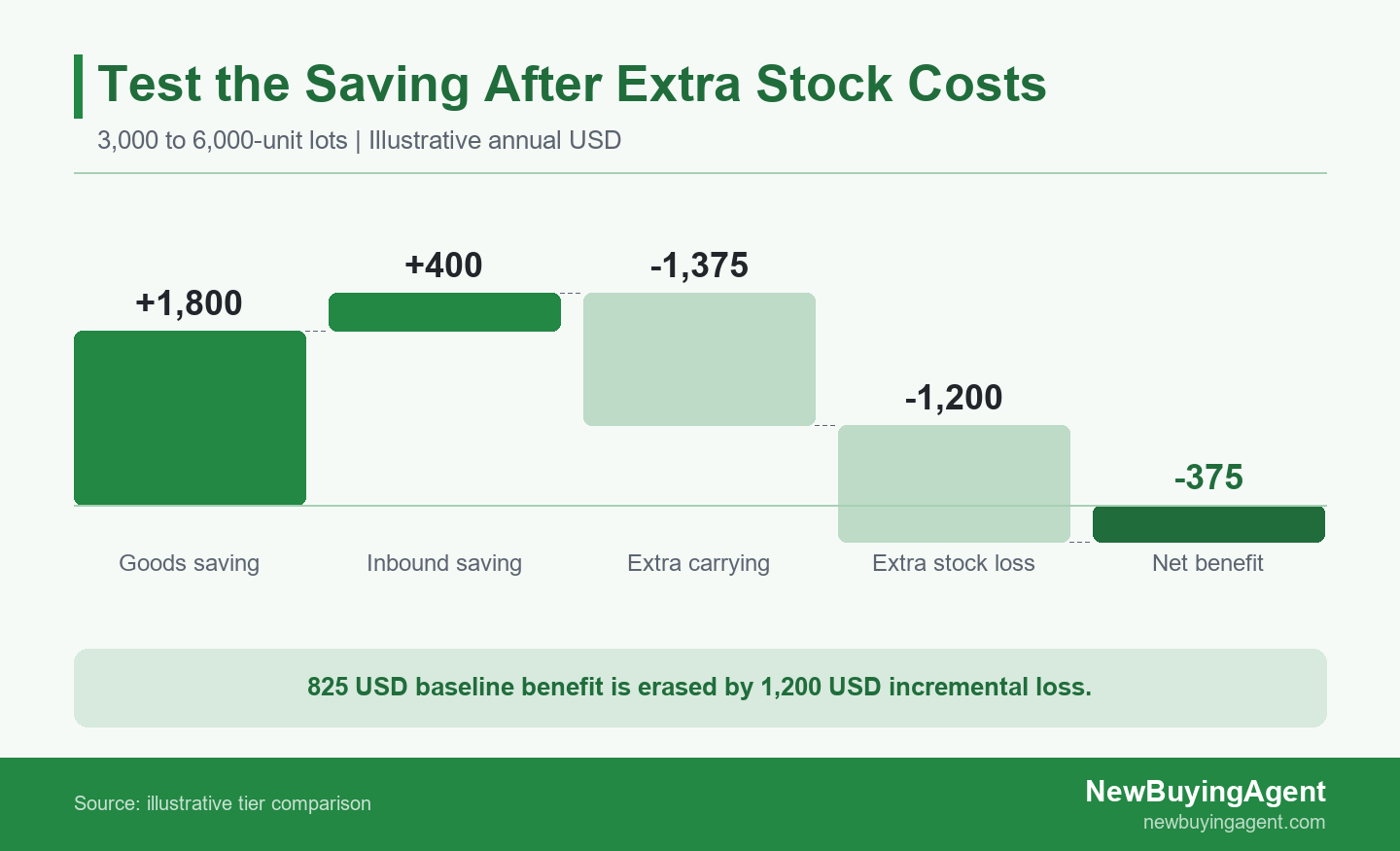
Illustrative annual savings from larger MOQ lots turn negative after extra carrying and stock losses
Put Every Tier on the Same Buying Basis
Compare the same product specification, demand horizon and buyer-paid cost scope across all tiers. Start with feasible quantities for one defined item and a period long enough to capture replenishment, rather than assuming every quoted quantity deserves consideration. If a larger lot changes packaging, quality requirements, delivery terms or the selling window, identify that change separately before calling the price difference a saving.
Keep the Product and Acceptance Standard Unchanged
A lower price for a different product is not a like-for-like quantity discount. Compare the same dimensions, material, finish, sample revision, unit packaging and agreed acceptance standard. For fragile products, removing protective packing can reduce the quote while changing the condition in which goods reach customers.
If your target price is unattainable at a workable quantity, consider a specification alternative openly. A standard finish, shared component or less customized package may make a smaller production run feasible. Price that alternative as a distinct offer and approve its sample; do not conceal the change inside the quantity comparison.
When the product itself needs adjustment, NewBuyingAgent's local China factory resources and product-development and quality-control capability support a supplied-product offer built around the required function and budget. Buyers can explore how feasible materials and packaging affect the available quantities through NewBuyingAgent's product-supply service.
Add the Costs That Move with Each Receipt
The cost of reaching the buyer matters as well as the factory unit price. Separate goods, buyer-paid transport, insurance, clearance, duties and other nonrecoverable import charges. Use the same named delivery point and quoted shipping basis, then map which party already pays each component.
The International Trade Administration's landed-cost guidance includes product price, insurance, freight, tariffs, taxes and other fees. For your comparison, ask finance how recoverable taxes should be treated economically while keeping their cash timing visible. Destination-specific amounts need current quotations and applicable classifications; a generic percentage cannot establish the landed cost of your shipment.
Freight need not change smoothly with quantity. A larger lot may use space better, but may also require another container or a different service. Obtain transport estimates for the actual packed dimensions and shipment pattern. Count inspection and order-administration costs where they genuinely change with receipt frequency, without adding charges already included in the supplier's offer.
Price the Extra Stock Before Accepting the Discount
Larger lots can lower annual acquisition costs while increasing average stock, financing needs and exposure to demand changes. Estimate routine carrying costs using the stock level and time the ordering pattern creates, not by charging a full year of storage against every unit purchased. Keep possible markdown or disposal losses visible, especially where an annual carrying allowance excludes them.
BDC's inventory guidance identifies storage, financing and obsolescence among holding costs and warns against relying on volume discounts alone. Those categories help organize the model; they do not supply a universal rate for your warehouse or business. Finance and operations should identify which costs are proportional to inventory value, which follow pallet space, and which change only when capacity is exceeded.
Use separate lines when the mechanisms differ. Financing may follow money tied up over time, while an overflow warehouse has a specific lease or handling charge. If an internal carrying rate already includes obsolescence, remove that component before adding a separate stock-loss scenario. Similarly, do not count the same transport charge in both landed acquisition and a general ordering allowance.
Cash affordability is a separate test. The principal paid for inventory is already in acquisition cost; adding it again as a financing expense double counts the purchase. Nevertheless, a larger deposit or earlier balance payment can prevent an otherwise economical order. Compare the maximum cash requirement and payment dates with the cash available, alongside the annual cost result.
Finally, check the demand pattern behind the average. Steady replenishment is a useful baseline, not a substitute for a launch forecast or seasonal sell-through plan. If demand is concentrated in a short window, model dated receipts and sales. Include additional safety stock, shortages or expedited freight where different lot choices change those risks.
Compare Four MOQ Tiers Against the Same Annual Demand
For equal annual demand, compare acquisition and carrying costs rather than the cash amount on one purchase order. The table models four feasible quoted tiers for one unchanged product, assuming steady demand and replenishment before stock runs out. It identifies the lowest baseline cost among those options; it does not establish an optimal quantity for every possible order size or demand pattern.
Illustrative assumptions: annual demand is 12,000 units, consumed at 1,000 per month. Each receipt contains the full lot, with no safety stock or shortages and unchanged lead-time assumptions. Goods prices are all-unit prices. Inbound additions per receipt are 300, 450, 600 and 1,000 USD respectively; for this simplified example, these are the complete modeled buyer-paid landed additions. All numbers are invented for the calculation, not freight quotations or industry benchmarks.
MIT's inventory lectures use Q/2 as average inventory in the steady depletion economic order quantity model. Here Q is the receipt lot. Apply an illustrative annual 20% financing-and-routine-storage factor to that average stock at its landed unit value; this factor excludes markdown and obsolescence losses. Annual acquisition equals goods for the full year's demand plus inbound additions for every receipt.
| Lot units | Goods USD/unit | Annual acquisition USD | Annual carrying USD | Annual total USD |
|---|---|---|---|---|
| 1,000 | 5.00 | 63,600 | 530 | 64,130 |
| 2,000 | 4.85 | 60,900 | 1,015 | 61,915 |
| 3,000 | 4.75 | 59,400 | 1,485 | 60,885 |
| 6,000 | 4.60 | 57,200 | 2,860 | 60,060 |
Based on this comparison, the 6,000-unit tier has the lowest modeled annual cost, but saves only 825 USD against the 3,000-unit tier. Choose it only if that marginal benefit survives your additional stock-risk and cash tests. The smaller tiers remain candidates when their lower commitments or more frequent replenishment are operationally necessary.
To reproduce the 3,000-unit row: four receipts cost 12,000 × 4.75 + 4 × 600 = 59,400 USD. Landed unit value is 4.75 + 600/3,000 = 4.95 USD. Average stock is 1,500 units, so carrying cost is 1,500 × 4.95 × 20% = 1,485 USD. Adding the two costs gives 60,885 USD.
Stress-Test the Small Saving Between the Best Two Tiers
A small incremental cost advantage can disappear when the larger batch creates stock losses that the smaller batch avoids. Test the additional exposure caused by the buying decision, rather than charging every uncertain unit to the larger tier. If both options suffer losses, compare the difference between them; the largest invoice is not automatically the full amount at risk.
The IFRS Foundation's IAS 2 inventory guidance explains that inventory cost may not be recoverable when goods become obsolete or selling prices decline. That accounting principle supports checking recoverability; it does not set the loss estimate or determine which MOQ your business should buy.
Illustrative Scenario: A Seasonal Stock Loss Reverses the Choice
Consider an importer buying one ceramic plant-pot design from a Chinese supplier using the table's 12,000-unit annual baseline. The sample, protective packaging and tier prices are ready, but the sales plan has not secured demand for every unit. The purchasing team is considering a 6,000-unit commitment instead of 3,000 units because its annual baseline cost is lower.
An illustrative 825 USD baseline advantage becomes a 375 USD disadvantage after a 1,200 USD incremental stock loss. In this stress test, a seasonal review identifies 400 units exposed only because of the larger commitment. Their net loss is assumed to be 3 USD each after recovery, giving 400 × 3 = 1,200 USD. The annual bridge is 1,800 USD goods savings + 400 USD inbound savings − 1,375 USD extra carrying − 1,200 USD incremental loss = −375 USD. The larger tier's adjusted cost is 61,260 USD against 60,885 USD for the smaller one.
Under those assumptions, the importer chooses the 3,000-unit tier unless revised commercial terms remove enough exposure. Procurement asks whether production can be committed in smaller releases and requests the associated price, handling charges and cancellation conditions. Moving cartons to a different warehouse without changing the obligation would not address the underlying risk. At 3 USD net loss per incremental unit, 275 affected units would consume the entire 825 USD baseline advantage.
Before approving an order, the buyer rechecks the affected-unit estimate with sales, the net recovery with finance, and release obligations with the supplier. The comparison must retain the same quality and inbound-cost assumptions or be recalculated. This is a hypothetical sensitivity overlay, not a predicted customer outcome or a complete seasonal inventory simulation: it holds baseline carrying costs unchanged to isolate the stated loss. A dated seasonal model may change carrying costs too. If losses also occur under the smaller tier, subtract only the incremental difference, and do not count obsolescence again in the 20% factor.
Can You Keep the Price Break but Take Smaller Deliveries?
Split deliveries help only when the production commitment, payment and remaining-stock obligations are explicitly agreed. A supplier might manufacture the whole quantity and ship it in parts, or schedule separate production releases under a broader agreement. Those arrangements create different exposure, so ask what is binding now, what can still change, and who pays for stock that is never called off.
For established suppliers, the implementation problem is keeping each release aligned with the approved product and shipment plan. NewBuyingAgent's existing-factory management path connects local production follow-up and quality-control capability to that continuity, while the buyer retains demand and commercial approval decisions. Explore this through NewBuyingAgent's factory-management service.
ICC's Incoterms explanation states that the rules do not determine payment timing or transfer of ownership. Do not treat a shipping term as permission to delay payment or walk away from finished goods. Agree the release schedule, minimum commitment, storage conditions, final collection date and treatment of cancelled quantities separately, with appropriate contractual advice.
Evaluate other concessions by the cost they create. A longer production window may help the supplier combine material purchases; prepayment may improve the quoted rate but increase your financing exposure. Neither is free savings. Add the changed cost and timing to the same comparison before accepting the concession.
Ask for Comparable Tiers, Not Just the Lowest Quote
Request a product quotation with consistent specifications, feasible quantities and delivery requirements. Give the supplier the quantities you can realistically approve, alongside an annual forecast clearly distinguished from a commitment. Ask for the goods total, packed dimensions, price validity and conditions at each tier, so procurement can compare executable offers rather than an appealing number that depends on unspecified volume.
If you need a China-sourced product offer, prepare the product specifications or approved sample, quantity options, target price, destination and delivery timing. Identify whether you need new product supply or help managing an existing factory. As a one-stop China sourcing agent, NewBuyingAgent can quote and supply products against that brief; the useful output is a product quotation reflecting your specification and delivery needs, not a promise that more inventory will sell. Use those inputs to ask NewBuyingAgent for a quantity-based product quotation.
FAQ
Can different colors count toward the same MOQ tier?
Different colors count together only if the supplier explicitly agrees. A total order may qualify commercially while each color still has a separate material or production minimum. Ask for the qualifying quantity per variant and the combined goods total. If one slow-selling color must be overbought to complete the mix, include that excess in the decision rather than averaging it away.
Do paid samples count toward a production price break?
Paid samples count only when the quotation or later agreement credits them. Sample development charges may cover work that is separate from production goods, and an approved sample is not itself a volume commitment. Confirm whether any credit reduces the invoice value, the payable sample fee or the qualifying unit count; these are different concessions with different effects on the comparison.
What happens if we miss an annual rebate threshold?
The rebate outcome depends on the agreed measurement and settlement rules. Confirm whether eligibility uses ordered, shipped, accepted or paid units, and how returns affect the total. Define the measurement period and whether missing the threshold removes the entire rebate or only part of it. Until those conditions are satisfied, show the rebate as conditional rather than reducing every invoice in your cash plan.
Does free factory storage make a larger tier risk-free?
Free storage removes only the charges explicitly waived. You may still have paid for the goods, owe the balance, or bear damage and obsolescence exposure while they wait. Ask about stock identification, access for inspection, insurance responsibility and the final collection deadline. Include any charges triggered by delayed collection; a waived warehouse fee does not establish that unsold goods can be cancelled.
NewBuyingAgent
Related Resources

Get Started Today
Let's Turn Your Sourcing Goals into RealityWeChat:+86 15157124615
WhatsApp:+86 15157124615
Address:Building 10 #39 Xiangyuan Road, Hangzhou, China
