


A supplier quarterly business review (QBR) is a scheduled meeting in which a buyer and supplier assess the past quarter, discuss upcoming requirements, and agree what must change in their working relationship.
To run one well, send a shared evidence pack first, bring people who can authorize action, and end with decisions that can be checked against later results. For China sourcing, pay particular attention to factory-side authority, technical language and production-calendar assumptions. A polished presentation is not the outcome: a more reliable next quarter is.
Make the Supplier Review Change the Next Quarter
A supplier QBR connects performance evidence to next-quarter decisions, with owners, deadlines and a test of whether agreed changes worked. Completed tasks can still leave recurring failures, so the review should connect each action to an observable result. When that result remains unproven, keep an affected growth decision conditional rather than treating a closed action list as permission to expand.
- Choose the decision: Name the capacity, quality or cooperation question the meeting must resolve.
- Reconcile first: Let both sides challenge the same quarter’s records before discussing performance.
- Secure authority: Include the people who can change factory resources and buyer commitments.
- Verify afterward: Separate an action being performed from the improvement it was meant to produce.
Decide Which Supplier Issues Belong in the QBR
Use the quarterly review to resolve recurring patterns and future resource choices; urgent product or delivery problems need action before the meeting. A delayed shipment needs an immediate recovery discussion, while repeated delays caused by the same planning constraint belong in the QBR. The distinction keeps the meeting focused without allowing current orders to wait for management’s calendar.
This separation is consistent with New Zealand Government Procurement’s performance guidance, which links monitoring frequency to risk and recommends addressing underperformance promptly. That is a useful management principle, not a mandatory review schedule for commercial suppliers in China.
Before sending invitations, write the decisions as questions. Can the factory support the proposed seasonal volume? Does a recurring defect require a process change? Which buyer approvals are preventing the supplier from meeting the production plan? Remove items that need only a factual update, and attach those updates to the pre-read instead.
Think of the review as a feedback loop: compare evidence, agree a change, assign an owner, check later production results, then update the purchasing decision. If the same issue returns, the loop has not closed merely because the previous minutes say “completed.” Escalate the unresolved mechanism, while continuing the separate controls that protect current products and deliveries.
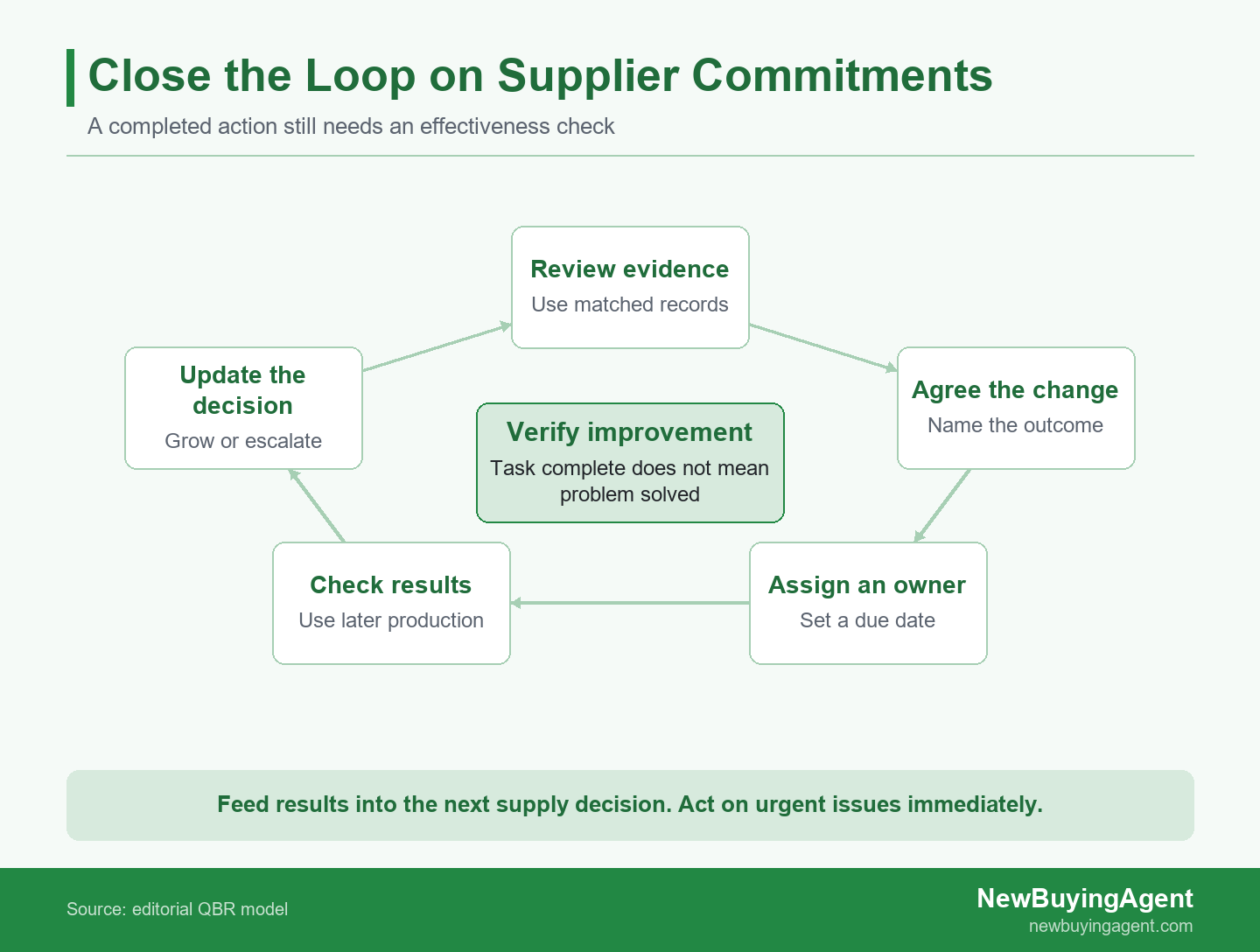
Supplier review actions feed into later production checks and the next purchasing decision
Prepare One Shared Evidence Pack
Send comparable performance records, unresolved actions and next-quarter assumptions before the QBR so disagreement can be narrowed to specific facts. A practical starting point is to distribute a short pre-read five working days ahead and invite corrections before the meeting. Adjust that preparation window to the complexity of the records; it is a suggested working arrangement, not an industry requirement.
Reconcile the Quarter Before Discussing the Score
Show the reporting period, agreed definitions, denominators and exceptions alongside the relevant order and lot records. Include delivery performance, product-quality findings, commercial changes and previous actions, but use the measures already agreed with the supplier. A quarterly meeting is a poor place to introduce a new scoring method and immediately judge past work against it.
Keep the summary readable and the evidence retrievable. Each exception should point to its purchase order, product specification version, production lot or relevant report. Show the quarter and its recent direction, not just an overall color. A strong average can conceal a worsening problem in the newest product variant.
The Scottish Procurement Journey guidance on performance management recommends consulting suppliers on the factual accuracy of reports. In a commercial QBR, apply that principle by logging disputed records and naming who will resolve them. Keep the disputed figures visible with their status; neither quietly delete them nor treat the supplier’s silence as agreement.
Ask Both Sides for Decisions, Not More Slides
Separate confirmed orders from demand forecasts and ask the supplier to identify capacity, material and approval constraints. The factory needs to know which quantities are commitments and which are planning assumptions. Procurement, in turn, needs to understand what extra tooling, material lead time or buyer approval would make a proposed delivery schedule feasible.
Ask the supplier to bring its own questions. Late artwork approval, changing packing instructions and unstable forecasts can undermine a production plan even when the buyer’s dashboard attributes the final delay to the factory. Include those dependencies in the pack with dates and responsible functions. A two-way review is more useful than a supplier-only list of failures.
If next quarter introduces a new product family that the current factory cannot support, turn that gap into a product brief. NewBuyingAgent’s local China factory resources and industrial-cluster sourcing access can support a suitable quoted product offer, with the buyer’s specifications and delivery needs kept together. That is the relevant next step for its China product-supply service.
Bring Factory Decision-Makers and Remove Language Ambiguity
Include people who can commit production and quality resources, and make technical terms, dates and decisions unambiguous across languages. The supplier’s sales contact may coordinate the relationship without controlling line capacity or process changes. Match the invitation list to the decisions on the agenda, rather than assuming the familiar contact can approve everything discussed in the room.
Procurement should chair the review, with buyer quality, planning or logistics joining where their decisions are needed. Ask for the factory production or quality manager when a recurring process issue is on the agenda. A senior commercial representative should join if pricing, investment or capacity allocation needs approval. Confirm beforehand who can commit and which matters still need escalation.
Where technical communication requires interpretation, arrange it before the meeting. The U.S. International Trade Administration’s business-travel guidance highlights the difference between conversational fluency and technical business language. Assess the actual participants’ needs; nationality alone does not tell you whether interpretation is necessary.
For a China factory review, circulate agreed English and Chinese terms for critical defects or processes when needed, alongside photographs and specification references. Write calendar dates rather than “after the holiday,” and confirm the factory’s own shutdown and restart assumptions. Include the time zone on invitations. Read back quantities, units, revision numbers and due dates in the language each action owner understands.
Do not force a factory manager to improvise an answer to a technical finding first shown during the call. Share the evidence early and ask a specific question: what changed, what records establish the cause, and what resources are needed? This makes disagreement about the problem easier to separate from disagreement about responsibility.
Run a 75-Minute QBR Around Specific Decisions
Reserve meeting time for unresolved performance patterns, future requirements and agreed decisions rather than reading every order update aloud. The 75-minute agenda below is an editable starting point for a supplier with meaningful recurring business. Extend a technical investigation in a separate working session if necessary, while retaining a clear decision owner and protecting the closing readback.
A useful distinction appears in Procurement Journey’s contract-governance guidance: operational meetings handle immediate issues, while quarterly performance reviews also consider change proposals and risk. Its Scottish public-sector model is a reference for separating meeting purposes; the timing below is a practical editorial proposal for a commercial supplier review.
| Minutes | Discussion | Required output |
|---|---|---|
| 0–5 | Confirm the decisions needed | Agreed priorities |
| 5–15 | Review previous commitments | Verified closures or escalation |
| 15–30 | Examine performance exceptions | Priority patterns and disputed facts |
| 30–45 | Discuss causes and corrective work | Investigation or change owners |
| 45–60 | Test next-quarter requirements | Capacity assumptions and buyer dependencies |
| 60–70 | Agree actions and resources | Owners, dates and evidence requirements |
| 70–75 | Read back decisions | Confirmed commitments and follow-up dates |
Start each priority discussion with the observed fact and its business consequence. Then distinguish a confirmed cause from a hypothesis. If the cause is still unknown, agree an investigation with a deadline instead of recording a convenient explanation as settled. The meeting can authorize the investigation without pretending it has already produced a result.
Give forward-looking topics equal discipline. Ask which production weeks support the forecast, what material constraints could change the plan, and when buyer approvals are required. Record any proposed specification, price or delivery change for the appropriate approval process. Meeting notes should not silently replace agreed purchase-order terms.
Challenge Repeat Failures Without Turning the Review into Blame
A repeated defect after a completed action calls for a review of the corrective mechanism and verification, not another unsupported promise to train staff. Ask what changed in the work and what later evidence shows about the result. Keep the discussion on the process and affected products, while acknowledging any buyer-side instruction changes that contributed to the problem.
ASQ’s root cause analysis guidance explains that identifying causes must form part of a larger problem-solving effort to produce improvement. Finding a plausible explanation is therefore a different milestone from demonstrating that the chosen correction works.
Illustrative Scenario: Repeated Pet-Bed Seam Failures
Consider an illustrative importer reviewing 4,800 pet beds across 6 lots before increasing next-quarter volume. An earlier action says seam-assembly training is complete, yet the same seam failure has appeared in 2 lots afterward. Those repeat findings make the completion record insufficient grounds for growth; the buyer needs evidence that the corrective work has become effective.
The procurement lead should separate the growth decision from the factory’s overall score. Work-instruction versions, seam settings and inspection records need comparison before anyone declares the cause resolved. The proposed response is to withhold the planned volume increase for this product until the quality concern is addressed, rather than reward a completed training form with a larger commitment.
Assign the factory production and quality owners to confirm the cause and test the selected correction. For this example, the buyer quality lead asks to review 2 subsequent lots against agreed product-specific criteria, using the relevant process records and inspection results. The acceptance check must evaluate the failure that triggered the action, not merely confirm that another training session occurred.
This is a proposed response to a hypothetical case, not a reported NewBuyingAgent customer result. Two later lots are an illustrative verification scope, not a universal acceptance rule. Product risk and the quality agreement determine the necessary checks. Decisions on existing shipments remain subject to their own acceptance requirements; a QBR growth decision does not release goods.
When a buyer wants to retain a factory but needs stronger China-side follow-through, NewBuyingAgent’s product-development and quality-control capability can connect recurring findings to production progress, inspection evidence and delivery coordination. That support sits within its existing-factory management service, giving the buyer a practical route for managing ongoing supply rather than leaving the issue in quarterly meeting notes.
Leave with an Action Record That Can Be Closed on Evidence
Record the issue, action owner, due date, required evidence and acceptance reviewer, then track overdue or ineffective actions between quarterly meetings. A useful record distinguishes work in progress from work awaiting verification and work accepted as effective. Without those separate states, an uploaded document can make an unresolved production problem look closed in the next management report.
This fits CIPS guidance on contract performance and improvement, which connects agreed performance indicators with relationship discussions, actions and timescales. The principle is to make commitments actionable; it does not prescribe one review frequency or one acceptance test for every supplier.
| Action-record field | What to write |
|---|---|
| Issue and scope | Product, affected records and observed failure |
| Action and owner | Specific work and one accountable person |
| Due date | Calendar date agreed with the owner |
| Evidence required | Records or product results proving the intended change |
| Acceptance reviewer | Person authorized to judge the evidence |
| Status and consequence | Open, awaiting verification or closed; decision affected |
Send the agreed record promptly and ask each owner to confirm their item. Put buyer commitments in the same register: approved artwork, demand updates and specification decisions need accountable owners too. Attach evidence to the action itself so a change of account manager does not erase the history.
Set follow-up dates according to the production event being checked, not simply the next quarter-end. If an action misses its date, record the reason and the decision now exposed, then escalate through the agreed management route. If evidence arrives but fails the acceptance check, reopen the corrective work rather than relabeling it successful. Carry unresolved business consequences into the next QBR.
Turn the Review into a Better China Supply Plan
Translate QBR findings into a product brief or an existing-factory improvement priority before requesting China sourcing support. A capacity gap requires different information from a recurring quality failure, even when both threaten the next order. Specify which decision is blocked, which requirements remain fixed and what evidence would allow the buyer to move forward with confidence.
NewBuyingAgent is a one-stop China sourcing agent for global buyers. If the review reveals a gap in the next product order, prepare the specification, quantity, target price, packing requirements, destination and required arrival date, along with the relevant review findings. Its local factory resources and product capability support a quotation aligned with those requirements and the supply of suitable products from China. Use that brief to request a product quote from NewBuyingAgent.
Frequently Asked Questions
Does a low-spend supplier need a quarterly meeting?
Not automatically; match the review effort to supply risk and business importance. A low-spend item can still stop a product launch if it is difficult to replace, while a larger routine purchase may need little management discussion. Use a lighter written review when performance is stable and no material decisions are pending. Increase attention when dependency, change or recurring failures warrant it.
What if the supplier refuses to share detailed production data?
Ask first for the minimum evidence needed to resolve the decision, with commercial confidentiality protected. A redacted record, product-specific extract or controlled on-site review may answer the question without exposing unrelated customers’ information. If the supplier still cannot support a critical claim, document the uncertainty and its consequence for the order. Missing evidence should not be converted into an acceptable score.
Can several factories join the same QBR?
Use separate reviews for supplier-specific performance and confidential commercial discussions. A joint session can help when factories share a genuine interface, such as compatible components or a coordinated delivery handoff, but agree the information boundaries first. Keep prices, unrelated capacity allocations and other customers’ details out of shared materials. Discuss the common dependency together, then manage each supplier’s commitments in its own record.
Should the QBR be on-site or remote?
Use remote reviews when the evidence is accessible and authorized participants can join; visit when physical verification matters. An on-site review is more useful if the decision depends on observing a changed process, examining products or understanding an unresolved production constraint. Define that objective before booking travel. Attendance at either format does not itself verify a factory’s quality or capacity claims.
NewBuyingAgent
Related Resources


Get Started Today
Let's Turn Your Sourcing Goals into RealityWeChat:+86 15157124615
WhatsApp:+86 15157124615
Address:Building 10 #39 Xiangyuan Road, Hangzhou, China
