

A product family can pass a sample approval and still ship the wrong configuration for most of its SKUs. When one product is sold in many SKUs and colors, the approved configuration has to survive being copied across sizes, colors, artwork and packaging, and it has to survive every later change. A buyer sourcing from China should freeze one configuration baseline, give each variant a unique identity, specify color by measurement, gate evidence per variant, and control changes so the first order and every reorder match the same approved configuration.
Configuration control is the discipline of defining, identifying and recording the approved configuration of every variant in a product family, then controlling any change to that configuration so production, packaging and repeat orders all match the same baseline.
The purchasing question is specific: what is common to the family, what changes per SKU, and what evidence will the buyer accept before releasing each variant?
What Configuration Control Must Protect Before the First Order
A multi-SKU product family is only as controlled as the weakest variant, so the buyer should freeze one baseline, identify every variant, measure color, gate evidence per variant, and control changes before the first order. The goal is not a longer specification; it is a single approved configuration that survives being copied across colors, sizes, packaging and later changes. The controls below are the ones a buyer can put into a China supply brief before production starts.
- Freeze one baseline: the master specification plus each variant's deltas is the reference every SKU is produced against.
- Identify every variant: a unique SKU, a trade-item identifier and a label version keep the right configuration attached to the right product.
- Specify color by measurement: a master color standard and an agreed tolerance replace a color name and a sample photo.
- Gate evidence per variant: release production only for the variants whose characteristics were actually verified.
- Control changes: a versioned change record stops a shared component fix from silently resetting the family.
What Configuration Control Means for a Multi-SKU Product
Configuration control identifies each product configuration, records its approved baseline, controls changes to that baseline, and keeps its status accurate through production. For a family with many SKUs and colors, that means one controlled reference rather than a folder of sample photos and email approvals. The discipline has a longer history in engineering and quality management, where it is usually called configuration management, and a buyer can borrow its logic without adopting an enterprise software stack.
The requirement is usually defined by the buyer's own quality plan, and the established method comes from standards work. ISO 10007:2017 is the quality-management guideline for configuration management. It describes the configuration management process as planning, configuration identification, change control, configuration status accounting and configuration audit, and it is applicable to products from concept to disposal. Those five activities answer the buyer's problem at a smaller scale: identify what a variant is, freeze what was approved, control what changes, and keep the record accurate. For a consumer product, the buyer's own specification and quality plan set the content; the standard supplies the discipline.
A product family also sits inside product development, so it helps to see how China manufacturing stages connect before writing a baseline; the China manufacturing and product guide explains how product requirements, tooling and production stages relate.
Two limits matter from the start: configuration control governs a defined configuration, and it depends on the buyer being able to state what the approved version actually is. A family with no written baseline cannot be controlled, only renegotiated.
Build One Configuration Baseline for the Whole Product Family
One master specification plus per-variant deltas, frozen as a baseline, gives every SKU a single source of truth and makes any later change comparable to what was approved. The master specification carries what is common to the family, and each variant records only what differs from it. A baseline is frozen in the sense that it is the reference for approval, not in the sense that it can never change; it changes through a controlled path, and that control is what keeps the record trustworthy.
For a buyer sourcing a multi-variant product, NewBuyingAgent's local China factory resources and product-development/QC capability can connect the baseline to the supply brief. Its product-supply service sources the product against the agreed master specification and per-variant deltas, with the color standard and release condition set for the project.
The Variant Matrix: One Master Spec Plus Per-Variant Deltas
A variant matrix records what is common to the family and what changes per SKU, so the factory produces each variant from the same controlled source instead of a fresh interpretation. It is the working form of the baseline: one row per variant, one column per attribute, with the common value written once and the deltas written explicitly.
| Attribute | Common to the family | Varies per variant | Evidence it needs |
|---|---|---|---|
| Form and function | Shape, capacity and mechanism | Not normally | First-article measurement |
| Body color | Color system and finish type | Each color | Measured result against the master standard |
| Material and components | Approved material and supplier | Where a variant differs | Material record and version |
| Artwork and label | Layout and mandatory marks | Variant name and identifier | Approved artwork proof |
| Packaging | Pack type and protection | Pack count and barcode | Packaging and barcode check |
Read the table as a control rule: the common column is fixed for the whole family, and the variant column is the only place a SKU may differ. When an attribute cannot be written in either column, the baseline is not yet specific enough to control.
Give Every Variant a Unique, Traceable Identity
Every variant needs a unique, traceable identity, such as an internal SKU plus a trade-item identifier and a label version, so production, inspection and reorders match the right configuration. Identity is what makes the matrix operational: without it, a color, a pack size and a label can be combined incorrectly even when each element was approved on its own.
The trade-item side of that identity is standardized. GS1 states that a Global Trade Item Number (GTIN) can be used to uniquely identify all of a company's trade items, which it defines as products or services priced, ordered or invoiced at any point in the supply chain. For a family, the unique identification of trade items usually means each sellable variant carries its own identifier rather than sharing one at the product-family level, because a color or a pack count that a customer can order separately is a separate trade item.
Deciding when a change needs a new identifier is itself a defined decision. The GS1 GTIN Management Standard is designed to help industry make consistent decisions about the unique identification of trade items in open supply chains, including when a product change requires a new identifier. A new color, a new pack count or a changed declared attribute is not just a factory note; it can change how the product is ordered and tracked, so the buyer should agree the identifier rule in advance instead of discovering it at the label stage.
Control Color as a Measured Specification, Not a Sample Photo
Control color as a measured specification: define a master color standard, agree a numeric tolerance, fix the viewing condition, and record each variant's measured result against it. A color name such as navy, or a sample photo, cannot be accepted or rejected, because neither can be measured. The master standard is the physical reference, and the tolerance is the limit within which a produced item is still considered the same color.
Color tolerance is an established measurement practice rather than a matter of opinion. ASTM D2244, the standard practice for color tolerances and color differences, covers the calculation of color tolerances and small color differences from instrumentally measured color coordinates, and it states that the purchaser and the seller shall agree upon the permissible color tolerance. Two practical rules follow. The tolerance is an agreement, so it belongs in the supply brief rather than in a later argument, and color differences should be compared within one color-scale system, because a difference measured in one system is not directly convertible to another.
Lighting is the part buyers skip. A color that matches under factory daylight can look different under a store's lighting, and two materials can match under one light and diverge under another. Fixing the viewing condition and the measurement method in advance removes that ambiguity and tells the supplier exactly what evidence to provide for each color.
Set Evidence Gates for Each Variant Before Mass Production
Set evidence gates per variant, such as first-article measurements for each color or material family, artwork and label proofs, and packaging and barcode checks, so production is released only for verified variants. The gates are the bridge between the baseline and the release decision: a variant whose evidence is missing is not approved, however convincing the sample looked. Grouping colors by material and process family keeps the workload proportionate without dropping coverage of the variants that actually ship.
A practical evidence set for a multi-variant order usually includes a first-article measurement for each material and process family, a measured color result for every color against the master standard, an approved artwork and label proof for every variant, a packaging and barcode check against the identification rule, and a recorded disposition for every deviation. The list is not meant to be long; it is meant to be complete enough that each release can be defended later.
The evidence earns its place when it changes the release decision: which variants are verified, which remain open, and what must happen before each one starts. Evidence that arrives after a run has begun may still help troubleshooting, but it has lost the chance to prevent the wrong release.
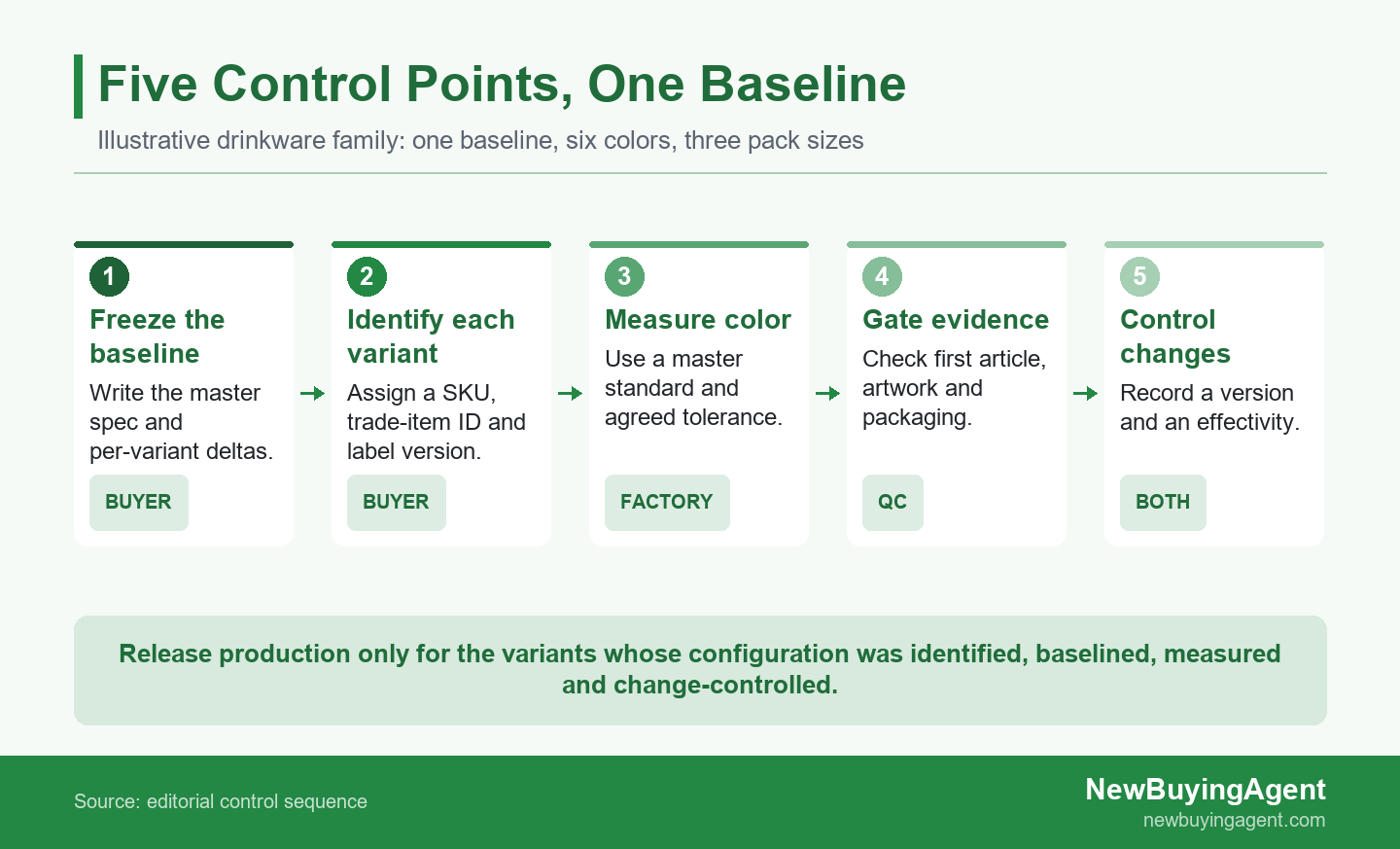
Five-step configuration-control sequence for a multi-SKU product family, from freezing the baseline to controlling changes
Control Changes to the Baseline, Not Just the First Sample
Control every change to the baseline with a defined approval path, a version, and an effectivity date, so a shared component or process change applies to exactly the variants and orders it affects. A change is not just a message to the factory; it is a new approved configuration that has to be scoped, recorded and made visible to anyone producing or inspecting the product. Without an effectivity date, the same change can be applied to the wrong orders, and the record stops describing what was actually shipped.
The discipline is not unique to physical products. IEEE 828-2012 defines configuration management in systems and software engineering as identifying configuration items, controlling changes, and reporting the status of configuration items. That standard governs software and systems rather than a consumer product, so the transferable lesson is narrower: identify each item that can change, control the change, and keep its status visible. A buyer can apply that lesson to a shared gasket or a revised label without claiming that a software standard governs the order.
Scope a shared change before approving it. If one lid tool, one gasket or one printing plate serves several variants, ask which variants use it and what each one's evidence becomes after the change. The answer may be a partial re-verification for some variants and a full one for others, and the change record should state which is which so the release decision stays explicit.
For buyers managing an existing Chinese factory, the harder part is often following an approved change into production. NewBuyingAgent's existing-factory management service connects local follow-up and quality-control capability with that ongoing supply work, so a versioned change and its re-verification can be tracked instead of forgotten.
Keep Repeat Orders on the Same Approved Configuration
Keep repeat orders on the same approved configuration with a reusable data package and configuration status accounting, so a reorder does not quietly inherit an unapproved change. The data package is simply the baseline, the identifier list, the master color standard and the change record kept together and reused instead of rebuilt. Status accounting is the part that makes it work: the buyer can state which version each variant is on and what has changed since the last order.
A reorder is where weak configuration control becomes expensive. If the buyer rebuilds the specification from memory or from the last email thread, the factory may quote the product that is easiest to make rather than the product that was approved. Reusing the package also shortens the next quote, because the supplier is pricing a known configuration instead of guessing at one.
When Variant Drift Reaches Production
Separate reversible preparation from the release that depends on missing configuration evidence, and state the condition for release. This keeps a project moving without treating an incomplete configuration as permission to start full production. In a multi-variant order the release is rarely all-or-nothing: some variants may be verified while others wait on a measurement or a change record.
Illustrative Example: A Six-Color Family That Drifted
In this illustrative example, a consumer brand is sourcing a custom insulated drinkware family of 18 SKUs from a new China factory that shares one lid tool across the family. The tooling and fixtures are built, a first production run is available, and the buyer has approved a sample against the released specification.
The family covers 6 body colors and 3 pack sizes, with 12,000 units planned for the first order. Most sample dimensions pass and the color looks acceptable on a screen, so the sample appears to close the development stage. Two gaps sit underneath it. The navy body was approved from a photo, and its measured color against a master standard was never recorded, so no one can say whether the produced navy is within any agreed tolerance. A gasket material was also substituted after sample approval, and the change was neither versioned nor scoped, even though the gasket is used by every SKU in the family.
The buyer's decision is to hold production release for the affected variants while allowing packaging and label preparation that remains reversible. The factory is asked to measure all 6 colors against the master color standard under the agreed viewing condition, and to record the gasket change with a version and an effectivity before any variant that uses it is released.
Before mass production is released, the buyer reviews the measured color results and the change record against the baseline; after release, ongoing sampling confirms that each variant stays on the approved configuration. This illustrative example invents no measured value and no passed test, and configuration control is not a guarantee for every later unit; the product's own critical attributes and tolerance govern the real scope.
Put Configuration Control Into the China Supply Brief
Put configuration control into the supply brief: the variant matrix, the master color standard and tolerance, the identification scheme, the per-variant evidence gates, the change path and the release condition. Written this way, competing suppliers quote the same controlled product, and the phrase "the same as the sample" is replaced by a configuration that can be checked. The brief also tells the factory what it must deliver before production may start.
Barcodes and identification keys follow a defined standard rather than a supplier convention. The GS1 General Specifications is the core standards document of the GS1 system describing how GS1 barcodes and identification keys should be used, which matters when a variant's label or pack count changes. Naming the standard in the brief helps the factory produce artwork that scans and identifies the variant correctly.
For a multi-SKU product entering China sourcing, prepare the master specification and per-variant deltas, the color list with a master standard and target tolerance, the quantity and forecast by variant, the target price, the destination and the delivery timing. NewBuyingAgent can use its local China factory resources and product-development/QC capability to develop a product quotation around those requirements, including the configuration baseline, the color standard and the release condition. With that brief ready, send your product requirements to NewBuyingAgent.
Frequently Asked Questions
Is configuration control the same as a bill of materials?
No; a bill of materials is one input, while configuration control also identifies each variant, freezes a baseline, controls changes and tracks status. A bill of materials tells the factory which parts to buy, while configuration control tells it which approved combination belongs to which SKU and what may change. For a family with many colors and sizes, the bill of materials is necessary but not sufficient.
Does every color need its own first article inspection?
Not always a full inspection per color, but every color still needs a measured result against the master standard, and each material or process family needs a first-article check. Colors that share a material and a process can be grouped for the mechanical checks, while the color itself is verified by measurement. The buyer should state the grouping and the measurement requirement in the brief rather than leave it to the factory.
How should a color tolerance be decided?
The buyer and the supplier should agree a numeric tolerance in a stated color space, measured instrumentally against the master color standard under a fixed viewing condition. The tolerance is a commercial and technical agreement, so it belongs in the supply brief rather than in a later dispute. A smaller tolerance is harder and often more expensive to hold, so the value should match how the color is actually judged in the market.
Does a new color or a packaging change need a new SKU or GTIN?
Often yes; when a change affects how the trade item is identified, ordered or priced, a new identifier is usually required, so decide it deliberately with the identification rules. A new color, a different pack count or a changed declared attribute can all change the trade item's identity. The buyer should define the rule once and apply it consistently across the family instead of letting each variant drift.
NewBuyingAgent
Related Resources



Get Started Today
Let's Turn Your Sourcing Goals into RealityWeChat:+86 15157124615
WhatsApp:+86 15157124615
Address:Building 10 #39 Xiangyuan Road, Hangzhou, China