

A lower unit price can make the same usable order more expensive. Procurement should track purchase price variance to explain the price movement, then reconcile the other costs before calling that movement a saving.
Purchase price variance (PPV) measures the difference between a purchase price and a stated standard or reference price, multiplied by the relevant quantity. It isolates a price difference; it does not, by itself, measure the full economic result of buying the goods.
Use PPV to Explain Price and Total Cost to Judge Value
PPV and total cost answer different questions: one isolates price movement against a baseline, while the other tests the wider economic consequence of a purchasing decision. Keep both measures in the procurement review, but use a comparable total-cost assessment to judge whether the purchase creates value. A price variance must not be counted again when the calculation already contains the actual purchase cost.
- Price performance: State the reference price, actual quantity and sign convention so finance and purchasing can reproduce the result.
- Economic outcome: Include relevant logistics, quality and inventory costs over the same period and for equivalent usable output.
- Evidence status: Separate a quotation-based forecast from a committed order and from costs actually incurred.
- Accountability: Explain which changes purchasing negotiated and which came from changed specifications, demand or market conditions.
Separate the Price Signal from the Cost Outcome
A favorable price variance can coexist with a higher total cost when additional logistics, quality or inventory costs exceed the unit-price saving. PPV is useful for investigating a price change, whereas total cost is better suited to comparing the overall consequences of purchasing alternatives. Neither measure is reliable without a stated scope, and a detailed cost model cannot compensate for unsupported assumptions.
CIPS groups total cost of ownership into procurement, acquisition, usage and end-of-life costs. That wider perspective matters when ownership creates expenses beyond delivery, but it does not mean every product comparison needs every category. A reseller evaluating one replenishment cycle and a manufacturer buying equipment for years of operation need different boundaries.
| Comparison dimension | Purchase price variance | Comparable total cost |
|---|---|---|
| Decision question | How did price differ from the reference? | Which option costs less for the required outcome? |
| Cost boundary | Defined purchase-price component | Relevant buyer costs within a named horizon |
| Baseline and timing | Standard or reference price; stated transaction stage | Equivalent output, period and commercial scope |
| Evidence | Price, quantity and reference-price records | Those records plus logistics, quality and other cost inputs |
| Limitation | Misses costs outside its price definition | Can mislead when estimates or allocations are weak |
For example, an illustrative 2,400 USD price reduction can be outweighed by 900 USD in extra freight, 1,400 USD in rework and 800 USD in holding and handling. The net change is a 700 USD increase, not a saving. The calculation below keeps usable quantity constant and explains which evidence the buyer would need before approving the cheaper offer.
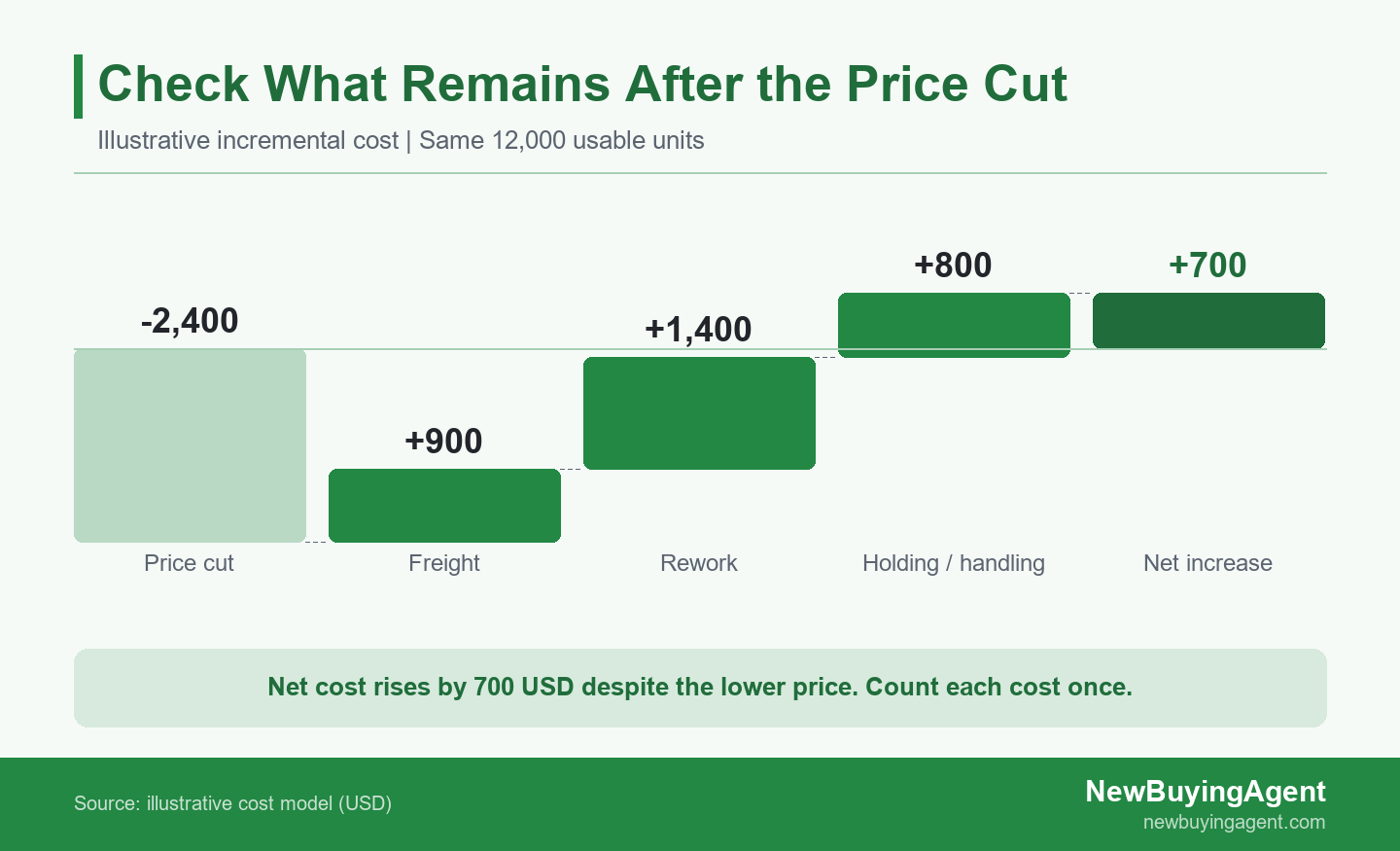
Additional freight, rework and holding costs can outweigh a purchase-price reduction
Calculate PPV Against a Comparable Baseline
Calculate a price variance using the price difference and the relevant actual quantity, with the baseline, sign convention and transaction stage explicitly stated. Using budgeted volume instead can mix a price effect with a quantity effect. Before comparing teams or suppliers, confirm that their reports use the same price components and recognize the transaction at the same stage.
State the Formula, Sign and Receipt Basis
A receipt-based example appears in Oracle’s Purchasing Help: it calculates PPV from quantity received and the difference between purchase-order price and standard cost. This is a legacy report definition, not a promise that every enterprise resource planning system uses identical postings. Ask finance which receipt, invoice and currency adjustments the company’s own report includes.
PPV = (actual purchase price − standard price) × quantity received. For a hypothetical receipt of 12,000 units at 4.80 USD rather than a 5.00 USD standard, the calculation is (4.80 − 5.00) × 12,000 = −2,400 USD. With actual price minus standard price, a negative variance is favorable on price; it is not proof of lower total cost. Label the result “2,400 USD favorable” as well as showing the signed amount. If an internal report reverses the subtraction, keep its established convention but explain that reversal when reconciling the two reports.
A quotation can support an expected price variance, but it is not a completed receipt. Keep that forecast out of the realized column until the chosen measurement event occurs; otherwise, cancelled volume can leave an apparent saving that was never earned.
Keep Scope, Currency and Timing Comparable
An old price is not a clean performance baseline when specifications, commercial scope, quantities or currency assumptions have changed. Match the product revision, packing specification, order quantity, delivery responsibilities and payment conditions first. Separate currency movement from the negotiated price change rather than crediting purchasing with an exchange-rate benefit it did not negotiate.
This comparability problem also appears in the US Federal Acquisition Regulation (FAR), which warns that an earlier price may be unsuitable when timing or acquisition terms differ significantly. That is a US federal procurement rule, not a rule imposed here on commercial importers. The relevant comparison principle is narrower: an old number needs context before it becomes a performance benchmark.
When a buyer is sourcing a new product range, NewBuyingAgent’s China product-supply service uses local factory resources and product-development capability to work from the buyer’s requirements toward a suitable supplied product. For the price comparison, the useful starting point is the same specification and packing brief across quotations. As a one-stop China sourcing agent, NewBuyingAgent connects that sourcing work with product quality control, rather than treating the lowest unqualified quote as the buying outcome.
Define Which Costs Belong in the Decision
Define the buyer perspective, time horizon and required usable output before adding costs; a landed-cost subtotal and a lifetime ownership estimate are not the same measure. For a replenishment decision, compare the costs needed to obtain and handle equivalent saleable goods over the chosen cycle. For equipment retained in use, the boundary may extend through operation, maintenance and disposal.
Start with net purchase spend, then identify relevant transport, handling, quality recovery and inventory effects. Give each cost one location in the model: freight already included in a delivered quotation must not reappear as a separate addition. Keep shared costs visible in an absolute-cost comparison, even when they cancel out in the incremental comparison.
Do not confuse this management calculation with the inventory balance in the accounts. The IFRS summary of IAS 2 includes purchase, conversion and other costs that bring inventory to its present location and condition. That accounting scope is not a universal definition of the costs relevant to a purchasing decision. Finance should determine classification and recognition under the company’s applicable accounting framework.
For uncertain costs, show the assumption and a range rather than entering zero. A holding-cost estimate should identify the additional inventory, expected holding period and finance-approved rate. If the rate already includes storage, do not add the same storage charge separately. Distinguish recoverable cash outlays from lasting economic costs without assuming that every market has the same tax treatment.
Connect Quality Costs to Accepted Products
ASQ distinguishes prevention, appraisal, internal failure and external failure costs. In a product order, that distinction helps separate work intended to prevent problems from the expense of correcting them before or after delivery. It is a classification for understanding cost, not evidence that any particular inspection budget will produce a guaranteed return.
Reduced prevention or checking spend is not a net saving if it creates larger rework, return or replacement costs. Compare the cost per accepted, usable unit, not just the cost per unit shipped. Where repairs restore the goods, count the repair expense; where goods are scrapped, account for lost usable quantity and any replacement cost without charging for the same loss twice.
For buyers retaining an existing factory, NewBuyingAgent’s existing-factory management service connects local production follow-up with product and quality-control capability. If a cheaper packing change threatens the goods, the practical objective is to coordinate correction and check the resulting products within supply-chain management. That gives the buyer a firmer basis for assessing usable output; it does not replace finance’s responsibility for assigning costs or promise that inspections eliminate every defect.
Reconcile a Lower Quote with a Higher Cost Forecast
A cost bridge should show the purchase-price change once, then add only the differences in other relevant costs. The same result should be obtainable by subtracting the old total cost from the new total cost for equivalent usable products. If those methods disagree, check for a missing cost, a duplicated price benefit or a change in the quantity being compared.
Illustrative Scenario: A Kitchen-Rack Price Cut
Consider an importer reviewing a lower-priced offer for 12,000 steel kitchen racks over one replenishment cycle. The specification is unchanged, but a trial shipment reveals packing damage before the main commitment. All figures are hypothetical forecasts in USD, not a NewBuyingAgent customer case or reported saving.
The trial identifies packing damage on 600 units. The revised freight quote is 900 USD higher because the proposed protective packing increases chargeable volume. The buyer also obtains a 1,400 USD rework estimate for the affected goods and allows 800 USD for additional holding and handling; these are separate costs, with no overlapping storage allowance.
A 2,400 USD price reduction offset by 3,100 USD of additional costs produces a 700 USD total-cost increase. The incremental bridge combines PPV, freight, rework and holding/handling: −2,400 + 900 + 1,400 + 800 = +700 USD. Purchase spend falls from 60,000 USD to 57,600 USD as the price moves from 5.00 USD to 4.80 USD. Holding common other costs at 8,000 USD, the old total is 68,000 USD and the new total is 57,600 + 8,000 + 3,100 = 68,700 USD.
The buyer should not approve the saving claim on price alone. Request improved packaging and revised freight and rework assumptions before scaling the offer. The 2,400 USD price benefit is the break-even allowance for additional costs: if those costs could credibly fall to 1,800 USD, the model would instead show a 600 USD net reduction. That is a sensitivity test, not an achieved result.
Verify packing-trial results, the final freight quote and accepted quantity before scaling. This illustrative example assumes all 12,000 units become usable after repair, including the 600 affected units; it does not project that every future shipment will have the same damage. If goods must be scrapped, revise both usable output and recovery costs. Do not subtract the favorable PPV again from 68,700 USD: the lower purchase price is already included.
Give Each Measure an Owner and Evidence Status
Track price variance, comparable total cost and product-service outcomes as linked measures, with forecasts kept separate from realized results. Assign each input to the function that can verify it, rather than asking purchasing to estimate every consequence alone. The monthly review should explain both the economic change and its causes, so a negotiated benefit is neither overstated nor hidden by unrelated movements.
- Purchasing and finance: Record the baseline version, unit price, received quantity, currency and transaction stage. Reconcile the reported PPV with the underlying records.
- Logistics: Confirm the shipment scope, freight and handling changes against quotations first and invoices when available. Explain differences caused by volume or delivery changes.
- Quality and operations: Record accepted quantity, rework, scrap, returns and delay consequences. Distinguish paid recovery costs from estimated future exposure.
- Finance: Reconcile the comparable total, approve allocation assumptions and distinguish forecast, committed and realized amounts. Keep cash timing and reported profit separate from the procurement value assessment.
The horizon also determines which owner must contribute. The Department of Energy’s acquisition training considers operating, maintenance and disposal costs beyond initial equipment cost. For equipment the buyer operates, engineering and maintenance therefore belong in the comparison. For merchandise sold onward, the end customer’s energy bill is not automatically the importing buyer’s expense. Apply the cost perspective, not the federal program’s rules, to the commercial decision.
To reduce subjectivity, preserve the original approved forecast and show later changes beside it. A model quietly rewritten to match the outcome cannot reveal whether the estimate, the purchasing decision or subsequent execution caused the difference.
Approve the Purchase on Net Value, Not a Headline Saving
Approve a purchasing change only when the expected net benefit survives realistic cost assumptions and the required quality and delivery conditions remain satisfied. When PPV looks favorable but the total-cost result does not, identify the largest offset before renegotiating. The answer may be a better packing design, a different delivery arrangement or retaining the existing offer rather than demanding another unit-price reduction.
Start with the unresolved input that could reverse the decision. If freight determines the result, obtain a quote for the actual packed dimensions; if recovery costs dominate, test the proposed correction. Give that evidence request an owner and a decision date. Do not let an uncertain estimate become an indefinite reason to delay a purchase whose critical costs are already sufficiently bounded.
For buyers comparing a cheaper product offer before committing volume, NewBuyingAgent’s China sourcing and product capability can support a suitable product offer with agreed commercial and delivery scope. A clearly defined quotation gives the buyer a more useful comparison than a low unit price detached from the required goods. Prepare the product specification, quantity, target price, packing requirements, destination and required arrival date, then request a product quotation from NewBuyingAgent.
FAQ
Can PPV be useful without a standard-cost system?
Yes, but identify the agreed reference price and label the measure accurately. A buyer can compare actual prices with an approved contract price or a documented prior comparable price without claiming that the result is an accounting standard-cost variance. Keep the reference date and product scope visible, and agree the method with finance before using it to reward purchasing performance.
Should a larger order discount count as a saving?
Only after the additional quantity and inventory consequences are evaluated. A discount that requires buying beyond expected demand may reduce the unit price while increasing cash tied up, storage exposure or obsolete stock. Compare the quantities needed to satisfy the same demand over the same period, including what happens to leftover goods. Report the price concession separately from the net benefit of accepting the larger commitment.
When should rebates enter the saving calculation?
Use a consistent treatment that reflects eligibility and avoids counting the same credit twice. A conditional rebate can be shown as a scenario until the relevant conditions and amount are sufficiently supported; it should not quietly reduce every forecast price. If a credit already reduces net purchase spend, do not add it again as a separate saving. Finance should determine the appropriate accounting treatment and timing.
Does favorable PPV immediately improve reported profit?
Not necessarily; a purchasing variance is not itself a complete profit calculation. The effect depends on the company’s accounting framework, inventory and expense recognition, and other costs associated with the goods. Ask finance to reconcile the purchasing report with the relevant financial statements. Keep expected procurement value, cash paid and recognized profit as separate views rather than using one favorable price number for all three.
NewBuyingAgent
Related Resources



Get Started Today
Let's Turn Your Sourcing Goals into RealityWeChat:+86 15157124615
WhatsApp:+86 15157124615
Address:Building 10 #39 Xiangyuan Road, Hangzhou, China
