

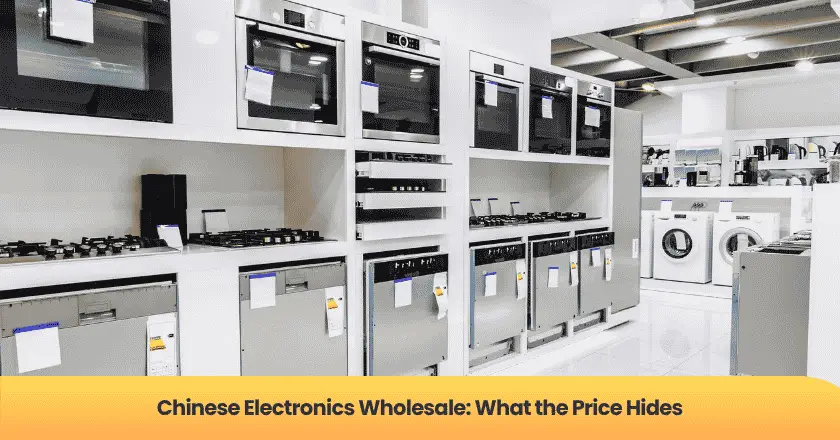
Introduction
Two suppliers, the same product photograph, the same model number printed on the same shell. One quotes $8.40 and one quotes $5.90. The cheaper unit powers on, charges, plays audio and looks identical on your desk. Four months later your return rate on that batch is running at nine percent and the other batch is at one.
Wholesale electronics is the category where price gaps are widest and least explained. The savings are real, and so is what was removed to produce them. Almost none of it is visible in a sample, which is why buyers who inspect carefully still get caught. Knowing where cost normally gets taken out tells you what to test for.
Key Takeaways
• Establish whether you are buying from a factory, a stock trader or a refurbishing channel before discussing price.
• Batteries and power adapters are the two components where cost is removed most often and noticed latest.
• A model number is not a specification, since internal revisions change between batches without any external marking.
• Price the expected failure rate into your landed cost, because returns arrive months after the invoice is closed.
• Buy one small test batch, record batch codes, and keep sealed reference units from every shipment.
Who Is Actually Selling You These Goods
Four different businesses sell wholesale electronics and they all look alike in a listing. The differences decide what you can verify and what recourse exists.
Factory, trader, stock dealer, refurbisher
A factory builds and can answer questions about its own process. A trading office sells for several factories and has real knowledge but no control. A stock dealer buys surplus and cancelled orders, which is genuinely cheap and entirely unrepeatable. A refurbishing operation restores returned or used units, which is a legitimate trade when disclosed and a serious problem when it is not.
How to tell which one you are talking to
Ask whether they can supply the same specification again in six months at the same price. Factories say yes with conditions. Traders say yes and check. Stock dealers hesitate, because the answer is no and they know it. Here's the thing: a supplier who cannot repeat an order is fine for a one-off and disastrous as the basis for a product listing you intend to keep.
Where you found the supplier is a clue in itself. Shenzhen electronics markets and the trading floors around them concentrate stock dealers and small traders, which suits opportunistic buying. B2B platforms mix all four types together with no reliable way to tell them apart from a listing. Neither channel is wrong, provided you know which kind of seller you have reached.
Expert Tip: Ask for a photograph of the goods in their current storage location with today's date written on a card in the shot. Stock and refurbished inventory sits in warehouses in specific quantities, and the photograph tells you whether the twenty thousand units quoted actually exist or whether the supplier is planning to assemble them after your deposit lands. Factories find the request unremarkable. Stock dealers find it awkward.
What Gets Removed to Reach a Price
Cost reductions in consumer electronics follow a predictable order, because manufacturers remove the things customers notice last.
The usual sequence
Five reductions appear again and again across categories, in roughly this order.
• Battery capacity is reduced while the printed rating on the label stays the same.
• The power adapter is downgraded to a cheaper unit that may not hold its rated output.
• An older chipset generation replaces the current one, which affects efficiency rather than basic function.
• Internal shielding, thermal pads and strain relief disappear, none of which are visible from outside.
• Packaging, manuals and accessory cables drop to the cheapest available option.
Why a sample proves so little
Every one of those reductions passes a functional test on day one. A device with two-thirds of its claimed battery capacity works perfectly and simply runs out sooner. A missing thermal pad causes no problem until the unit sits in a warm room for an hour. Sample testing catches assembly faults, not specification substitutions.
Common Mistake to Avoid: Judging a wholesale electronics supplier on the sample it chose to send you. Sample units are frequently assembled by hand from the best available parts, and on stock goods they may come from a different batch entirely. Buy three units yourself at the quoted price through a normal order, and compare them against the sample. The gap between those two, if any, is the real finding.
Batteries and Power: The Cheapest Place to Cut
Cells and adapters carry a real cost, they are invisible inside a sealed product, and they are responsible for a large share of the failures that reach your customers.
Capacity claims and how to check them
Printed capacity is a claim, not a measurement. A discharge test on a handful of units costs very little and answers the question directly, and any supplier confident in its cells will accept the result. Ask what cell brand is used and whether it varies between batches, since a supplier switching cells to protect a margin will usually say so when asked plainly.
Run the test warm as well as cold. Many cheap cells perform acceptably at room temperature on a first cycle and lose capacity quickly after a few dozen charges or in a warm environment. Charging a handful of units repeatedly over a fortnight tells you more about what your customers will experience than any single measurement taken on arrival.
Adapters, cables and the paperwork that travels with them
Adapters need to match the plug standard and safety requirements of every market you sell into, and a supplier quoting one price for all destinations has probably assumed one adapter for all of them. Lithium cells also require transport documentation before a carrier will accept the shipment. Confirm both before booking freight rather than at the forwarder's warehouse.
Expert Tip: Order your first batch with the adapters unfitted and buy those separately from a specialist supplier if your category allows it. Power units are the single most common source of safety complaints and marketplace takedowns on cheap electronics, and they are also the easiest component to source independently to a known standard. The cost difference per unit is small. The risk difference is not.
Same Model Number, Different Product
Wholesale electronics drifts between batches, and unlike custom manufacturing there is usually no agreement stopping it.
Silent revisions
A factory revises a board, swaps a module or changes a supplier and keeps the model number, because the model number is a sales identifier rather than a technical one. Your second order looks the same and behaves differently. Through 2026 more wholesale suppliers will share batch-level test records on request, which makes asking for them a reasonable expectation rather than an unusual demand.
How to hold a specification across orders
Write down the configuration you accepted: cell brand and capacity, chipset, adapter rating, firmware version if there is one, and accessory list. Attach it to every purchase order as the agreed specification. This converts a silent substitution from an unfortunate surprise into a breach of something specific, which is the only basis on which you can ask for a remedy.
Custom manufacturing gives you a change-control process because you commissioned the design. Wholesale gives you none by default, since the product existed before you did and will continue after you leave. That asymmetry is the real difference between the two routes, and it is worth understanding before choosing wholesale for a product you intend to build a brand around.
Expert Tip: Record the batch or date codes printed on the units and the cartons from every shipment, and keep two sealed units from each. When a failure pattern appears five months later, those codes tell you whether the problem covers all your stock or one batch. Suppliers respond very differently to a complaint that identifies a specific production window compared with one that describes a general impression.
The Cost That Arrives Later
The wholesale price is paid once. Failures, returns and support are paid continuously, and they land long after the supplier has been settled.
Failure rates and what they actually cost
Ask for the DOA rate (dead on arrival — units that fail before the customer uses them) and the return rate the supplier sees from other buyers. Then build your own number. A return costs the unit, the outbound shipping, the refund, the handling and usually the review, which together often exceed twice the product's wholesale price.
Who carries the warranty
Most wholesale suppliers offer replacement units on a defined percentage rather than cash compensation, and shipping those replacements is normally your cost. Establish the percentage covered, the claim window and the evidence required before the first order. Suppliers who decline to discuss it at all are telling you what their failure rate looks like.
Support time belongs in the same calculation. Each failed unit generates messages, a diagnosis attempt and often a dispute, all of which consume hours that scale with your volume. Sellers moving from one hundred to one thousand units a month frequently discover that a tolerable failure rate has quietly become a second job.
Common Mistake to Avoid: Comparing wholesale quotes on unit price when the failure rates differ. A product at $5.90 with an eight percent return rate costs more in practice than one at $8.40 returning at one percent, once refunds, shipping and lost listings are counted. Build the return cost into the comparison before choosing, because that calculation is straightforward in advance and painful to run retrospectively.
Buying Without Getting Caught
None of the risks above require expensive tooling to manage. They require a sequence, and most buyers skip it because the first order looked fine.
The test order
Buy a few hundred units before a container. Run them through whatever your customers will do, then hold a portion for six weeks and test again. Electronics failures cluster early and then after a period of use, and a fortnight of testing sees only the first group. The delay costs you nothing except patience.
Certification, and whose name is on it
A certificate held by the manufacturer covers the manufacturer, and it may not transfer to you as the importer placing goods on a market. Ask whose name appears on each report, whether it matches the exact configuration you are buying, and what happens if you switch to a second supplier for the same product.
Structure the payment to match the risk. Stock goods are often sold on full payment before shipment because the seller is carrying inventory it wants cleared. Pushing for a portion held against a functional inspection is still reasonable, and a supplier refusing any inspection-linked payment on goods it claims are already in its warehouse deserves a direct question about why.
Expert Tip: Keep a second qualified supplier for any electronics line you sell continuously, and place a small order with them once a quarter. The units give you a running quality comparison, the relationship stays live, and your main supplier prices with the knowledge that a replacement exists. On a category where batch quality drifts, one supplier is a dependency rather than a partnership.
Consistency Across Batches and How NewBuyingAgent Approaches It
Everything above is a version of the same underlying problem, and it is the one buyers name most often when a wholesale relationship disappoints them. Quality Uncertainty: No guaranteed consistency in product quality.
Solving it takes people watching production rather than better instincts at the negotiating table. NewBuyingAgent is your perfect partner for global sourcing from China, backed by 30 years of expertise in trade, manufacturing and quality control. Checking at that scale is a staffing question. 20,000+ product development & QC experts ensure your products match market needs and stay high-quality.
Being able to change supplier when one drifts is the other half of consistency, and that depends on how many alternatives exist within reach. 100% Access to China's Factories. Use its 50,000+ cooperated partner factories—no language/region/time zone barriers.
Frequently Asked Questions
Is chinese electronics wholesale worth the risk for a small seller?
For most categories the margin difference is large enough that the answer is yes, provided you buy a test batch first and price returns into your model. The buyers who struggle are those treating a wholesale price as a finished cost. A realistic landed cost including failures still usually beats domestic distribution by a wide margin. Start with one product rather than five, since the testing routine takes practice before it becomes quick.
How do I tell refurbished units from new ones?
Look at screw heads for tool marks, check whether internal seals are intact, compare serial number sequences across a carton, and look for mismatched date codes between the shell and the internal components. A refurbished unit sold honestly at a refurbished price is a reasonable product. The problem is the one sold as new at a price that only refurbishing makes possible.
Should I ask for an inspection on wholesale stock goods?
Yes, and specify functional testing rather than a visual check. On sealed electronics a standard cosmetic inspection tells you about cartons and scratches. Ask for a stated sample of units to be powered up, charged, run for a set period and measured against the specification you agreed, with the results reported as numbers.
Can NewBuyingAgent help if I buy across several product types?
Coordination load rises with every category you add, and that cost never appears on an invoice. NewBuyingAgent handles all factory communication—perfect for multi-category buyers. The coverage is not restricted to one product family, since it can supply products from China across all categories to you at better price, quality and service.
Conclusion
Find out who is selling, write down the configuration you accepted, test the battery rather than the label, record batch codes, and price the returns before you compare quotes. The cheap unit is sometimes the right buy and sometimes an expensive lesson, and the difference is knowable in advance for the price of a few hundred test units. Leave all the sourcing headaches with NewBuyingAgent. It handles sourcing, you grow.
Sources
1. Equipment Authorization – Federal Communications Commission — https://www.fcc.gov/engineering-technology/laboratory-division/general/equipment-authorization
2. CE Marking: Manufacturers – European Commission — https://single-market-economy.ec.europa.eu/single-market/goods/ce-marking/manufacturers_en
3. Electronics (Small Appliances) Industry | NewBuyingAgent — https://www.newbuyingagent.com/cases/electronics-small-appliances-industry
4. Contact Us | NewBuyingAgent — https://www.newbuyingagent.com/contact
NewBuyingAgent
Related Resources

Get Started Today
Let's Turn Your Sourcing Goals into RealityWeChat:+86 15157124615
WhatsApp:+86 15157124615
Address:Building 10 #39 Xiangyuan Road, Hangzhou, China
