

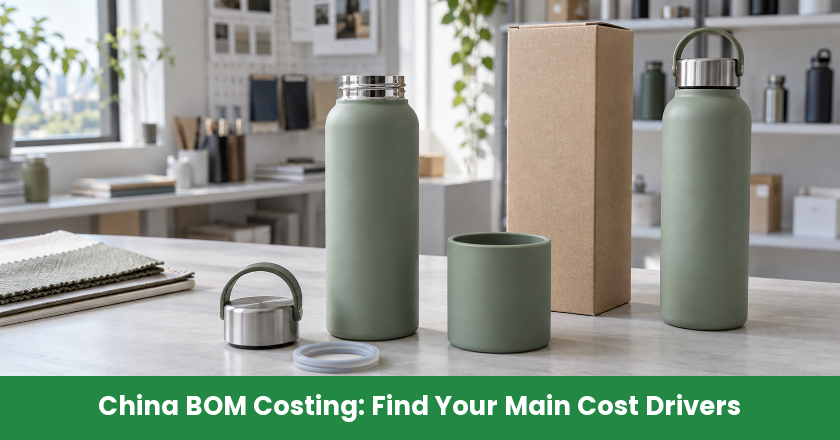
BOM costing is the process of assigning costs to the quantities of parts and materials needed for a defined product. BOM means bill of materials; its cost roll-up helps explain where product spending begins.
The most expensive part deserves attention, but it is not always the best place to seek the first saving. A redesign can consume more money than it saves on the next order. Buyers sourcing from China need both a component-cost ranking and a test of what a proposed change would actually deliver.
Find the Cost Driver Before Asking for a Discount
Start by ranking extended component costs, reconciling them with the product quotation, and testing feasible changes before selecting a saving. This separates a large cost exposure from a worthwhile improvement project, because the latter also depends on order volume, implementation expense and product performance. The comparison is meaningful only when the underlying specification and commercial terms remain consistent.
- Pricing: Multiply each component's quantity by its unit cost; do not rank unit prices alone.
- Common mistake: The difference between materials and the quoted price is not automatically supplier profit.
- Cost comparison: Subtract testing, tooling and other change costs from the expected order saving.
- Decision: Request priced alternatives that preserve the product requirements, then verify the assumptions before approval.
Separate the Component Total from the Quoted Price
A component subtotal leaves other priced activities and commercial allowances outside its scope, so an unexplained difference is not automatically profit. Assembly, inspection, overhead, order preparation and commercial terms can sit elsewhere in the calculation. For a useful BOM review, identify what each line includes before deciding whether the price is high or which part should change.
Microsoft's BOM documentation combines the materials list with a production route or flow to establish the basis for estimating product cost. The practical distinction is between what goes into the product and the work needed to make it. Buyers do not need that software to ask a factory for the same separation.
For example, the bottle model used below has a $4.80 subtotal for components, finish and packaging. Adding $1.10 for other manufacturing, $0.90 for a combined commercial allowance and $0.40 for allocated setup produces a $7.20 modeled offer. These are invented USD amounts per finished unit, not Chinese market benchmarks; the commercial allowance includes assumed selling overhead and profit without claiming to know a factory's actual margin.
Treat this cost bridge as a scope check, not a demand that every supplier disclose its accounts. If a purchased bottle body already includes forming and welding, those operations must not be charged again in the manufacturing line. Likewise, label the delivery basis and separate freight, import charges or financing that the offer excludes; the $7.20 example is not a landed-cost estimate.
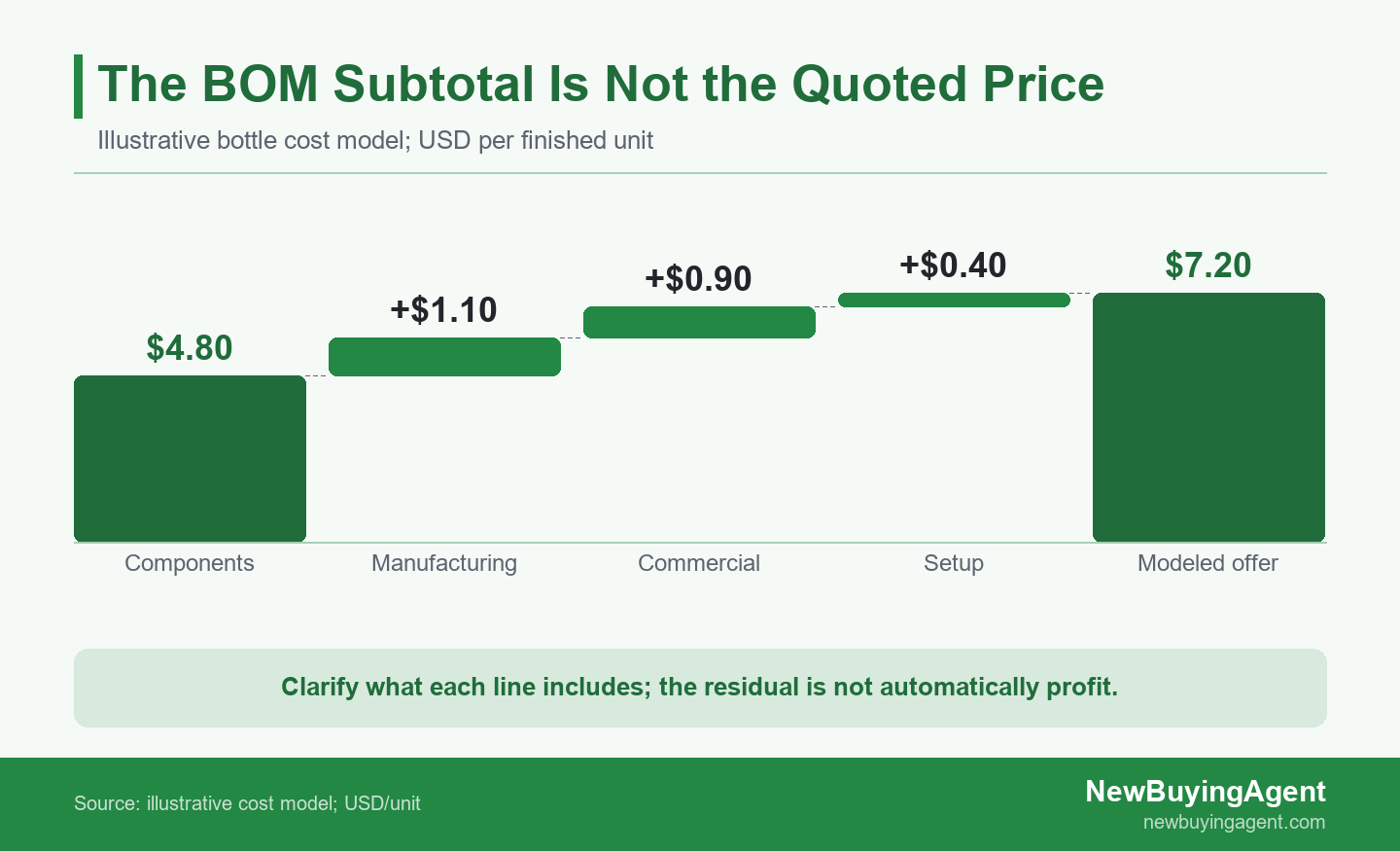
Illustrative cost bridge from a 4.80 dollar component subtotal to a 7.20 dollar modeled product offer
Rank Extended Costs on One Consistent BOM
Rank each line by the quantity used in one finished product multiplied by its unit cost, with a consistent revision, currency, volume and quotation basis. A cheap fastener used repeatedly can matter more than a higher-priced part used once. Sorting these extended costs reveals where spending is concentrated, while the specification tells you which changes are permissible.
Microsoft's BOM calculation guidance specifies the costing version, BOM version, route version, calculation quantity, date and site. That is a useful reminder to write the calculation basis at the top of a worksheet. A prototype cost and a production-volume cost should not enter the same ranking without explanation.
For a new product whose target price appears difficult to reach, NewBuyingAgent's local China factory resources and product-development capability connect cost questions with feasible product choices. Buyers can use its product-supply service to seek a quoted China-sourced product against the required performance and cost priorities, rather than treating an isolated component discount as the finished result.
Illustrative Scenario: The Largest Component Is Not the First Saving
In an illustrative order of 8,000 insulated bottles, the cost review covers all 8,000 bottles before a design change is approved. A consumer brand is assessing a China production quotation against one agreed product revision. The worksheet below uses invented costs for one finished bottle; the body is a purchased formed assembly, the lid excludes the separately listed seal, and each other line covers only its stated item or finish.
| Item or finish | USD per bottle | Share of $4.80 subtotal |
|---|---|---|
| Formed bottle body | $2.40 | 50.0% |
| Lid, excluding seal | $0.90 | 18.8% |
| Packaging set | $0.60 | 12.5% |
| Surface coating | $0.40 | 8.3% |
| Protective sleeve | $0.35 | 7.3% |
| Seal | $0.15 | 3.1% |
| Total | $4.80 | 100.0% |
The body accounts for half the listed subtotal, but only one-third of the $7.20 modeled offer. Suppose a body redesign reduces the final quoted unit price by $0.20 and requires $2,400 in additional tooling and validation. Its gross order saving is 8,000 × $0.20 = $1,600, leaving a negative $800 after the change cost. A packaging proposal reducing the final unit price by $0.12, with $300 of validation expense, instead produces $960 gross and $660 net.
The sensible next investigation is therefore the packaging proposal, even though packaging represents a much smaller share of the original cost. The buyer requests the revised packaging specification, the itemized change expense and confirmation that packing labor or carton dimensions will not erase the discount. The body redesign remains an option for a different volume or commercial arrangement, rather than being rejected as technically unsuitable.
Neither proposal is approved on arithmetic alone. The packaging must pass the agreed protective-performance checks, and the factory must confirm the final quoted saving and applicable quantity. This illustrative example's $660 is a modeled net benefit, not an achieved customer result; these calculations exclude unmodeled changes in freight, failure costs, financing and taxes. If those conditions change, the commercial decision must be recalculated before the order is released.
Test the Change, Not Just the Cost Share
Cost share measures exposure; a sensitivity test shows what a specific feasible input change would do to the total. In the example, the $0.12 packaging reduction is 20% of the $0.60 packaging line but only about 1.7% of the $7.20 modeled offer, before the one-time validation expense. Calling it a 20% product saving would use the wrong denominator.
The GAO cost-estimating guide describes testing one factor at a time while holding the others constant. Apply that logic to a supported alternative: a specified material grade, a quoted order tier or a measured consumption change. Arbitrary percentage cuts are not evidence that a factory can deliver those savings.
If several changes interact, model the combined proposal separately. A thinner component may require extra reinforcement; a different package may alter packing time. Do not simply add independent savings estimates when the same labor, material or tooling benefit appears in more than one proposal.
Check the Inputs That Can Distort the Ranking
Unit conversions, material consumption, scrap treatment, bundled assemblies and stale prices can all distort a component-cost ranking. Before challenging a factory's most expensive line, check how its quantity and price were obtained. A spreadsheet can calculate perfectly while comparing a price per kilogram with a quantity per piece, or counting a subassembly and its contents twice.
For purchased components, record the exact part specification, quantity per finished product, price unit, quotation date and quantity tier. For raw materials, distinguish the mass remaining in the product from the mass consumed to produce it. An illustrative 0.20 kg of net material at $3.00/kg costs $0.60 before losses; if the applicable material yield is 90%, gross consumption is 0.20 ÷ 0.90 kg and material cost is approximately $0.67, before any scrap credit.
The EPA's materials-management guide describes tracking material into products and waste streams. This helps frame the right factory question: is a claimed material cost driven by purchase price, consumption or loss? The guide supplies a method, not a current waste-rate benchmark for Chinese production; the 90% figure above is only an illustration.
Check whether the supplier's per-piece price already includes normal losses before applying another yield allowance. Recovered scrap may also have value, but a buyer should not deduct it without confirming ownership, recovery expense and the credit actually included in the quote. A complete assembly price may already include its fasteners, coatings or seals, even when an engineering drawing shows them individually.
Keep estimates, supplier quotations and actual purchase records visibly distinct in the working model. For different currencies, state the conversion rate and date used for comparison, then preserve the original quoted currency. A changed exchange-rate assumption is not proof of a production saving, and a commodity index does not establish the delivered price of a finished component.
Keep Tooling and Volume Assumptions Visible
Test one-time change costs against the quantities you can credibly commit, not an optimistic lifetime forecast. Spreading tooling over more units makes the displayed unit cost smaller, but it does not remove the initial cash payment. The relevant decision is whether the expected saving recovers the incremental investment within the actual order plan and its commercial conditions.
The SBA's break-even guidance distinguishes fixed and variable costs and recommends separating the two portions of mixed costs. For a purchasing change, a simple adaptation is to divide the additional one-time cost by the net saving per unit. This is a change-project recovery calculation, not the SBA calculator's sales break-even result.
Using the bottle assumptions, $2,400 ÷ $0.20 gives 12,000 units to recover the body redesign cost. Packaging reaches the same simple threshold at $300 ÷ $0.12, or 2,500 units. These thresholds assume constant savings and no other incremental costs; the body proposal might become attractive beyond the present 8,000-unit order, but only if later demand and continued pricing justify that assumption.
Ask whether setup is charged separately or recovered inside the unit price, and what happens on repeat orders. The example's existing $0.40 allocation is already included in the $7.20 baseline; it is not an extra saving unless a revised quotation removes it. New change costs must also be counted only once, whether paid upfront or included in the revised price.
A lower price tied to a larger minimum order quantity can create excess inventory rather than better economics. Compare the payable order total and usable demand, not just the quoted unit rate.
Protect Performance When a Cheaper Component Is Proposed
A cheaper component improves the buying decision only if the revised product meets its required performance without offsetting failure costs. For a bottle, changing the seal, body or packaging can affect different outcomes: leakage, temperature retention or damage during distribution. The buyer's product and quality owners should specify the evidence needed for the affected function before accepting the substitution.
ASQ's cost-of-quality model separates prevention and appraisal from internal and external failure costs. The distinction explains why deleting a check is not equivalent to improving a component price. Less spending on validation can leave more exposure to rework or customer complaints; the direction and size of that effect require product evidence, not a guessed defect percentage.
Write each proposed substitution as a change against the approved baseline. Identify the affected part, the required performance, the test or inspection method, the acceptance criteria and the person authorized to approve it. A visually similar seal is not sufficient evidence of equivalent sealing behavior, and a package that looks neater still needs the protection required by its actual distribution route.
When an existing China factory introduces an approved lower-cost component, the challenge shifts from choosing the design to keeping production aligned with it. NewBuyingAgent's existing-factory management service connects local production follow-up and quality-control capability with the approved product version. The buyer should provide the revision record and relevant checks so later orders do not silently revert to a different part.
Turn the Cost Findings into a Product Quote
A useful quotation request combines the product baseline, priority cost questions, permitted alternatives and purchasing needs so the next offer can be compared fairly. It should distinguish the unchanged product from each proposed revision, rather than asking for a lower total with no explanation. That gives the buyer a way to identify whether a discount comes from efficiency, changed scope or a different order commitment.
- Product baseline: Supply the BOM revision, drawings or specifications, required performance and packaging details.
- Cost questions: Identify the few lines driving expenditure and the assumptions that need confirmation.
- Alternative pricing: Request a separate unit price and one-time cost for each permitted change, keeping unchanged requirements explicit.
- Commercial basis: State quantity, currency, delivery basis, destination, timing and quote-validity needs.
- Approval conditions: Name the evidence and buyer decision needed before a revised component enters production.
Retain the original quotation alongside the revised offer. A brief change log should explain which part, quantity, process or commercial assumption caused each movement. If the supplier cannot explain the full cost structure, focus the comparison on clearly specified product alternatives and their confirmed prices rather than assigning invented values to confidential cost lines.
If a defined product still misses its target cost, prepare that baseline with the target price and request a product quote from NewBuyingAgent. As a one-stop China sourcing agent for global buyers, it can use local factory resources and product/QC capability to quote and supply products around the purchasing brief. The desired outcome is a product offer aligned with price, quality and delivery needs, not an unsupported percentage reduction.
Questions About Using a Costing BOM
What if the factory will not share its complete BOM?
A full internal BOM is not essential if the factory provides enough scoped cost information to compare meaningful alternatives. Ask for grouped component costs, key assumptions or the price effect of a defined change. Confidentiality limits are not proof of excessive profit. If the remaining uncertainty prevents a sound decision, compare complete equivalent product offers and record what the breakdown cannot establish.
Can catalog prices replace factory component prices?
Catalog prices are reference points, not proof of the cost in a particular production order. The listed item may differ in material, finish, purchase quantity, packaging or delivery terms. Use a catalog to identify a question or possible alternative, then obtain a relevant quotation. Do not claim that a factory is overcharging simply because a superficially similar part has a lower online price.
Should a buyer purchase expensive components separately?
Separate purchasing can help when the saving justifies the added responsibility for supply and integration. Agree who owns incoming rejects, replacement stock, transport, assembly losses and warranty-related disputes. Confirm that the assembly factory accepts the supplied part and its delivery schedule. Otherwise, a lower component purchase price may be offset by coordination costs or interrupted production that the original complete-product quote covered.
How often should the costing BOM be updated?
Update the costing baseline when an input that affects the decision changes. Common triggers include a product revision, new order quantity, expired quotation, changed material price or different delivery basis. Preserve the previous version instead of overwriting it, so the buyer can explain why the total moved. A calendar review is useful, but it should not replace updates triggered by actual purchasing changes.
NewBuyingAgent
Related Resources
Get Started Today
Let's Turn Your Sourcing Goals into RealityWeChat:+86 15157124615
WhatsApp:+86 15157124615
Address:Building 10 #39 Xiangyuan Road, Hangzhou, China
