Safety Stock
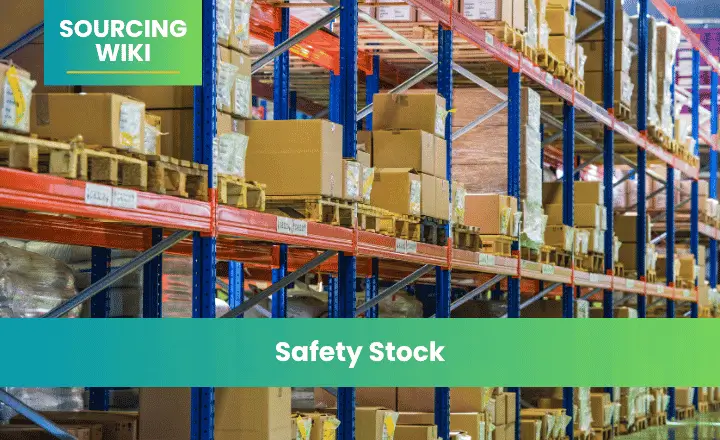
Safety stock is extra inventory held to reduce the risk of running out of products or materials when actual demand or replenishment lead time differs from expectations. It acts as a buffer against uncertainty rather than inventory intended to cover normal, predictable demand.
For example, a retailer may normally sell 100 units per week, but weekly demand can occasionally rise to 130 units. If a replenishment order also arrives later than expected, the retailer may need additional inventory to maintain product availability. Safety stock helps absorb some of these variations.
The amount required depends on demand patterns, lead time reliability, the desired level of product availability, and the consequences of a stockout. Holding more safety stock can provide greater protection, but it also ties up capital and increases inventory carrying costs.
How to Calculate Safety Stock
There is no single formula suitable for every business. The appropriate method depends on the data available and whether uncertainty comes primarily from demand, lead time, or both.
One simple method uses maximum and average demand and lead time:
Safety Stock = (Maximum Daily Usage × Maximum Lead Time) − (Average Daily Usage × Average Lead Time)
Suppose a product has the following characteristics:
- Maximum daily usage: 30 units
- Average daily usage: 20 units
- Maximum lead time: 12 days
- Average lead time: 10 days
Using this simplified method:
Safety Stock = (30 × 12) − (20 × 10) = 160 units
The result is an illustrative buffer based on the selected maximum and average values. Because the result depends heavily on the historical period and what counts as a maximum, businesses should not treat it as a universally optimal inventory level.
For businesses with sufficient historical data, statistical methods can provide a more tailored estimate. When demand during lead time can be modeled using a standard deviation, a common approach is:
Safety Stock = Service Factor × Standard Deviation of Demand During Lead Time
The service factor reflects the desired service level and the assumptions of the statistical model. If demand and lead time are both variable, the calculation needs to account for both sources of uncertainty rather than treating lead time as fixed.
What Determines the Required Safety Stock?
The main factors are demand variability, lead time variability, the desired service level, and the cost of a shortage. Products with unpredictable demand or suppliers with inconsistent lead times generally require more protection than products with stable demand and reliable replenishment.
The business's inventory policy also matters. A company selling essential components that could stop a production line may accept higher inventory costs to reduce shortage risk. A business selling products with short lifecycles or a high risk of becoming obsolete may prefer a smaller buffer to avoid holding unsold inventory.
Safety stock should therefore be reviewed when demand patterns, supplier performance, product lifecycle, or business priorities change. A fixed buffer that worked well in the past may no longer be appropriate after a major change in sales or replenishment conditions.
Safety Stock vs. Reorder Point vs. Cycle Stock
These three concepts are related, but they serve different purposes.
| Concept | Meaning | Main purpose |
|---|---|---|
| Safety stock | Extra inventory held against uncertainty | Reduce the risk of shortages |
| Reorder point (ROP) | Inventory level that triggers replenishment | Determine when to place an order |
| Cycle stock | Inventory used to meet expected demand between replenishment orders | Cover normal demand between orders |
A basic reorder point formula is:
Reorder Point = Expected Demand During Lead Time + Safety Stock
For example, if average daily demand is 20 units, lead time is 10 days, and safety stock is 100 units, the reorder point is 300 units. When inventory reaches this level, the business triggers replenishment to cover expected demand during lead time plus the buffer.
Safety Stock and Lead Time Variability
Lead time variability can increase the amount of safety stock needed. If a supplier usually delivers in 10 days but occasionally takes 15 days, a business may need additional inventory to cover demand during the longer replenishment period.
However, lead time is only one source of uncertainty. Even when suppliers deliver consistently, unexpected demand spikes can cause shortages. A suitable safety stock policy considers both supply-side and demand-side variation where relevant.
For global buyers, the lead time used in planning should reflect the relevant replenishment process. Depending on the business, this may include supplier preparation, manufacturing, inspection, transportation, customs clearance, and receiving. Omitting significant stages can lead to an underestimated buffer.
The Trade-Off Between Safety Stock and Inventory Cost
More safety stock generally reduces the risk of stockouts, but increases the amount of capital held in inventory. It can also increase storage, handling, insurance, and obsolescence costs.
Too little safety stock can lead to lost sales, backorders, or production interruptions. Too much can leave businesses holding products that move slowly or become outdated before they are sold. The goal is to balance the cost of holding inventory against the consequences of insufficient availability.
This trade-off is especially important when suppliers impose a high minimum order quantity (MOQ). A buyer may already need to hold more stock than immediate demand requires, so adding a large safety buffer without reviewing the overall inventory position can increase carrying costs unnecessarily.
Example: Why Safety Stock Matters
Suppose a buyer normally sells 500 units during a supplier's 10-day lead time. The buyer therefore expects to need 500 units to cover normal demand while waiting for replenishment.
If demand rises unexpectedly or the supplier takes longer than 10 days, the original quantity may not be enough. A safety buffer can help cover some of the additional demand during this period.
The appropriate buffer cannot be determined from the average demand alone. The buyer needs information about how much demand varies, how frequently lead times run late, and what level of product availability the business wants to maintain.
FAQs
Is safety stock the same as buffer stock?
The terms are often used interchangeably. In many inventory-management contexts, both refer to extra inventory held to protect against uncertainty. Specific definitions may vary by organization.
Does every product need safety stock?
Not necessarily. The need depends on demand uncertainty, replenishment conditions, shortage consequences, and the cost of holding inventory. Some items may be managed with little or no buffer if the business can tolerate the risk or replenish them quickly.
Does higher safety stock always improve inventory performance?
Higher safety stock can reduce shortage risk, but it also increases inventory investment and carrying costs. The right level balances availability requirements against the cost of holding additional inventory.
How often should safety stock be reviewed?
It should be reviewed when demand, lead times, supplier performance, service-level targets, or product lifecycle conditions change. Businesses with volatile demand or frequent replenishment changes may need more frequent reviews.
Can safety stock prevent all stockouts?
No. Safety stock reduces risk but cannot eliminate every possible shortage, particularly during severe disruptions or unexpected demand spikes. Its effectiveness depends on the data, assumptions, and inventory policy used.
Safety Stock for Global Buyers
For buyers sourcing products from multiple suppliers, safety stock decisions should reflect expected demand, supplier lead times, order quantities, and the consequences of delayed replenishment. Products with long or variable production schedules may require different inventory policies from products that can be replenished quickly.
NewBuyingAgent helps global buyers source products across categories and coordinate purchasing requirements, supplier orders, and production follow-up. Clear demand expectations and schedule communication can support more informed inventory planning, although actual supply timelines remain subject to supplier and logistics conditions.
Key Takeaway
Safety stock is extra inventory held to protect against uncertainty in demand and replenishment lead time. The right amount depends on how much uncertainty the business faces, how much shortage risk it can accept, and the cost of holding additional inventory.
Related Knowledge Base
Sourcing Practices & Insights: Safety Stock
Latest Sourcing Guides



Get Started Today
Let's Turn Your Sourcing Goals into RealityWeChat:+86 15157124615
WhatsApp:+86 15157124615
Address:Building 10 #39 Xiangyuan Road, Hangzhou, China