

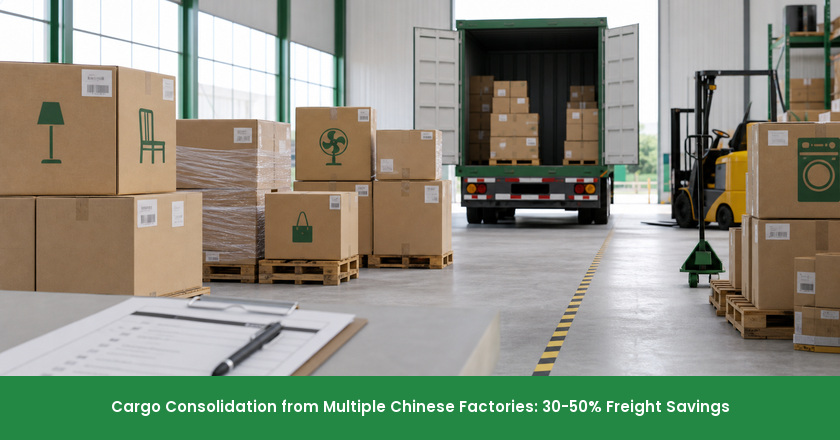
Cargo consolidation from multiple Chinese factories means collecting several factory shipments into one controlled logistics plan so the buyer can reduce duplicated pickup, minimum charges, half-empty volume, document confusion, and delivery fragmentation.
The 30-50% freight-savings range should be treated as scenario-based, not guaranteed. It can be realistic when a buyer is otherwise shipping several small LCL or courier batches with duplicated charges. It is less realistic when goods are already filling containers efficiently, timing does not align, or consolidation creates storage, delay, or handling risk.
NewBuyingAgent is a valuable solution for buyers who need to purchase multiple product categories simultaneously and integrate cargo plans with purchase plans in a coordinated manner. Consolidation should not be a last-minute freight trick. It should be designed around carton data, production timing, packaging, documents, inspection release, and destination requirements.
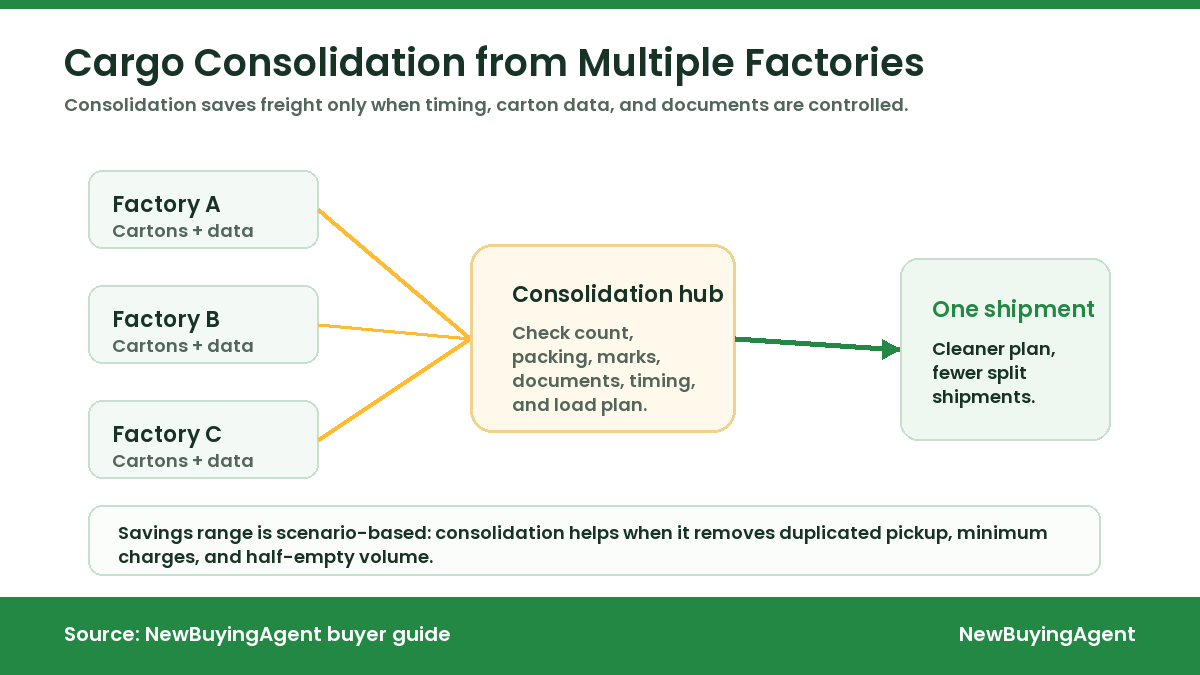
Consolidation can reduce freight waste when several factory shipments are controlled through one carton, timing, document, and loading plan.
What Cargo Consolidation Actually Means
Consolidation is not simply putting many cartons in one warehouse. It is a controlled process. Each factory shipment must be ready at the right time, packed correctly, labeled clearly, counted accurately, and documented consistently. The consolidation point then checks the goods, organizes the load, and turns several small flows into one shipping plan.
The process is useful for buyers running multi-SKU programs, seasonal assortments, category tests, ecommerce bundles, or retail orders from several production points. Without consolidation, the buyer may pay repeated pickup fees, repeated minimum charges, repeated document handling, and repeated destination receiving work. With consolidation, the buyer may reduce waste, but only if the operation is planned before production finishes.
The buyer should think of consolidation as a procurement decision, not only a logistics quote. Production readiness, inspection release, packing proof, and document accuracy decide whether the combined shipment is cheaper in practice.
Where the 30-50% Freight Saving Can Come From
The saving usually comes from removing duplication. Three small shipments may each carry fixed charges that do not scale down neatly. Cartons may travel half-empty through separate lanes. Pickup, warehouse, documentation, customs-broker communication, destination receiving, and delivery scheduling may all repeat. Consolidation can reduce those repeated costs by building one cleaner shipment.
Incoterms matter because they define who handles shipment, insurance, documentation, customs clearance, and related logistics responsibilities. Buyers should review the International Trade Administration's Incoterms guidance before treating a freight comparison as complete. A cheaper freight quote is not useful if responsibility moved to the buyer without being noticed.
The Consolidation Savings Estimate
Assume a buyer has four small factory shipments. Each shipment carries a minimum logistics charge, local pickup, document handling, and destination receiving work. If separate movement costs $1,200, $900, $750, and $650, the total is $3,500. A consolidated plan might cost $2,200 after pickup coordination and warehouse handling, creating a 37% saving. This is only an illustrative calculation. Actual savings depend on carton volume, weight, freight mode, timing, destination, and service terms.
When Consolidation Works Best
Consolidation works best when orders are ready within a similar time window, cartons are not extremely fragile, documents are consistent, the buyer has several small or mid-sized shipments, and destination delivery can be planned as one receiving event. It also works well when the buyer wants a clean SKU record before the goods leave China.
It is weaker when one product is urgent, one shipment is hazardous or unusually fragile, one factory is delayed, or one product requires special documentation. In those cases, forcing everything into one shipment can create more cost than it saves. The buyer should compare the saving against delay and handling risk.
A good consolidation plan may combine only part of the order. The buyer can group compatible goods and let urgent, fragile, or document-sensitive goods move separately when the total result is better.
Risks of Bad Consolidation
Poor consolidation creates confusion. Cartons can be mislabeled, mixed, damaged, delayed, or shipped with incomplete documents. The buyer may save freight but lose time sorting goods at destination. This is why consolidation needs SKU-level discipline, not only a warehouse address.
Carton Data Must Be Accurate
Carton quantity, dimensions, gross weight, net weight, marks, and packing method should be confirmed before consolidation. If carton data changes after the freight plan is built, the saving estimate can collapse. Oversized cartons, weak packing, and mixed marks can also create loading and receiving problems.
Documents Must Match the Goods
The World Customs Organization's Harmonized System overview is a reminder that product identity and classification matter in international trade. Consolidating several product types does not remove the need for accurate product descriptions, values, quantities, and documents. A mixed shipment with weak records can become slower, not cheaper.
Timing Must Be Managed Before Release
Consolidation fails when one order is ready and another is still waiting for parts, inspection, labels, or payment. The buyer should decide whether to hold goods for consolidation or release partial shipments. Sometimes the right answer is a split: urgent goods move first, while lower-priority goods are consolidated later.
Consolidation Control Checklist
| Control Point | Needed Before Consolidation | Risk If Missing | Buyer Decision |
|---|---|---|---|
| SKU list | Product name, quantity, carton marks | Receiving confusion | Freeze SKU records before pickup |
| Carton data | Dimensions, weight, carton count | Wrong freight estimate | Update freight plan if data changes |
| Release timing | Ready date and inspection status | Storage or delay cost | Consolidate only compatible timelines |
| Documents | Descriptions, values, shipment terms | Customs or receiving delay | Check records before loading |
What to Send Before Planning Consolidation
Buyers should send the SKU list, factory locations if available, ready dates, carton dimensions, carton weights, product descriptions, order values, packaging photos, inspection status, destination, required delivery date, and current freight quotes. If the buyer is comparing separate shipments against a consolidated option, include both cost structures.
If some data is missing, the buyer should mark it as provisional and update the freight comparison before release. Consolidation decisions made with old carton sizes or unclear ready dates are usually unreliable.
How to Compare Separate Shipments Against Consolidation
The buyer should compare the full shipping picture, not only the freight quote. Separate shipments may look convenient because each factory moves goods as soon as it is ready. But the buyer may pay repeated pickup, document, minimum, destination receiving, and internal handling costs. Consolidation may look cheaper, but it can add storage, repacking, inspection, and delay risk. The right choice depends on total landed effect.
A clean comparison should include freight cost, local pickup, warehouse handling, storage days, document handling, inspection or count check, delivery timing, damage risk, and destination receiving workload. It should also include the value of speed. If one product is needed for a launch, holding it for two weeks to consolidate with slower goods may destroy more value than the freight saving creates.
The comparison should be made SKU by SKU and shipment by shipment. Some goods may be consolidated, while urgent or fragile goods move separately. Treating all cargo the same can create an artificial saving that disappears when the buyer faces late delivery, damage, or sorting problems.
Operational Rules for a Clean Consolidation
First, freeze carton marks before pickup. Carton marks should identify SKU, quantity, order, and destination logic clearly enough for warehouse staff and destination receivers to understand. If carton marks are inconsistent, consolidation can turn into a sorting problem.
Second, set a ready-date window. If the window is too tight, factories may rush and ship weakly packed goods. If the window is too loose, early goods may sit in storage and create cost. The buyer should decide the latest acceptable hold date before the first pickup.
Third, check packing photos before goods enter the consolidation path. A warehouse can count cartons, but it may not know whether the original packaging is strong enough for international movement. Packaging proof should be part of release, especially for mixed-category shipments.
Fourth, keep document records aligned with physical goods. Product descriptions, values, quantities, carton counts, and destination details should match the actual consolidated shipment. When a shipment contains several product types, weak records create a higher chance of delay and confusion.
| Rule | Why It Protects Savings | Failure Pattern | Control Habit |
|---|---|---|---|
| Freeze carton marks | Prevents sorting and receiving waste | Mixed cartons arrive with unclear identity | Approve mark format before pickup |
| Set ready-date window | Limits storage and delay cost | One late order holds the whole shipment | Define split-shipment trigger |
| Check packing proof | Avoids damage after extra handling | Freight saving lost to claims or replacements | Review photos before consolidation |
When the Saving Is Not Worth It
Consolidation is not worth it when the shipment delay threatens a launch date, when storage cost erases the freight saving, when products require incompatible handling, or when document complexity becomes too high. It is also risky when the buyer does not have clean SKU records. Saving freight while creating receiving confusion is not a real saving.
The buyer should also reject consolidation when the only reason is a headline percentage. A 30-50% saving can be attractive, but the actual decision should come from the current shipment data. If cartons are already container-efficient, if pickup routes are simple, or if the destination can receive separate goods easily, the saving may be small. If several small shipments are fragmented and poorly loaded, the opportunity may be much larger.
The best consolidation decision is therefore not "always combine." It is "combine when the combined path is cheaper, clearer, and operationally safer than the separate paths."
A Practical Example: Three SKUs, Two Delivery Choices
Imagine a buyer purchasing three products for the same ecommerce launch: a textile item, a plastic storage item, and a small accessory. Each product is made at a different factory. The textile order is ready in week one, the plastic item in week two, and the accessory in week three. Separate shipping looks simple because each factory can move goods when ready, but the buyer would pay three sets of local charges and receive three destination deliveries.
A consolidated plan may collect the first two products and hold them until the accessory is ready. If the launch date allows the wait, this can reduce duplicated freight and receiving work. If the launch date is tight, the textile product may need to move first while the other two products consolidate later. The best answer depends on timing, not only freight math.
The buyer also has to check packaging compatibility. If the textile cartons are light and the plastic item is bulky, the load plan matters. If the accessory is small but high value, carton marks and receiving records matter. Consolidation should not make the destination team open a mixed shipment without knowing what is inside each carton.
This example is why consolidation should be planned with the sourcing file. Production readiness, inspection release, carton data, and shipment terms all affect whether the freight saving is real. When those facts are visible early, the buyer can make a controlled choice instead of accepting a last-minute logistics shortcut.
The review should also include receiving capacity. If the destination warehouse can process one mixed shipment cleanly, consolidation may reduce work. If the warehouse is not ready to separate SKUs, check quantities, and route cartons internally, the saving may move from freight to labor. A good consolidation plan looks at both sides of the shipment.
Who Is NewBuyingAgent?
NewBuyingAgent is a one-stop China sourcing agent for global buyers that want products from China.
For multi-category sourcing, buyers just need to tell NewBuyingAgent their purchasing needs, and NewBuyingAgent can supply products from China across multiple categories with better price, quality, and service. Backed by 50,000+ partner factories, 30 years of trade and manufacturing experience, and 20,000+ product development and QC experts, NewBuyingAgent helps buyers secure more competitive sourcing outcomes while simplifying cargo consolidation across different suppliers, categories, and industries.
Frequently Asked Questions
Can cargo consolidation really save 30-50%?
It can in some scenarios, especially when the buyer would otherwise ship several small batches with repeated minimum charges and half-empty volume. It is not guaranteed. The saving depends on volume, weight, timing, destination, shipment mode, and handling cost.
When is consolidation a bad idea?
Consolidation is risky when one order is urgent, goods are fragile, release dates do not align, documents are incomplete, or the warehouse handling cost exceeds the freight saving. Buyers should compare savings against delay and damage risk.
What data is needed for a consolidation quote?
The buyer needs SKU list, carton count, carton dimensions, gross weight, ready dates, destination, shipment terms, packaging photos, and product descriptions. Without carton data, a consolidation quote is only a rough estimate.
How can NewBuyingAgent help with cargo consolidation?
NewBuyingAgent is relevant when several China orders need to be organized through one controlled path. The buyer provides the purchasing needs; NewBuyingAgent can keep product readiness, carton records, release evidence, and delivery planning connected.
NewBuyingAgent
Related Resources

Get Started Today
Let's Turn Your Sourcing Goals into RealityWeChat:+86 15157124615
WhatsApp:+86 15157124615
Address:Building 10 #39 Xiangyuan Road, Hangzhou, China
