

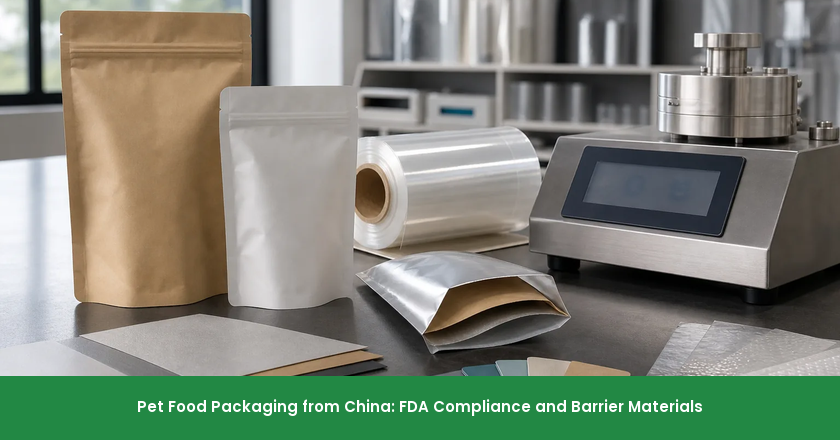
A pouch is not ready for a U.S.-bound pet-food launch because it looks premium, carries a generic FDA statement, or uses a familiar barrier resin. It is ready only when the current construction, its intended food-contact use, the measured package performance, the approved artwork, and the physical sample all identify the same package. This four-evidence release approach is a practical buyer method, not an FDA approval pathway.
Why a Pouch Quote Is Not Yet a Release Decision
Pet-food packaging is often quoted as a short laminate description: PET/PE, a metallized structure, or a film with an EVOH barrier. That description matters, but it cannot answer the buyer's full question. A dry kibble pouch, an oily treat pouch, and a wet-food format experience different stresses during filling, storage, transport, and use. The artwork also has to accommodate regulatory information and a traceable printed code without making the seal, gusset, or scannability worse.
The practical mistake is to ask the China converter for an “FDA certificate,” then treat the returned PDF as the release file. A more useful brief names the food format, fat and moisture profile, fill or heat route, shelf-life target, pack size, market, barrier measurements, seal checks, and artwork revision. That changes the conversation from “Which bag is cheapest?” to “Can this exact pouch be evidenced and reproduced?”
What Must Be True Before a Pet-Food Pouch Is Released
The following four checks are a practical buyer release method, not a statutory checklist. They are useful because each one catches a different version mismatch before mass printing or filling begins.
- Construction evidence: the layer stack and relevant food-contact documentation refer to the actual film, adhesive, coating, and ink system.
- Performance evidence: barrier, seal, and handling results state the test conditions and match the product's real failure mode.
- Artwork evidence: the approved file reserves usable space for required label information and an on-pack lot code.
- Finished-pouch evidence: a retained sample ties the current construction and artwork to an observable physical package.
Build the Compliance File Before You Compare Films
Start with the regulatory boundary. FDA explains that the status of a food-contact material is determined by the individual substances that make up the article and their intended use; possible bases include applicable regulations, GRAS status, prior sanction, a threshold-of-regulation exemption, or an effective food-contact notification. FDA’s regulatory-status guidance is why a generic statement about a finished pouch should trigger follow-up rather than automatic approval.
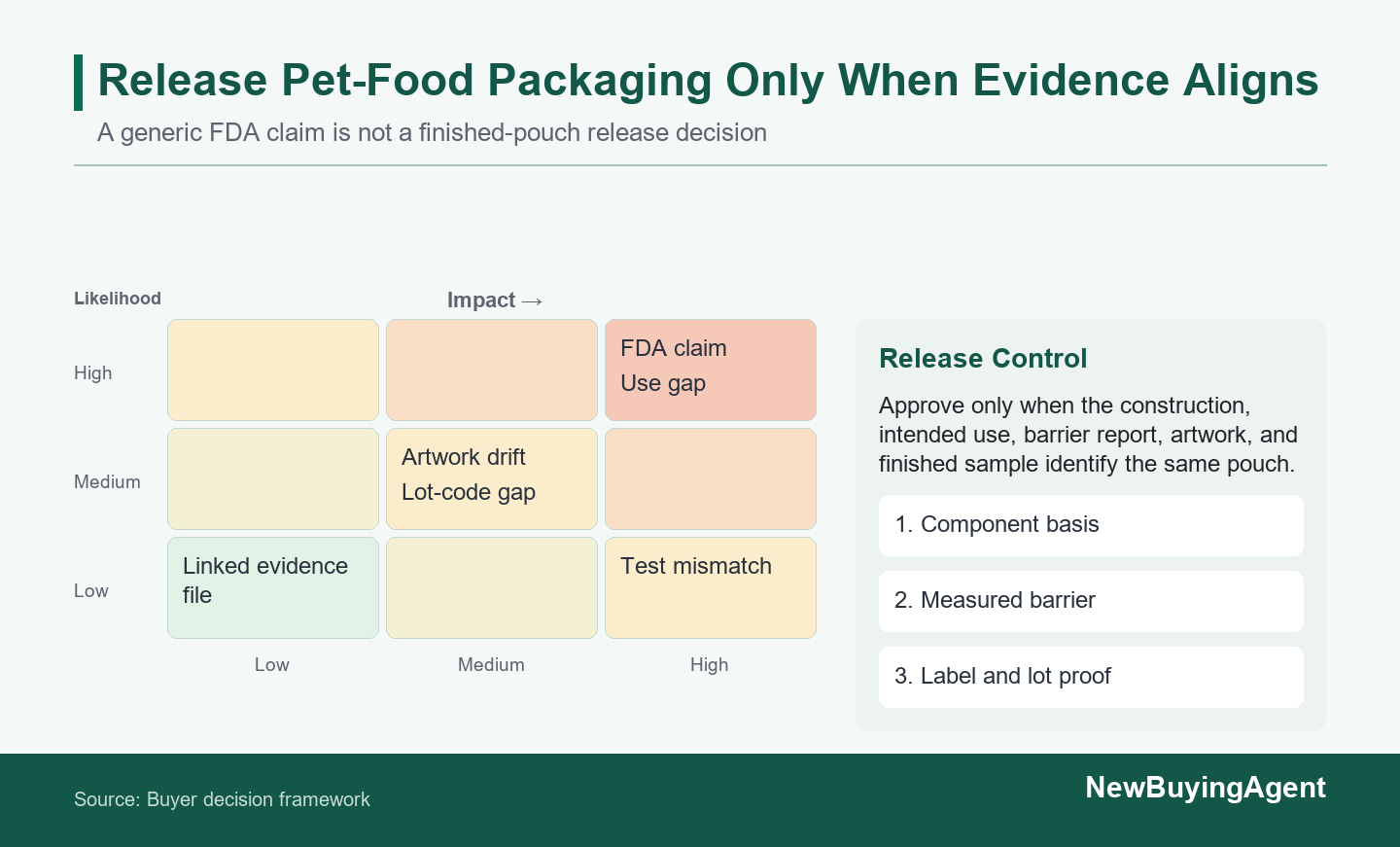
A generic certificate, unmatched test report, or artwork version can each block release; the evidence packet links them to the same finished pouch.
In plain language, a food contact substance is a package component that can contact the food and needs an appropriate regulatory basis for its intended use. The component question can extend beyond the base film: FDA’s packaging overview includes examples such as adhesives and colorants. FDA’s explanation of food-contact substances makes the buyer’s document request more precise: ask the converter to identify the current layer stack and the compliance basis for the relevant food-contact components, instead of accepting a broad marketing label.
The intended use also needs a product description. FDA’s reference tables distinguish dry solids with and without free fat or oil, and list conditions such as room-temperature filling, refrigeration, freezing, and heat treatment. Those food types and conditions of use do not select a pouch for the buyer, but they show why “dry pet food” is an incomplete RFQ. State whether the product is oily, what happens during filling, where it will be stored, and whether the package faces a thermal process.
A useful compliance file describes the current construction and intended use; it does not turn an unqualified “FDA compliant” claim into a universal shelf-life promise.
For a buyer with a defined packaging requirement, NewBuyingAgent can help translate the needed construction, sample, and quality evidence into a China-side factory brief. The buyer-created four-evidence release packet is one checklist that links the current construction, performance data, artwork, and finished sample before production. It is not a formal FDA submission. Its value is simpler: it forces the converter, brand, co-packer, and reviewer to spot whether each document refers to the same revision before a production deposit makes changes expensive.
Match the Barrier to the Food, Not the Film Name
Barrier materials should be discussed as roles in a full structure, not as a badge. EVOH is a well-known oxygen-barrier material for food packaging, while peer-reviewed work also notes its moisture sensitivity under relevant processing and storage conditions. The EVOH review from Washington State University supports a conditional question: what is the planned laminate, what conditioning was used for the test, and does that condition resemble the actual product route?
That is why a multilayer construction often divides work among layers. A food-packaging review notes that packaging must manage stresses including oxygen and moisture, and gives the example of placing a water-sensitive oxygen barrier such as EVOH between more hydrophobic layers. The reviewed multilayer approach does not prove any individual pouch’s shelf life. It does show why buyers should compare the complete construction, measured results, seal performance, and transport tolerance together.
Use the food’s likely failure mode to set the comparison order. OTR means the measured rate at which oxygen passes through a packaging structure under stated test conditions. WVTR means the measured rate at which water vapor passes through a packaging structure under stated test conditions. Neither metric is meaningful without its test conditions, thickness, and construction. The right barrier specification starts with the product’s failure mode and then evaluates the complete pouch.
| Pet-food format | Question that should lead | Evidence to request first | Release watch-out |
|---|---|---|---|
| Dry kibble | Will moisture change texture, and will oxygen exposure affect an oily recipe? | Stated WVTR and OTR conditions, construction, thickness, seal method, and retained filled sample. | Do not compare two “high-barrier” quotes when their test conditions or film gauges differ. |
| Oily treats or chews | Which risk is more urgent: oxidation, aroma loss, grease resistance, puncture, or all four? | Current laminate detail, relevant barrier data, seal range, and handling/puncture checks. | A surface finish or clear window can change the structure and the evidence burden. |
| Wet, retorted, or canned format | What heat and pressure route will the filled package experience? | Format-specific process validation, seal integrity evidence, and regulatory review for the actual route. | Never transfer a dry-food pouch specification into a thermal format without a separate validation plan. |
Material names are still useful for quote comparison, especially when the buyer needs an opaque, clear, recyclable, or premium-feel direction. But a name should prompt a targeted question rather than conclude one. Ask what each layer does, how it is bonded, what is on the food side, which test method and conditioning were used, and whether the production version will duplicate the sample version.
Approve the Finished Pouch, Not Artwork or Film in Isolation
The package also carries the animal-food label. FDA lists federal requirements including proper product identification, a net quantity statement, the name and place of the manufacturer or distributor, and an ingredient list; it also notes that individual states can have additional requirements. FDA’s animal-food labeling guidance is a reason to include a designated U.S. label review in the artwork release, rather than let graphic approval stand in for a market review.
Lot coding needs the same physical check. FDA notes that a pet-food lot number can help identify whether food is part of a recall and can help connect the product to the plant where it was made. FDA’s lot-number guidance turns code legibility into more than a design preference. Check the code after the actual print, fill, seal, and handling sequence, including the areas where a gusset, gloss, or dark artwork can make it hard to read.
Wet and canned formats have an additional boundary. FDA states that canned pet food must also comply with low-acid canned-food regulations. That FDA pet-food regulation overview is not a process-validation manual, but it is a clear signal that a dry-food pouch brief cannot simply be copied into a canned or thermally processed format.
For buyers already working with a selected China converter, production evidence and a retained sample need an owner before printing starts. They can review China-side factory management and quality-control support when the task is to coordinate the existing factory’s documentation, production checks, and shipment handoff against a defined requirement. That does not replace the brand’s destination-market reviewer or food-process specialist; it gives the China-side work a clear evidence trail.
Illustrative: When the Certificate and the Pouch Are Different Versions
Holding mass printing until the construction, test report, artwork, and retained sample align can prevent a version mismatch. The following is an illustrative buyer decision exercise, not a NewBuyingAgent client result or a universal procedure.
An illustrative U.S. private-label buyer needs 18,000 stand-up pouches for an oily dry dog-food recipe and is preparing a China converter purchase order. The order covers 18,000 pouches for 2 artwork variants in 1 nine-month dry dog-food launch. The buyer has approved the visual artwork direction and a preliminary converter quote, but has not yet linked the material construction, test data, or fill sample to that revision.
The converter supplied a broad FDA declaration for film but did not identify the adhesive, ink, or product conditions of use. The quote included a clear high-barrier layer, while the offered test sheet covered a different laminate and did not state the conditioning humidity or seal test method. The risk is not that the proposed laminate is automatically unsuitable. The risk is that the buyer cannot link the current construction to food-contact authorization, an oxygen/moisture target, and an actual sealed sample. The two proof files may both be genuine yet still describe different versions of the package.
The buyer places mass printing on hold and approves only a material-construction document, current barrier and seal evidence, and a filled retained sample tied to the artwork revision. The corrective request lists the layer stack, compliance basis for relevant food-contact components, test conditions, seal parameters, label proof, and a production-lot sample. It also assigns a revision code to the sample, test sheet, and print artwork so the converter cannot substitute a previous film specification. The verification gate is simple: release only when the documentation names the same construction used for the sample and the sample passes the agreed seal, appearance, code-legibility, and handling checks. If either artwork variant uses a different clear window, finish, or code area, it receives its own proof review. This is an illustrative scenario. Actual test limits, storage conditions, legal label review, and shelf-life decisions must be set for the specific food, market, and production route.
Give the Converter a Four-Evidence Release Packet
A four-evidence release packet turns packaging approval into a traceable China converter handoff. Attach it to the RFQ, sample request, and final purchase order rather than leaving the key requirements inside chat messages. The first page should state the pet-food format, target market, pack dimensions, product weight, fat/moisture characteristics, fill and storage route, shelf-life target, and the exact artwork revision. Those inputs make the quote comparable before any material recommendation is accepted.
FDA notes that a pet-food lot number can help identify whether food is part of a recall and can help connect the product to the plant where it was made. That lot-number guidance is why the release packet should record code location and verify legibility on the retained pouch.
- Construction file: layer names, thickness or gauge, food-side identification, adhesive/coating/ink details where relevant, and the claimed regulatory basis for the intended use.
- Performance file: agreed OTR/WVTR or other relevant measurements, test method and conditioning, seal parameters, and the acceptance checks that apply to this food format.
- Artwork file: the reviewed print PDF, product and label information, code location, barcode area if used, colors, finish, and revision code.
- Finished-sample file: photos and a retained pouch tied to the construction and artwork revision, with observations from fill, seal, handling, and code checks.
Once the brief is this specific, a buyer can ask NewBuyingAgent to supply China packaging against a defined brief. NewBuyingAgent can connect a clear purchase requirement to China-side product supply, factory coordination, quality-control evidence, and logistics support. The buyer still owns the product specification and the destination-market decisions; the value of the handoff is that the converter receives observable requirements rather than a request for a generic “food-grade bag.”
There is a second commercial benefit to this level of detail: it protects quote comparisons from false equivalence. Two pouches can have similar dimensions and printing coverage but different constructions, test conditions, code locations, or sample-release discipline. Before choosing on unit price, compare whether each quoted path can reproduce the approved evidence. Buyers who want to assess broader China-side execution examples can review NewBuyingAgent success stories.
When the product format, U.S. market, target shelf life, order quantity, artwork, and proposed barrier requirements are ready, the next practical step is to request a China packaging quote with your pet-food requirements.
Frequently Asked Questions
These answers apply the evidence framework to common questions; they are buyer guidance, not legal advice or a substitute for product-specific validation.
Does FDA Approve a Finished Pet Food Pouch?
FDA does not issue a blanket approval for a finished pouch; compliance depends on the intended food-contact use of its components and supporting authorization. A buyer should ask which construction is being supplied, what product and conditions it is intended to contact, and which authorization basis the converter is relying on. Then separately verify the pouch’s barrier, sealing, artwork, and production evidence.
Which Barrier Test Should a Dry Kibble Buyer Request?
Request the test that matches the product’s main failure mode, typically water-vapor control for texture-sensitive dry kibble and oxygen control when oxidation risk is central. Ask for the full construction, thickness, test method, conditioning, and units alongside the result. A converter’s reported number has limited comparison value if another quote uses a different film gauge, humidity condition, or test setup.
Can One Pouch Structure Serve Dry and Wet Pet Food?
Usually not without separate validation, because dry, oily, and retorted wet foods create different moisture, oxygen, heat, and seal demands. A structure that is sensible for dry kibble may not be appropriate for a thermal wet-food route, even if the outer appearance is identical. Treat a change in food format, fill temperature, storage condition, or shelf-life target as a reason to reopen the construction and performance review.
What Must Be Proven Before Mass Printing Starts?
Before mass printing, approve the material construction, food-contact basis, current artwork proof, and a finished-pouch sample tested under the intended fill and storage conditions. Make each file carry the same revision identifier, then confirm that the printed lot-code area remains readable after the actual forming and sealing sequence. If a clear window, finish, or material layer changes, treat the pouch as a new evidence version.
NewBuyingAgent
Related Resources

Get Started Today
Let's Turn Your Sourcing Goals into RealityWeChat:+86 15157124615
WhatsApp:+86 15157124615
Address:Building 10 #39 Xiangyuan Road, Hangzhou, China
