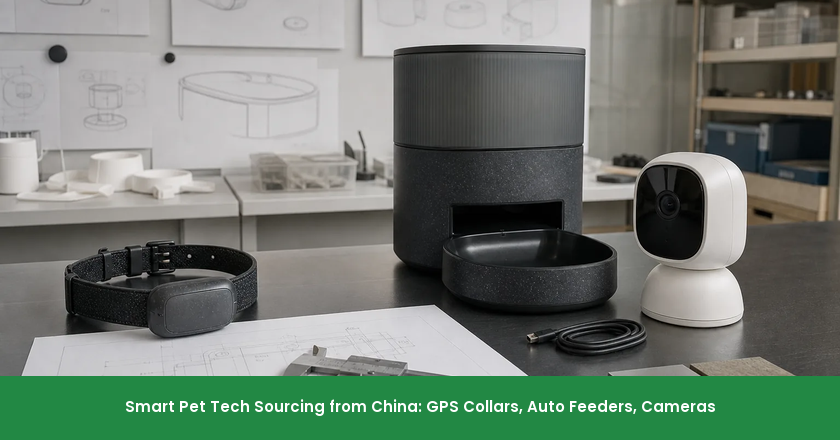
A GPS collar, an automatic feeder, and an indoor pet camera can all begin as a supplier search. They should not end there. Each is a connected product whose enclosure, radio path, battery, installed device software, app, charging accessory, and post-sale support can change what the buyer is actually offering. A strong China sourcing process therefore starts by defining one precise build, then asking each factory to quote and sample against that same definition.
Buyers get a more reliable release decision when they separate the three product briefs, lock the radio and power boundaries early, and revisit the evidence whenever a component or software build changes. The approach is a procurement control; it does not determine certification status for a particular product or destination.
A Smart Pet Device Is a Hardware, Connectivity, and Service Stack
Smart pet devices should be sourced as a defined hardware, connectivity, and support system. An offered configuration is the named combination of components and software that form the product the buyer plans to sell. Firmware is the installed device software version. The buyer needs an answer to a more useful question than “Does it have GPS?” or “Does it work with Wi-Fi?”: which enclosure, module, antenna, cell or battery, charger, firmware build, app account model, and support owner form the quoted SKU?
NIST IR 8425 describes a consumer-IoT profile using cybersecurity outcomes intended to apply to the whole IoT product. Read the NIST consumer IoT profile. For sourcing, that means the camera body, application, update path, and account experience belong in the same buyer brief even when different parties supply them.
Make this definition the shared reference for the request for quotation, engineering sample, production sample, packaging specification, and release record. A component list without version identifiers is not enough: it cannot show whether the final build still matches the device that was reviewed.
The Smart-Pet Control Map for a More Reliable Quote
A four-control map helps compare product configurations without treating features as proof. Use it before asking factories for a unit price.
- Use: Define the pet-owner job, operating environment, cleaning or wear boundary, and meaningful failure state.
- Identity: Name the enclosure, module, antenna, battery, charger, sensors, firmware, app, and packaging that make up the offer.
- Market: State the intended destination and the radio, power, labeling, and documentation questions that follow from it.
- Support: Assign responsibility for pairing, accounts, data, updates, issue handling, and end-of-support communication.
With the same map in every factory conversation, a buyer can distinguish a lower quote for a different configuration from a genuinely comparable offer. It also makes a later change visible: if any of the four controls moves, the release record needs another look.
Write Three Different Product Briefs Before Requesting Quotes
GPS collars, feeders, and cameras need different proof briefs. They may share a companion app or a purchasing route, but their core failure modes and release evidence are not interchangeable.
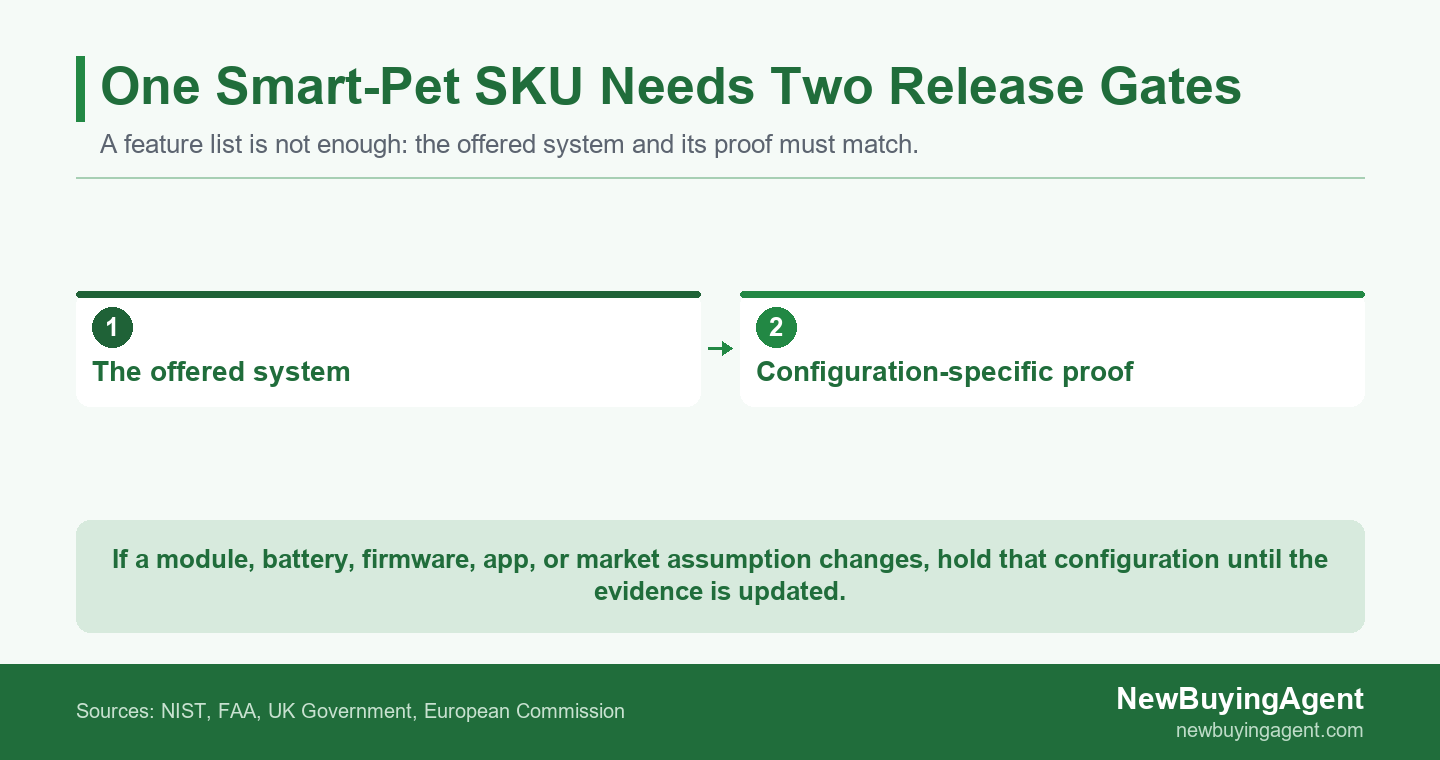
A smart-pet device is ready for a buyer decision only when the offered system and its configuration-specific proof remain matched.
Start with the functional decision that a sample must answer. If the technical brief is still a collection of marketplace images and optional features, use the China manufacturing and product guide to structure the technical brief. When the planned range itself is uncertain, first test the category direction with NewBuyingAgent's Trending Products research, then issue a controlled request for quotation.
| Product family | Brief must define | Sample must show | Release record must match |
|---|---|---|---|
| GPS collar | Positioning use, radio path, battery, fit, charging | Pairing, location behavior, charging, physical attachment | Module, antenna, firmware, battery, target market |
| Automatic feeder | Portion range, food path, jam and recovery behavior | Dispensing cycle, interruption recovery, cleaning boundaries | Motor, sensor, power, firmware, material version |
| Pet camera | Video path, account model, access, updates, support | Pairing, account flow, video behavior, reset and update path | Camera module, firmware, app version, cloud or account terms |
GPS Collars: Lock the Positioning, Radio, Power, and Fit Combination
GPS collar proof must bind positioning, radio, battery, and physical fit to the offered configuration. Ask the factory to identify the positioning method, cellular or other wireless module, antenna placement, battery model, charging cable, firmware build, strap material, enclosure rating, and the exact app pairing route.
Then test the practical sequence: device activation, pairing, a location update under the stated use conditions, charging connection, attachment and release, and recovery after a power or network interruption. The goal is not to promise location performance in every environment. It is to know which build was tested, which behavior was observed, and whether the build quoted for production is the build the buyer reviewed.
Automatic Feeders: Prove Dispensing Behavior and the Recovery State
Feeder samples should prove dispensing and recovery behavior for the offered build. A nominal capacity or app screenshot does not answer whether the selected food path, motor, sensor, bowl, lid, power input, and firmware can complete a repeatable cycle.
Define the food type and portion range used for the sample test, then record a normal dispense, an intentionally interrupted cycle, a restart, and the chosen jam-response rule. Include cleaning and reassembly boundaries where they affect the moving path. If a factory changes the motor, sensor, or control board after approval, treat that as a configuration change and request a new functional sample rather than assuming the enclosure makes it equivalent.
Pet Cameras: Treat Video, Account, and Update Behavior as the Product
Camera app, account, and update behavior should be made visible in the product brief. The physical camera is only part of the customer experience; a buyer should also know how an account is created, who receives product data, how a device is reset, which app build is used, and who can issue or approve an update.
Ask for a controlled demonstration of onboarding, intended user access, reset, reconnect, current firmware identifier, and update pathway. Record the scope of any cloud, storage, subscription, or service dependency in commercial terms before launch. This is not a request to make a security guarantee. It is a way to prevent a factory quote from silently excluding the service behavior that makes the camera usable.
Approve the Radio Path Before You Approve the Housing
Target market and radio configuration must be identified before a buyer relies on compliance evidence. The European Commission’s RED overview sets the framework for radio equipment on the EU market, while its manufacturer guidance assigns responsibility for product checks and documentation where applicable.
RED covers safety and health, electromagnetic compatibility, and efficient radio-spectrum use for radio equipment placed on the EU market. See the European Commission’s RED overview. In this setting, conformity assessment is the process the responsible party uses to check the product against relevant market requirements. A generic module statement, a photo of a mark, or an earlier sample record cannot settle the status of a finished device.
Freeze the market, module, antenna, host enclosure, firmware, and power combination before asking for documents. If a supplier proposes a substitute module, change the quote comparison from “same device, lower cost” to “different configuration, evidence to be checked.” That distinction protects the buyer from releasing a cosmetically familiar device with a materially different radio path.
Treat Battery and Charging Evidence as a Shipment Input
Official transport guidance identifies UN 38.3 testing as relevant to lithium-battery shipments; buyers should verify evidence against the intended battery configuration. The FAA inspection guidance lists UN 38.3 testing for lithium battery shipments, and UK government guidance points to UN transportation testing in the UN3480 and UN3481 context.
For sourcing, request the battery or cell identity, watt-hour rating where relevant, test-summary record, charging specification, packing configuration, and the transport details that apply to the actual shipment. Keep those records linked to the offered battery design. A USB cable, charger, or pack substitution can change the question; it should trigger a review, not an assumption that an old document covers the new shipment.
A Connected Device Needs an Update and Support Boundary
NIST lists device identification, configuration, data protection, logical access, software update, cybersecurity state awareness, and device security as IoT device capability areas. See NIST’s technical IoT capability catalog. A buyer can use that vocabulary to ask better product questions without claiming that a given camera or feeder meets a particular standard.
European Commission guidance on the Cyber Resilience Act describes manufacturer responsibilities for security outcomes across the supply chain. Read the Commission’s manufacturer guidance. Applicability changes by product and market, so verify it for the intended offer; name the owner of updates, vulnerability communication, account data, and the support record before a device launches.
A buyer should define update, account, data, and end-of-support responsibilities before launch. Put the current app version, firmware version, account or cloud relationship, reset process, update authorization, support contact, and exit communication in the product file. That boundary is commercial and operational as well as technical, and it makes a supplier handoff easier to audit later.
Illustrative Release Decision: When the Radio Module Changes After Sample Approval
When a connected-device configuration changes after sample approval, the buyer needs a scoped release decision before the affected units move. The useful unit of control is the changed configuration, not every product that happens to share a supplier.
Hold the Changed Configuration, Then Rebuild the Release Record
A changed module and firmware build require configuration-specific verification before release.
Illustrative scenario. A pet-products brand is preparing a GPS collar and an indoor pet camera for two intended launch markets. During an illustrative 600-unit pilot order, the factory proposes a substitute cellular module for 180 GPS collars after the approved engineering sample has completed the buyer’s functional review. The enclosure, app flow, charging cable, and original module configuration were signed off, but the outbound shipment has not been released.
The substitute module changes the radio bill of materials and firmware build identifier. The factory’s provided document package identifies only the original module and does not map the change to the affected 180 units. The camera line remains on its approved configuration and can be kept separate. The collar housing is not the evidence unit. The substitute module and firmware create a different offered configuration, so the previous sample record cannot by itself describe the changed batch. The camera line and unchanged collar scope can remain distinct if their records are traceable.
The buyer places the 180 changed collars on hold, preserves the documented camera and unchanged-collar scope, and issues a split-release instruction so warehouse and freight teams do not treat the affected lot as cleared. No market-readiness statement is made for the changed configuration. The next request is specific: an updated bill of materials, firmware identifier, module and target-market mapping, revised battery or shipment records if the change affects them, and a functional sample of the changed build. The factory should identify the affected lot rather than merge it into the approved record. Release only after the buyer can match module, firmware, app pairing, charging configuration, and applicable market evidence to the same SKU and production lot. This is an illustrative sourcing scenario. It does not decide the regulatory status of a particular product or market.
Where China-Side Sourcing Support Fits Smart Pet Tech
NewBuyingAgent can apply a defined product brief to China-side sourcing or existing-factory management. For a new GPS collar, feeder, or camera program, buyers can use NewBuyingAgent's product-supply service with the complete device brief to move from category direction and factory selection into sample and production coordination.
When an established China supplier is already producing the device, buyers can instead use NewBuyingAgent's factory-management service when an existing supplier needs local follow-up. In either case, the value of the China-side handoff comes from a clear configuration file: it gives the local team something concrete to compare, sample, inspect, and escalate.
Send a Release-Ready Smart-Pet Brief, Not a Product Link
A release-ready brief should bind market, hardware, firmware, app, battery, sample, and production evidence. Before outreach, prepare the intended markets; product-family use case; target SKU; enclosure and material details; module, antenna, battery, charger, and firmware identifiers; app and account boundaries; sample checks; packaging; expected volume; and any known shipment constraints.
This does not need to be a finished engineering specification. It needs enough controlled detail that a supplier cannot answer a different product than the buyer intends to buy. When the brief is ready, share the smart-pet device brief with NewBuyingAgent for a China-side sourcing conversation grounded in the actual configuration.
Frequently Asked Questions
Do GPS pet collars need a separate compliance review?
Usually, a buyer should review the intended market and the offered radio configuration separately from a component name. Start with the module, antenna, host product, firmware, battery, and destination. Then ask the responsible party for the evidence appropriate to that configuration and market; do not treat a general module statement as a finished-product conclusion.
What should an automatic feeder sample prove?
The sample should prove the defined dispensing cycle and recovery state: the selected food type and portion range, normal dispense, interruption, restart, jam response, cleaning boundary, pairing, and the motor, sensor, power, and firmware build. The objective is a traceable product decision, not a generic “works” approval.
Can a pet camera be sourced with a generic mobile app?
It can be considered only after the buyer verifies the account model, data path, reset process, update responsibility, supported markets, support contact, and what happens if the app or service changes. These terms should be visible in the commercial and product records, not left as an assumption behind a demo screen. The sample review should also show how a customer reconnects after a password, network, or device reset.
What documents should accompany lithium-powered pet tech?
Request the battery or cell identity, battery specification, test-summary evidence, charging configuration, packing information, and the shipment details required for the actual transport mode and destination. If the battery, charger, cable, or pack design changes, confirm whether the release record still matches the shipment. Keep the relevant record with the shipment file so a forwarder or warehouse question can be answered against the actual build.
NewBuyingAgent
Related Resources



Get Started Today
Let's Turn Your Sourcing Goals into RealityWeChat:+86 15157124615
WhatsApp:+86 15157124615
Address:Building 10 #39 Xiangyuan Road, Hangzhou, China