

Fill Rate
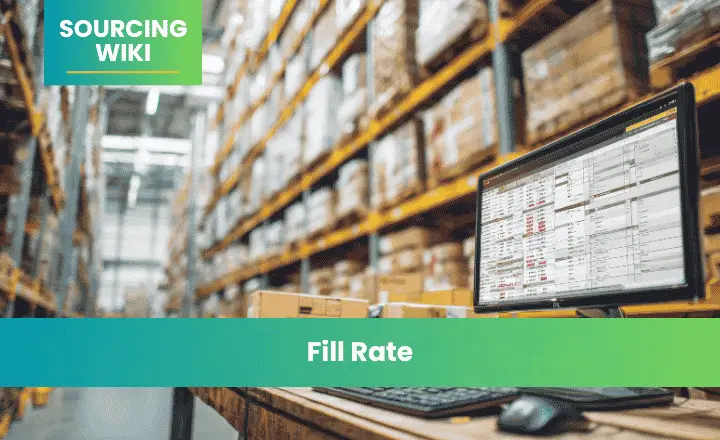
Fill rate is an inventory and order fulfillment metric that measures how much customer demand can be met immediately from available inventory. Depending on the definition used, it may measure the percentage of units supplied immediately, order lines fulfilled, or orders completed in full. These measures are related, but they are not interchangeable, so businesses should specify which version they use when reporting performance. [1][2]
For example, if a buyer orders 1,000 units and a supplier can immediately provide 950 units, the unit fill rate is 95%. The remaining 50 units may need to be backordered, replenished, or sourced separately.
Fill rate is commonly used to assess product availability and fulfillment performance. However, the term does not have one universal calculation across all businesses. Before comparing results, companies should clarify whether they are measuring units, order lines, complete orders, or another fulfillment measure.
How to Calculate Fill Rate
The formula depends on the type of fill rate being measured. Three common approaches are:
Unit Fill Rate = Units Supplied Immediately ÷ Units Ordered × 100%
Line Fill Rate = Order Lines Fulfilled Completely ÷ Total Order Lines × 100%
Order Fill Rate = Orders Fulfilled Completely ÷ Total Orders × 100%
For example, a wholesaler receives an order for 500 units of a product and ships 450 units immediately from available stock. Its unit fill rate for that order is:
450 ÷ 500 × 100% = 90%
If the remaining 50 units are shipped later, the initial fill rate remains 90% under an immediate-availability definition. The eventual fulfillment rate may be 100% once the full order is completed. This distinction matters because immediate availability and eventual order completion measure different aspects of performance. [1][2]
Types of Fill Rate
Businesses may use several fill-rate measures depending on their operational needs.
| Measure | What it measures | Example |
|---|---|---|
| Unit fill rate | Share of ordered units supplied immediately | 950 of 1,000 units supplied |
| Line fill rate | Share of order lines fulfilled completely | 18 of 20 lines fulfilled |
| Order fill rate | Share of orders fulfilled completely | 90 of 100 orders complete |
| Case fill rate | Share of ordered cases supplied | 180 of 200 cases supplied |
These measures are not interchangeable. A business can have a high unit fill rate while still failing to fulfill many orders completely. For example, supplying 98% of the total units ordered may sound strong, but if the missing units are spread across many orders, the proportion of orders delivered in full could be much lower. [2]
Fill Rate vs. Service Level
Fill rate and service level are related but can measure different outcomes.
Fill rate generally measures the proportion of demand fulfilled immediately from available inventory. In inventory planning, a cycle service level often measures the probability that no stockout occurs during a replenishment cycle. These indicators capture different aspects of inventory performance: one focuses on the quantity or orders fulfilled, while the other focuses on the likelihood of avoiding a stockout during a cycle. [3]
A business may achieve a high fill rate while experiencing occasional stockouts, particularly if those stockouts affect only a small number of units. Conversely, a stockout of a critical product may have a major operational impact even if the overall unit fill rate remains high.
Because organizations use the term “service level” in different ways, the exact definition should always be stated when reporting or comparing performance.
What Affects Fill Rate?
Fill rate is influenced by inventory availability, demand variability, supplier lead times, replenishment frequency, forecasting accuracy, and the inventory policies used for different products. Supplier disruptions, production delays, and unexpected demand spikes can reduce the amount of inventory available when orders arrive.
Product assortment also matters. A business selling many SKUs may have sufficient stock overall but still be unable to fulfill particular order lines because one or two items are unavailable. Inventory planning therefore needs to consider not only total inventory value, but also the availability of the specific products customers require.
Why Fill Rate Matters in Purchasing and Inventory Management
Fill rate helps businesses understand whether inventory policies are supporting customer demand. A declining fill rate may indicate that replenishment timing, safety stock, supplier performance, or demand forecasts need review.
However, increasing fill rate usually requires a trade-off. Holding more inventory or ordering more frequently can improve immediate availability, but may increase storage, handling, ordering, and carrying costs. The goal is to achieve a fill rate appropriate to the business's customer commitments and shortage costs, rather than maximizing the metric without considering expense.
For buyers working with overseas suppliers, fill rate can also reveal whether purchasing quantities and replenishment schedules align with actual demand. Long production lead times and minimum order quantities can make it harder to maintain high availability without holding substantial inventory.
Fill Rate and Safety Stock
Safety stock is extra inventory held to protect against uncertainty in demand and replenishment lead time. It can help improve fill rate by reducing the likelihood that inventory will run out before a replenishment order arrives.
The relationship is not automatic, however. The impact of safety stock depends on where it is allocated, the demand pattern of each product, and the type of fill rate being measured. Adding stock to slow-moving products may have little effect if shortages mainly occur in high-demand items.
Businesses should therefore evaluate fill rate alongside stockout frequency, inventory turnover, carrying costs, and product-level demand rather than relying on one overall number.
Example: Comparing Fill Rate and Complete Orders
Suppose a business receives 100 orders containing a total of 2,000 units. It supplies 1,900 units immediately, giving it a unit fill rate of 95%.
However, if only 82 of those 100 orders are fulfilled completely, its order fill rate is 82%.
Both figures can be correct because they measure different outcomes. The unit fill rate shows how much of the total demand was available, while the order fill rate shows how often customers received everything they ordered without a shortage.
Reporting both metrics may provide a more useful view of fulfillment performance than reporting either one alone.
FAQs
What is a good fill rate?
There is no single target that suits every business. An appropriate fill rate depends on customer expectations, product characteristics, the cost of shortages, and the cost of holding inventory. Comparisons are meaningful only when the calculation method and measurement period are consistent.
Is fill rate the same as order fulfillment rate?
The terms sometimes overlap, but their definitions can differ. Fill rate may measure units or lines supplied immediately, while order fulfillment rate may measure whether orders are completed. Businesses should specify the exact metric they use.
Can fill rate be higher than 95% while stockouts still occur?
Yes. A high unit fill rate can coexist with occasional stockouts if the unavailable quantity represents only a small share of total demand. The impact on individual customers or production operations may still be significant.
How can a business improve fill rate?
Common approaches include improving demand forecasts, reviewing safety stock and reorder points, monitoring supplier lead times, and prioritizing inventory for products with high demand or serious shortage consequences. The most suitable action depends on the cause of the shortfall.
Does a higher fill rate always mean better inventory management?
Not necessarily. A higher fill rate may require more inventory and higher carrying costs. Inventory performance should be evaluated alongside cost, stockout risk, and customer requirements.
Fill Rate for Global Buyers
For global buyers managing multiple products and suppliers, fill rate can help assess whether purchasing and replenishment plans are meeting demand. Reviewing product-level availability alongside supplier lead times, order quantities, and production schedules can help identify where supply planning needs attention.
NewBuyingAgent supports buyers with product sourcing, purchasing coordination, order management, and production follow-up across product categories. Clear purchasing requirements and supplier schedule communication can support better coordination between expected demand and supply, although actual fulfillment depends on inventory and supply chain conditions.
Key Takeaway
Fill rate measures the proportion of demand fulfilled, but the result depends on whether a business measures units, order lines, or complete orders. Defining the metric consistently helps buyers evaluate inventory availability, identify shortages, and balance customer service against inventory costs.
References
[1] Federal Aviation Administration (FAA). Inventory Management Guide — Inventory fill rate and related inventory performance measures.
[2] Larsen, C. & Thorstenson, A. The Order and Volume Fill Rates in Inventory Control Systems. International Journal of Production Economics. https://doi.org/10.1016/j.ijpe.2012.07.021
[3] Sobel, M. J. Fill Rates of Single-Stage and Multistage Supply Systems. Manufacturing & Service Operations Management. https://doi.org/10.1287/msom.1030.0027
Related Knowledge Base
Sourcing Practices & Insights: Fill Rate
Latest Sourcing Guides

Get Started Today
Let's Turn Your Sourcing Goals into RealityWeChat:+86 15157124615
WhatsApp:+86 15157124615
Address:Building 10 #39 Xiangyuan Road, Hangzhou, China
