Work-in-process traceability is the ability to link unfinished goods to their material batches, production events and current locations.
For multi-batch China orders, that means knowing which goods share an input or operation even after splitting, outside processing or rework. Build the links before a quality problem makes the buyer ask where the affected pieces went.
Multi-Batch WIP: Key Takeaways
Multi-batch WIP traceability works when physical identity, recorded events and current quantities remain connected. A different tote number or a production percentage can show where work is happening without revealing which materials and operations a group shares. Agree the records needed at meaningful handoffs, then test whether the factory can trace a selected group backward to inputs and forward to its current descendants.
- Definition: Follow goods and their history across production changes.
- Standard: Link input and output identities at the events that matter.
- Risk: A missing relationship can leave a wider quantity uncertain.
- Decision: Use traceability to define scope and quality evidence to decide disposition.
What WIP Traceability Needs to Answer
WIP traceability should answer where an identified group is now, which inputs and operations formed it, and where its descendants went. Batch identity is the starting point; production events connect that identity to its history and current location. For a buyer managing several China batches, the useful result is a connected account of the goods, not a screenshot that only says the order is partly complete.
The GS1 Global Traceability Standard distinguishes critical tracking events from the data describing actual instances of those events, including who, what, where, when and why. Receiving, transforming and packing therefore need more than a general date on an order sheet. The buyer’s practical task is to identify which events could change the batch relationship and capture the facts needed to follow those changes.
Choose the traceable group according to the product and process. A material batch, coating run, assembly group and purchase order may describe different boundaries. Record how they relate instead of using the order number for all of them. If a group cannot remain physically identifiable through a shared operation, the recording method needs enough detail to recover the relationship, or the team should acknowledge that its uncertainty extends further.
Use the China manufacturing and product guide to place the batch requirements alongside the material and process questions for the product. The event records then explain what actually happened to the identified goods during the factory’s production route.
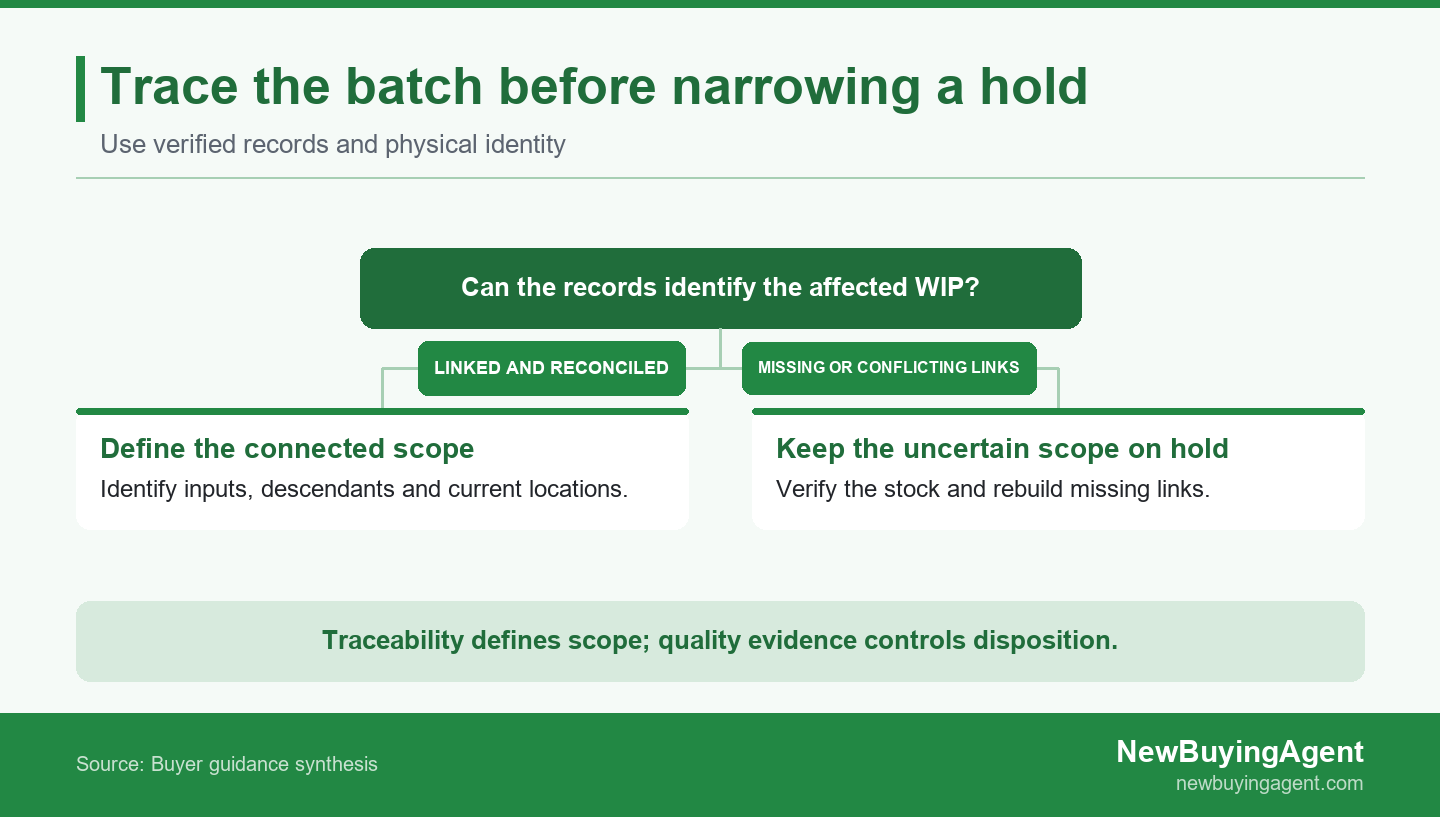
Use linked batch records to define the connected WIP scope; keep uncertain links on hold for verification.
Record the Events That Change Batch Identity
Record the events that change a group’s identity, quantity, location or disposition, and connect each event to the goods involved. The record should identify the inputs and outputs, operation, actual time, responsible party and supporting evidence. Select the necessary fields for the product and factory route, so the team can reconstruct a movement or production change without relying on the person who remembers it.
The GS1 EPCIS standard provides a common model for sharing visibility event data within and across enterprises. It gives trading partners a way to describe events consistently. That is a useful design reference for a buyer’s handoff record, but it does not establish that every factory needs a particular software package or that a scanned identifier proves the recorded history is correct.
| Event-record field | Fill for this production event |
|---|---|
| Object and order | Product/revision: ______ order reference: ______ |
| Event identity and time | Event ID: ______ actual time and time zone: ______ |
| Input identities | Material/WIP batches and quantities, with units: ______ |
| Output identities | Resulting batches/groups, quantities and links to inputs: ______ |
| Operation and location | Activity, work centre, line or subcontract location: ______ |
| Current business state | WIP / inspection pending / held / other agreed status: ______ |
| Recorder and evidence | Responsible person: ______ transfer/process/inspection record: ______ |
| Exceptions and disposition | Loss, mismatch, rework reference or approved correction: ______ |
Capture the event at the handoff or operation, and name who records it. For outside processing, the dispatching and receiving parties should be able to match the same transfer. Keep a readable physical identifier available where the goods are handled; a system record that cannot be connected to the actual tote or pieces leaves the buyer with a data trail and an unresolved physical question.
Local factory codes can remain useful if their meanings are linked. Keep the mapping from supplier batch to internal WIP group and then to the buyer’s order reference. When a label changes, preserve the old-to-new relationship and why it changed. Replacing the number everywhere in the record can make yesterday’s inspection or transfer document impossible to interpret, even when the current screen looks tidy.
Preserve Links Through Splits, Processing and Rework
Preserve the actual input-to-output relationship whenever goods are split, combined, processed or sent through an operation again. A movement of unchanged pieces needs a different record from a process that creates a new output using several inputs. State which relationship the event represents, identify every contributing group and keep the prior history accessible, so a later trace can follow the physical production route.
Splitting Stock Is Different from Transforming It
The GS1 EPCIS implementation guideline separates aggregation from transformation. In an aggregation, the children retain their identities and can be separated again; in a transformation, input objects are consumed and outputs are produced. This distinction matters because putting cases on a pallet does not create the same genealogy as combining material batches into a new production output.
For a handling split, assign identifiable child groups and record their parent and allocated quantities. For a merge or transformation, record all input contributions and the output batch or group. Do not create a convenient one-to-one link if the operation actually allows several inputs to contribute to several outputs. Where exact allocation is unavailable, preserve the known contributors and disclose the unresolved relationship instead of presenting an inferred allocation as observed fact.
The event type should follow the physical operation. Cutting, coating or assembling may change which object or attributes the team tracks, while moving unchanged pieces to another station may only change location. Agree that interpretation with the factory’s product and process owners. A buyer-level record can describe the necessary relationship in plain language; claiming formal EPCIS conformance requires the corresponding implementation work, not simply adding the standard’s name to a spreadsheet.
Keep Subcontracting and Rework in the Same History
Keep subcontract dispatch and return connected to the same history. Record what left the factory, where it went, which processing run received it and what came back, including documented losses and any new identifiers. Match the return to its dispatch and relevant operation evidence. An outside processor’s delivery note showing a total quantity is insufficient if it cannot distinguish the buyer’s contributing batches from other stock.
Status also needs a shared meaning. The GS1 Core Business Vocabulary distinguishes the business step from the disposition describing the object’s business state following an event. A factory’s “coating complete” describes an activity; it does not automatically mean “inspection accepted.” Map the relevant local terms before combining reports, and keep production progress separate from the authorization needed for the goods’ next use.
For rework, link the repeated operation to the original WIP group and the reason it was selected. Retain its previous inspection history, record any split quantities and identify the resulting goods. If rework changes a tracked characteristic or identity, capture that change explicitly. A new label should help find the repeated operation; it should not erase the issue that made the rework necessary or act as evidence that the correction succeeded.
Reconcile Quantities Without Counting WIP Twice
Reconcile quantity at a stated item, unit and time, using actual current stock and documented movements or losses. Historical issued quantity and the resulting child groups describe related records, so adding them together can count the same goods twice. Start with a defined operation or stock boundary, then account for returned output, remaining WIP and scrap on a consistent basis before accepting the factory’s total.
Compare pieces with pieces when the process preserves a meaningful piece count. If the inputs are material weight and the outputs are assembled units, direct addition is meaningless; use the applicable conversion or consumption model and record its assumptions. Keep containers and the goods inside them separate in the count. A pallet count can locate the handling units while leaving the number and identity of their contents unresolved.
When the numbers disagree, check the physical goods and original event evidence before editing the ledger. Look for an unrecorded transfer, delayed return entry, duplicate movement, mistaken unit or loss that lacks a disposition record. Assign the correction to an accountable person, retaining the original entry, reason and time. A balancing adjustment without a verified cause can make the arithmetic look right while weakening the trace.
For a new China product-supply brief, batch requirements belong with the product specification and purchasing needs. NewBuyingAgent’s China product-supply service uses local factory resources and product development/QC capability to quote and supply products. Define the material and production groupings that matter to the order so those requirements travel into the product-supply decision, rather than arrive as an unexplained request for more labels.
Use Traceability to Bound the Affected Scope
Use traceability to identify the goods that could share a relevant input or operation when quality evidence changes. A narrower hold needs reliable links and physical separation, while missing relationships or mixing leave a wider scope uncertain. This determines where to investigate and contain the problem; an identified group still needs the applicable inspection, corrective verification and authorized disposition before the buyer treats it as acceptable.
NIST’s manufacturing traceability meta-framework discusses organizing, linking and querying verifiable product history, with selective disclosure that protects proprietary information. Linked evidence matters more than a long list of labels when several organizations participate. Request the records needed to resolve the connected scope; a supplier can protect unrelated commercial information without leaving the essential product history inaccessible to authorized review.
Illustrative Example: A Split Batch Sent for Coating
Consider an illustrative example: an importer orders 6,400 brackets made from metal, including a 2,400-piece batch split into 1,400 pieces sent for outside coating and 1,000 retained onsite. The processor returns 1,360 pieces and reports 40 scrapped. An inspector observes coating flaking on returned pieces. The immediate issue concerns that returned coating group; the observation alone does not establish a material defect throughout the original batch or show that every returned piece is defective.
The same-item piece count reconciles as 1,360 returned + 40 documented scrap + 1,000 retained = 2,400 issued pieces. The buyer initially holds the 1,360 returned pieces pending investigation, and asks the factory to verify the dispatch, processing, return and scrap links against the physical goods. Matching arithmetic supports stock accounting; it does not prove that the coating conforms or that the reported scrap has actually left circulation.
| Accounting category | Pieces in the example | What the record needs to establish |
|---|---|---|
| Returned coating group | 1,360 | Identity, operation and current physical location |
| Remaining onsite WIP | 1,000 | Separate identity and relevant process history |
| Reported scrap | 40 | Recorded disposition and removal from circulation |
| Accounted issued quantity | 2,400 | Same-item reconciliation; excludes counting the parent again |
If those links and the physical separation are verified, the onsite group has a different coating history that can be assessed under its own requirements. If the groups were mixed or a return link is missing, expand the hold to the potentially connected scope until the uncertainty is resolved. Investigate and correct the coating issue, then verify the affected output under the agreed quality criteria before an authorized disposition. This illustrative example does not assume successful correction or release of the rest of the order.
For an existing Chinese supplier, NewBuyingAgent’s China-side factory management can support local factory communication, production follow-up and staged quality reporting. Its China-side resources and QC capability are relevant when the buyer needs current factory evidence to connect the returned group to the production decision. The verified records and product criteria still determine the appropriate scope and disposition.
Test the Trace Before the Next China Production Run
Test the proposed trace on actual WIP before relying on it for a multi-batch order. Select a group and ask the team to follow it backward to its relevant inputs and forward through its recorded descendants, checking current locations and quantities. Record the missing links and responsible owners, then repeat the affected part of the exercise after repair so the result demonstrates retrievable evidence, not merely a completed form.
- Selected physical group and product revision are identifiable: ______
- Relevant input batches and contributing operations can be retrieved: ______
- Split, combined, subcontracted and reworked outputs remain linked: ______
- Current goods, remaining WIP and documented losses reconcile: ______
- Inspection and hold status are distinct from production progress: ______
- The required records are accessible to the authorized reviewers: ______
- Missing links have an owner and a verification result before reliance: ______
Choose the recording technology around that exercise. NIST’s manufacturing supply-chain study describes production networks as potentially web-like and examines traceability requirements alongside possible data-sharing and storage technologies. A tool demonstration should show how the selected goods and their links are retrieved across the actual factory route. The study’s discussion does not make blockchain, a particular scanner or a new platform a universal purchasing requirement.
For an existing factory, hand over the product revision, expected batch relationships, current WIP locations and unresolved record questions. For new sourcing, include the product specifications, quantity, target price, destination and timing, together with the traceability requirements that matter to the product. This gives the receiving team a purchasing context and a specific chain to verify, rather than a general request for a real-time dashboard.
To discuss the product-supply or existing-factory-management route, send the purchasing brief to NewBuyingAgent. Include the current batch and event-record problem so the response can address the relevant purchasing need and next steps.
FAQ
What if a scanner or network fails?
Use an agreed fallback record when a scanner or network fails. Keep the physical identity, actual event time and responsible recorder visible, and flag any delayed system entry so it is not mistaken for the event time. Reconcile the fallback records with the system once available. If the missing entry prevents the team from knowing which goods moved, preserve that uncertainty instead of guessing the relationship.
How long should buyers retain WIP traceability records?
Set record retention for the product, contract and applicable obligations instead of using one universal period. Consider the period during which an order, its descendants or a later quality question may need to be reconstructed. Agree who retains original evidence and how authorized people can retrieve it after a factory or system change. A retained summary is insufficient when it discards the links needed for the trace.
Can a supplier keep sensitive source details confidential?
A supplier can use controlled aliases for sensitive source details if authorized reviewers can resolve the real relationship when needed. Agree who holds the mapping and how a batch investigation can access the necessary records. A code that nobody on the review route can resolve protects little useful traceability. Share the minimum relevant source and event information while preserving unrelated commercial details under the agreed access rules.
Can the same batch code be reused on repeat orders?
A repeated batch code needs a clear namespace or linked attributes that keep historical identities unambiguous. Include the relevant supplier, product and production context in the agreed identification rule, rather than overwrite an earlier record when a repeat order starts. Test a query containing the repeated code against both histories. If it can return the wrong goods or lose the earlier links, improve the identification before relying on it.
NewBuyingAgent
Related Resources


Get Started Today
Let's Turn Your Sourcing Goals into RealityWeChat:+86 15157124615
WhatsApp:+86 15157124615
Address:Building 10 #39 Xiangyuan Road, Hangzhou, China