
5 Whys is a method of repeatedly asking why to explore a causal path, as described by the Lean Enterprise Institute. A fishbone diagram is a categorized map of possible causes, described in IHI’s cause-and-effect tool. Both organize an investigation; neither makes an untested explanation true.
For a factory quality issue, choose the starting tool according to what the team already knows. A clear, narrow failure path can support focused questioning. When several process stages or explanations remain plausible, map those alternatives first. If the basic defect facts are missing, collect them before drawing either tool.
Choose the Tool That Matches the Evidence Gap
Use 5 Whys when the factory has a defined problem and evidence supporting a narrow causal path. Use fishbone when the investigation needs to explore several possible explanations or perspectives. Combine the tools when the map identifies branches worth investigating more deeply. The quality of the records and tests determines the strength of the result, rather than the neatness of the diagram.
- Focused path: question each causal link and check its evidence.
- Broad uncertainty: map competing explanations before selecting a path.
- Combination: investigate supported branches instead of treating a vote as proof.
- Buyer decision: verify the cause and correction separately from the decision on affected goods.
5 Whys vs Fishbone: Compare What Each Tool Actually Does
The useful comparison between 5 Whys and fishbone is depth versus breadth, with evidence required for both. The matrix below compares their functions, starting inputs, outputs, meeting effort and failure exposure on the same dimensions. It is a qualitative assessment of how the methods work in a factory investigation, rather than a measured claim that one always costs less or finishes faster.
| Decision dimension | 5 Whys | Fishbone | Buyer review condition |
|---|---|---|---|
| Primary question | Why did this specific condition occur? | What different factors could explain this defect? | Choose according to whether the cause path is narrow or still broad. |
| Starting input | A specific symptom, observed process and a plausible path to investigate. | A specific symptom and people who know different parts of the process. | If defect details are missing, collect facts before either tool. |
| Visible output | A causal chain, with evidence attached to each answer. | A categorized map of possible causes and sub-causes. | Ask which entries are observations, hypotheses or verified explanations. |
| Investigation coverage | Depth along a path; separate chains can cover different paths. | Breadth across material, method, machine and other relevant categories. | Do not force a multi-cause issue into a single chain. |
| Meeting effort | Compact discussion when the path is clear; unsupported links create rework. | Broader discussion needs facilitation and follow-up prioritization. | Judge the work required by uncertainty, not a universal time ranking. |
| Common failure | A plausible story ending in blame without supporting records. | A full diagram that lists ideas but tests none. | Return the missing evidence, not just a request for cleaner formatting. |
| Best next step | Test the causal links and the proposed corrective action. | Select evidence-supported branches for records, questioning and tests. | Make the test plan visible before approving the explanation. |
Based on these differences, a narrow, evidence-supported path favors focused questioning, while broad uncertainty favors a possible-cause map followed by targeted investigation. Neither route should be selected merely because the supplier’s template already contains it. When the issue involves several credible paths, combine the tools or pursue the necessary technical testing instead of declaring a universal winner.
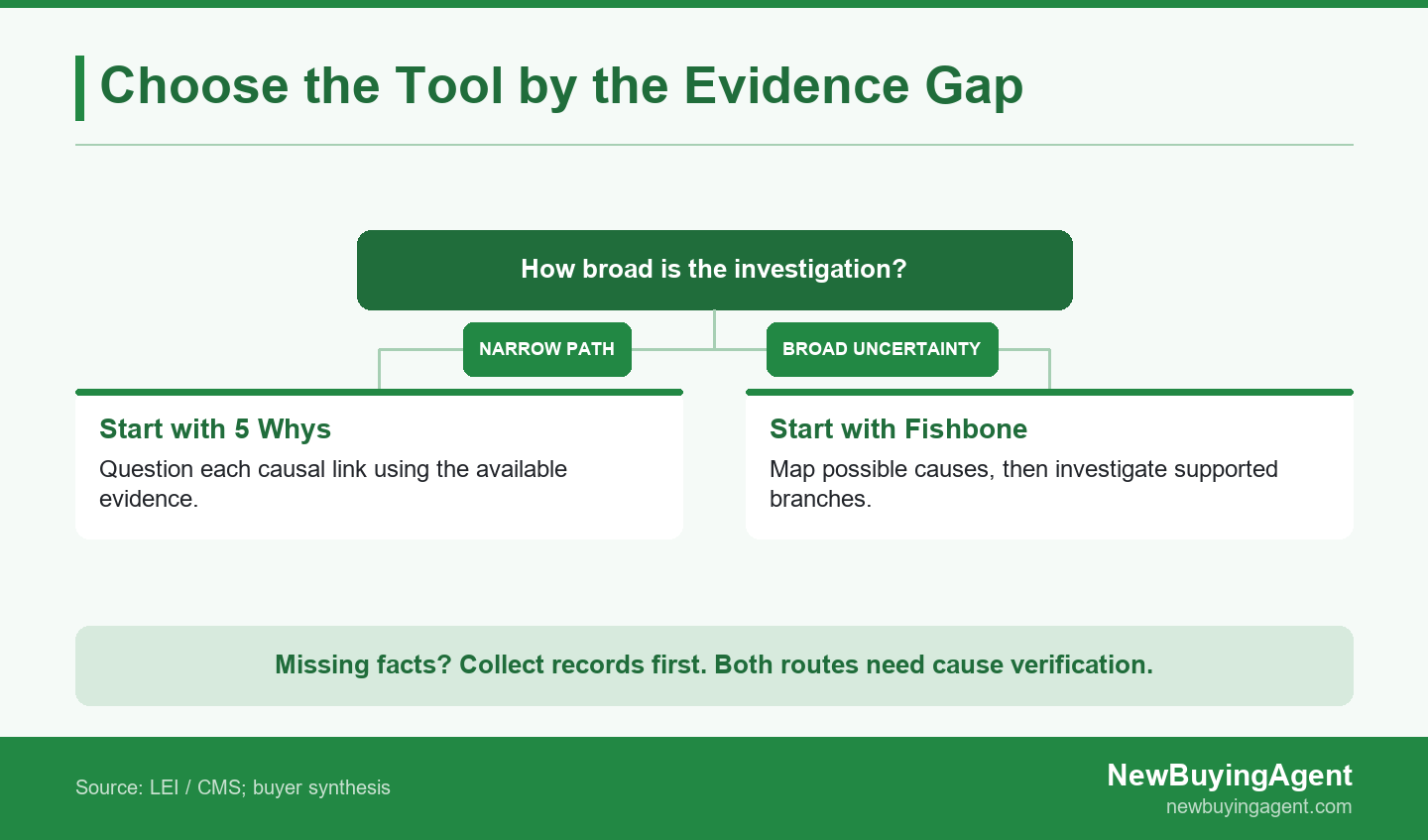
A focused causal path favors 5 Whys; broad uncertainty favors fishbone, with verification required for both.
Define the Factory Problem Before Choosing a Diagram
Before choosing 5 Whys or fishbone, define the gap between the product requirement and the observed result. State what failed, where it was found, when it appeared and which production conditions may be involved. A problem such as “poor coating” is too broad to investigate reliably; a recorded blistering failure under an identified inspection condition gives the team something concrete to explain.
Request the product and specification revision, defect photographs or measurements, lot or shift records, production changes and the status of suspect stock. Distinguish the confirmed affected quantity from the wider quantity that could be affected. If records cannot narrow the production scope, keep that uncertainty visible rather than allowing the team to assume the latest checked carton represents the entire order.
A useful map reflects the process being investigated. MIT’s quality-tools teaching material presents suggested categories such as measurements, personnel, materials, methods, environment and machines, and shows a cause-and-effect diagram supported by 5 Whys. These headings help the team look beyond its first explanation; they are a starting vocabulary rather than a requirement to fill every category.
For product and manufacturing context, NewBuyingAgent’s China Manufacturing & Product Guide can help buyers organize the requirements they need to discuss. The actual investigation still needs the agreed product specification and defect record, rather than a generic category description.
Use Depth and Breadth for Different Investigation Jobs
Depth and breadth address different weaknesses in a supplier investigation. A focused chain asks whether each explanation leads to a deeper, actionable cause. A broader map checks whether the team has overlooked another plausible source of the defect. Both need evidence, and either can mislead when observations, assumptions and conclusions are mixed together without being identified.
Use 5 Whys for a Focused Causal Path
Use 5 Whys to follow an evidence-supported causal path from the observed defect toward the process condition that allowed it. Each answer should explain the previous condition and have a record, observation or test behind it. If the next answer is speculation, mark the uncertainty and collect evidence instead of filling the next box with a convenient explanation.
Ask the supplier to identify the evidence alongside each answer. A machine setting may be supported by a program record; a material change may be supported by a batch record; an instruction gap may be checked against the revision actually used. The important distinction is between “this could have happened” and “this condition was present and explains the observed failure.”
IHI’s root-cause questioning tool cautions that a problem may have multiple root causes and that people seeing different parts of a system may give different answers. Although the tool is presented in healthcare improvement, that analytical caution is useful for factory teams: include the people who can check the material, process and inspection facts before settling on one explanation.
An answer such as “the operator did not follow the instruction” is a point to investigate. Check which instruction was available, whether it described the required operation and whether the conditions made compliance possible. Training can be part of a correction when evidence supports a knowledge gap; it should not replace investigation of a faulty method, inaccessible instruction or uncontrolled change.
Use Fishbone to Explore Competing Explanations
Use fishbone when the team needs to compare possible causes across several parts of the process. Put a specific defect at the head of the diagram and organize candidate explanations under categories that fit the work. A branch means an explanation deserves consideration; it does not mean the explanation has been verified or that every branch contributes to the defect.
The CMS fishbone guide describes categorized possible causes and repeated questioning within the diagram. Its healthcare QAPI context is different from factory production, but the transferable principle is useful: a structured map can prompt the team to consider alternatives that would otherwise be missed. It does not create a factory mandate or establish the cause of your particular defect.
Keep the map specific. Under materials, name the actual batch or property being questioned; under equipment, identify the setting, fixture or condition that could produce the failure. Avoid vague labels such as “bad materials” or “machine problem.” Record whether each entry is supported, contradicted or still unknown, and name the evidence needed to investigate it.
A team vote may help choose which branch to investigate next, but popularity does not verify a cause. Prioritize the branch using the defect pattern, changes in the process and evidence that can discriminate between explanations. If a cause remains plausible but untested, leave it open rather than erasing it because another idea received more votes.
Combine the Tools When the Evidence Supports a Branch
Combine fishbone and 5 Whys when a broad map identifies a branch that has enough evidence for deeper investigation. The map keeps alternatives visible while focused questioning examines why the supported condition arose. This combination is useful when an initial explanation fits only part of the observed defect pattern, or when the occurrence and missed-detection problems need different investigation paths.
Select a branch, state its hypothesis and identify what observation would support or contradict it. Then attach the why questions to that branch without deleting other unresolved possibilities. If questioning reaches an unsupported link, return to records or testing. Reopening the map at that point is a normal response to incomplete evidence, rather than a failure to finish the chosen tool.
For buyers using existing China suppliers, NewBuyingAgent can manage production and quality at existing China factories. Its local factory communication, pre-production, in-process and final inspections, and real-time plus official reporting give buyers observations they can compare with the supplier’s explanation. That visibility helps the buyer identify which records or production conditions need attention in the ongoing investigation.
See How Tool Choice Changes a Supplier Investigation
Tool choice can change when the evidence does not fit the supplier’s first explanation. A compact chain may be appropriate once a mechanism is supported, while a wider map is useful when competing explanations remain unresolved. The following illustrative factory example shows how using both approaches can improve the investigation without turning a completed worksheet into a release decision.
Illustrative Case: Coating Blisters on Steel Hooks
Consider an illustrative order of 6,400 coated steel hooks, including 1,600 suspect hooks identified through shift records after a blistering complaint. The supplier’s initial chain says the operator cleaned the hooks incorrectly and recommends retraining. That response lacks a test or observation connecting the proposed cleaning error to the defect, even though the suspect quantity can be traced to a recorded shift.
The quality director asks the factory to map material, surface preparation, curing equipment and measurement possibilities. The team notes that the same cleaning instruction was used across shifts, while the recorded curing program differed during the suspect shift. Cleaning, material and curing explanations remain hypotheses until checked. Comparing the program records and relevant production observations gives the curing branch a stronger basis for further investigation than the original blame conclusion.
Focused questioning then asks why the program differed and why the change was not controlled. The team proposes a controlled program-change process, with a segregated comparison and appropriate coating tests to check whether the suspected condition explains the blisters and whether the correction works. The buyer maintains control of the suspect hooks pending an authorized disposition, and requests follow-up evidence under relevant normal-production conditions. All quantities and findings here are illustrative, not a client case or a prescribed coating acceptance plan. The value of the combined approach is that it identifies what to test and what remains open.
Verify the Cause Before Approving Corrective Action
Verification asks whether the proposed cause actually explains the defect and whether changing it addresses the problem. A completed diagram or questioning chain is a useful investigation record, but it is not sufficient proof. Compare the explanation with the defect’s timing, location and distribution, then select observations or tests that can distinguish it from credible alternatives.
Data patterns can help narrow the search. NIST’s scatter-plot guidance explains that an association does not prove causality. If defects appear on one shift, that pattern may relate to a material batch, setting, tool condition or another factor that changed with the shift. The pattern helps identify questions; it does not establish that the shift personnel caused the failure.
Where several factors could explain the result, a competent technical team may need a controlled investigation. NIST’s experimental-design guidance describes designed experiments alongside engineering judgment in establishing causal relationships. Define the suspected factor, the outcome being measured and the relevant comparison conditions. Avoid changing several uncontrolled inputs together and then attributing improvement to whichever change the team preferred.
Investigate missed detection as well as defect creation. Siemens’ manufacturing 8D explanation separates the occurrence cause from the escape cause. An inspection method that did not check the failed characteristic needs a different correction from the production condition that created it. A successful process trial therefore does not automatically demonstrate that the inspection control can detect a future recurrence.
Keep current-stock disposition and long-term correction distinct. Inspection or screening evidence may support a decision on identified goods, while later process evidence is still needed to judge whether the correction remains effective. State the conditions covered by the verification, including relevant material, setup or operating changes. The customer’s applicable acceptance requirements determine the goods decision; the choice of diagram does not authorize shipment.
For new purchasing, use confirmed defect lessons to clarify product requirements and quality checks. NewBuyingAgent can supply products from China against your purchasing needs through its local factory network and product development and QC capability. This connects the lesson to the supplied product and its purchasing needs, rather than repeating an untested factory explanation in the next order.
Give the Supplier a Clear Investigation Brief
Give the supplier an investigation brief that names the problem, explains the chosen route and requests the evidence needed for the next decision. This keeps the response focused on the defect rather than on whether a favored template has been completed. Use the brief below to make missing facts and verification work visible to both the factory and the buyer.
- Problem and scope: record the requirement, observed result, product revision and known or suspect production range.
- Tool choice: state whether the evidence supports a focused path, a broad possible-cause map or a combination.
- Cause status: distinguish observations, hypotheses, contradicted possibilities and supported explanations.
- Evidence request: identify the record, measurement, observation or comparison needed for each unresolved link.
- Verification proposal: specify the proposed test, result measure and conditions covered, including any missed-detection issue.
- Next update: agree a responsible person and milestone, with affected-stock control maintained while relevant evidence remains unresolved.
A useful request might read: “The cleaning explanation remains unverified. Compare it with the recorded program change and material-batch history, identify evidence supporting each candidate, and propose a segregated test that distinguishes them. Explain why the final check did not detect the failure. Keep the suspect stock controlled while the investigation and disposition are reviewed.”
Buyers managing an affected order can share the product specification, defect evidence and production status to discuss China-side factory management and staged quality checks. Agree the relevant inspection scope and reporting needs, including real-time observations and official inspection reports. Contact NewBuyingAgent about factory management.
FAQ
Must a 5 Whys analysis have exactly five answers?
No; the number is a guide rather than a completion test. A useful 5 Whys analysis keeps its causal links supported and reaches a condition that can be addressed and verified. If a question exposes several credible paths, investigate them separately. Do not add unsupported answers merely to reach the expected number of boxes.
How should buyers review an issue involving a subcontracted process?
Ask the contracted supplier to connect the subcontracted process to the affected product and records. Request the relevant process-change history, batch references and verification evidence through that supplier. When details are confidential, agree what redacted records or appropriate technical review can verify the explanation. Keep unexplained evidence gaps open instead of accepting “the subcontractor fixed it” as a conclusion.
Can a remote buyer choose the tool without visiting the factory?
Yes, when records and observations make the evidence inspectable. A remote buyer can review defect patterns, production changes and the supplier’s reasoning to request an appropriate investigation route. If essential factory practice is unobserved or measurements are disputed, obtain targeted on-site observations or technical testing before accepting the explanation. A remote diagram review cannot fill that evidence gap.
Which tool should buyers use for a potentially safety-related defect?
For a potentially safety-related defect, escalate the technical assessment first. Maintain appropriate control of affected stock and follow applicable product and customer requirements while the issue is assessed. Either tool may organize hypotheses, but neither replaces the engineering investigation or testing needed for the specific risk. Avoid deliberate trials that expose customers or workers to a suspected unsafe condition.
NewBuyingAgent
Related Resources
Get Started Today
Let's Turn Your Sourcing Goals into RealityWeChat:+86 15157124615
WhatsApp:+86 15157124615
Address:Building 10 #39 Xiangyuan Road, Hangzhou, China