

A product that has shipped for years can still become impossible to reorder. The risk rarely sits in the product itself; it sits in the components, materials and processes the product depends on, and in whether they will still be available, compliant and economic when the next purchase order is placed. A repeat order can be blocked by a single component's end-of-life notice even though nothing about the product changed.
Product obsolescence risk is the chance that a part, material, or process a product depends on stops being available, compliant, or economic before the repeat orders it was designed for can be placed. In China sourcing, it connects a buyer's repeat-order plan to supplier lifecycle status, substance restrictions and single-source dependencies before the next order is committed.
The practical question is not whether the part is shipping today, but which components the reorder depends on and how each one is secured.
What Securing Components for Repeat Orders Protects
Securing components for repeat orders means naming the parts the product depends on, scoring each one for how likely it is to end and how much the reorder depends on it, and applying a buffer, qualify, or redesign rule before the next purchase order. The goal is not to stock every part; it is a short list of components with a recorded decision and an owner, so a supplier notice becomes a planned response instead of a stopped order. That short list is the basis for the decisions that follow.
- Best for: global buyers keeping a product already in production buildable across repeat orders.
- How it works: score each component by likelihood of ending and impact on the reorder, then buffer, qualify an alternate, or redesign.
- Key advantage: the decision is recorded before the notice arrives, so a component's end is a planned response rather than a stopped order.
- Decision: buffer the high-impact items, qualify an alternate for the items most likely to end, and redesign only when neither protects the order.
- Risk: a pin-compatible substitute is not an approved alternate until it passes qualification against the approved specification.
What Product Obsolescence Risk Means for a Repeat-Order Product
Product obsolescence risk is the chance that a component, material, or process in a product stops being available, compliant, or economic before the buyer can place the repeat orders the product was designed for. It is a property of the product that is already in production, not a prediction about the distant future: a reorder is only buildable while every component it depends on still exists, still meets the applicable restrictions, and can still be bought at a workable price. It is narrower than a portfolio review and wider than a single end-of-life notice.
The three failure modes are worth separating because they are checked in different places. A part can stop being available when a supplier discontinues it; it can stop being compliant when a restriction list or a standard changes; and it can stop being economic when a single source raises the price or the minimum order beyond what the reorder can carry. A component that fails any one of the three breaks the approved bill of materials for every unit that uses it, which is why obsolescence risk is a decision about the current product rather than a forecast.
Two limits matter from the start. Obsolescence risk is not a statement that the part will end; it is a statement about how exposed the reorder is if it does. And securing a component records a decision and covers the orders it names; it does not guarantee that every later unit will be produced from the same supply.
Where Obsolescence Risk Enters a Repeat-Order Product
Obsolescence risk enters a repeat-order product through three different doors: the electronic lifecycle, material and substance restrictions, and single-source or tooling dependency. Each door fails in a different way and calls for a different check, so a buyer who watches only for end-of-life notices can still be stopped by a restriction list or by a supplier that quietly becomes the only source. The next three sections take each door in turn, because a component risk list is only useful if it covers all three.
Electronic and Semiconductor End-of-Life Signals
Semiconductor and electronic suppliers publish product change notifications and end-of-life notices with defined last order and last delivery windows, so an electronic component can end on a date the buyer did not choose. A product change notification is a supplier notice that a component or its manufacturing process will change or be discontinued, and end of life is the point at which a supplier stops producing a component or announces a final order date. Both are decisions made on the supplier's schedule, not the buyer's, which is why the notice is a decision point rather than a warning to file.
That schedule is often published. Texas Instruments states that it complies with the requirements for timely notification in J-STD-046 and notifies customers of major changes that affect form, fit or function, and its product withdrawal schedule allows 12 months for the last order and an additional six months for final delivery of obsolete products. Those windows belong to one manufacturer and its own policy, so the buyer's lesson is narrower than copying the numbers: read the supplier's notification process and record the last-order date for the components the reorder depends on.
Material, Coating, and Substance-Restriction Risk
Substance restrictions and updated standards can make a compliant material or component non-compliant without any change to the product, so material risk has a regulatory clock. A solder alloy, a coating or a plasticiser can be acceptable when the product is approved and restricted later, and the reorder then needs a different material or a different component. That clock is not visible on the factory floor; it is kept by regulators and standards bodies. Those rules bind their own market and product scope, so the transferable lesson is to screen materials against the restriction list that applies to the destination rather than assume one global rule.
The clearest example is substance restriction in electrical and electronic equipment. The European Commission states that the RoHS Directive currently restricts the use of ten substances in electrical and electronic equipment, including lead, cadmium, mercury, hexavalent chromium, PBB, PBDE and four phthalates. The Directive applies within its own scope and market, so the transferable lesson is to screen materials against the restriction list that applies to the destination, not to assume a single global list.
The standards behind compliance move too. The European Commission states that a harmonised standard is a European standard developed by a recognised European Standards Organisation: CEN, CENELEC, or ETSI, created following a request from the Commission. Because those standards are revised, a component's compliance can be re-opened even when the product has not changed; the applicable standard and its edition decide the exact requirement.
Chemical restriction can move faster than a product cycle. The U.S. Environmental Protection Agency maintains public information on PFAS, including the laws and regulations that apply. Those rules apply within their own jurisdiction, so the transferable lesson is only that a chemical restriction can end a material used in a product, not that a specific rule governs a China order.
Single-Source and Tooling Dependency Risk
A single source or a custom tool is a dependency that can end for commercial reasons even when the component itself is technically available. The part may still be in the catalogue, but if only one factory makes the tool that forms it, or one supplier holds the relationship, the reorder depends on a commercial decision the buyer does not control. Source count and tooling ownership are therefore their own risk, separate from lifecycle status.
For a factory the buyer already uses, this is a follow-up question rather than a sourcing one: which components have a single source, and which are tied to a tool the factory holds? NewBuyingAgent's existing-factory management service connects local China follow-up and quality-control capability to that check, so component availability, source count and change records are confirmed during production rather than at the next purchase order.
How to Score Component Risk Across the Bill of Materials
Scoring each component by likelihood of ending and impact on the repeat order turns a long bill of materials into a short list of decisions. The score does not need a formula; it needs two honest judgments per component, placed on the same two axes for every part, so the buyer can see which few components actually threaten the reorder. That ranking is what makes the next step, buffer or qualify or redesign, a decision rather than a guess.
A substitution or a reorder change is a readiness decision, and readiness benefits from documented evidence and a named owner. The NIST Manufacturing Extension Partnership is a program administered by the U.S. Department of Commerce's National Institute of Standards and Technology to strengthen small and medium-sized U.S. manufacturers through MEP Centers. The program supports U.S. manufacturers, so the transferable lesson is narrower: treat a component change as a documented readiness decision, wherever the factory is.
Because the ranking runs against how a China-made product is actually built, it helps to see how product development, tooling and production stages connect; the China manufacturing and product guide explains how those stages relate.
Scan the Bill of Materials and Rank Each Component
A bill-of-materials scan marks each component for lifecycle status, source count and substance exposure, then ranks it by the two risk axes. A bill of materials is the list of components and materials that make up a product and the sources approved for each, so it is already the right document to work from. The scan adds three marks to each line: whether the component is active, nearing end of life, or already under notice; whether it has one source or more; and whether any material in it sits on a restriction list that applies to the destination.
The ranking is deliberately blunt. Likelihood of ending is high for a part under an end-of-life notice or limited to a single source, medium for a part under review or on a restricted list, and low for a commodity with several sources. Impact is high when the reorder cannot be built without the part, medium when it delays one SKU, and low when it is easily substituted. A component with high likelihood and high impact is the one to secure first, before the next order is quoted. Treating a substitution as a documented readiness decision is a transferable lesson from manufacturing practice rather than a formal obligation.
The Component Evidence to Request From the Factory
A named evidence list shows the buyer what to request from the factory and who owns each item, so a component's status is not closed on a verbal assurance. The list below is deliberately short; it names the item that changes the securing decision for each component and the owner who must accept it. It is the part of the method a buyer can copy into a repeat-order brief.
Component data is comparable because the electronics industry maintains shared standards and vocabulary. IPC describes itself as the global electronics-industry association whose members design and build electronics. A buyer does not need the standards themselves; the point is that lifecycle status, change records and alternates have a shared form, so a factory's answer can be checked rather than trusted.
| Component risk | Question to close | Evidence to request | Owner |
|---|---|---|---|
| Lifecycle status | Is the part active, or under notice? | Supplier lifecycle status and any notice with a last-order date | Buyer and factory |
| Source count | Can more than one supplier provide it? | Approved source list and second-source status | Factory |
| Substance exposure | Is any material restricted in the destination market? | Material declaration against the applicable restriction list | Factory and buyer |
| Tooling dependency | Is the part tied to a single tool? | Tool ownership, tool life and tool location | Factory and buyer |
| Alternate | Is there a qualified substitute? | Qualification record and first-article results | Buyer and QC |
Read the table as a release rule: a component is secured only when its status, sources and alternate are recorded and its owner has accepted them; anything less keeps the reorder exposed.
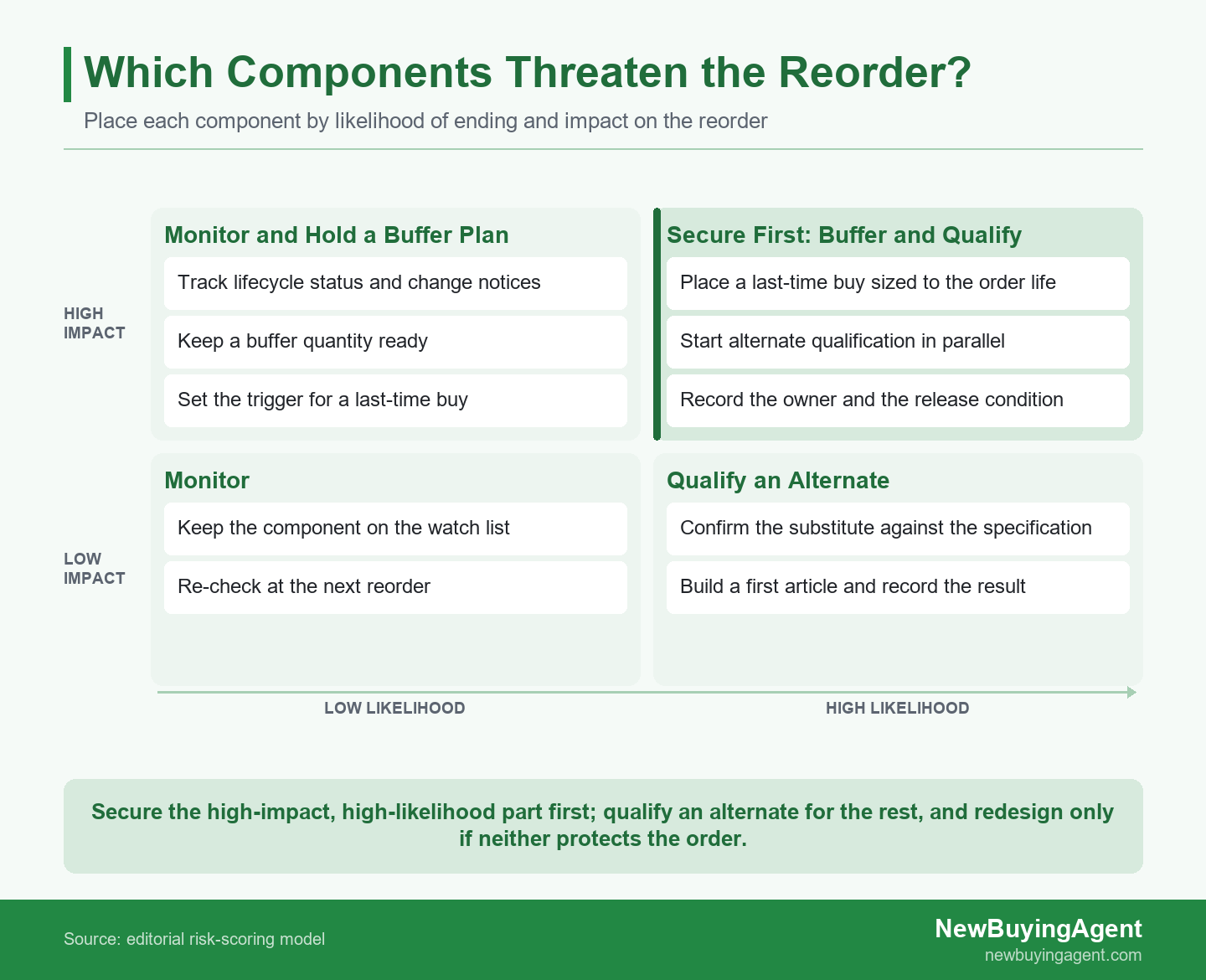
Component obsolescence risk matrix plotting likelihood of ending against impact on a repeat order, with buffer, qualify, and redesign responses
Decision Rules: Buffer, Qualify an Alternate, or Redesign
The risk position points to one of three responses: buffer the high-impact items, qualify an alternate for the items most likely to end, or redesign when neither protects the order. The response is chosen on the risk position, not on the component's price or its importance to the brand, because a low-cost part with no second source can stop a reorder as completely as an expensive one. The two rules below cover the buffer and the alternate; the redesign boundary follows them.
When the response is to source or qualify rather than redesign, the work is a product-supply task. NewBuyingAgent's product-supply service uses local China factory resources and product-development/QC capability to confirm component availability and to source and qualify an alternate against the buyer's component rules.
Last-Time Buy and Buffer-Stock Rules
A last-time buy or buffer covers a stated quantity and time; it bridges the gap to an alternate, it does not remove the need to qualify one. A last-time buy is a final purchase of a component, placed before it is discontinued, that covers an agreed remaining quantity. The quantity should be set against the remaining production life rather than a feeling of safety, and it should include an attrition allowance for scrap and rework.
Buffer stock also has costs and limits. It ties up cash, it occupies storage, and some parts have a shelf life or a battery self-discharge that makes long storage a bad idea. For those parts the buffer is short and the alternate qualification is the real plan. The useful discipline is to state three numbers together: the coverage quantity, the months of production it covers, and the date by which the alternate must be qualified.
Qualifying an Alternate Source
A substitute becomes an approved alternate only after it passes qualification against the approved specification, not because it is pin-compatible. An approved alternate is a second component that has passed qualification and can be substituted for the original in the approved bill of materials. Pin compatibility is a useful starting point, but it says nothing about firmware behaviour, thermal margin, timing or the product's own critical characteristics.
Qualification is a short, recorded project: confirm that the substitute meets the specification, build a first article with it, test the functions the component affects, and record the result as an approved alternate against a version of the bill of materials. Until that record exists, the substitute is only a candidate, and a candidate cannot carry a reorder.
Boundary Cases: When Obsolescence Forces a Redesign
When no available component and no qualified alternate can protect the order, obsolescence becomes a redesign decision; and for a regulated product the redesign sits inside a mandatory lifecycle. Redesign is the right answer when the component has no second source, no workable substitute and no buffer that reaches the end of production life, or when every substitute would change a characteristic the product is sold on. The decision is to redesign the affected part of the product, not to accept a reorder that the supply cannot support.
Regulated products add a boundary of their own. The FDA's Device Advice is the Center for Devices and Radiological Health's resource explaining medical device laws, regulations, guidances and policies, covering both premarket and postmarket topics. Medical devices are not general consumer goods, so the transferable lesson is only that a regulated product follows its own mandatory lifecycle; a substitution that triggers a re-approval has to be handled inside that lifecycle, not only inside the buyer's component record.
When a substitute would change a characteristic the product is registered on, the transferable lesson is narrower than the borrowed rule: a regulated category keeps its own re-approval path, so route the change through that re-approval before the first reordered unit is built, and treat the buyer's component record as an input to that path rather than a replacement for it.
Illustrative Example: An End-of-Life Notice Before a Repeat Order
Separate the reversible work from the release that depends on the missing qualification, and state the condition that closes the gap. In a repeat order the response is rarely all-or-nothing: some work can continue while the substitute is still unqualified, and the buffer can cover production in the meantime. The point is to make the split explicit instead of letting an unqualified part reach the next order.
Illustrative Example: An End-of-Life Notice on the Microcontroller
In this illustrative example, a consumer brand sells a rechargeable LED task lamp that uses one microcontroller, one custom LED driver IC and a USB-C charging module across 3 color SKUs. Repeat orders of 12,000 units per year are planned for at least two more years at one China factory, on one approved bill of materials. The lamp has been in production for two years; the bill of materials is approved, but it carries no component lifecycle status and no approved alternates.
The microcontroller supplier issues an end-of-life notice with a last order date nine months away. The factory proposes a pin-compatible microcontroller, but the firmware has never been qualified on it, and the custom LED driver has a single source with no alternate listed. The notice affects one component; the missing qualification record affects every SKU that shares it. The repeat order cannot be built past the last order date on the current bill of materials, and a pin-compatible substitute is not the same as a qualified part because the firmware behaviour has not been tested.
The buyer's decision is to place a last-time buy covering the remaining production life, hold the substitute as unqualified, and start alternate qualification on a parallel board while the buffer covers production. The last-time buy is placed with an agreed attrition allowance and recorded as bonded stock held for the repeat order, and the substitute is qualified through firmware regression and a first-article build before it is added to the approved bill of materials.
Before switching to the alternate, the buyer runs a first-article build and confirms firmware behaviour against the approved specification; the buffer stays the bridge until the alternate passes. This illustrative example invents no measured value and no passed test, and buffer coverage is not a guarantee for every later order; the component's own lifecycle and the product's risk profile govern the real scope.
Example: When a Furniture Hardware Component Becomes Unavailable
A furniture buyer may have an approved product design that relies on a specific hinge, drawer slide, or custom metal fitting. If the original factory discontinues that component before the next order, the product may no longer be reproducible to the original specification.
Before accepting a replacement, the buyer should compare the dimensions, material, finish, load requirements, installation method, and compatibility with the existing design. Samples and relevant test results should be reviewed before the substitute is approved for production.
If the original component remains available, a limited buffer may help cover near-term orders. If a suitable alternative can be validated, the buyer can update the approved product specification and BOM. If neither option works, the design may need to be revised.
The key is to identify component dependencies before placing the next purchase order, rather than discovering the problem after production has been scheduled.
Securing Components in the Supply Brief and Contract
Put the component risk list, the buffer quantity, the alternate requirement and the notice period into the supply brief and contract, so securing the component is a documented instruction rather than a memory. Written this way, a reorder is quoted against a known component baseline, and "the same as last time" is replaced by a set of recorded conditions the factory must satisfy. The brief also tells the factory what it must deliver before the next order is released.
Import and standards documentation belongs in that record rather than at the port. The U.S. International Trade Administration's China Country Commercial Guide covers customs, regulations and standards, including tariff and non-tariff barriers, import requirements and documentation, and product standards. Naming the applicable documentation keeps compliance evidence attached to the component record instead of surfacing at the port.
For a repeat order that depends on components approaching end of life, prepare the product and current bill of materials, the target quantity and forecast for the remaining production life, the component lifecycle status and any notice, the target price, the destination and the delivery timing. NewBuyingAgent can use its local China factory resources and product-development/QC capability to confirm availability, source and qualify alternates, and follow the reorder against those component rules. With that brief ready, send your repeat-order requirements to NewBuyingAgent.
Frequently Asked Questions
What does product obsolescence risk mean for a repeat order?
Product obsolescence risk is the chance that a component, material, or process in a product stops being available, compliant, or economic before the repeat orders it was designed for can be placed. It is a property of the product already in production, not a forecast, and a component that fails any one of those three conditions breaks the approved bill of materials for every unit that uses it.
How do you secure components for repeat orders?
Score each component for how likely it is to end and how much the reorder depends on it, then buffer the high-impact items, qualify an alternate for the items most likely to end, and redesign only when neither protects the order. Record each decision with an owner and write the component risk list into the repeat-order brief, so a supplier notice becomes a planned response instead of a stopped order.
Is a last-time buy the same as a lifetime buy?
They are used almost interchangeably: both mean a final purchase placed before a component is discontinued to cover an agreed remaining quantity, and both bridge to an alternate rather than replace the need to qualify one. The quantity should be tied to the remaining production life, with an attrition allowance, and the buffer should be short where a part has a shelf life or a battery self-discharge.
When should a buyer qualify an alternate component?
Start qualifying an alternate as soon as a component shows a high likelihood of ending, because qualification takes time and the buffer is only a bridge; a substitute is not usable until it passes qualification against the approved specification. Confirm the substitute meets the specification, build a first article with it, test the functions the component affects, and record the result as an approved alternate against a version of the bill of materials.
NewBuyingAgent
Related Resources
Get Started Today
Let's Turn Your Sourcing Goals into RealityWeChat:+86 15157124615
WhatsApp:+86 15157124615
Address:Building 10 #39 Xiangyuan Road, Hangzhou, China
