


You have a product idea. Maybe you've seen a product online, found a competitor's bestseller, or identified a gap in your target market.
You save a few pictures, write down an estimated price, and start contacting suppliers in China.
Then the quotations arrive.
One supplier offers a price that fits your budget. Another is significantly more expensive. A third suggests a slightly different product that looks almost identical to your reference.
Which one should you choose?
Before comparing prices, there is a more important question to answer: Are all three suppliers quoting for the same product?
A product image can communicate appearance, but it rarely explains everything a supplier needs to know. Materials, dimensions, construction, functionality, packaging, order quantity, and customization requirements can all influence the quotation.
When these details are unclear, suppliers may make different assumptions. Their quotations may look comparable on paper while covering very different products.
This is why a sourcing project should begin with more than a product idea. It needs a clear, practical brief that communicates what you want, what matters most, and where you are willing to consider alternatives.
In this guide, we'll look at six areas to clarify before sourcing from China, common mistakes that can complicate the process, and a sourcing brief template you can use for your next product.
1. Define the Product Beyond Its Appearance
A reference image is a useful starting point, but appearance is only one part of a product specification.
Consider a simple home storage organizer. Two products may look nearly identical in an online listing, yet differ in material thickness, dimensions, load capacity, surface finish, assembly method, or included accessories.
These differences can affect the price, usability, durability, and suitability for your target customers.
Before contacting suppliers, identify the specifications that define your product.
What to clarify:
- Dimensions, shape, and overall design
- Main materials and important components
- Color, surface finish, and appearance
- Functions, features, and accessories
- Required performance or durability characteristics
- Reference samples, drawings, or technical specifications, if available
You don't necessarily need a complete engineering drawing to start a sourcing conversation. The level of detail should match the complexity of the product.
For a standard product, reference images and a list of key specifications may be enough to begin. For a customized product, drawings, measurements, material requirements, and sample references become more important.
A practical tip: Divide your requirements into two groups: essential specifications and flexible preferences.
For example, the organizer's dimensions and load-bearing requirements may be essential, while its color or certain decorative details may be open to discussion.
This distinction helps suppliers understand where alternatives are acceptable without changing the core product you want.
2. Set a Target Price That Suppliers Can Actually Work With
A target price helps suppliers understand your commercial expectations. However, a price target without context can create confusion.
Suppose your target price for a product is $5 per unit. One supplier quotes $4.80, another quotes $5.60, and a third quotes $4.20.
At first glance, the third supplier appears to offer the best deal.
But what if the $4.20 quotation covers a thinner material, standard packaging, and a larger minimum order quantity? What if the $5.60 quotation includes the customized packaging and product features you actually need?
The lowest number does not necessarily represent the best match.
What to clarify:
- Your target unit price or budget range
- Expected order quantity
- Required product specifications
- Customization and packaging requirements
- What the quotation should include or exclude
If your budget is flexible, a range may be more useful than a single fixed number. If your budget is firm, explain which specifications are non-negotiable and which could be adjusted.
This gives suppliers a clearer basis for suggesting alternatives.
For example, if a product exceeds your target price, a supplier might propose a different material, simplify a component, or offer an existing design instead of developing a customized version. You can then assess whether the trade-off makes sense for your business.
A practical tip: Don't ask suppliers to meet a target price without explaining the product requirements behind it. First establish what you need, then explore which options can meet your budget.
3. Specify Order Quantity and Minimum Order Expectations
Order quantity is not just a number to include in a quotation request. It can influence the products and manufacturing options available to you.
A supplier may offer a standard product in relatively small quantities but require a larger order for custom colors, private-label packaging, or a new design. Another supplier may accept a smaller initial order but charge more per unit.
These differences can be especially important for e-commerce sellers testing a new product or businesses expanding into an unfamiliar category.
What to clarify:
- Expected quantity for the first order
- Whether you are testing demand or replenishing an established product
- Potential repeat-order volume, if reasonably estimable
- Whether the product requires customization
- Your flexibility regarding minimum order quantities
You do not need to promise future orders to discuss future potential. The purpose is to help suppliers understand your current needs and the possible direction of the business.
For example, a buyer planning an initial order of 300 units might ask whether the supplier offers a standard version suitable for that quantity, and how pricing or customization options would change at 1,000 units.
The answer can help the buyer compare options without committing to a volume they may not achieve.
A practical tip: Ask suppliers to quote against the same quantity assumptions. If you want to compare several order volumes, request separate quotations for each volume rather than comparing prices based on different quantities.
4. Treat Packaging as Part of the Product Requirement
Packaging often receives less attention than the product itself, especially during early sourcing discussions.
Yet packaging can influence unit cost, customization requirements, preparation time, and the product's presentation to customers.
A buyer selling a home accessory online may need only standard protective packaging for a wholesale order. A private-label brand selling the same item may require a branded retail box, product inserts, labels, and specific carton arrangements.
Those are different requirements, even if the product inside is identical.
What to clarify:
- Standard packaging versus customized retail packaging
- Logo placement and branding requirements
- Printed boxes, labels, inserts, or instruction manuals
- Protective materials and packaging presentation
- Individual packaging and master-carton requirements
- Artwork, labeling, or other materials that must be supplied by the buyer
If you already have packaging artwork, share it early. If the design is not finalized, explain what is known and what remains undecided.
You should also distinguish between packaging that is essential for your product and packaging that can be developed later.
A practical tip: Include packaging in the original quotation request, even if you are still exploring options. Otherwise, a supplier's initial price may not reflect the finished product you intend to sell.
5. Translate “Good Quality” into Specific Expectations
“Good quality” sounds straightforward, but it can mean different things to different people.
A buyer may care most about appearance and finish. Another may prioritize strength, consistent dimensions, functionality, or resistance to wear.
If these priorities are not explained, a supplier may focus on characteristics that are not the buyer's main concern.
The solution is to describe quality in terms that can be communicated, evaluated, and, where appropriate, measured.
What to clarify:
- Appearance, workmanship, and surface finish
- Material requirements and consistency
- Functional and performance expectations
- Important dimensions or tolerances
- Reference samples or approved product examples
- Any known defects or characteristics that are unacceptable
Not every product requires a lengthy technical specification. The goal is to identify the characteristics that matter most for the particular item.
For example, for a storage organizer, the buyer may want consistent dimensions, stable construction, smooth edges, and a specified load-bearing capability. For a decorative product, color consistency and surface finish may be more important.
Where requirements can be measured, specify the relevant criteria rather than relying on subjective descriptions.
If you have a reference sample, explain which characteristics should be matched. If the sample is only an inspiration, make that clear too: suppliers should not assume every detail must be replicated exactly.
A practical tip: Separate the product's required characteristics from your preferred characteristics, and identify any critical acceptance criteria before production begins.
This gives both parties a clearer understanding of what the finished product is expected to be.
6. Clarify Customization and Timeline Before Committing
An existing product and a customized product can involve very different development paths.
A standard item may be available for quotation with relatively little preparation. A customized version may require design confirmation, material selection, sample development, revisions, and additional preparation before mass production can begin.
If you have a launch date in mind, these steps matter.
What to clarify:
- Whether you want an existing product or a customized version
- Which changes are essential
- Whether a sample is required before production
- Your target date for sample review or order completion
- Any important launch or sales deadlines
- Which design details are finalized and which remain open
Be specific about your target dates, but leave room for suppliers to explain realistic lead times based on the actual requirements.
For example, if you want to launch a product before a seasonal sales period, communicate that target at the beginning. Ask the supplier to identify the steps and timing that depend on your approvals, sample revisions, or customized materials.
A quotation that looks attractive but does not fit your actual timeline may not be the right choice.
A practical tip: Ask suppliers to distinguish estimated sample-development time from mass-production lead time. Confirm what each timeline assumes and which decisions or approvals are needed before the next stage can begin.
Why Different Suppliers Give Different Quotations for the Same Product
Let's bring these points together.
Imagine that a buyer wants to source a reusable household storage product and sends the same reference image to three suppliers.
The quotations come back with noticeably different prices.
After reviewing the details, the buyer discovers that:
- Supplier A has quoted a standard product with standard packaging.
- Supplier B has included a thicker material and customized retail packaging.
- Supplier C has quoted a lower price based on a higher minimum order quantity and fewer included accessories.
All three suppliers may have quoted accurately based on their own assumptions. The problem is that the buyer has not yet established a common basis for comparison.
This is a hypothetical example, but the underlying issue is common in product sourcing: a shared reference image does not guarantee shared product requirements.
Before deciding which quotation is best, the buyer should confirm:
- Are the main specifications consistent?
- Are the material and construction requirements the same?
- Do the quotations cover the same packaging and accessories?
- Are the order quantities and customization assumptions comparable?
- Are the quoted timelines suitable for the project?
Once these points are aligned, the buyer can make a more meaningful comparison.
If the prices still differ, the next step is to understand why. A difference may reflect a genuine cost advantage, a different product specification, or a different production arrangement. The quotation alone will not tell you which explanation applies.
The goal is not to make every supplier offer the same price. It is to make sure you understand what each supplier is offering.
A Practical Sourcing Brief Template You Can Use
You do not need a complicated document to begin sourcing. A clear one-page brief can be enough for many standard products, while more complex or customized products may require supporting drawings, specifications, or sample references.
Before contacting suppliers, use this checklist to make sure you've covered the essentials.
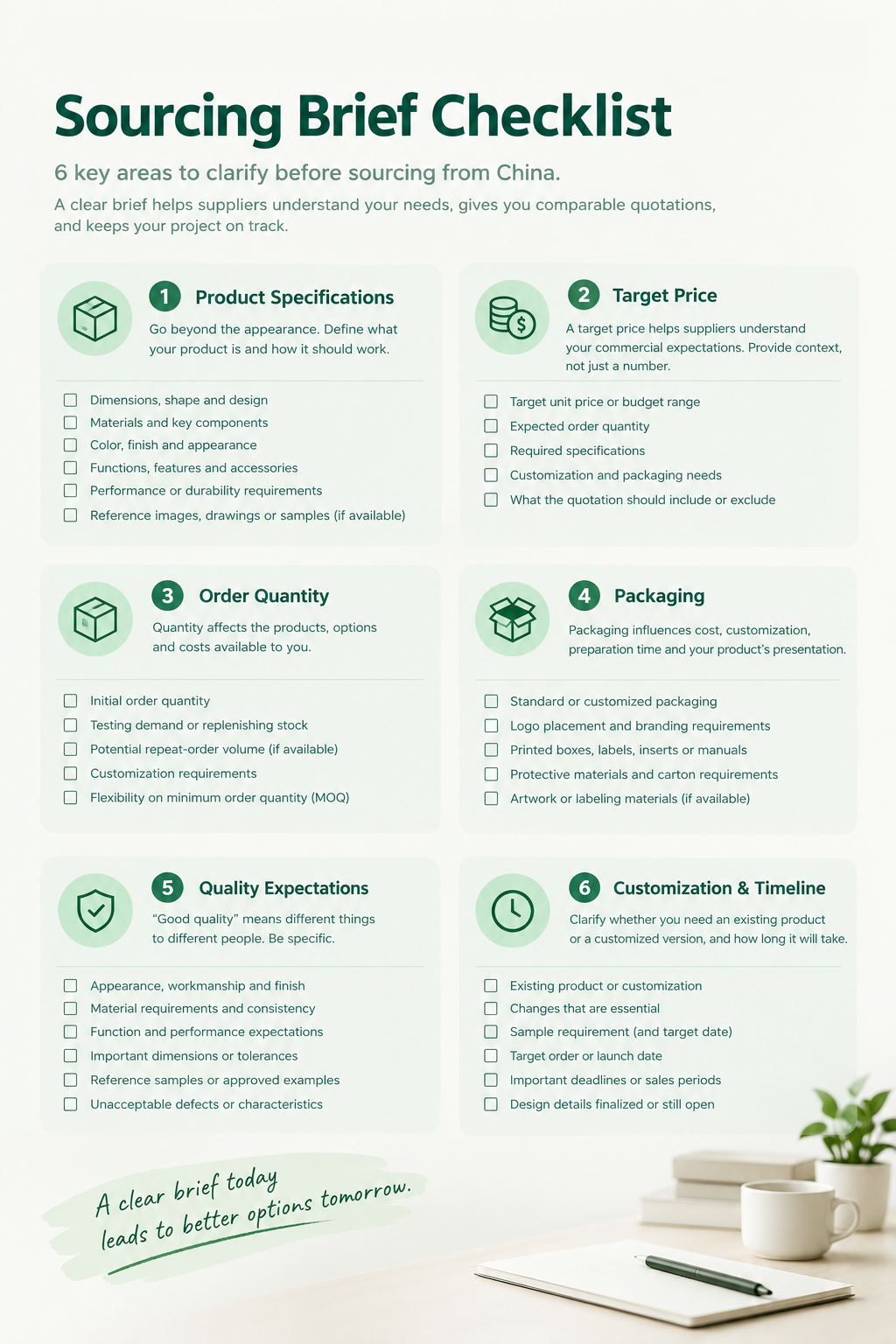
| Category | Information to Provide | Your Requirements |
|---|---|---|
| Product Information | Product name or category | [Enter product name or category] |
| Product reference | [Add images, links, drawings, or sample references] | |
| Intended market and use | [Describe your target customers and how the product will be used] | |
| Specifications | Dimensions and design | [Specify size, shape, and essential design details] |
| Materials and finish | [Specify materials, colors, and surface finish] | |
| Functions and accessories | [List required functions and included items] | |
| Essential requirements | [List features that must not change] | |
| Flexible preferences | [List features that can be adjusted] | |
| Commercial Requirements | Target price | [Enter target unit price or budget range and currency] |
| Initial order quantity | [Enter expected quantity] | |
| Potential repeat orders | [Add an estimate if available] | |
| Packaging requirements | [Specify standard, retail, or customized packaging] | |
| Quality and Development | Quality expectations | [List the most important product characteristics] |
| Reference sample | [Available / Not available / To be arranged] | |
| Customization needs | [Describe required changes or indicate that you are open to options] | |
| Sample requirements | [State whether a sample is needed and any target date] | |
| Target timeline | [Enter your target order or launch date] | |
| Questions for Suppliers | Existing product options | [Can you meet the requirements with an existing product?] |
| Customization | [Which requirements would need customization?] | |
| MOQ and pricing | [What is the minimum order quantity, and how does pricing vary by quantity?] | |
| Quotation details | [What is included or excluded from the quotation?] | |
| Lead time | [What are the estimated sample-development and production timelines?] | |
| Open questions | [What additional information or decisions are needed?] |
You can adapt this template to suit the product. For a straightforward standard item, some fields may not be necessary. For a technically complex or customized product, you may need a more detailed specification.
The important point is to make the requirements clear enough for suppliers to respond meaningfully.
Before You Send Your First Inquiry: A Quick Checklist
Before sending your brief, take a few minutes to check the following:
- I have provided a clear product reference.
- I have identified the specifications that matter most.
- I have distinguished essential requirements from flexible preferences.
- I have stated my target price and expected order quantity.
- I have included packaging and customization needs.
- I have explained my quality expectations.
- I have shared my target timeline.
- I have listed any unresolved questions for the supplier.
You do not need to have every detail finalized before contacting suppliers. In many projects, part of the sourcing process is exploring available options and refining the requirements.
What matters is knowing what has already been decided, what can be adjusted, and what still needs discussion.
Better Sourcing Starts with Better Communication
Finding a supplier is only one part of sourcing from China. The quality of the initial requirements can influence how accurately suppliers understand the product, how useful their quotations are, and how efficiently the project moves forward.
A clear brief does not eliminate every uncertainty. It gives you a better starting point for asking questions, evaluating alternatives, and making informed decisions.
At NewBuyingAgent, we help global buyers source products across categories in China, connecting purchasing needs with manufacturing resources. We also support supplier coordination, production follow-up, and quality-related requirements according to each buyer's needs.
Whether you are exploring a new product category, developing a private-label item, or looking for alternatives to an existing product, start by defining what matters most.
A better sourcing decision begins before the first quotation arrives.
Learn more about NewBuyingAgent: https://www.newbuyingagent.com/
NewBuyingAgent
Related Resources


Get Started Today
Let's Turn Your Sourcing Goals into RealityWeChat:+86 15157124615
WhatsApp:+86 15157124615
Address:Building 10 #39 Xiangyuan Road, Hangzhou, China
