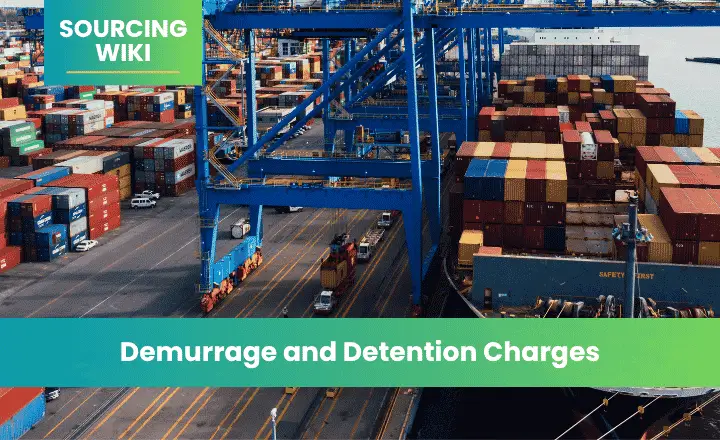
Demurrage and Detention Charges
Definition and Scope
Demurrage and detention are penalty fees charged by ocean carriers to encourage the efficient turnover of container equipment, and while the two terms are often used interchangeably, they apply to different situations defined by where the container physically is. Demurrage applies when a loaded container remains inside the port terminal beyond its allotted free time — the window during which cargo can sit at the terminal before customs clearance and pickup, at no extra charge. Detention applies once the container has left the terminal: it is charged when the container is not returned to the carrier's designated depot within the agreed timeframe, typically because it is still being unloaded inland or hasn't yet been sent back empty. The simplest way to keep the two straight is by location — demurrage is time spent inside the terminal, detention is time spent outside it while the container remains in the shipper's or consignee's possession.
How Free Time and Charges Work
Every shipment is granted a "free time" window by the carrier — commonly somewhere in the range of a few days to about a week, though the exact number is set by the specific carrier contract — during which no demurrage or detention fees apply. Once that window closes, charges accrue daily, typically starting lower for the first few days over the limit and increasing for longer overages. Demurrage delays are most often caused by customs clearance issues, incomplete documentation, or terminal congestion that keeps a container sitting at the port past its free days. Detention delays, by contrast, tend to originate at the shipper's or consignee's own facility — inland transport taking longer than planned, warehouse unloading delays, or simply forgetting to return an empty container promptly.
Billing Requirements Buyers Should Know
In the United States, demurrage and detention billing is subject to specific regulatory requirements set by the Federal Maritime Commission. Under the FMC's rule on demurrage and detention billing practices, carriers and marine terminal operators must include specific minimum information on an invoice, and issue that invoice within a defined timeframe from when the charges were incurred; failing to include the required information or missing the issuance deadline eliminates the billed party's obligation to pay[1]. The rule also sets out a process for disputing charges, giving billed parties a window to request fee mitigation, a refund, or a waiver, with the billing party required to attempt resolution within a set period[1]. This matters practically for importers: an invoice that is late, incomplete, or sent to the wrong party may not be payable as billed, which makes it worth reviewing demurrage and detention invoices against these requirements rather than paying automatically.
Avoiding Unnecessary Charges
Because these charges are calculated by the day, the most effective way to avoid them is planning around the free-time clock before a shipment even arrives: confirming the number of free days in the carrier contract, pre-arranging customs clearance and inland transport (drayage) so a container can be picked up promptly once available, and making sure the destination warehouse has capacity ready to unload and free the container quickly. Since customs clearance delays are a common trigger for demurrage specifically, having complete and accurate documentation prepared in advance — so clearance isn't the bottleneck — is one of the more reliable ways to protect the free-time window from being eaten up by paperwork rather than genuine transport delay.
FAQ
What's the simplest way to remember the difference between demurrage and detention?
Location. Demurrage is charged while the container is still inside the port terminal; detention is charged once the container has left the terminal but hasn't been returned to the carrier on time.
How much free time is typically given before charges start?
It varies by carrier and contract, but commonly falls somewhere between a few days and about a week. The exact number should always be confirmed in the specific shipping agreement rather than assumed.
What usually causes demurrage charges specifically?
Most often customs clearance delays, incomplete or inaccurate documentation, or terminal congestion — anything that keeps a container sitting at the port past its free days.
Can I dispute a demurrage or detention invoice?
Yes. In the US, FMC rules require carriers to include specific information on the invoice and issue it within a defined window, and they set out a formal process for billed parties to request mitigation, a refund, or a waiver if the charge appears incorrect[1].
Does customs delay affect detention charges the same way it affects demurrage?
Not usually in the same way. Demurrage is more directly tied to in-terminal delays like customs clearance; detention delays more often originate after the container leaves the port, such as slow inland transport or delayed unloading at the receiving warehouse.
Sources & References
- Federal Maritime Commission — official guidance on demurrage and detention billing requirements under the rule issued pursuant to the Ocean Shipping Reform Act of 2022: fmc.gov. Accessed August 20, 2026.
Related Knowledge Base
Sourcing Practices & Insights: Demurrage and Detention Charges
Latest Sourcing Guides




Comece hoje
Vamos transformar seus objetivos de compras em realidadeWeChat:+86 15157124615
WhatsApp:+86 15157124615
Endereço: Edifício 10 #39 Xiangyuan Road, Hangzhou, China