An 8D report for supplier defects is a record of an eight-discipline problem-solving process that describes the defect, contains its immediate impact, investigates causes, verifies corrective action and prevents recurrence. A good supplier response connects each conclusion to evidence and identifies what remains unresolved. The BSH manual describes these eight disciplines.
That matters when a factory wants to resume shipments after a complaint. Sorting records may help protect an order, but they do not explain why the defect happened or prove that the next production run will avoid it. Review the response as a chain of evidence, with separate decisions for affected goods and report closure.
What Makes a Supplier 8D Response Credible?
A credible supplier 8D response tells the buyer what failed, which products may be affected, what currently protects the customer and why the permanent change should work. It distinguishes completed actions from demonstrated results. When a conclusion lacks evidence, keep that part of the investigation open and request the specific record needed to resolve it.
- Defect scope: Match the defect to a specification, observation and affected production scope.
- Customer protection: Check temporary containment across the factory, transit and receiving locations.
- Cause evidence: Verify both the occurrence cause and the escape cause.
- Action results: Judge corrective action through results under stated production conditions.
- Lasting prevention: Record lasting controls, outstanding work and a separate goods-disposition decision.
A Buyer’s D1–D8 Review Checklist
Use the eight disciplines, D1–D8, to review the supplier’s reasoning, rather than treating filled boxes as approval. A useful report lets another reviewer follow the problem, actions and results without reconstructing the history from emails. BSH’s supplier quality manual describes the progression from team formation and containment to cause analysis, efficacy monitoring, prevention and finalization; the buyer-facing evidence tests below turn that progression into a practical checklist.
| Discipline | Evidence to look for | Buyer review test |
|---|---|---|
| D1 — Team | Named leader and relevant production, quality and technical contributors. | Who can investigate the process and implement the change? Return a report owned only by a sales contact without technical support. |
| D2 — Problem | Product/revision, failed requirement, observed result, discovery point and known affected scope. | Can the reader distinguish the defect from its suspected cause? Request measurements or defect examples if the description says only “poor quality.” |
| D3 — Containment | Locations and quantities checked, screening method, rejected units, status of suspect stock and proof the method detects the defect. | Which customer exposure remains? Keep unresolved locations or unverified screening visible rather than accepting “all stock checked.” |
| D4 — Causes | Evidence supporting why the defect occurred and why the control missed it. | Does the investigation test its causal explanation? Return an unsupported “operator error” conclusion for a mechanism and evidence. |
| D5 — Selected action | A proposed change tied to each verified cause, with feasibility, risk and verification checks. | Why should this action remove the mechanism without another failure? Request a trial or engineering rationale before full implementation. |
| D6 — Implementation and effectiveness | Implemented change, dated records, results, production conditions and evaluation against agreed criteria. | What improved after the action? Separate installation or training records from evidence of sustained performance. |
| D7 — Recurrence prevention | Updated instructions or controls, related-product review, responsible owners and change-control records. | Will the improvement survive normal production changes? Request evidence that the revised control is in use. |
| D8 — Closure and recognition | Final review, evidence references, completed actions, residual risks and recorded closure decision. | Can the reviewer justify closure from the complete chain? A signature or thank-you note cannot replace unresolved D4 or D6 evidence. |
Mark each row supported, incomplete or not yet evaluated, and attach the relevant record reference. An initial response can legitimately contain open investigation work; it should make the gap and next milestone clear. Some organizations add a preparation stage called D0. That is additional preparation, while D1–D8 remain the eight disciplines reviewed here.
Start D2 with the agreed product requirement. Buyers refining that baseline can use NewBuyingAgent’s China Manufacturing & Product Guide as a product and manufacturing resource, then put the actual drawing revision, specification and acceptance criteria into the complaint record.
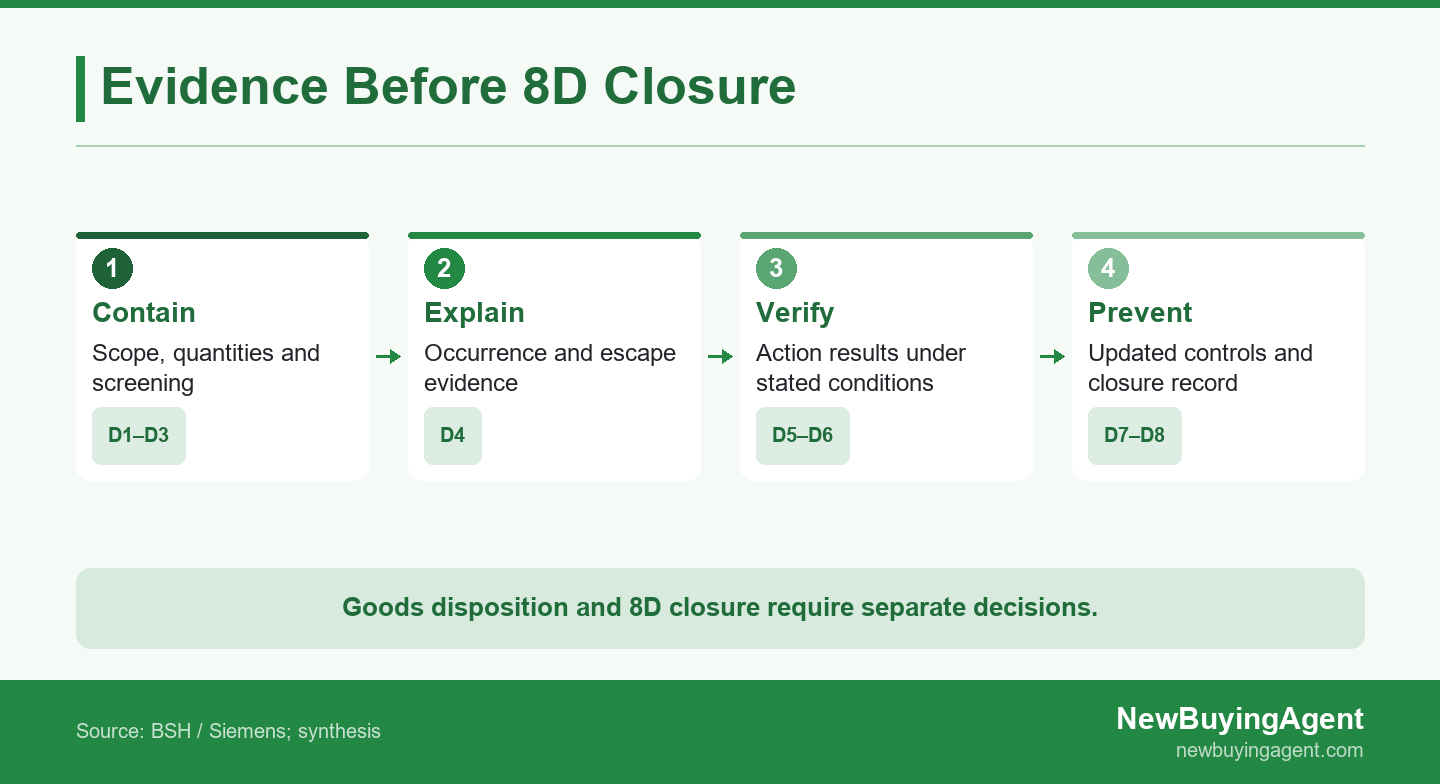
Supplier 8D review links containment, verified causes, proven actions and recurrence controls.
Check Which Products the Containment Actually Protects
Containment is credible when the supplier can show which suspect products are controlled and how the temporary check protects the customer. Review the physical scope before debating the permanent fix. A statement that the factory “sorted everything” is incomplete if goods already left the site, quantities do not reconcile or the sorting method cannot detect the reported failure.
Ask for a stock-location record covering work in progress, finished stock, subcontractor stock where relevant, goods in transit and stock already received. Reconcile the quantities in each location with the identified suspect production window. If the supplier excludes a lot, ask what traceability evidence supports that exclusion. Where records cannot establish a reliable boundary, widen the suspect scope until evidence supports a narrower one.
The screening method matters as much as the screened quantity. For a dimensional defect, photographs of workers checking parts do not show that the gauge distinguishes acceptable and defective pieces. Request the inspection criterion, gauge identification, check records and confirmation using known examples of the actual defect. Track screened, rejected, reworked and unchecked quantities separately to avoid counting the same stock twice.
A passed inspection also answers a narrower question than permanent correction. NIST’s acceptance-sampling guidance explains that sampling supports an accept-or-reject decision for a lot. Apply the agreed inspection or screening plan to goods disposition; use the causal investigation and effectiveness evidence to judge whether the production problem is resolved.
For buyers using existing China suppliers, NewBuyingAgent can manage production and quality at existing China factories. Local factory communication, pre-production, in-process and final inspections, plus real-time and official reporting, give buyers observations they can compare with the supplier’s containment account. Clear buyer instructions help connect those observations to the decision on affected goods.
Ask Why the Defect Occurred—and Why It Escaped
A good root cause explanation answers two questions: why the process created the defect and why the detection control allowed it to escape. These are the occurrence cause and the escape cause. Siemens’ 8D explanation separates the two paths and describes verification of the causes; a report that repairs only one path can leave the other weakness active.
Test the Occurrence Cause Against the Evidence
Treat “tool wear,” “incorrect setting” or “operator error” as a hypothesis until the supplier connects it to the actual failure. Ask what changed, when it changed and why that change explains the observed parts. The explanation should account for the defect’s timing and distribution, including apparently similar products that did not fail.
A worn-tool hypothesis becomes stronger when measurements, tool-use records and a controlled comparison show the same dimensional pattern. It becomes weaker if defects appeared before the tool was installed or affect a different machine that did not use it. Request the evidence that tests the explanation, including contradictory findings. A neatly drawn fishbone diagram or five-why chain organizes an investigation; it does not make every branch true.
Where feasible, the supplier can compare the suspected condition with the corrected condition in a controlled, segregated trial. Record other variables that changed, because replacing a tool, material and fixture together makes the result harder to interpret. For destructive or unsafe failures, use an appropriate engineering investigation without deliberately creating customer exposure. State what the test establishes and what remains uncertain.
Challenge the Detection Control Separately
The escape investigation examines the control that should have found the defect before the next process or customer. Determine whether the feature was missing from the inspection plan, the gauge checked the wrong limit, the method lacked sensitivity or the recorded check was skipped. Each possibility calls for different evidence and a different corrective action.
Use a known defective part to challenge the actual detection method where appropriate. If the method accepts it, adding more checks with the same method will not solve that weakness. If it rejects the part reliably, investigate execution, sampling scope and record integrity instead. The report should show why the chosen explanation fits the escape, rather than defaulting to retraining every inspector.
Require Results Before Calling the Action Effective
An action is effective when results show that it addresses the verified cause under the conditions relevant to production. A revised instruction, training attendance sheet or new fixture proves an implementation activity; it does not by itself demonstrate the result. Agree the evaluation method and acceptance criteria before reviewing the data, including the conditions under which temporary containment can be withdrawn.
Check that the action addresses the occurrence mechanism and the detection weakness where both were confirmed. TI’s 2012 supplier quality document provides a useful first-party example: corrective-action verification checks cause removal and whether another defect was created. For your order, request the corresponding trial record, results against the original failure measure and checks for effects such as assembly fit, damage or performance changes.
Then examine exposure. A short run on one machine and one shift may support that trial’s result, while leaving later tool use or another shift untested. Record the date range, output covered, material and process conditions, measurement method and observations. A statement of “no recurrence” is much more useful when the reviewer can see what opportunities for recurrence were actually observed.
For a suitable measurable characteristic, monitoring can help show whether performance stays consistent. NIST’s control-chart guidance describes plotting a quality characteristic against sample number or time. Choose a method appropriate to the process and data; a chart that tracks a different characteristic will not verify the complaint’s correction.
Be cautious if a supplier turns a handful of passing parts into a capability claim. NIST’s process-capability guidance concerns the output of an in-control process compared with specification limits. Review whether the conditions and data justify that analysis. If they do not, record the successful trial and the follow-up evidence still needed rather than approving an unsupported permanent-resolution claim.
How a Better 8D Response Changes the Buyer’s Decision
A useful supplier review can produce different decisions for existing stock and the changed process. The buyer may accept a verified screening result for identified goods while keeping the investigation open for later production evidence. The following illustrative example shows how an apparently complete response becomes more useful when its observations, causes and decisions are connected.
Illustrative Case: Repeated Undersized Holes
Consider an illustrative order of 12,000 brackets. A receiving inspection finds undersized holes, and production records identify 3,000 suspect pieces made during a particular tool-use window. The supplier initially reports that those pieces were sorted and an operator was retrained. The stock record establishes a possible containment boundary, but the buyer has no evidence that retraining addresses the dimensional failure.
The investigation adds measurements showing hole size moving with tool use, followed by a segregated comparison that supports tool wear as the occurrence mechanism. The team finds that tool-life control was missing. Separately, challenging the final inspection method with a known undersized part shows that its gauge did not test the lower specification limit. These observations explain why the hole became too small and why the final check missed it; they support separate changes to tool control and detection.
The supplier introduces a validated tool-life control and a checked detection method. The buyer keeps the suspect pieces on hold until screening records reconcile their status and the authorized disposition is recorded. A successful changed-process trial supports the next verification stage, while normal-production follow-up across the relevant tool-use conditions is still needed before closure. These numbers and outcomes are illustrative, not a client case or a prescribed sample plan. The improved response makes both the remaining work and the basis for each decision visible.
Close the Report With Controls That Survive the Next Order
Recurrence prevention makes the correction part of routine production, including the situations that could undo it. Review how the supplier changed the work instruction, inspection plan, maintenance rule or other relevant control, and how people now use that change. A report is stronger when the lasting control can be checked during the next order instead of relying on a remembered conversation.
Ask whether the same mechanism exists on similar products, machines or processes. Bosch Rexroth’s supplier quality manual includes lessons learned from similar products and projects in preventive work. The practical buyer lesson is to request a justified transfer review: identify where the cause applies, what changes were made there and why other products were excluded. An unrelated product list does not demonstrate prevention.
For new product purchasing, carry the confirmed failure lesson into the product requirements. NewBuyingAgent can supply products from China against your purchasing needs, connecting those requirements with its local factory network and product/QC capabilities.
For the bracket example, prevention could include tool-life limits in setup instructions, a defined replacement trigger, the correct inspection method and checks after a tooling change. The report should identify document revisions and show that the revised controls are being followed. If a sub-supplier owns part of the failure mechanism, include its action and verification evidence in the connected response.
D8 then records the final review and recognizes the team’s work after the evidence chain is resolved. Retain the complaint reference, relevant attachments, closure date, decision-maker and any clearly scoped residual risk. Resolve outstanding actions or formally manage them through an agreed follow-up process; do not silently label unfinished verification “closed.”
Send a Clear Evidence Request Back to the Supplier
Return an incomplete 8D response with a precise evidence request tied to the decision it blocks. This makes the next supplier update easier to assess than a general demand for a “better report.” Keep the request in the complaint record so both sides can distinguish a missing attachment from an investigation that has not yet established its conclusion.
- Report reference and revision: identify the complaint and update being reviewed.
- Open discipline and gap: name the missing fact, test or result.
- Evidence requested: specify the record, measurement or demonstration that would resolve it.
- Responsible person and next milestone: agree who will respond and when.
- Decision affected: state whether the gap blocks containment acceptance, stock disposition, action verification or closure.
For example: “D4 escape cause remains unverified. Provide the result of challenging the final check with known undersized parts, identify the method used and explain whether the failure was in detection capability or execution. Keep the existing containment in place while that conclusion is unresolved.”
For an affected existing order, share the product specification, defect evidence and current production status to discuss factory management and staged quality checks. Agree the relevant inspection scope and reporting needs, including real-time observations and official inspection reports. Contact NewBuyingAgent about the affected order.
FAQ
How quickly should a supplier submit an 8D report?
Agree milestones according to the defect’s risk and your purchasing requirements. Separate the immediate protection update from the cause investigation and effectiveness review. Customer manuals may specify their own timing; use the applicable agreement and issue severity rather than treating an example deadline as a universal 8D rule.
What if the same defect returns after the 8D is closed?
Reopen the relevant cause and effectiveness conclusions. Compare the recurring defect with the earlier problem definition, then check whether the action was implemented, the mechanism was correctly identified and the verification covered the new conditions. Preserve useful prior evidence and record what changed in the investigation.
Is a completed customer template enough to approve the response?
No; complete fields still need supporting evidence and a clear status. Follow the required customer format when one applies, but verify that each conclusion refers to a usable record. An open action with a named owner and milestone is more transparent than unsupported wording that makes the form appear finished.
Can buyers review a supplier 8D report remotely?
Yes, when the records allow the buyer to check the claims and their scope. Review measurement results, traceability, trial conditions and revised controls remotely. Where a causal claim depends on unobserved factory practice or disputed measurements, request targeted on-site observation or product testing to close that evidence gap.
NewBuyingAgent
Related Resources
Comece hoje
Vamos transformar seus objetivos de compras em realidadeWeChat:+86 15157124615
WhatsApp:+86 15157124615
Endereço: Edifício 10 #39 Xiangyuan Road, Hangzhou, China