
A layered process audit (LPA) is a short, repeated check of important process controls by people at different levels of a factory.
For repeat quality problems at Chinese suppliers, layered process audits are useful when the team needs to verify whether an agreed control survives ordinary production changes. The useful question is whether the required check, setting or method is actually working at the station, including after a restart. A completed form alone cannot answer that.
Repeat-Defect Audits: Key Takeaways
Layered process audits help repeat-defect work when the checks are tied to a specific failure, performed at the active process and followed by a defined response. The layers bring production leaders, technical managers and plant leadership back to the same important control. For an overseas buyer, the value is evidence that the supplier can maintain the correction through normal work, with a clear route for exceptions.
- Definition: Different factory levels repeatedly verify critical process controls.
- Standard: Each question refers to an approved, observable condition.
- Risk: High audit completion can coexist with a repeated defect.
- Decision: Verify control adherence, corrective action and product disposition separately.
When Layered Process Audits Help
Use layered process audits when a repeated defect may be linked to a control that is skipped, reset or inconsistently followed during production. Examples include a torque check missed after a restart, a wrong drawing left at the workstation or a fixture check bypassed during a changeover. The audit checks the condition that should prevent the failure and makes its continued execution visible to several levels of factory management.
The layered approach involves more than sending Quality around the line again. AIAG’s explanation of layered process audits describes quick process verifications performed by different organizational levels, including plant leadership. The buyer should therefore look for management participation at the process and action on obstacles that operators cannot resolve, rather than accept a schedule owned entirely by one inspector.
Keep the purpose separate from shipment acceptance. NIST’s explanation of acceptance sampling describes using information from a sample to decide whether to accept or reject a lot. An LPA instead examines an agreed process control at the time of the audit. A passing workstation check does not establish that goods already made meet the product requirements, and it cannot substitute for the agreed product evaluation.
An LPA is a sensible addition when the standard is clear enough to observe and the supplier has authority to respond to a miss. If the defect mechanism remains uncertain, begin with the process investigation: what changed, when the defect appeared and which operation could produce it. Adding a daily signature to an untested explanation can make the reporting look stronger while leaving the actual failure untouched.
Use the China manufacturing and product guide to place these checks in the product’s manufacturing context. Materials, machining, assembly and finishing can require different controls. The checklist should follow the actual route and approved product requirements, so the same generic question does not quietly stand in for several different operations.
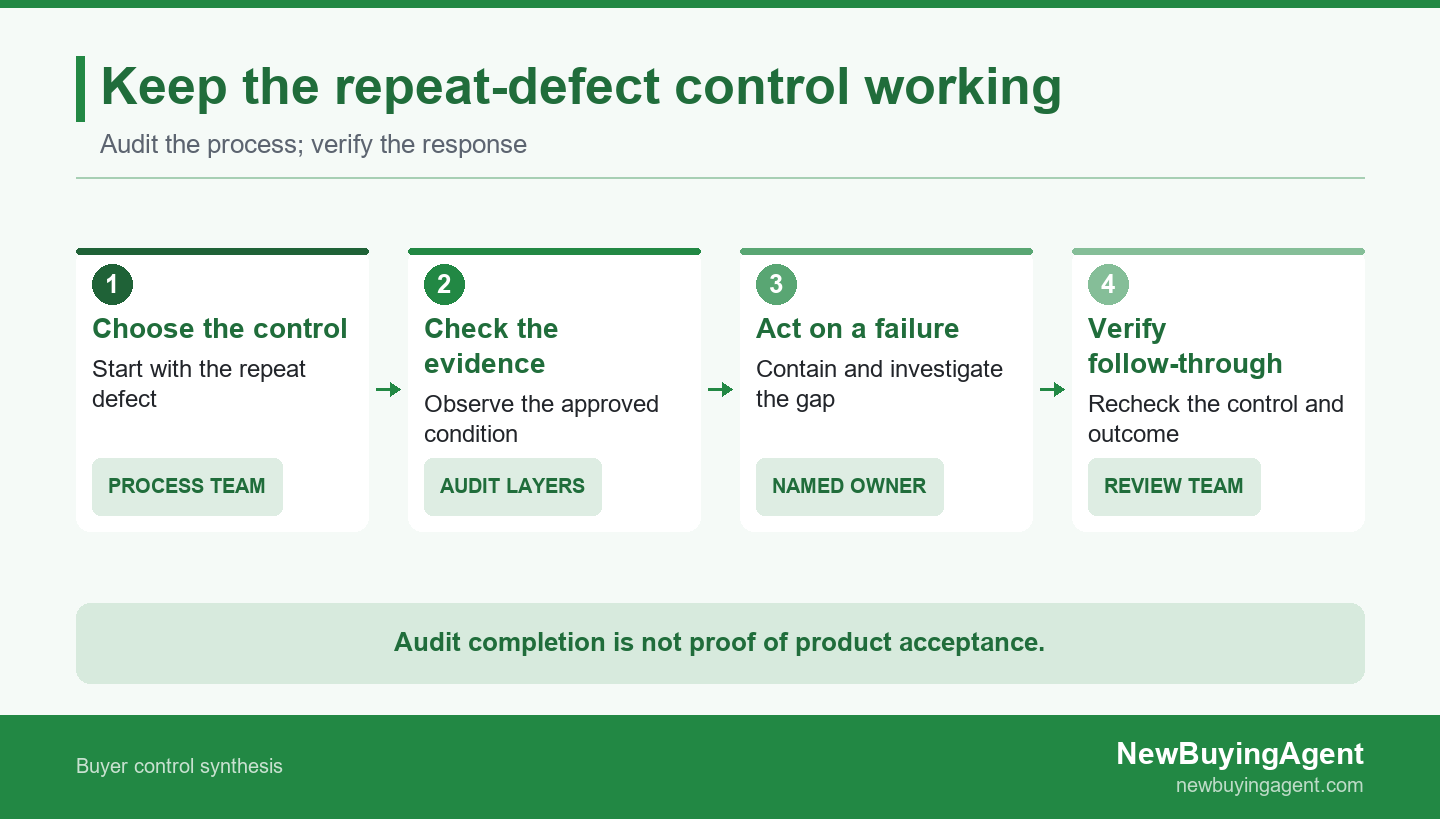
Turn a repeat defect into a control question, check it across factory layers and verify the response; product release needs separate evidence.
Turn Repeat Defects Into Observable Audit Questions
Write the audit question around an observable control condition, its approved reference and the response when the condition cannot be verified. Start with the repeat defect, then ask what the auditor can see, compare or witness at the active station. A good question identifies the object being checked and the expected state, so two auditors can reach the same conclusion using the same evidence.
A question such as “Is quality OK?” leaves the auditor to invent the criteria. AIAG’s discussion of effective LPA questions emphasizes objective, specific questions and reviewing checksheets when the audit adds little value. For a loose-fastener problem, ask whether the current torque tool setting matches the approved assembly reference and whether the required restart check is recorded. Those questions reveal a particular gap and give the supplier something concrete to correct.
Choose the Control to Verify
A repeated defect can reflect an unperformed control, an ineffective standard or an unreliable measurement method. These explanations require different responses. If the specified setting is repeatedly missed, the audit can help expose the adherence gap. If the setting is followed and the product still fails, engineering needs to reconsider the setting, equipment or underlying method. Asking workers to sign the same instruction more often does not resolve that second problem.
Correct execution and a suitable process are distinct questions. NIST’s process capability guidance compares the output of an in-control process with specification limits. This matters when a stable operation still produces unacceptable variation: verifying its routine setting is useful, but the setting or method may need technical improvement. Do not derive a capability claim from a few LPA pass marks; it needs appropriate measurements and analysis of the actual process output.
Write a Checksheet That Requires Evidence
Record the actual reference, result and evidence for each check rather than a signature that only confirms the form was completed. Write the questions in language the supplier’s auditors can use at the station, and retain the drawing, instruction or approved setting version that defines a pass. Where possible, ask the auditor to observe the control during work. A historical record can support the check, but it may not demonstrate the current condition after a recent change.
Use this checksheet as a starting point, replacing its product-specific references with the supplier’s approved requirements. Record the product, station, shift, actual audit time, auditor and form version above it. For each row, enter the reference and evidence before choosing pass, fail or not applicable. Explain a not-applicable answer; if the auditor cannot verify a relevant condition, record that gap and use the agreed response instead of marking it as passed.
| Audit question | Reference, result and evidence to record |
|---|---|
| Is the current product and revision identified at this station? | Product/revision: _____; approved instruction: _____ |
| Does the active setting match the approved process reference? | Required setting: _____; observed setting: _____ |
| Was the required startup or restart check completed? | Trigger/time: _____; check record or witnessed result: _____ |
| Is the specified tool or gauge available and within its agreed control status? | Tool/gauge ID: _____; status evidence: _____ |
| Is the required error-prevention or detection control functioning? | Approved test method: _____; actual observation: _____ |
| Can potentially affected goods be identified when this control fails? | Batch/time window: _____; location/identity evidence: _____ |
| Was the previous action verified under its agreed conditions? | Action ID: _____; verification evidence: _____ |
| What response follows a fail or an unverifiable condition? | Owner/action: _____; affected scope and follow-up: _____ |
For each answer, preserve what was actually observed. A photo may show the selected setting but omit the product revision; a copied inspection record may refer to the previous shift. Record the identity and time that connect the evidence to the question. The supervisor should be able to reconstruct why the auditor selected the result without relying on the auditor’s memory or on an unexplained green tick.
Assign Audit Layers, Timing and Escalation
Give production leaders, technical managers and plant leadership distinct responsibilities for checking the same high-risk control and acting on findings. The frontline layer can observe routine execution close to the work; higher layers can confirm follow-through, challenge recurring gaps and remove resource barriers. Keep the core question consistent across layers while making each person’s responsibility clear, so the routine adds independent attention rather than several signatures on one form.
Ownership is broader than the quality department. The public AIAG CQI-8 overview expands ownership beyond Quality and covers process-specific checksheets, roles, findings and management review. Use that scope to assess the supplier’s proposed routine. A technical manager can address an inadequate fixture or unclear instruction, while plant leadership can resolve a shortage of controlled tools or time for the required check. Neither contribution is captured by audit completion alone.
Set audit timing around risk and changes such as restart, shift change or tool replacement, rather than assume one universal schedule. A weekly visit to a continuously running station may miss the short restart condition that causes the defect. Agree a routine cadence and the events that trigger extra verification. Ensure coverage reaches the relevant shifts and workstations, then revise the frequency when findings or process changes show that the current coverage is insufficient.
The layer plan below is an illustrative starting arrangement to agree with the supplier, not a prescribed CQI-8 frequency table. Name an actual person and substitute a locally approved cadence for each role.
| Layer and verification focus | Timing to agree | Follow-through to record |
|---|---|---|
| Production leader: observe the critical control at the active station | Routine cadence: _____; change/restart triggers: _____ | Actual condition and immediate response; unresolved gap sent to: _____ |
| Quality or technical manager: verify findings and corrective action | Review cadence: _____; repeat-failure trigger: _____ | Cause investigation, technical correction and verification evidence: _____ |
| Plant leadership: sample execution and remove recurring barriers | Visit cadence: _____; overdue/systemic trigger: _____ | Resource decision, accountable owner and follow-up date: _____ |
Treat a missed audit as a separate record from a failed control. One means the verification did not happen; the other means it happened and found a problem. Assign a response to both. In particular, a relevant control that was never checked should not disappear into the average completion rate, and an auditor should not backdate a record to make the schedule appear complete.
Respond to Findings Without Assuming Product Release
A failed process check calls for immediate control of the suspected product scope, a responsible investigation and separate verification of the corrective action. First identify what may have been produced while the control was missing or incorrect, and prevent that uncertainty from passing downstream unnoticed. Then restore the control and test whether the correction addresses the problem. The agreed product evaluation and authorized disposition determine what happens to the identified goods.
Record the finding, affected process, evidence and actual time. Give the owner a due date and a verification condition that relates to the failure: for a restart gap, observe a restart, rather than check an unchanged machine later. If batch identity or timing is inadequate, widen the potentially affected scope until the investigation can establish a defensible boundary. Escalate a repeat failure or overdue action to someone with authority to change the method or resources.
For buyers keeping existing Chinese suppliers, China-side factory management through NewBuyingAgent can support supplier communication, production follow-up, staged QC and logistics. Its local product development and quality-control capability is relevant when an overseas quality team needs usable production evidence from the factory. Agree the recurring defect and inspection needs within that broader management arrangement, including which reports support the buyer’s production decision.
Example: A Torque Check Missed After Restart
In this illustrative example, an importer orders 9,000 cabinet handles assembled at a Chinese supplier. An earlier loose-fastener finding is marked closed after the factory updates its restart instruction. During a later plant-manager audit, the torque-check field is blank for the restart window in which 1,200 pieces were assembled. The missing record provides no actual torque result; the exercise concerns what the buyer and supplier should do with that uncertainty.
The missing check makes the 1,200-piece restart window uncertain. It does not establish that every handle is defective or that the other pieces are acceptable. The factory holds the identified group pending product evaluation and investigates whether the check was skipped, performed without a record or recorded against the wrong work. If the production records cannot bound the window, the initial hold cannot be treated as the full affected scope. The same failure should also be reviewed against the supposedly closed action.
The supplier restores the check and plans observed restart verification, product evaluation and authorized disposition before closing the action. The revised audit question names the restart trigger and the evidence expected from that event; the technical manager checks whether the requirement is workable across the relevant shifts. This example does not assume a completed successful result. Correction of the form or tool setting is an action taken, while observed execution and the identified product’s evaluation remain the verification gates.
Measure Whether the Repeat Problem Is Improving
Review audit coverage, repeat findings and the original defect outcome separately, using comparable periods and an explicit denominator. Completion shows whether the planned checks happened; findings show what they detected; defect evidence shows whether the production problem changed. Read the measures together and by the relevant shift, station or product, because a factory-wide average can hide a concentrated failure in the operation that matters to this order.
Keep the quality outcome visible over time. NIST’s control-chart explanation describes displaying a quality characteristic against sample number or time. An appropriate chart can support the technical review of process behavior; the LPA record answers whether a selected control was verified. The measures complement each other. Define the data collection and analysis method before comparing periods, rather than turn pass marks on an audit checklist into an unsupported statistical claim.
- Coverage: Completed checks against planned checks, showing missed work separately.
- Recurrence: Findings on the same control, identified by station and shift.
- Follow-through: Open, overdue and verified actions, with the verification condition visible.
- Product outcome: The original defect with a consistent unit or opportunity denominator and the relevant production period.
Increase or adjust the audit focus when the same control fails again, even when completion is high. Repeated green checks alongside recurring defects call for a review of the question and standard: did the auditor verify the wrong condition, visit at the wrong time or apply a criterion that does not prevent the defect? A rising finding count can initially reflect better detection, so judge the finding and its response before assuming that more findings mean worse production.
Evaluate the Supplier’s Audit Routine Before Commitment
Before committing to the next production run, ask the supplier to demonstrate an actual audit, one finding’s response and the evidence used to verify its closure. Review the routine on the operation linked to the repeat defect, rather than judge a presentation about the whole factory. The useful outcome is confidence that the proposed questions, responsibilities and reaction rules can be carried out under the conditions this order will face.
- Identify the repeat defect and the approved control intended to address it.
- Ask two auditors to apply the same question to one live station and compare their evidence.
- Check whether the audit reaches the relevant shifts, restarts and changes.
- Follow one failed or missed check from finding to owner, response and verification.
- Confirm how potentially affected goods are identified and evaluated.
- Compare the repeat-defect outcome with the audit results using the agreed denominator.
When the purchasing decision involves a new China-sourced product, the quality history belongs in the specification and sourcing discussion from the start. Buyers can provide those needs through NewBuyingAgent’s China product-supply service. Its local China factory network and product development/QC capability can support the supplied product’s price, quality and delivery needs. The repeat-defect history helps describe what the supplied product must achieve.
To discuss the relevant arrangement, send the purchasing requirements with the product specification, quantity, target price, destination and timing, plus the existing supplier details and repeat-defect history where relevant. NewBuyingAgent can discuss China product supply or existing-factory management; agreed staged quality reports then help the buyer assess the agreed production decision and the next order.
Frequently Asked Questions
Are layered process audits mandatory for every Chinese supplier?
A supplier’s location alone does not make layered process audits mandatory. Check the customer’s actual contract and applicable product or sector requirements before describing a particular routine as required. Where a customer requires a named guideline, agree its current version, scope and evidence expectations with the supplier rather than assume the generic checklist establishes compliance.
Can the buyer perform every audit remotely?
Remote evidence can support the review, but it cannot always verify the live process condition. A video call might show a setting or witness a check, while leaving its timing, product identity or later execution uncertain. Agree which questions can be answered remotely and which need competent onsite observation. Keep those limits visible in the record instead of labeling all collected photographs as an equivalent factory audit.
What if the repeat problem comes from a subcontractor?
Include the subcontracted process when it may explain the repeat defect, and agree who can verify the relevant controls. The main factory’s assembly checklist cannot establish what happened during outside coating or heat treatment. Clarify access, responsibility and the evidence returned with the goods before relying on the routine. If verification cannot reach that operation, retain the evidence gap in the supplier evaluation and product investigation.
Does an LPA pilot need dedicated audit software?
A small LPA pilot can use a controlled paper form or spreadsheet if the records remain usable and current. Preserve the question version, actual audit time, evidence, owner and follow-up so a later reviewer can reconstruct the result. Software may simplify scheduling and reporting as the routine grows, but it cannot make an ambiguous question objective or verify a control that nobody actually observed.
NewBuyingAgent
Related Resources


Comece hoje
Vamos transformar seus objetivos de compras em realidadeWeChat:+86 15157124615
WhatsApp:+86 15157124615
Endereço: Edifício 10 #39 Xiangyuan Road, Hangzhou, China