

Customs Holds and Inspections
A customs hold occurs when customs authorities temporarily prevent a shipment from being released while they review information, verify compliance, or conduct further examination. Depending on the circumstances, authorities may request additional documents, examine the cargo, or refer the shipment for review by another government agency.
For shipments entering the United States, U.S. Customs and Border Protection (CBP) may place a hold when additional documentation or examination is required. A shipment subject to a hold generally cannot be released until the relevant hold is removed and applicable release requirements are met. [1][2]
A customs hold does not automatically mean that the goods have violated the law. It may result from missing paperwork, an information discrepancy, a routine or risk-based examination, or a concern that needs further investigation.
It is important to distinguish among three related terms:
- Customs hold: The shipment is temporarily prevented from being released while an issue is reviewed or a required step is completed.
- Customs examination: Customs authorities inspect documents, cargo, or both to verify shipment information and compliance.
- Customs seizure: Authorities take legal control of goods under applicable enforcement procedures. This is more serious than a routine hold or examination and may involve suspected violations.
The exact terminology and legal consequences vary by jurisdiction. Importers should follow the official notice they receive rather than assume that every delay is a seizure.
Why Do Customs Authorities Hold or Inspect Shipments?
Customs authorities may examine shipments for different reasons. Some involve administrative errors; others relate to product regulations, duties, security, or enforcement concerns.
1. Missing or Incorrect Documentation
Commercial invoices, packing lists, shipping documents, and customs declarations need to describe the shipment accurately and consistently.
Common problems include:
- Product descriptions that are vague or incomplete.
- Differences in quantity or value between documents.
- Incorrect consignee or importer information.
- Missing permits, certificates, or other required supporting documents.
- Inconsistent country-of-origin information.
CBP identifies incomplete or incorrect paperwork as one possible reason an imported shipment may be delayed. [2]
2. Questions About Customs Value or Tariff Classification
Customs authorities may review the declared value of goods or the tariff classification used to determine applicable duties and regulatory requirements.
For example, an invoice that does not clearly explain the products being imported, or a declared value that requires supporting evidence, may lead to further questions.
Importers should retain relevant commercial records, including purchase orders, invoices, payment records, and product specifications. The appropriate supporting information depends on the issue being reviewed.
3. Product Restrictions or Additional Regulatory Requirements
Certain products may be subject to requirements administered by agencies other than customs. Depending on the product, these may include permits, product-specific documentation, safety requirements, or other regulatory controls.
CBP advises importers to check requirements that apply to their particular commodities and to consult the relevant government agency when necessary. [3]
Importers should therefore verify applicable requirements before shipping rather than assume that a general customs entry alone is sufficient.
4. Security Screening or Risk-Based Examination
Customs authorities use shipment information and risk assessment procedures to determine whether further review is needed. A shipment may be selected for examination even when the importer has not identified an obvious documentation error.
Selection for inspection does not, by itself, prove that the goods are non-compliant.
5. Unpaid Duties, Taxes, or Outstanding Requirements
A shipment may remain unreleased if required payments, documents, or other clearance steps are incomplete. The specific issue should be confirmed with the customs broker, carrier, or relevant authority rather than inferred from the shipment's delayed status. [2]
6. Concerns About Prohibited Goods or Trade Enforcement
Customs authorities may hold goods when there are concerns about prohibited or restricted merchandise, suspected counterfeiting, or potential violations of trade laws. Certain enforcement measures can also affect goods suspected of being connected to prohibited production practices. [2]
Such cases may require additional investigation and cannot necessarily be resolved by correcting a routine paperwork error.
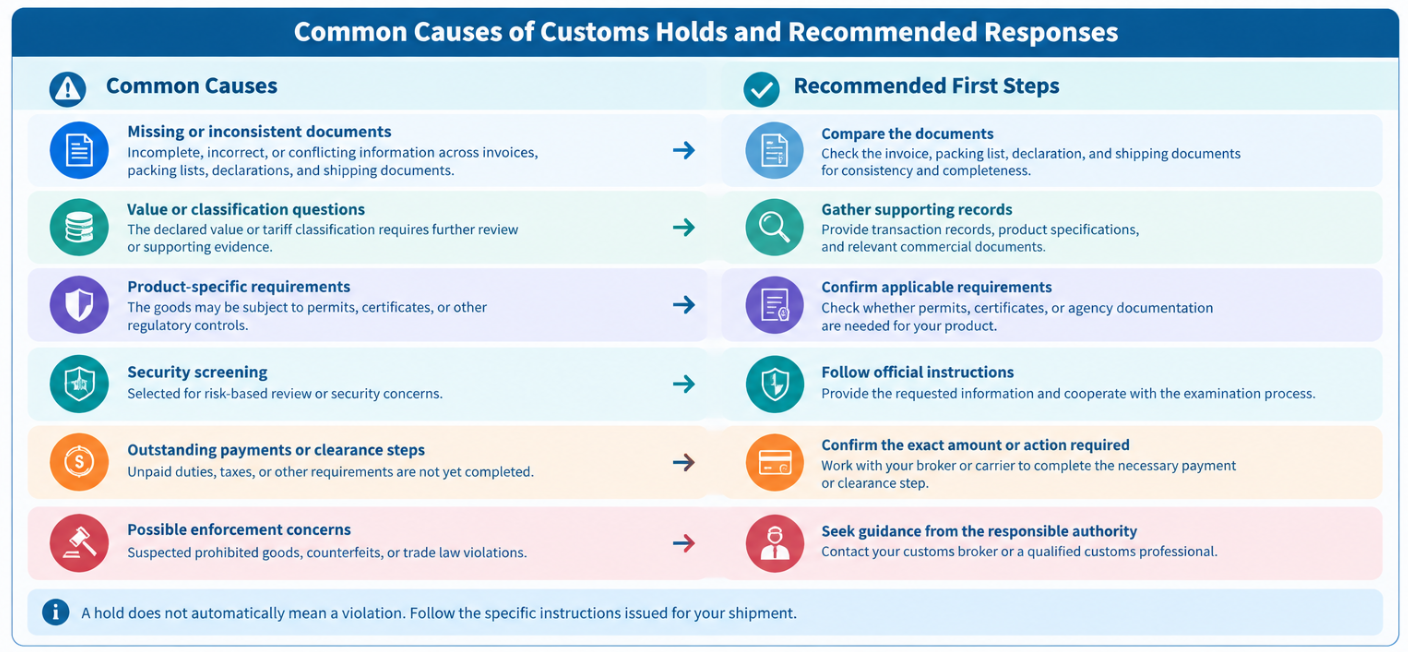
Image caption: Common reasons for customs holds and the first steps importers can take to address them.
What Happens During a Customs Inspection?
The process depends on the reason for the hold, the type of shipment, and the authority involved. A review may be documentary, physical, or both.
Document Review
Customs authorities may request additional information to verify the declared goods or determine whether applicable requirements have been met. The importer or its broker may need to provide commercial documents, product descriptions, valuation records, or other supporting evidence.
Physical Examination
A physical examination involves making the cargo available for inspection. In the United States, certain intensive CBP examinations require cargo to be transferred to a designated Centralized Examination Station (CES). The shipment cannot move without the required authorization while the applicable hold remains in place. [1]
Examination-related costs may include cargo movement, unloading and reloading, handling, and storage. CBP notes that importers may be responsible for costs associated with making goods available for examination, even though the examination itself is not ordinarily charged as a CBP service. Actual third-party charges vary by location and circumstances. [3]
Review by Another Government Agency
Some products require review or authorization from an agency other than customs. Depending on the commodity and the issue, the importer may need to work with that agency or provide additional evidence before the shipment can proceed. [3]
Release or Further Action
After the review, authorities may release the goods, request additional information, require further examination, or take other action under applicable law.
There is no universal release timeframe. The duration depends on the reason for the hold, the complexity of the issue, the completeness of the information provided, and the relevant agency's procedures.
What Should You Do If Customs Holds Your Shipment?
When a shipment is held, the most useful first step is to establish the exact status and the action required. Avoid making assumptions based only on a tracking message or an informal statement from a supplier.
Step 1: Confirm the Shipment's Status
Contact your customs broker, freight forwarder, or carrier to determine:
- Which authority or agency has placed the hold.
- Whether the issue involves documents, physical examination, payment, or another requirement.
- Whether a formal notice or document request has been issued.
- Which party is expected to respond.
For U.S. shipments, CBP directs users seeking information about an intensive examination to contact the relevant service port. [1]
Step 2: Obtain the Specific Reason and Instructions
Ask for the official notice, status message, or document request whenever available. Confirm the submission method, deadline, and any reference number associated with the shipment.
If the reason is unclear, ask the broker or responsible authority to clarify it before submitting unrelated documents or making changes to the declaration.
Step 3: Gather the Relevant Supporting Records
Depending on the issue, the documents may include:
- Commercial invoice and packing list.
- Purchase order or sales contract.
- Bill of lading or air waybill.
- Product specifications, material composition, or intended-use information.
- Payment records or other evidence supporting the declared transaction value.
- Permits, certificates, or other documents required for the product.
Provide the documents that address the actual question raised. Keep copies of submissions and records of communications.
Step 4: Coordinate with the Correct Parties
The customs broker can assist with customs entry issues within the scope of its engagement. The freight forwarder or carrier may provide transport status and coordinate cargo movement. The importer or supplier may need to provide commercial records or product information.
If another government agency is involved, follow the instructions of the agency responsible for the requirement.
Step 5: Monitor the Case and Control Additional Costs
Ask whether storage, demurrage, detention, examination handling, or other charges may accrue while the shipment is held. These charges are not identical, and the applicable terms depend on the carrier, facility, contract, and shipment circumstances.
Track the case until you have confirmation that the hold has been removed and the goods are authorized for release. A document submission alone does not necessarily mean the shipment has been cleared.
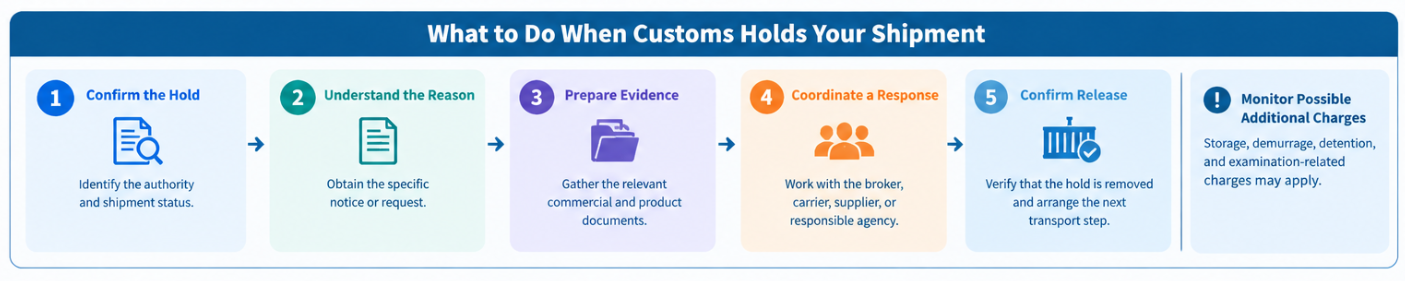
Image caption: A practical response workflow for importers whose shipments are held by customs.
How Can Importers Reduce the Risk of Customs Delays?
Not every customs examination can be prevented. However, importers can improve the accuracy and completeness of their shipment information before goods leave the supplier.
Keep Shipment Documents Consistent
Review the commercial invoice, packing list, transport documents, and customs declaration for consistency. Check product descriptions, quantities, values, parties' details, and country-of-origin information.
Provide Specific Product Descriptions
Descriptions such as “accessories,” “parts,” or “household goods” may not provide enough information for customs purposes. Describe what the product actually is and provide relevant details such as material, function, composition, and intended use when applicable.
Check Requirements Before Shipping
Identify whether the product is subject to additional permits, certificates, declarations, or agency requirements in the destination country. Do this before the shipment departs whenever possible.
Maintain Supporting Commercial Records
Keep purchase orders, invoices, payment records, product specifications, and other records that explain the transaction. If customs questions the declared value or classification, these records can help support a response.
Confirm Filing Responsibilities and Deadlines
Clarify who is responsible for the customs entry and any advance cargo filings. For example, U.S.-bound ocean shipments are subject to Importer Security Filing requirements, including a filing deadline before the cargo is loaded onto the vessel. [4]
Communicate Changes Promptly
If the product, quantity, packaging, value, or shipping arrangements change after documents have been prepared, tell the relevant parties promptly. Correcting information before filing or shipment may help avoid inconsistencies later.
Customs Hold vs. Customs Examination vs. Customs Seizure
These terms describe different situations and should not be used interchangeably.
- Customs hold: A release restriction while customs or another responsible authority reviews an issue or awaits a required action.
- Customs examination: A review of shipment documents, physical cargo, or both.
- Customs seizure: A formal enforcement action in which authorities take control of goods under applicable legal procedures.
A hold may lead to an examination, and an examination may uncover an issue requiring further action. However, a hold or inspection does not automatically result in seizure.
If a formal seizure notice or enforcement action is issued, follow the notice carefully and obtain qualified advice about the applicable response procedures and deadlines. Do not treat a serious enforcement matter as an ordinary documentation delay.
Frequently Asked Questions
How long can customs hold a shipment?
There is no single timeframe that applies to every shipment. Some document issues may be resolved relatively quickly, while physical examinations, agency reviews, or enforcement concerns can take longer. Ask the responsible authority or service provider for the current status and any outstanding requirements.
Does a customs hold mean my goods are illegal?
No. A hold may result from missing information, routine screening, a document discrepancy, or a need for further review. The specific reason and any official instructions determine what happens next.
Who pays for a customs inspection?
Responsibility depends on the applicable law, the type of examination, and the relevant service agreements. In the United States, CBP explains that importers may be responsible for costs associated with preparing and moving cargo for examination, including charges from third-party facilities. [3] Confirm expected charges with the broker, carrier, or examination facility.
Can a customs broker get my shipment released faster?
A customs broker may help identify outstanding requirements, prepare or correct customs submissions, and communicate with customs authorities within the scope of its authorization. However, a broker cannot guarantee release or override an authority's decision.
Can I ask customs why my shipment is being held?
Yes. Start with your broker or carrier to obtain the shipment status and any available notice. If further clarification is needed, contact the responsible authority through its official channels. For U.S. intensive examinations, CBP advises contacting the relevant service port. [1]
What if customs asks for additional product information?
Provide accurate information that addresses the request, such as product composition, function, intended use, manufacturer details, or supporting transaction records. If you do not understand the request or believe the information is being interpreted incorrectly, seek clarification before submitting a response.
Will I have to pay storage or other charges during a hold?
Possibly. Depending on the shipment and service agreements, storage, terminal handling, examination facility, demurrage, or detention charges may accrue. Ask the relevant providers which charges apply, when they begin, and whether any options are available to limit additional costs.
Final Thoughts
A customs hold can disrupt delivery schedules and create unexpected costs, but it does not automatically indicate a violation. The most effective response is to establish the exact reason for the hold, follow the official instructions, provide accurate supporting information, and coordinate with the parties responsible for customs clearance and transportation.
Importers can also reduce avoidable problems by preparing consistent documents, understanding product-specific requirements, and confirming filing responsibilities before shipping.
For businesses sourcing products from China, NewBuyingAgent helps buyers communicate their purchasing requirements and source products across categories. Importers should separately confirm the customs brokerage, freight forwarding, and destination-specific compliance arrangements needed for each shipment.
References
[1] U.S. Customs and Border Protection (CBP). CBP Intensive Physical Exam Status. https://www.help.cbp.gov/s/article/Article-1268?language=en_US
[2] U.S. Customs and Border Protection (CBP). Importers - I ordered goods from abroad, but the seller said they are being held up by CBP. https://www.help.cbp.gov/s/article/Article-1171?language=en_US
[3] U.S. Customs and Border Protection (CBP). Tips for New Importers and Exporters. https://www.help.cbp.gov/s/article/Article-1894?language=en_US
[4] U.S. Customs and Border Protection (CBP). Import Security Filing (ISF) - When to submit to CBP. https://www.help.cbp.gov/s/article/Article-1868?language=en_US
Related Knowledge Base
Sourcing Practices & Insights: Customs Holds and Inspections
Latest Sourcing Guides

Get Started Today
Let's Turn Your Sourcing Goals into RealityWeChat:+86 15157124615
WhatsApp:+86 15157124615
Address:Building 10 #39 Xiangyuan Road, Hangzhou, China
