

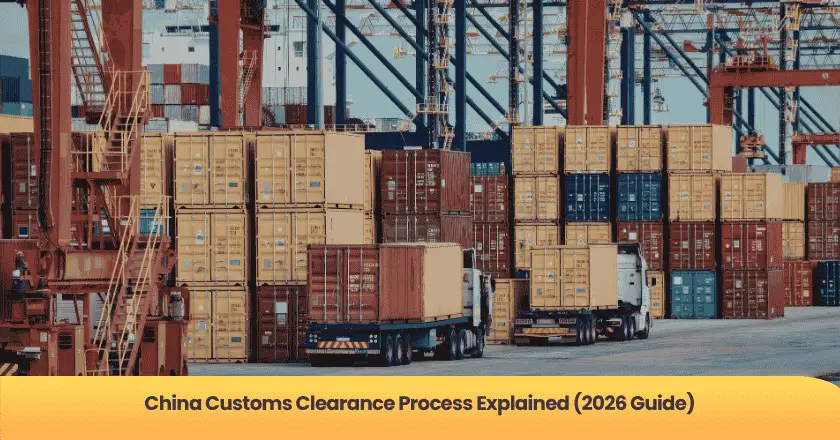
If you've ever had a shipment sit at the port for days — with no clear explanation from your freight forwarder — you already know the frustration customs clearance can cause. For importers sourcing from China, this stage is consistently the least understood part of the supply chain, yet it carries the highest operational risk: unexpected duties, regulatory holds, or outright seizure of goods.
The landscape has shifted considerably heading into 2026. New tariff structures, tightened ISF enforcement, and the expansion of AI-assisted risk targeting by U.S. Customs and Border Protection (CBP) have changed how cross-border shipments are processed and screened. The elimination of de minimis exemptions for Chinese-origin goods — a seismic policy shift — has added a new layer of compliance pressure even for small-volume importers.
This guide breaks down exactly how the customs clearance process works, what documents are required, where costs are often hidden, and how to move goods across borders efficiently — without the delays that drain time and margin.
Key Takeaways
- Customs clearance is a government-mandated process required for every international commercial shipment; it verifies compliance with trade law before goods are released into the destination market.
- The process involves three core stages: document verification, duty and tax assessment, and official release of goods — any failure in this chain delays the entire shipment.
- Incorrect or incomplete documentation is the single leading cause of clearance delays; a value discrepancy on a commercial invoice is enough to trigger a formal examination.
- In 2026, CBP has expanded AI-assisted risk targeting, meaning low-documentation or inconsistent shipments face a substantially higher likelihood of physical inspection.
- Section 301 tariffs on Chinese goods remain in effect, with select HS code categories seeing rate adjustments — verifying your classification is no longer a best practice, it's a necessity.
- The U.S. de minimis exemption (previously $800 USD) no longer applies to goods of Chinese origin under revised 2025–2026 executive policy.
- A licensed customs broker is not legally required in most jurisdictions, but significantly reduces error rates — particularly for shipments valued over $2,500 USD or involving regulated product categories.
1. What Customs Clearance Actually Means
Customs clearance is the formal process by which a government's border authority reviews, assesses, and approves goods entering or leaving a country. In plain terms: your shipment cannot legally enter the destination market until the relevant customs agency releases it. That release isn't automatic — it follows a sequence of steps that your documentation either supports or delays.
Every commercial import from China — whether it's a pallet of consumer electronics, apparel, industrial components, or food products — must pass through this process. There are no exceptions based on shipment volume or shipping method, though the complexity scales with both the value and the nature of the goods.
The customs authority in the United States is U.S. Customs and Border Protection (CBP). In the UK, it's His Majesty's Revenue and Customs (HMRC). In Canada, the Canada Border Services Agency (CBSA) manages clearance. Each operates under its own regulatory framework, though many underlying documentation requirements are standardized internationally through the World Customs Organization (WCO).
What most importers underestimate is that customs clearance is not a single event. It's a sequence: a formal entry is filed, documents are reviewed, duties are assessed, payment is confirmed, and only then are goods released. Any break in that chain — a missing certificate of origin, a miscoded tariff heading, an undervalued commercial invoice — halts the entire shipment. In a supply chain built around tight lead times, that disruption has real financial consequences.
Expert Tip: Don't conflate customs clearance with customs inspection. Clearance is the administrative process of approving a shipment based on documentation. Physical inspection — where customs officers actually examine the cargo — is a separate, risk-triggered event. The quality of your paperwork is the single most controllable factor in keeping your shipments off the physical examination shortlist.
2. The Customs Clearance Process
Understanding the sequence of clearance helps you identify where failures occur — and address them before a shipment is already sitting at the dock.
Stage 1
Pre-Shipment Filing (ISF)
For shipments bound for the United States via ocean freight, the Importer Security Filing (ISF) — sometimes called "10+2" — must be submitted to CBP at least 24 hours before cargo is loaded onto the vessel in China. This document identifies the importer of record, the seller, the manufacturer, the country of origin, and commodity-level details. Late or missing ISF filings carry penalties of up to $5,000 per shipment under current CBP enforcement policy. This is not a technicality enforcement teams overlook — it's one of their primary compliance metrics.
Stage 2
Arrival and Entry Filing
When a shipment arrives at the port of entry, a formal customs entry is filed with the relevant authority. In the U.S., formal entry is required for goods valued at $2,500 or more. The entry documentation package — commercial invoice, bill of lading, packing list, and applicable certificates — is submitted electronically through CBP's ACE (Automated Commercial Environment) system. It's at this stage that automated targeting algorithms first screen the shipment profile against known risk indicators.
Stage 3
HS Classification and Duty Assessment
Goods are classified using the Harmonized System (HS) code — a standardized international nomenclature that assigns each product a numerical code, which directly determines the applicable duty rate. For Chinese-origin goods in 2026, getting this right carries heightened stakes: an HS code error can be the difference between a standard 5% duty and a 25% Section 301 tariff. Customs authorities may also apply anti-dumping (AD) or countervailing duties (CVD) on specific product categories where foreign price manipulation has been formally determined.
Stage 4
Payment and Release
Once duties and fees are assessed, payment must be confirmed before goods are released. Under DDP (Delivered Duty Paid) incoterms, the seller or freight forwarder arranges payment in advance; under DDU/DAP (Delivered At Place), the liability falls on the importer at the destination port. A compliant shipment with accurate documentation can clear in hours. Shipments flagged for document review or physical examination can sit for days — or longer.
Common Mistake to Avoid
Undervaluing goods on the commercial invoice to reduce duty exposure is customs fraud — full stop. CBP cross-references declared values against transaction databases and published market benchmarks. Flagged undervaluation triggers back-duty assessments, penalties, and places your importer of record (IOR) profile under long-term heightened scrutiny. The short-term saving is rarely worth the long-term compliance cost.
3. Documentation: The Paperwork You Cannot Get Wrong
No part of the clearance process is more directly under the importer's control — and more consistently mishandled — than documentation. The following are standard requirements for China-origin imports:
- Commercial Invoice (CI): Must include the full legal names and addresses of buyer and seller, a detailed description of goods (not just a product name or SKU), unit prices, total declared value, transaction currency, and country of origin. This document forms the basis of duty calculation — its accuracy is not negotiable.
- Bill of Lading (BOL) / Air Waybill (AWB): Issued by the carrier, this is the legal contract of carriage and the primary document establishing title to the goods. For sea freight, a negotiable BOL is typically required. Discrepancies between the BOL and the commercial invoice are among the most common triggers for examination.
- Packing List: Specifies the contents of each carton or pallet — dimensions, weights, quantities, and item-level descriptions. Customs officers use this to verify the physical shipment against declared contents. Vague packing lists invite scrutiny.
- Certificate of Origin (COO): Required when claiming preferential duty treatment under trade agreements, or for goods subject to origin-specific tariff measures. For Chinese-origin goods entering the U.S. under current trade policy, this document is subject to close review — particularly where country-of-origin marking compliance is at issue.
- Import License (where applicable): Certain regulated categories — food and agricultural products, medical devices, chemicals, textiles, firearms — require additional licenses or permits before import is permitted. Attempting to clear regulated goods without the appropriate license results in immediate holds.
In 2026, electronic filing is the standard across the U.S., EU, and most major import markets. Paper-only submissions raise flags in automated screening systems that weren't designed to accommodate them. If your freight forwarder is still handling entry documentation primarily on paper, that's worth revisiting.
Expert Tip: Document mismatches are among the most preventable causes of customs holds. The product description on your commercial invoice, packing list, and entry filing must be consistent — not just broadly similar. "Aluminum components" on one document and "machine parts" on another will prompt an examination request, even if the goods are identical. Standardize your product descriptions across all shipment documents before goods leave the factory.
4. Duties, Tariffs, and What's Actually Changed in 2026
The duty landscape for China-origin goods remains one of the most complex in global trade — and 2026 has brought further adjustments that importers need to track actively.
Section 301 tariffs, first imposed in 2018, continue to apply to a broad range of product categories. The USTR's ongoing review has resulted in rate changes across specific HS code ranges — some categories (notably select industrial inputs) have seen modest reductions, while others in clean energy components and advanced electronics have been subject to increases. Treating your Section 301 exposure as a fixed, known quantity is a mistake; verification against the current USTR tariff schedule should be part of every new product sourcing decision.
Beyond base duties, importers are also liable for Merchandise Processing Fees (MPF), Harbor Maintenance Fees (HMF) on ocean freight, and — for specific product categories — anti-dumping and countervailing duties (AD/CVD). These additional levies can be substantial: AD/CVD rates on steel products or solar components, for instance, can reach multiples of the standard duty rate.
One development that has materially affected importers of all sizes: the U.S. de minimis threshold. Previously, shipments valued under $800 USD were exempt from formal customs entry and duties. Under revised 2025–2026 executive policy, this exemption no longer applies to goods of Chinese origin — meaning direct-to-consumer small-parcel shipments from Chinese sellers are now subject to standard duty assessment. For businesses reliant on high-volume, low-value cross-border fulfillment models, this change has forced significant supply chain restructuring.
Common Mistake to Avoid: Many importers rely on their Chinese supplier to assign HS codes. The problem: Chinese exporters use PRC customs HS codes, which do not always align with U.S. HTS (Harmonized Tariff Schedule) or EU CN (Combined Nomenclature) classifications. Always independently verify the tariff classification applicable in your country of import. Misclassification is your legal liability as the importer of record — not your supplier's. A licensed customs broker or a trade attorney can confirm the correct classification before your first shipment, not after an audit.
5. Do You Actually Need a Customs Broker?
Legally, in the United States and most other import markets, importers are permitted to self-file customs entries. Practically, the right answer depends on what you're importing, in what volumes, and how much compliance risk you can absorb.
A licensed customs broker (LCB) — licensed in the U.S. by CBP — acts as your authorized agent in all dealings with customs authorities. They prepare and file entry documentation, calculate and remit duties on your behalf, correspond with customs officials during examinations or inquiries, and maintain awareness of regulatory changes that affect your specific product categories.
The case for using a broker strengthens considerably in several situations:
- Your shipment value exceeds $2,500: This is the formal entry threshold in the U.S., where documentation requirements are more stringent and the cost of errors is proportionally higher.
- Your goods are in a regulated category: Food, medical devices, textiles, chemicals, and similar product categories require licenses, agency coordination, and documentation that goes well beyond standard customs paperwork.
- You're importing under Section 301 tariffs: Accurate HS code classification and awareness of available exclusions require ongoing expertise, not just a one-time lookup.
- You've experienced delays or penalties before: A pattern of clearance issues almost always points to a documentation or classification problem that a competent broker can diagnose and resolve systematically.
Broker fees for standard shipments typically range from $75 to $200 per entry, with additional charges for ISF filing, document handling, and examination coordination. The alternative — self-filing through ACE — is viable for experienced importers with a consistent, well-understood product catalog. The learning curve, however, is real, and a single significant duty error can cost far more than a full year of broker fees.
Expert Tip: When evaluating customs brokers, ask specifically about their experience with China-origin goods and their familiarity with current Section 301 tariff exclusion windows. A broker who handles general freight is not the same as one who actively tracks USTR decisions and can identify exclusion opportunities that reduce your duty liability. Those distinctions matter in a tariff environment this dynamic.
6. Avoiding Clearance Delays — What Actually Works
Delays cost money across multiple lines: demurrage and detention fees at origin and destination ports, warehouse storage charges during holds, and downstream supply chain disruption that compounds with each day. The hard truth is that the majority of clearance delays are preventable — they trace back to documentation errors, timing failures, or classification issues that could have been caught before the shipment left the factory.
Accuracy in documentation is the foundational requirement — but timing matters just as much. ISF filings submitted too close to the deadline, or entry documents filed after vessel arrival, increase the likelihood of automated system flags before a customs officer even reviews the paperwork. Build documentation preparation into your procurement timeline, not your logistics timeline.
On the trade compliance side, staying current in 2026 is non-trivial. The regulatory environment for China imports is unusually dynamic: tariff exclusions are granted and expire on rolling schedules, new product categories periodically enter restricted or enhanced-scrutiny lists, and country-of-origin enforcement (particularly for goods involving Chinese manufacturing that transships through third countries) has become a priority enforcement area for CBP. What cleared without issue six months ago may face additional scrutiny today — that's not alarmism, it's the current operating environment.
One often-overlooked factor in clearance speed is physical packaging and labeling. Goods lacking proper country-of-origin markings — required by U.S. Customs regulations under 19 CFR 134 — are regularly pulled for examination. This marking must be applied at the point of manufacture, clearly visible on the item or its retail packaging. Applying country-of-origin stickers at a bonded warehouse after the fact is both legally insufficient and a red flag during examination.
Common Mistake to Avoid: Assuming that a shipment profile that cleared without issues previously will continue to do so. CBP's targeting systems use historical data — but they're not static, and importers who've established a clean record can still be flagged following a regulatory change affecting their product category. Treat compliance as an ongoing process, not a solved problem.
Frequently Asked Questions
How long does customs clearance take for shipments from China?
For compliant shipments with complete documentation, clearance is typically processed within 24 to 72 hours of arrival at the port of entry. Air freight shipments often clear faster due to lower cargo volumes at air cargo facilities. If a shipment is selected for a document examination or physical inspection, clearance can be extended by several days to several weeks, depending on the nature of the inquiry and the responsiveness of the importer in providing requested information.
What is the difference between DDP and DDU (DAP) shipping terms?
DDP (Delivered Duty Paid) means the seller assumes full responsibility for all shipping costs, import duties, taxes, and customs clearance fees up to the buyer's specified delivery location. DDU — now more precisely referred to as DAP (Delivered At Place) under Incoterms 2020 — means the buyer is responsible for import duties, taxes, and clearance costs once the shipment arrives at the destination port. The distinction is significant: DDP offers the importer administrative simplicity but reduced cost transparency, while DAP gives the importer direct control over broker selection and duty payment.
What happens if my shipment is held at customs?
Customs authorities will issue a formal notice specifying the reason for the hold — this could be a request for additional documentation, a declared value discrepancy, a product classification question, or a compliance issue with an import license. Your customs broker will typically communicate with the relevant customs office on your behalf. Resolution time depends on the complexity of the issue and how quickly supporting documentation can be provided. Unresolved holds beyond a specified period can result in the goods being abandoned or seized by the customs authority.
Are all goods from China subject to Section 301 tariffs?
No. Section 301 tariffs apply to specific product categories defined by USTR tariff lists, not to all Chinese-origin goods categorically. Coverage is broad but not universal, and applicable rates vary by HS code classification. Additionally, the USTR maintains a formal exclusion process under which specific products can be granted temporary relief from Section 301 duties — these exclusions have defined expiration dates and must be actively monitored. Your duty exposure should be calculated for your specific HTS codes against the current USTR schedule, not estimated from general reporting.
Does the U.S. de minimis exemption still apply to Chinese goods in 2026?
As of 2025–2026 executive policy, the $800 USD de minimis exemption no longer applies to goods of Chinese origin. This means small-value direct-to-consumer shipments from China — previously exempt from formal entry and duties — are now subject to standard customs processing. This change has had substantial implications for cross-border e-commerce models reliant on direct fulfillment from Chinese sellers or warehouses.
What is an ISF filing, and what are the penalties for missing it?
The Importer Security Filing (ISF) is a mandatory pre-shipment data submission required by U.S. CBP for all ocean freight. It must be filed at least 24 hours before cargo is loaded onto the vessel at the Chinese port of origin. The ISF includes ten data elements covering the importer, seller, manufacturer, buyer, ship-to party, container stuffing location, consolidator, and commodity HS code, along with two carrier-provided elements. Late, incomplete, or missing ISF filings carry penalties of up to $5,000 per violation — and a history of ISF non-compliance can result in elevated examination rates across all subsequent shipments from that importer.
Can I clear customs without a licensed customs broker?
Yes — U.S. importers can self-file customs entries through CBP's ACE (Automated Commercial Environment) platform without broker representation. This is a viable path for experienced importers with a consistent, well-understood product catalog and stable tariff classifications. For first-time importers, complex product categories, regulated goods, or shipments subject to AD/CVD measures, broker representation substantially reduces the risk of classification errors, documentation failures, and the financial penalties that accompany them.
NewBuyingAgent
Related Resources

Get Started Today
Let's Turn Your Sourcing Goals into RealityWeChat:+86 15157124615
WhatsApp:+86 15157124615
Address:Building 10 #39 Xiangyuan Road, Hangzhou, China
