

Recordal readiness—not the filing receipt alone—determines whether a trademark owner can give China Customs useful, timely information when a shipment becomes suspicious. A recordal can put a protected right and relevant product information into the Customs protection system. It cannot, by itself, decide that a product infringes, compel Customs to find every counterfeit, or replace the evidence and procedure required for a particular shipment.
That distinction matters most for brands sourcing from China. A trademark owner may have a registration, a production agreement, and carton photos, yet still lose time if the current factory name, approved user, product identifiers, or response contact cannot be connected quickly. The practical question is therefore not only “Have we recorded the mark?” It is “Can the right holder prove what is authorized and respond responsibly if Customs asks?”
Recordal Is a Customs Information Record, Not an Automatic Border Ban
- Confirm that the China-protected right and the goods in the shipment match.
- Keep current authorized-user, product, packaging, and response-contact facts available.
- Separate an information record from a shipment-specific request for protective action.
- Assign counsel, brand, and sourcing responsibilities before a Customs notice arrives.
China Customs recordal is an IP information and protection pathway for rights connected to import or export goods; it does not itself decide that any given shipment infringes. The Customs protection regulations available through WIPO Lex separate recordal from a right holder’s later application for protective measures, including a detention request. That structure is why a recordal should be treated as a readiness layer, not an outcome.
The useful model is a Recordal Readiness Chain with three links. First, there must be a valid China-protected right that fits the goods at issue. Second, the record needs current facts about genuine products, approved use, and contacts. Third, a shipment-specific response must be possible when facts, timing, and any security requirement call for it. A weak link in any one layer changes the first action: resolve right scope, refresh the record, or gather case evidence. It does not justify an unsupported accusation.
| Layer | What it can do | What it cannot do alone |
|---|---|---|
| China trademark right | Establish the right that may be protected for the relevant goods. | Identify current factories, packaging, or a suspect shipment. |
| Customs recordal | Give Customs right-holder, product, user, and known-risk information. | Guarantee detection, detention, or an infringement finding. |
| Shipment response | Connect a specific shipment with evidence, requested measures, and the right holder’s position. | Repair an unclear right or stale record after a notice arrives. |
Based on this comparison, recordal is worth doing when it makes the other two layers easier to use. A filing that contains a clear mark but no current user, product, or contact information is not worthless; it is simply less ready for the moment when time and facts matter most.
Once the legal route is in place, NewBuyingAgent can support a defined China product-supply brief using the owner-approved product and packaging specification. That China-side execution support does not determine trademark scope, recordal eligibility, or a Customs enforcement outcome.
Start With the Right China Customs Can Recognize
The recordal route requires right-holder and trademark information, and foreign companies without a China business domicile must use a lawfully established trademark agency for China trademark matters. The official China Customs recordal service guide lists the holder, right, license, legitimate-goods, and known-infringement information that belongs in the process. For trademark registration and related trademark matters, CNIPA’s current guidance for foreign applicants says a foreign company without a business domicile in China must entrust a lawfully established trademark agency.
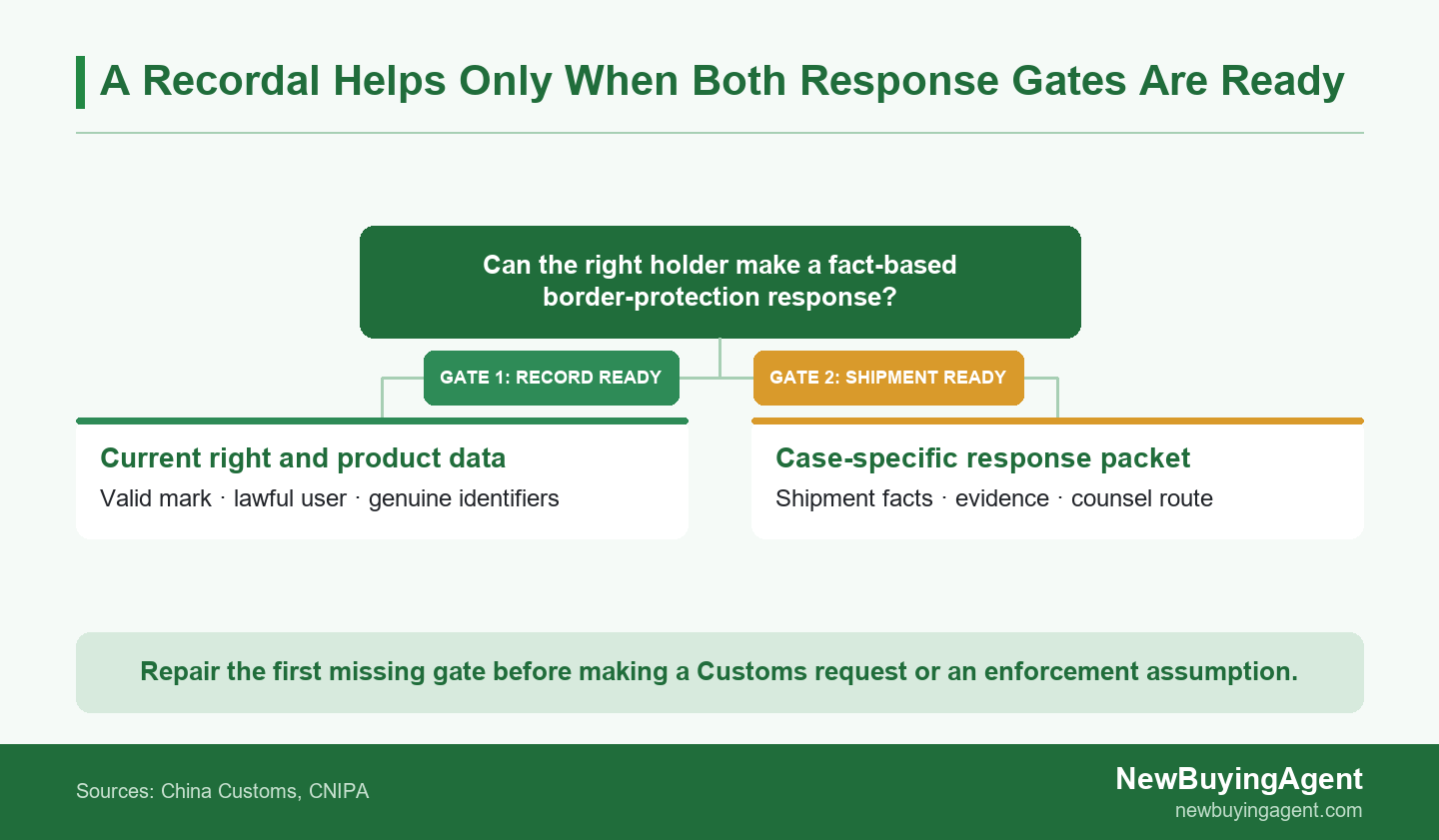
Two-gate decision diagram showing that China Customs trademark recordal needs both current right-and-product data and a shipment-specific response packet.
The ownership and control picture needs to be unambiguous: identify the owner, China right, relevant goods, and authorized users. A factory quote, purchase order, or foreign registration certificate is not a substitute for a right-holder analysis. The U.S. International Trade Administration likewise notes that a registration in the United States does not automatically confer rights in China and recommends planning protection and evidence before an enforcement event. Its China IP guide is a useful strategic reminder, not a substitute for China counsel.
Match the Registered Mark to the Goods You Actually Move
Customs implementing rules describe trademark registration material and information tied to covered goods as part of the recordal route. The implementing rules in WIPO Lex are the reason to review the real product set before treating recordal as complete. A marketing name, a logo variation, or a newly added product family may need a different legal analysis from the one used for the original launch.
Put the comparison into one review sheet for counsel and the brand owner: the trademark reference, the product description, the factory’s product name, the visible mark or artwork, the relevant class or goods description, and the intended import or export use. The goal is not to create a second legal opinion inside a sourcing file. It is to surface mismatches while they can still be clarified, instead of discovering them from a Customs notice.
Then Make Lawful Users Easy to Verify
A lawful user is a party the right holder has authorized to use the relevant intellectual property. In China Customs recordal practice, the relationship between a licensee, the covered commodity, and the legitimate manufacturer can be operationally important. Keep contact details, licensees, goods, and authentic-product information organized before a notice, not reconstructed afterward.
For a buyer, the safe operating rule is simple: keep a right-holder-approved list of the legal entity names, relevant factories or exporters, product families, and authorization references that are actually current. A renamed factory, a new packaging subcontractor, or a transferred brand can be commercially ordinary. It becomes a border-readiness problem when those facts cannot be reconciled with the information the right holder is entitled to provide. Ask counsel to decide whether a licence or ownership document is sufficient; ask the operating team to keep the factual record accurate.
Build a Recordal Packet That Can Be Matched to Real Goods
The official recordal guide identifies legitimate goods, known-risk information, photographs, and supporting documents alongside trademark and licence information. Review the China Customs recordal service guide with counsel when assembling the packet. That is a useful signal: a Customs-facing packet should help distinguish real goods from suspicious ones, not just prove that a logo exists. Assemble it around the current product, rather than around a folder of historic brand files.
A strong packet normally has four practical groups. The first is the rights group: owner identity, trademark references, and counsel-approved ownership or licence materials. The second is the genuine-goods group: product names, mark artwork as used, approved packaging views, distinguishing features, and the current product specification. The third is the legitimate-trade group: approved users, manufacturer and exporter information where appropriate, and relevant contact routes. The fourth is the known-risk group: facts about suspected counterfeiters or patterns only when the right holder can state them truthfully and support them.
Do not turn this into a surveillance exercise for every supplier. The point is accuracy and retrieval. A short product sheet that a non-designer can understand is often more useful than a large archive with no version date, no product mapping, and no owner. Preserve the original source file and approval trail, but give the response team a current visual and factual summary that can be checked against cartons, labels, invoices, or shipment data.
Use Genuine-Product Identifiers That a Non-Designer Can Check
Current product identifiers make owner-approved goods easier to distinguish from a generic brand reference during a readiness review. Choose identifiers that answer a practical comparison question: “What could a reviewer look for on these goods or their packaging?” Examples may include the exact mark placement, label format, approved color or material cue, carton mark, product model, or a combination of these. The right choice depends on the product and must remain consistent with the owner’s direction.
Do not rely on one polished product photo taken years earlier. Pair a clear image with a plain-language note about what the image shows, which product family it belongs to, and which version date applies. If the actual packaging changes, treat that as an information-update trigger. The article’s recommendation is operational: records should make an authorized product recognizable. It is not a claim that a visual difference proves infringement.
Treat Changes as a Border-Readiness Event
China Customs regulations state that, when recordal information changes, the right holder must complete the applicable change or cancellation procedures within 30 working days. The Customs protection regulations in WIPO Lex set out that maintenance duty. This is more than an administrative date. A change in ownership, contact person, licensee, authorized factory, or relevant product presentation can affect whether a later response has the right facts at hand.
Set one named owner for the legal record and one for the operating product file. When the factory changes a carton mark, the brand changes a licensee, or the contact who can receive a Customs notice changes, the two owners should compare notes. Escalate the legal question to qualified counsel; do not ask a factory to decide whether a recordal must be amended. This separation keeps the record truthful and prevents a procurement convenience from becoming an unsupported legal assertion.
When the legal route and owner-approved specification are in place, Ask NewBuyingAgent to supply products from China with the defined product, quantity, destination, timeline, and packaging requirements. NewBuyingAgent can keep the China-side product brief aligned with approved production facts; the brand owner and qualified advisers retain the trademark, licence, recordal, and enforcement decisions.
A Suspected Shipment Creates a Separate Response Decision
A recordal can support a Customs-to-right-holder information path, but a suspected shipment creates a new decision. The IPKey Customs enforcement roadmap describes notification, a timely application, and a guarantee within the proactive protection pathway. If Customs notices the right holder about goods, the first objective is not to demand a result. It is to verify the notice, preserve the shipment facts, locate the current right and user data, and bring qualified China IP counsel into the response.
China Customs guidance describes verification of lawful users and supporting documents when goods involve a recorded IPR during clearance. The implementing rules in WIPO Lex provide that clearance-stage context. This is where the two response gates meet. Gate one asks whether the right, authorized-user data, product identifiers, and contact details are current. Gate two asks whether the particular shipment can be identified through exporter or importer details, port, timing, product description, carton or packaging cues, and evidence. A complete first gate does not prove the second. A detailed shipment report does not repair a weak first gate.
Where a right holder believes goods are suspect, counsel should determine what the applicable procedure requires and who can make each factual statement. The operating team can preserve documents, photographs, production records, and shipment references. It should not decide infringement, promise detention, or create backdated authorization paperwork. A recordal is valuable partly because it lets these roles be separated before time pressure arrives.
Illustrative Scenario: Find the Missing Link Before You Escalate
In the illustrative shipment, the first missing link among right, user data, and shipment evidence determines the first responsible escalation action. This illustrative example is a composite, not a NewBuyingAgent client case. A global brand owner has recorded a China-protected trademark for two approved product classes, while one class accounts for 480 cartons and the factory’s current corporate name is not on the owner-approved user list.
The recordal contains the mark and earlier product photographs. However, the contact list is stale, a packaging subcontractor has changed names, and the affected cartons display updated marks that are not in the prior product file. Customs sends a notice concerning goods that may involve the mark. The fact pattern does not prove that the goods are counterfeit; it shows that the record and the current shipment cannot yet be connected cleanly.
Reconcile the Documents Before You Make an Enforcement Assertion
In the illustrative shipment, the responsible first step is to reconcile owner, user, product, and carton information before asking for a legal conclusion. This illustrative example involves two approved product classes in a 1,200-carton export shipment, with 480 cartons in the affected class. Preserve the original purchase, production, packaging, and shipment records; then give the notice and the current materials to qualified China counsel. Counsel can assess ownership, licence, and procedure. The product and sourcing teams can verify whether the current factory, packaging identifiers, and carton information match owner-approved records.
The buyer should not tell Customs that the cargo is authorized or infringing until those links are checked. If the mismatch is a stale user name, the record and product file may need correction. If the goods or authorization cannot be matched, counsel may advise a different response. The verification gate is clear: no legal assertion or release assumption rests on an unverified document set. This example shows a method for protecting evidence, not a prediction about detention, infringement, or outcome.
Keep China Sourcing Records Aligned Without Turning Sourcing Into Legal Advice
China-side sourcing follow-up can preserve owner-approved product and packaging records, but it does not decide trademark scope, file recordals, or guarantee Customs enforcement. The IPKey Customs enforcement roadmap provides context for why lawful-user details need to remain usable. That boundary is important because the same files often cross a factory, brand, freight, and legal workflow. The sourcing role is to keep the factual product trail usable: agreed artwork version, approved sample, packaging requirement, factory identity, production change, and shipment reference.
For an existing China supplier, Ask NewBuyingAgent to manage your China factories when the practical need is factory follow-up, quality-control evidence, packaging alignment, or logistics coordination. That work can reduce document drift by keeping approved production information visible. It is not a substitute for counsel’s view of a changed licensee, a Customs application, or a suspected-infringement response.
Before any escalation, retain the approval trail that connects the product specification to the actual goods: the approved sample, packaging artwork version, factory identity, carton marking, inspection record, and shipment reference. A simple dated change log can show which facts are settled, which have changed, and which need the right holder or counsel to verify. That keeps the sourcing handoff factual and makes it easier to retrieve the right documents without turning a factory follow-up request into a legal conclusion.
Set a 30-Day Recordal Readiness Path Before the Next Shipment
A 30-day ownership plan for the right, recordal data, and response route can uncover readiness gaps before a shipment event forces a rushed decision. The timeline below is an operating framework, not a statutory timetable and not legal advice.
- Days 1–7: Have the owner and qualified China counsel confirm the right, relevant goods, ownership, and licensing path.
- Days 8–14: Build a current genuine-goods sheet with approved packaging views, product identifiers, lawful-user facts, and a named response contact.
- Days 15–21: Compare that sheet with actual factory, exporter, carton, and shipment records; flag changes that need legal review or record maintenance.
- Days 22–30: Set the notice-response route: who receives it, who preserves documents, who contacts counsel, and who may speak for the right holder.
If you are preparing a defined branded-product sourcing brief after that legal route is in place, assemble the product specification, quantity, destination, timing, and approved packaging requirements first. The discussion can focus on China-side supply or existing-factory follow-up, not trademark filing or Customs legal representation. Submit product requirements to NewBuyingAgent.
Frequently Asked Questions
Is Customs recordal mandatory for every trademark?
No. The Customs regulations describe recordal as an application a right holder may make, rather than a universal step required for every trademark registration. Whether it is worthwhile depends on the brand’s China rights, goods, border exposure, and ability to maintain accurate information. Qualified China counsel should assess the brand’s own portfolio and planned trade routes.
Can a recordal stop every counterfeit shipment?
No. Recordal can help connect a protected right with information Customs may use, but it does not guarantee that Customs will identify every suspect shipment or that any one shipment will be detained. A specific response still depends on the facts, the applicable procedure, evidence, and any required security. The safe expectation is improved readiness, not a promised enforcement outcome.
What information should an authorized factory provide?
Provide only owner-approved, current facts that identify the lawful user, covered products, packaging version, factory or exporter role, and the route for confirming a question. The factory should preserve production and shipment records but should not draft retrospective authorization evidence after a Customs notice. If the legal entity, product scope, or authorization has changed, the brand owner and counsel should determine the proper update.
When should a brand owner involve China counsel?
Involve qualified China IP counsel before filing when ownership, licensing, registration scope, suspected infringement, a detention request, or security requirements are uncertain. Counsel should also be involved when a factory name, product presentation, or ownership chain changes in a way that could affect recordal information. Sourcing and factory teams can assemble accurate facts, but they should not make the legal conclusion.
NewBuyingAgent
Related Resources

Get Started Today
Let's Turn Your Sourcing Goals into RealityWeChat:+86 15157124615
WhatsApp:+86 15157124615
Address:Building 10 #39 Xiangyuan Road, Hangzhou, China
