

A production control plan describes how important product and process characteristics will be controlled during manufacturing. An inspection checklist guides a particular checking activity and records its findings. Use the plan to define the controls and responses, then connect the checklist to those requirements so a completed inspection produces useful evidence.
For a buyer managing production in China, the practical question is whether the factory's documents cover both jobs. A detailed checklist may confirm that a delivery looks acceptable while leaving a performance requirement unchecked. A control plan can identify that requirement yet accomplish little if the person checking the product has no usable method or record.
Match the Document to the Production Decision
- Decision: Use a control plan for the production controls that must operate; use a checklist to execute and record a defined inspection.
- How it works: Connect the characteristic, specification revision, method, checking occasion and response across both documents.
- Risk: A completed checklist does not demonstrate an untested property or establish that the process remains stable.
- Common mistake: Treating the document title or number of tick boxes as evidence of effective quality control.
What Is the Difference Between the Two Documents?
The main difference is the job the document performs. A control plan connects important characteristics to controls throughout the relevant production stages; an inspection checklist turns an assigned check into actions and a record. Their contents can overlap, especially in a well-designed factory system, so judge coverage and usability rather than insisting that every piece of information appear in only one document.
For example, a plan may define how a molding operation controls a functional characteristic, including the required check and reaction to an unacceptable result. The corresponding checklist gives the inspector the applicable method and a place to record findings. A checklist with its own clear reaction instructions still performs the inspection job; that detail does not make the two documents interchangeable. The comparison below examines their typical purpose, coverage, instructions, evidence, problem response and revision; it does not impose exclusive field boundaries.
| Comparison dimension | Production control plan | Inspection checklist | Buyer question | Connection to verify |
|---|---|---|---|---|
| Primary question | How will this characteristic be controlled? | What must be checked on this occasion? | Which product requirement does this address? | The same characteristic appears in both |
| Coverage | Relevant operations, product characteristics and process controls | The assigned inspection stage, product or lot | Where could the requirement be missed? | The inspection scope reaches the planned control |
| Instructions | Method, checking frequency, responsibility and reaction | Inspection steps, acceptance references and result fields | Can the assigned person perform this check? | Method and requirement references agree |
| Evidence | Defines the expected control and its linked records | Records the observation, measurement or test performed | What actually happened on this occasion? | A completed record demonstrates execution |
| Problem response | Defines who acts and how affected production is handled | Flags the finding and initiates the referenced response | Who controls the affected stock? | The finding reaches a named responsible role |
| Revision trigger | Changed product requirements, process or demonstrated control needs | Changed applicable requirements or checking instructions | Which revision applies to this production? | Current instructions remain linked to the record |
Based on this comparison, connect the planned characteristic to an executable check and its recorded result. Neither column is a rigid restriction: a checklist can include reaction instructions, and a control plan may carry recorded results. The important distinction is between an intended control and evidence of its execution. For the broader purchasing context, read the China sourcing guide alongside the product and production requirements.
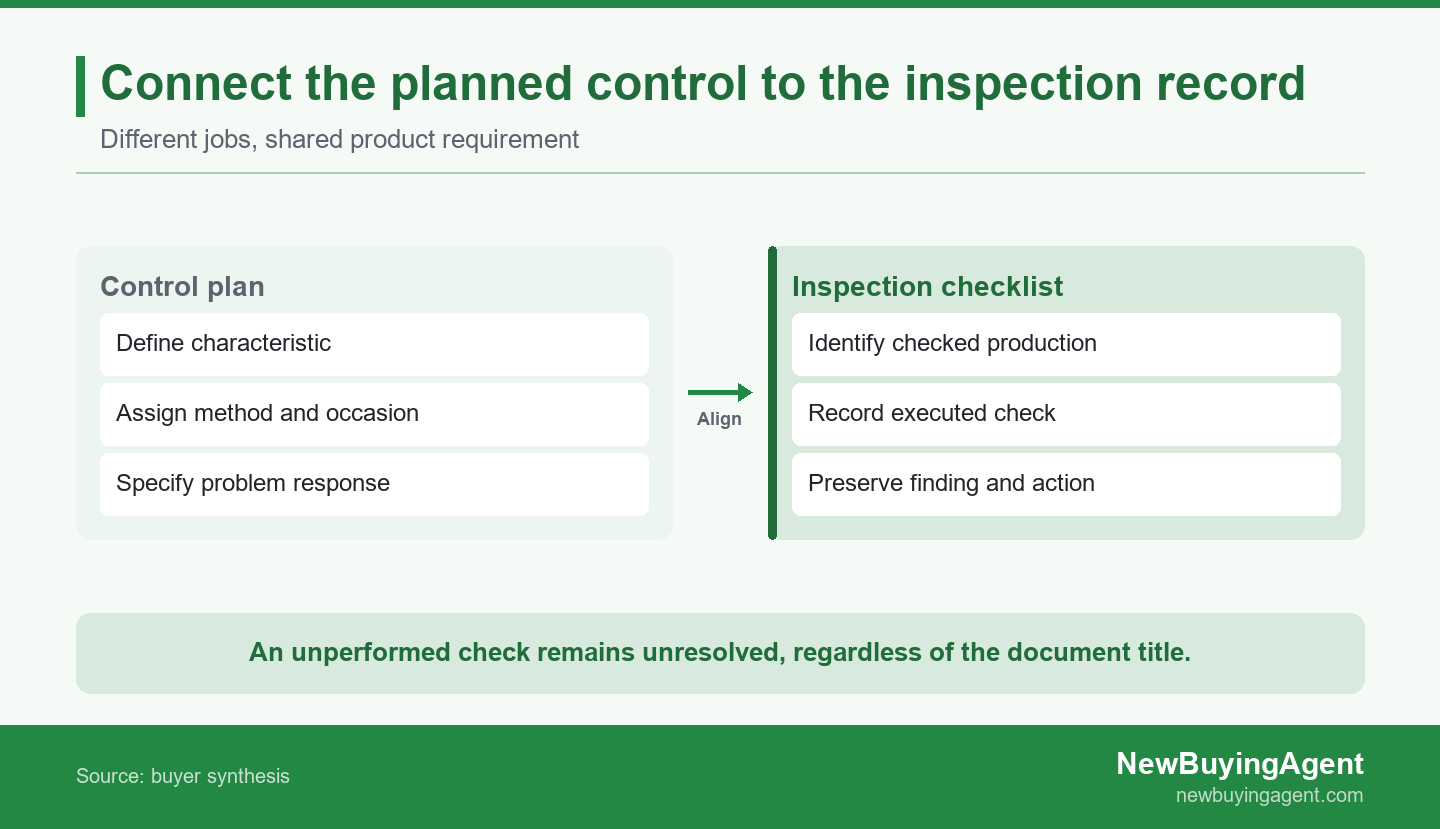
The control plan defines the check and response; the checklist records execution and findings.
What Should a Production Control Plan Cover?
A useful production control plan identifies which characteristics matter, where they are controlled and what happens when the control indicates a problem. It should make the factory's intended work understandable before the order reaches final inspection. Start with product requirements and relevant operations, then assign methods and responsibilities; copying a generic plan without checking those relationships can leave the buyer's main risk uncovered.
In its automotive Quality Core Tools overview, AIAG presents the Control Plan alongside tools including measurement system analysis and statistical process control. This is useful context for how manufacturing controls connect with methods and monitoring. Its automotive scope does not make that complete toolset mandatory for every consumer product; choose the controls required for the actual product and customer.
For each relevant operation, identify the product or process characteristic, the specification reference, the checking method and the checking occasion or frequency. Name the responsible role and the response to an unacceptable result. Include the record used to demonstrate execution. If a buyer has supplied an approved drawing, the factory should be able to show where its important requirements enter these controls.
Some characteristics call for monitoring over time rather than a single end-of-order check. NIST's explanation of control charts describes comparing process data with control limits to monitor behavior. A buyer does not need to demand a chart for every feature; where statistical monitoring is appropriate, the plan should identify what is monitored and the action expected from a signal.
For an established China supplier, NewBuyingAgent's management of existing China factories is relevant to following production and quality activity locally. Its China-side execution team and product/QC capability can help connect the buyer's product requirements with factory follow-up. Agree on the documents and records to be reviewed so communication addresses the actual product, rather than merely reporting that a plan exists.
What Makes an Inspection Checklist Usable?
An inspection checklist should let the assigned inspector perform the required checks and record what happened. It needs clear item descriptions, the applicable acceptance reference, a suitable method and space for meaningful findings. A list of features followed by pass boxes is insufficient when the checking conditions or required measurements are ambiguous, especially when several factories or inspectors must apply the same buyer requirements.
Keep identification beside the findings: product version, inspected lot or scope, date, inspection stage and inspector. For a dimensional requirement, record the result and relevant measurement conditions. For a visual requirement, use a defined defect description or approved reference. A photograph can document visible condition; it cannot stand in for a performance test that was never performed.
The checklist should distinguish a completed acceptable check from a failed check, a check not performed and a genuinely inapplicable item. Otherwise, a blank cell can disappear into an overall pass status. Where a result calls for escalation, give the inspector a direct reference to the reaction instruction and preserve the finding before corrective work changes the evidence.
A good inspection record still describes its actual scope. NIST's guidance on assessing process stability uses observations over time to examine whether process behavior remains stable. An acceptable result on one checking occasion does not provide that history. Use the checklist for the inspected findings and the relevant production records for questions about continuing process behavior.
How to Connect a Control Plan to a Checklist
Connect the documents through the same characteristic and requirement reference, then make the planned activity visible in the inspection record. The following example uses snap-fit retention on a molded enclosure to illustrate that connection. It is a working structure for adaptation, not a validated test method; the actual specification, fixture, sampling and acceptance values must come from the product requirements and appropriate technical review.
Control Plan Entry: Define the Intended Control
Use an entry that joins the required function to the operation and its response. For this illustrative enclosure, appearance and retention are separate characteristics. The retention entry should therefore reference a suitable approved method rather than relying on an appearance check to prove both. Record the actual revision identifiers in the spaces below before putting the entry into use.
| Control plan field | Example entry to adapt |
|---|---|
| Characteristic and operation | Snap-fit retention after the specified molding and assembly stages |
| Requirement reference | Approved product specification: document ID and revision ______ |
| Method and conditions | Approved retention test: method ID, fixture and preparation conditions ______ |
| Checking occasion and sample | Required production stage, frequency and sampling procedure ______ |
| Responsibility and record | Assigned checking role ______; linked checklist/report ID ______ |
| Reaction and affected scope | Hold the identified affected production; notify the assigned quality role; apply approved investigation and disposition instructions |
Checklist Entry: Record the Actual Check
The corresponding checklist entry should identify the inspected production and preserve the actual retention result under that method. An appearance pass remains a separate finding. This makes it possible to see whether the planned functional check occurred, rather than allowing an overall pass box to hide missing evidence. Fill the record during execution and retain unresolved findings.
| Inspection record field | Information to record |
|---|---|
| Product and inspected scope | Product/version ______; lot or production identification ______ |
| Linked requirement and method | Specification revision ______; test method/fixture reference ______ |
| Execution details | Date ______; inspector ______; samples and relevant conditions ______ |
| Findings | Actual retention results ______; acceptance assessment ______; checks not completed ______ |
| Response | Issue reference ______; affected stock/status ______; notified quality role ______ |
| Disposition reference | Authorized decision and supporting record ______ |
Example: Appearance Passes While Retention Remains Unverified
In this illustrative scenario, an importer is buying 8000 units of molded snap-fit enclosures from an existing China factory. Production is awaiting a quality decision before the affected stock is released. The product specification requires retention performance as well as acceptable appearance. This is a hypothetical buying situation, not a reported client case.
The inspector's checklist records acceptable surfaces and assembly appearance, but no retention test was performed. The control plan names retention as a characteristic without providing an agreed checking method. These observations establish missing evidence and an incomplete instruction; they do not establish that the enclosures fail the retention requirement.
The quality manager holds the affected scope, while the buyer and factory resolve the specification reference, test conditions and responsibility. The factory updates the plan and linked checklist so the functional check has an executable instruction and a result field. The inspector then performs the agreed check on the defined samples and records the findings.
The authorized decision maker reviews those findings against the requirement and determines the stock's disposition. If the evidence remains incomplete, the hold remains; if it supports acceptance within the agreed scope, the decision is recorded. Updating documents alone is not verification, and this example assumes neither a passing test nor a successful shipment.
What Should the Documents Say About Problems?
A reaction instruction should turn a significant finding into a defined response. Identify who is notified, what production or stock is affected, how it is controlled and what decision is needed before normal activity resumes. The response belongs wherever the assigned person can use it; a checklist can contain it directly or reference the relevant control plan instruction without weakening the connection.
Also establish whether the measurement can support the acceptance decision. NIST's guidance on metrological traceability explains that traceability alone does not establish fitness for purpose. A traceable measurement may still have uncertainty unsuitable for the need. The method, instrument, conditions and interpretation should be appropriate to the characteristic, rather than relying on a calibration label as the entire justification.
Keep process signals and product acceptance criteria distinct. NIST's discussion of process capability compares the output of an in-control process with specification limits. Stable behavior and acceptable product requirements therefore answer different questions. Depending on the finding, the factory may need to address process behavior, assess affected product, or do both; an automatic overall pass can obscure that distinction.
Sorting or rework needs a defined method, an identified scope and a way to confirm the result. Record the original finding, the action taken and the follow-up evidence separately. This lets a remote buyer distinguish a proposal to fix the problem from work performed and from the subsequent decision on the affected product.
Which Document Should a Buyer Request First?
Request the document that answers the immediate gap, then check its connection to the other job. Before a new or changed process begins, review how the factory will control the important characteristics. For an upcoming inspection, obtain an executable checklist aligned with those requirements. Where both exist, review a representative characteristic across the documents and its actual records before asking the factory to produce another template.
Industry and customer obligations may determine the required format. AIAG's Control Plan manual provides guidance linked to automotive advanced product quality planning. Automotive buyers should check the applicable customer requirements and approved practices. That industry context does not make the same manual or format a universal obligation for every consumer product sourced from China.
For a new product purchase, NewBuyingAgent's product supply from China connects purchasing needs with local factory resources and product/QC capability. Include important performance and appearance requirements in the product brief so they can inform the supplied product offer and production arrangements. The document discussion should serve those product requirements, alongside quantity, target price, destination and delivery timing.
When a drawing, material, tool, operation or checking method changes, identify which instructions and records are affected. Give the revision a clear effective point so the inspector knows which requirement applies to the inspected production. A file with a newer date is useful only if the relevant people are using it and its changes address the actual production arrangement.
What to Send Before a Production Quality Review
Send the product specification and relevant revisions, the factory's current plan and checklist, and a recent record for the characteristic causing concern. Describe the production stage and the decision needed next. This gives the reviewer something concrete to compare: an agreed requirement, the intended control, the checking instruction and the available result, rather than a general request to improve quality documentation.
Begin with the requirements most likely to affect use, acceptance or rework. Ask the factory to show their route through the documents and name the unresolved point. If there is already enough execution detail in a combined document, improve the missing connection instead of demanding a separate form purely for its title.
NewBuyingAgent is a one-stop China sourcing agent for global buyers, with local factory resources and product/QC capability relevant to purchasing and existing-supplier quality management. For an established factory, provide the current documents, product requirements and production concern to discuss China-side follow-up; for a new purchase, include quantity, target price, destination and timing to discuss the product offer. To start the appropriate discussion, send the purchasing requirements.
Frequently Asked Questions
Can one document serve both purposes?
Yes, if it defines the relevant controls and gives the assigned inspector usable instructions and result fields. Check that changing the plan preserves historical findings and that production staff can distinguish the current instruction from a completed record. Separate documents may be easier to manage when roles or checking occasions differ.
Must an established supplier replace its existing forms?
Only where the existing forms leave important requirements unclear or unmet, or an applicable customer requirement calls for a particular format. Review a critical characteristic and its recent records first. Preserve usable instructions and history while correcting the actual gap, rather than replacing a functioning system simply because its headings differ.
Does an external inspection replace the factory's control plan?
An external inspection produces findings within its agreed scope. The factory still needs appropriate controls for the operations it performs. Align the inspection brief with the relevant product requirements and identify which production records the buyer also needs; a final inspection cannot reconstruct every earlier operation from the finished product.
Can these documents establish product safety compliance?
They can organize relevant controls and evidence, but document completion alone does not establish compliance. Identify the product and market requirements, required testing or certification, and the appropriate technical responsibilities. Keep those obligations connected to production records without treating a generic checklist as a substitute for the required assessment.
NewBuyingAgent
Related Resources
Get Started Today
Let's Turn Your Sourcing Goals into RealityWeChat:+86 15157124615
WhatsApp:+86 15157124615
Address:Building 10 #39 Xiangyuan Road, Hangzhou, China
