

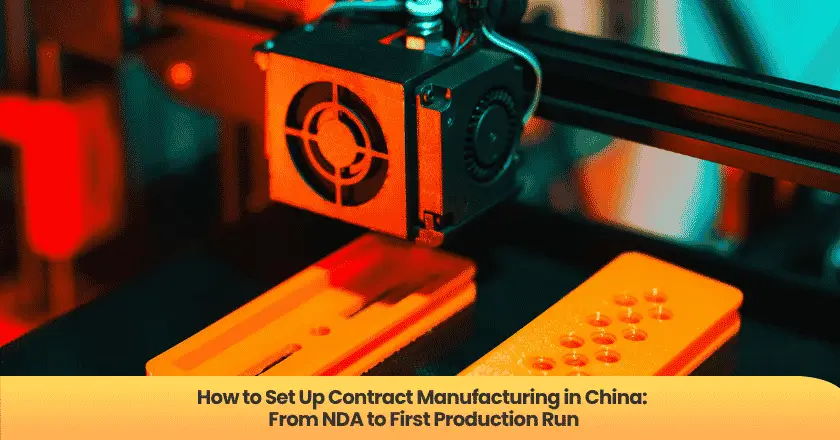
Introduction
Buying a product a factory already makes is simple. Having a factory build your product, to your design, with your name on it, is a different undertaking entirely. Contract manufacturing means handing a Chinese factory your intellectual property, your specifications, and your reputation, and trusting them to produce something that did not exist until you designed it. The rewards are real, namely a unique product and a defensible brand, but so are the risks, and the gap between the two is decided almost entirely by how you set the relationship up.
Setting up contract manufacturing in China is a sequence of deliberate steps, each protecting something the next one builds on. The agreement that guards your design before you reveal it. The factory selection that finds a partner who can actually build what you imagined. The tooling and samples that turn a drawing into a physical reality. The first production run that proves the whole arrangement works at scale. Skip or rush any one and the others inherit the weakness.
This guide walks through that sequence from start to finish. How to protect your idea before you share it, how to choose a manufacturer who fits your product, how to handle tooling and approve a sample, and how to manage a first production run so it becomes the foundation of a lasting manufacturing relationship rather than a costly lesson.
Key Takeaways
• Contract manufacturing hands a factory your design and reputation, so protecting your intellectual property with a proper agreement before sharing anything is the foundational first step that every later stage depends on.
• Choosing the right manufacturer for custom work means verifying genuine OEM capability, since a factory that can produce a stock item well may lack the engineering depth to build a product to your unique specification reliably.
• Tooling ownership must be settled in writing before molds are made, because who owns the tooling determines whether you can move production elsewhere later or stay locked to a single factory by default.
• A formally approved golden sample turns your design into an enforceable physical standard, giving both sides an objective reference that every production unit is measured against before and during the manufacturing run.
• The first production run is a test of the whole arrangement, so inspecting it rigorously and tying payment to passing protects you at the exact moment a new manufacturing relationship is least proven and most vulnerable.
Protecting Your Idea Before You Share It
Contract manufacturing starts with a vulnerability, namely that you must reveal your design to a factory before they can build it. How you handle that exposure, before any drawing changes hands, sets the tone for everything after.
The Agreement That Comes First
Before sharing detailed designs, put a proper agreement in place. In a China context, a well-drafted NNN agreement (non-use, non-disclosure, non-circumvention) tends to protect a buyer better than a standard Western NDA, because it is written to be enforceable under Chinese law and addresses not just secrecy but the factory using or competing with your design. The short answer is that the agreement protecting your idea has to be built for the jurisdiction where you would actually enforce it, not copied from a template written for somewhere else.
Stage your disclosure as well. There is rarely a reason to hand over every detail of a design at first contact. Share enough for a factory to quote and confirm capability, and reserve the most sensitive specifications until an agreement is signed and the relationship is real. Controlling what you reveal, and when, is as much a protection as the contract itself.
Register What You Can
Contracts are one layer, but registration is another. Where it applies to your product, registering trademarks and design rights in China gives you a legal standing that a contract alone cannot. Real talk: relying solely on a supplier's goodwill to protect a valuable design is a gamble, and the buyers who treat IP protection as a system of contract plus registration plus staged disclosure sleep better than those who trust a single signature.
Common Mistake: Sending complete, detailed designs to multiple factories for quotes before any agreement is signed. Each unprotected disclosure is a risk, and a sensitive design scattered across a dozen unvetted suppliers is exposed long before you have chosen one. Protect first, disclose narrowly, then widen access only as trust is established.
Choosing a Manufacturer Who Can Actually Build It
Not every factory that makes products can make your product. Custom manufacturing demands capabilities that stock production does not, and choosing a partner without confirming those capabilities is how promising designs become unbuildable in practice.
OEM Capability Is Specific
A factory offering OEM (original equipment manufacturer, where the factory builds to your design rather than selling its own) work should be able to discuss your product in concrete engineering terms, namely materials, tolerances, tooling, and what happens when a design is hard to manufacture. A real OEM partner often improves your design, flagging a feature that will fail in production or suggesting a material that performs better. A factory that simply nods at everything you propose may lack the depth to build it well.
Match the factory to the specific product, not to a general impression. A producer brilliant at one category may be wrong for yours. Confirm they have made things genuinely similar to what you need, verify they are a real manufacturer rather than a trading company routing your design elsewhere, and check that their capacity fits your volume. Worth knowing: the closer a factory's existing work sits to your product, the lower the risk that your design exposes a capability they do not actually have.
ODM as a Faster Path
Full custom OEM is not the only route. ODM (original design manufacturer, where you customize a factory's existing design) can get a differentiated product to market faster and cheaper, since it builds on tooling and engineering that already exist. For a first product or a tighter budget, lightly customizing a proven design often delivers most of the distinctiveness of full custom at a fraction of the cost and risk. Choosing between OEM and ODM is a strategic decision worth making deliberately, not a default.
Expert Tip: Ask a prospective manufacturer to critique your design, not just quote it. A capable OEM partner will spot manufacturing problems and suggest improvements, which both tests their real engineering depth and improves your product. A factory that offers no input is either inexperienced with custom work or not paying attention, and either way that silence is information.
Tooling, Samples, and Turning Design Into Reality
Between an approved design and a finished product sits the physical groundwork of manufacturing, namely the tooling that shapes your product and the sample that proves it can be built. Both carry decisions that echo for the life of the relationship.
Who Owns the Tooling
Custom products usually require tooling, a one-time mold or setup that can be a significant cost. The critical question, settled in writing before the mold is cut, is who owns it. If you pay for and own your tooling, you can move production to another factory later. If the factory owns it, you may be locked to them regardless of how the relationship develops. This single clause quietly determines how much freedom you keep, so it belongs in the agreement, not in an assumption.
Treat tooling cost as part of your real unit economics. Spread the one-time mold cost across your expected volume to understand your true per-piece price, and factor it into the decision between a higher-minimum custom run and a lower-minimum ODM approach. The tooling math often shapes which manufacturing route actually makes sense for your stage.
The Sample That Becomes the Standard
Before any production run, approve a golden sample, a physical reference unit both you and the factory keep as the agreed standard. Pay for it so the factory invests genuine effort, document it thoroughly, and reference it in your manufacturing agreement. Every production unit is then measured against this approved sample, which turns your design from a set of drawings into an enforceable physical fact. A dispute about whether production matches the design becomes a simple comparison rather than an argument.
Expert Tip: Get tooling ownership in writing before you pay the tooling deposit, not after the mold is cut. Once a factory holds an unowned mold, renegotiating who controls it becomes far harder, and your bargaining position is gone. Settle ownership, storage, and the right to move the tooling while the factory still wants your business.
Managing the First Production Run
The first run is where the whole setup meets reality. Everything before it was preparation. This is the moment the factory proves it can build your product at scale, and the moment you are most exposed if it cannot.
Inspect Hard When Trust Is Lowest
A new manufacturing relationship is least proven on its first run, which is exactly when rigorous inspection matters most. Set your AQL (acceptable quality limit, the defect rate an inspection passes) in writing, inspect during production as well as before shipment, and use a third party or your own representative rather than relying on the factory's internal check. Catching a problem on the first run, while it is still small, prevents it from becoming a pattern baked into every order that follows.
Tie payment to a passing inspection. A deposit up front with the balance due after the goods meet your standard gives the factory a concrete reason to get the first run right, at the precise moment they are still learning your expectations. The first run sets the template, so the standard you enforce now is the standard you will live with later.
From First Run to Lasting Partnership
Done well, the first production run is the start of a relationship that compounds. A factory that has built your product once, learned your standards, and been held to them fairly becomes faster, sharper, and more flexible on every run after. By 2026, digital production tracking and AI-assisted tools give you clearer visibility into each run and smoother communication, which makes scaling a contract-manufacturing relationship easier than it has ever been.
Protect the relationship by keeping the discipline that built it. Inspect every run, not just the first, and hold the golden sample as the standard on every reorder, since a factory that earned your trust can still drift. The contract manufacturers who become true long-term partners are the ones where both sides know the standard is real and consistently enforced, which is what turns a single successful run into a product line you can build a business on.
Building Custom Products With NewBuyingAgent
Contract manufacturing asks more of a sourcing relationship than buying stock ever does, since it leans on real product-development depth and the standing to find a factory that can build to your design. NewBuyingAgent is a strong partner for global sourcing from China, backed by 30 years of expertise in trade, manufacturing and quality control. On the development and quality side, that depth is exactly what custom work demands: its 20,000+ product development and QC experts ensure your products match market needs and stay high-quality. And on cost, the right factory match keeps even a custom build competitive, since its wide factory network lets it pick low-cost, high-cooperation suppliers, and even with its margin included, it cuts your costs by 5%-10%. Contact now.
Frequently Asked Questions
What agreement should I sign before sharing my design?
In a China context, a well-drafted NNN agreement, covering non-use, non-disclosure, and non-circumvention, usually protects a buyer better than a standard Western NDA, because it is written to be enforceable under Chinese law. Pair it with staged disclosure, sharing only enough to quote at first, and where applicable register your trademarks and design rights for an added legal layer.
How do I know a factory can handle custom OEM work?
A genuine OEM partner discusses your product in concrete engineering terms and often improves the design, flagging features that will fail in production or suggesting better materials. Confirm they have made genuinely similar products, verify they are a real manufacturer rather than a trading company, and check their capacity fits your volume. A factory that simply agrees to everything may lack the depth to build it well.
Should I choose OEM or ODM for my first product?
ODM, customizing a factory's existing design, often makes sense for a first product or tighter budget, since it builds on tooling and engineering that already exist and reaches market faster and cheaper. Full custom OEM gives maximum distinctiveness but costs more in tooling, time, and risk. Choose deliberately based on your differentiation needs, budget, and stage rather than defaulting to one.
Why does tooling ownership matter so much?
Because it determines your freedom. If you pay for and own your tooling, you can move production to another factory later. If the factory owns it, you may be locked to them regardless of how the relationship develops. Settle ownership in writing before the mold is cut, and spread the one-time tooling cost across your volume to understand your true per-unit price.
How important is inspection on the first production run?
It is most important precisely then, when the relationship is least proven. Set your AQL in writing, inspect during production and before shipment with a third party, and tie payment to passing. Catching a problem on the first run while it is small prevents it from becoming a pattern in every later order. The first run sets the standard you will live with.
How is contract manufacturing changing in 2026?
Through 2026, digital production tracking and AI-assisted tools give clearer visibility into each run and smoother communication, making it easier to manage and scale a contract-manufacturing relationship from a distance. The fundamentals, namely protecting IP, verifying capability, owning tooling, and enforcing quality, stay the same, but the tools for monitoring and coordinating production keep improving each year.
Conclusion
Setting up contract manufacturing in China is a chain of decisions where each link protects the next. The agreement guards your design before you reveal it. The factory selection finds a partner who can actually build what you imagined. The tooling terms decide how much freedom you keep, and the golden sample turns your drawing into an enforceable standard. The first production run tests the entire arrangement at the moment it is least proven. Handle each step with the care it deserves and the result is a unique product made reliably. Rush one and the weakness travels downstream into everything that follows.
What separates a successful contract-manufacturing relationship from a cautionary tale is rarely the factory's skill alone. It is the buyer's discipline in protecting their IP, verifying real capability, settling tooling and standards in writing, and inspecting hardest when trust is lowest. Do that groundwork, lean on the development and quality expertise that custom work demands, and your first production run becomes the foundation of a manufacturing partnership that produces a distinctive product, run after run, and gives your brand something competitors buying off the shelf can never quite match.
NewBuyingAgent
Related Resources
Начните сегодня
Давайте превратим ваши цели по закупкам в реальностьWeChat:+86 15157124615
WhatsApp:+86 15157124615
Адрес: Здание 10 #39 Xiangyuan Road, Ханчжоу, Китай
