


A purchase order (PO) fails operationally when a later update cannot be tied to the current order version, the goods being released, or the buyer decision it requires. The evidence chain matters more than the volume of updates. A sourcing agent can keep China-side execution moving, but the buyer should still see which record is current, who owns the next action, and which choices have not been delegated.
This 16-step model turns a PO into a shared operating record from creation through closeout. It is not a template for drafting enforceable PO terms, and it is not a shipment-status tracker. It is a way to decide whether a factory update, quality result, booking instruction, or final file is complete enough for the order to move forward.
The 16-Step PO Lifecycle Is an Evidence Chain
GOV.UK’s commercial standard frames commercial work across define, procure, and manage stages, with roles and management planning made explicit. For a buyer working through a sourcing agent, the practical translation is simple: each PO transition should leave behind a current record, a named owner, or a buyer decision. If it leaves none of those, it is a message—not a controlled step.
The 16 steps below create that evidence chain. The agent maintains the operational continuity; the buyer retains approval of product, cost, timing, quality, and release trade-offs unless those rights are expressly delegated in writing.
- Use one current PO reference before production starts.
- Route a material variance to the buyer with evidence, impact, and a deadline.
- Release only the quantity and version that match current quality and packing evidence.
For NewBuyingAgent buyers, the same map creates a practical way to keep a China-side supply conversation connected to the records that control the order.
| Step | What the agent should make visible | Buyer decision or boundary |
|---|---|---|
| 1 | Current PO pack, line-item scope, version, and approvers | Confirm the governing order record |
| 2 | Factory receipt and scope acknowledgement | Return unclear commitments |
| 3 | Milestones, dependencies, and evidence dates | Approve the baseline or flag a conflict |
| 4 | Payment trigger, commercial assumptions, and owner | Keep payment approval with the named buyer role |
| 5 | Start conditions: current sample, materials, plan, and first output | Ask for evidence when the start is not verifiable |
| 6 | Approved specifications and controlled revisions | Approve a material change or retain the original version |
| 7 | Production progress against the baseline | Distinguish routine follow-up from a material variance |
| 8 | Exception log with impact, owner, due date, and decision needed | Decide only the trade-off that needs buyer authority |
| 9 | Finished quantity and current version confirmation | Do not infer release from a completion percentage |
| 10 | Quality evidence tied to the relevant order scope | Accept, correct, or hold against agreed criteria |
| 11 | Packing list, carton data, labels, and handoff readiness | Confirm the population that can move |
| 12 | One release or hold instruction | Approve the released scope and any exception route |
| 13 | Booking request matched to released quantity and documents | Confirm the movement instruction |
| 14 | Shipment handoff package and remaining open items | Keep unresolved scope visible |
| 15 | Final documents, payment status, and claim references | Confirm which obligations remain open |
| 16 | Closeout record and repeat-order baseline | Carry forward only approved, documented changes |
Based on this comparison, the right question at every stage is not “Has the factory replied?” It is “Which current record lets us take the next action, and who can approve it?” That discipline prevents a finished quantity, a booking request, or a document bundle from silently becoming a release decision.
Stage 1: Make the PO Executable (Steps 1–4)
World Bank guidance for borrowers places a contract management plan and monitoring, evaluation, and payment systems in the manage-contract stage. A commercial China PO is not the same as a World Bank-funded contract, but the operating lesson is useful: define the working record and monitoring method before factory activity creates competing versions of the truth.
Steps 1 through 4 establish the reference that later production, quality, packing, and handoff evidence must point back to. If a buyer is starting a new product requirement, the same discipline belongs in the initial supply brief; see how NewBuyingAgent supports a product-supply brief from China.
Build One Current Reference Before the First Factory Reply
Step 1 is the current PO pack: PO number, line items, quantities, product and packing specifications, agreed sample or artwork references, price basis, milestones, delivery assumptions, inspection or evidence gates, and named buyer approvers. Step 2 records the factory’s receipt against that reference. Step 3 turns the plan into dated milestones, including dependencies such as materials, tooling, packaging, or test evidence. Step 4 identifies which payment trigger belongs to which evidence and buyer owner.
One file does not mean one spreadsheet forever. It means that every controlled file has an identifier and revision date, and a buyer can tell which version governs a particular PO line. An email thread may provide context, but it should not be the only place where a packaging revision, delivery change, or price assumption can be found.
Turn Receipt Into a Confirmed Commitment
A “received” reply is not yet an executable commitment. Ask the factory to confirm the operative PO reference, quantity, version, planned completion window, evidence it will provide, and any assumption that could change timing or scope. The sourcing agent can collect and compare those confirmations across factories, but should flag a conflict rather than quietly choosing the version that seems most convenient.
That distinction matters most in multi-factory orders. If a product factory, a packaging factory, and a component factory each cite a different revision, there is no shared baseline to inspect or hand over later. Resolve the discrepancy while the buyer can still make a clean decision, not after finished goods are waiting for a booking instruction.
Stage 2: Keep Production Bound to Current Evidence (Steps 5–8)
FAR contract-administration functions include production support, surveillance, and timely reporting of potential and actual delivery slippages. That does not make FAR a rulebook for every import order. It does show why a sourcing agent’s production updates should report verified conditions and potential impact, rather than a reassuring percentage with no record behind it.
Steps 5 through 8 test whether the order is still being made against the approved baseline. For buyers with existing suppliers, China-side follow-up is most useful when it turns factory information into one current view of production, quality, and next decisions; see how NewBuyingAgent manages existing China factories.
Verify the Start Conditions Before Output Ramps
FAR production-surveillance guidance describes reviewing plans, schedules, controls, industrial processes, and actual performance to identify factors that may delay performance. At Step 5, apply that thinking to the PO: compare the current specification or approved sample, material or component status, production plan, and first-output evidence. A stated start date alone cannot prove that production began against the right version.
Step 6 records any approved revision. Step 7 compares current output and milestone evidence with the baseline. The purpose is not to force every factory into one reporting format. It is to make the evidence comparable enough that the agent can identify a conflict before it reaches final packing.
Classify Variances Before They Become Buyer Decisions
GOV.UK’s contract and supplier management guidance includes governance, reporting, change control, and risk management. In this lifecycle, a variance means a verified difference from the approved order or plan. The agent can log the difference, request evidence, assess scope, and propose options. A buyer still needs to approve any un-delegated change to product, price, delivery, quality, or release risk.
Step 8 is the exception record. It should state the affected PO lines, current evidence, likely impact, action owner, due date, and exact buyer decision needed. This keeps normal follow-up normal, while ensuring a material issue does not become an accidental approval simply because the deadline is close.
Stage 3: Make Release and Handoff Explicit (Steps 9–12)
Steps 9 through 12 make the release decision visible. Finished quantity, quality evidence, packing evidence, and booking readiness must reconcile before the sourcing agent treats goods as ready to move. “Factory complete” is useful information, but it is not a release instruction.
Reconcile the Release Population, Not Just the Inspection Result
FAR quality-assurance guidance ties surveillance to defined quality requirements and the work being monitored. The buying equivalent is to link quality evidence to the actual scope under review. A release population is the exact quantity and version being approved for handoff. Define it once here: it must be possible to match the inspection or quality evidence, finished count, version, packing list, and carton information to the goods that will move.
That is the release rule: hold unmatched scope. A favorable inspection result does not release extra cartons, an older product version, or a packing configuration that was not included in the evidence. Conversely, a traceable affected subset may be held while matched scope follows a buyer-approved route. The decision is not “pass or fail” in the abstract; it is which identified population can move under the current PO record.
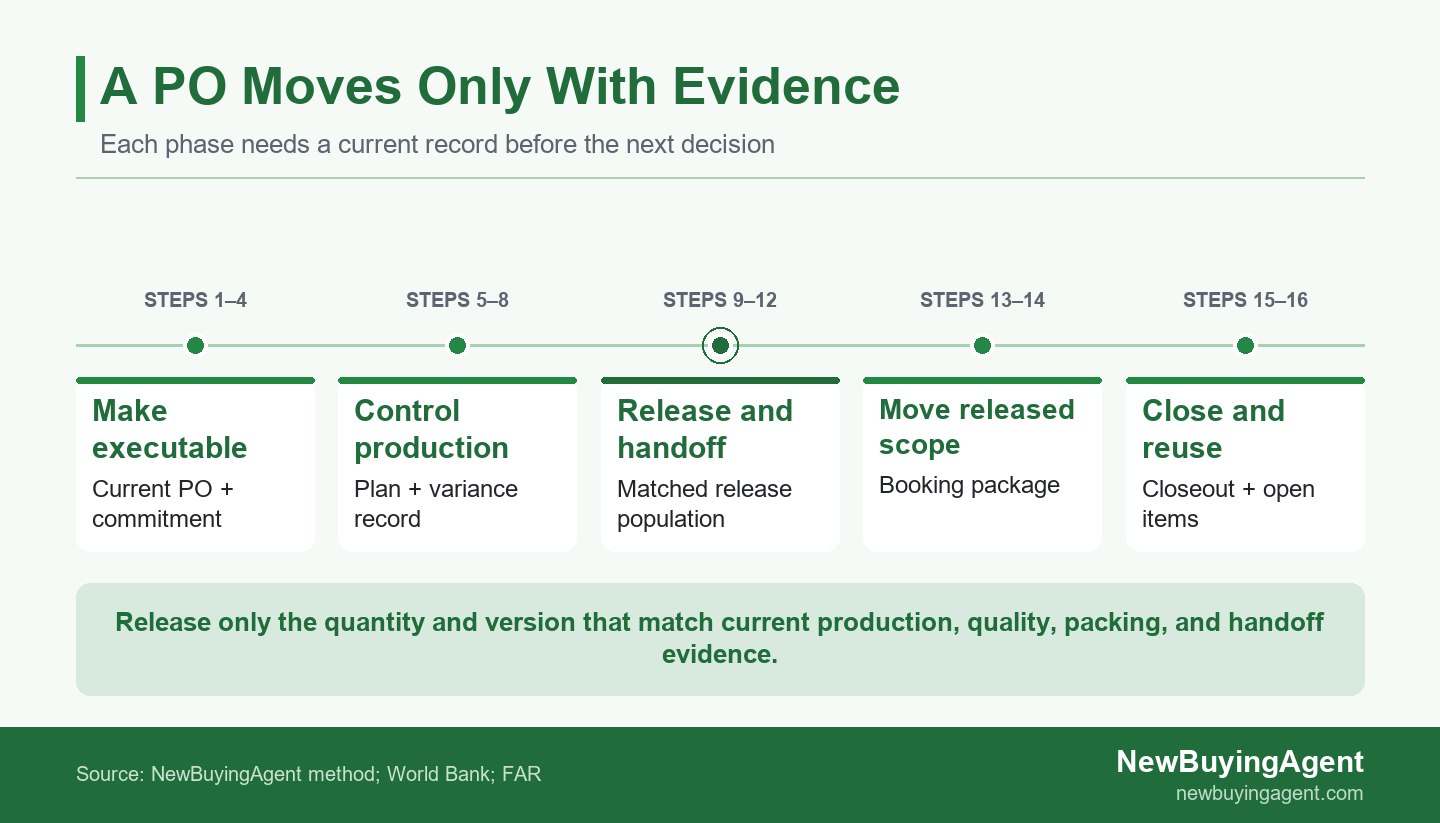
Milestone timeline showing purchase order evidence from executable baseline through release and closeout
Give the Booking Owner One Current Handoff Package
GOV.UK’s NISTA guidance says a governance and reporting review examines reporting mechanisms, escalation routes, and the responsibilities of named roles overseeing delivery. At Steps 11 and 12, apply a proportional version of that discipline: the booking owner receives one current package showing released quantity, packing facts, document status, any held scope, and who answers a remaining question.
Steps 13 and 14 then turn that package into a booking instruction and shipment handoff. The agent should not send a carrier or forwarder an instruction that conflicts with the release record. If an item remains open, name it in the handoff package, together with its owner and the point at which the booking plan must be updated.
Stage 4: Close Without Leaving a Silent Commitment (Steps 13–16)
Closeout is the final record of released scope, documents, payment status, approved changes, and unresolved commitments. It is not a ceremonial archive. It is the control that stops a claim, a documentation gap, or an unapproved temporary change from becoming the invisible baseline for the next PO.
Steps 13 and 14 record the instruction and handoff. Steps 15 and 16 confirm final documents, payment and claim references, then preserve the repeat-order baseline. When the buyer is assessing whether China-side support fits the broader product supply or factory-management need, review NewBuyingAgent success stories across product categories.
Close the PO With a Decision Record
FAR Part 4 describes contract-file documentation for the award, administration assignments, and subsequent actions. Use that as a narrow record-keeping reminder: keep the final PO version, approved changes, release evidence, handoff documents, payment status, exceptions, claims, and the reusable baseline together. Note which commitments are complete and which are still open, with a named owner for each.
A closeout record is especially valuable on repeat orders. It gives the buyer and agent a factual starting point for the next conversation: which specification version worked, which packaging revision was approved, which evidence arrived late, and which supplier commitment still needs a different control. It should not quietly turn a one-off exception into a new default.
Illustrative Scenario: A Split Release After a Packaging Revision
The Agent Owns the Record; the Buyer Owns the Route
This illustrative example is not a reported NewBuyingAgent client result. A retailer has one PO for 1800 modular storage sets across 3 factories: a product factory, a metal-frame factory, and a packaging factory in China. After the product factory and frame factory complete their scope, the packaging factory identifies that 420 cartons still carry 1 earlier assembly-leaflet revision. The 1380 matched sets have current product, packing, and release records; the remaining 420 sets cannot yet be matched to the buyer-approved leaflet version. The carton count and PO line references identify the 420 affected sets separately from the 1380 matched sets. The product factory and frame factory provide finished-quantity and current-version confirmations for the 1380 matched sets. The packaging factory provides a revision plan and a dated rework estimate, but the corrected leaflet has not yet been verified in the affected cartons. This is a traceable late change, not a whole-order failure: the sourcing agent can assemble the version, quantity, packing, and booking impact without silently approving the packaging revision.
The buyer may release the 1380 matched sets, hold the 420 affected sets pending corrected packing evidence, or defer the whole handoff if a single arrival window is commercially necessary. If the buyer selects a split route, the agent records that choice, gives the booking owner the released quantity and held quantity, issues 1 split booking instruction, and requests corrected-leaflet evidence for the 420 affected sets. The held 420 sets move only after the corrected leaflet version, carton count, packing evidence, and revised handoff instruction are linked to the current PO record. In this illustrative example, the sourcing agent owns the evidence record and routing; the buyer owns the product, commercial, and release route unless authority was expressly delegated.
Prepare a PO Lifecycle Brief Before China-Side Execution Starts
Before production begins, give the China-side execution team six things: the current PO and version authority; product and packing references; milestone and evidence gates; named buyer approvers; the booking owner and expected handoff package; and the closeout standard for documents, payments, claims, and repeat-order changes. This brief is short, but it makes the agent’s coordination role visible before a late update turns into a rushed buyer decision.
NewBuyingAgent can support buyers who need China-sourced products or China-side management of existing factories. If you have those records ready, send a PO lifecycle brief to NewBuyingAgent for a sourcing discussion.
Frequently Asked Questions
Does a sourcing agent approve a PO change?
No, unless the buyer has explicitly delegated that authority in writing. The agent should identify the affected PO lines, gather current evidence, explain the impact on product, price, timing, quality, or release, and route the decision to the named approver. This keeps coordination fast without allowing a factory deadline to create an accidental buyer approval.
When should an inspection result trigger a release hold?
Hold the affected release population when the evidence cannot be matched to its current version, quantity, packing status, or agreed acceptance condition. A problem does not always require a whole-order hold. If the affected subset is traceable and the buyer approves the route, matched goods may move while the remaining scope receives correction and verification.
Can the booking proceed while one PO item remains open?
Yes, when the released and held populations are separately traceable, the buyer approves the split, and the booking instruction states exactly what may move. The handoff package should also name the open item, its owner, the evidence still needed, and the trigger for updating the booking plan. Do not rely on a verbal exception.
What should remain in the PO closeout file?
Keep the final PO version, approved changes, release evidence, handoff documents, payment status, exceptions, claims, and the next-order baseline together. Add a clear open-item list with an owner and due date. The useful closeout file lets the buyer see what was actually released and prevents an old drawing, temporary packing fix, or unresolved commercial issue from being treated as the new normal.
NewBuyingAgent
Related Resources
Начните сегодня
Давайте превратим ваши цели по закупкам в реальностьWeChat:+86 15157124615
WhatsApp:+86 15157124615
Адрес: Здание 10 #39 Xiangyuan Road, Ханчжоу, Китай
