


An approved outdoor product sample does not make a sellable collection ready. A dining set can look right, a cantilever umbrella can function well, and a storage bench can have an acceptable carton, yet the range can still break at the handoffs: a changed metal tone, a shade-base footprint that crowds the seating plan, an instruction that describes an earlier model, or a pallet pattern that no longer works. The collection needs its own approval logic.
For buyers sourcing garden furniture and outdoor living products from China, the practical sequence is to define one outdoor occasion, lock the items that set the constraints, control the interfaces shared by every product family, and release the combined pickup only when the complete range is ready. Furniture, shade, storage, and accessories can come from different China factories; they should not arrive as separate decisions.
Five Approvals That Turn Separate Outdoor Products Into One Collection
An outdoor living collection becomes coherent when product roles, shared interfaces, evidence, packaging, and release are approved together. Treat these as connected approvals, not five documents collected after each factory has already made its own local decisions.
- Role: define the outdoor room, buyer, channel, and job of every product before requesting comparable quotes.
- Interface: govern finishes, hardware, dimensions, labels, and accessory fit across the range.
- Evidence: identify product-specific information, instructions, and technical records for the destination.
- Packaging: approve packed dimensions, cartons, pallet assumptions, and transport packaging before pickup planning.
- Release: use one rule for accepted versions, evidence, cartons, quantities, and pickup readiness.
This is a coordination method, not a universal product-testing or legal checklist. Its value is making the buyer’s decision visible early enough for a local factory change to be judged against the collection rather than accepted because one SKU is almost ready.
Start With One Outdoor Room, Not a List of SKUs
A collection brief should define the outdoor occasion, anchor products, supporting roles, target market, and commercial boundaries before individual product requests begin. “Backyard dining after work,” “compact balcony hosting,” and “covered terrace storage” may all use outdoor furniture, but they create different priorities for footprint, shade, storage, protection, retail price, and delivery timing.
Write a one-paragraph use setting before a factory receives a product request. State who uses the space, how many people it must support, whether shade is permanent or movable, the sales channel, price position, target market, and the non-negotiable customer promise. Then give every proposed product a role. Furniture may establish seated capacity; a parasol may establish the comfort window; storage may protect cushions or accessories; trays, covers, and small tables should support the same setting rather than merely make the assortment longer.
That brief also establishes commercial boundaries. A buyer may accept a storage bench as a later delivery but not accept a different warm-gray metal finish on a focal umbrella base. Those choices belong to the buyer. The purpose of coordination is to preserve them while factories quote and make separate goods.
Buyers developing a new range can use NewBuyingAgent's product-supply service for an outdoor living collection once the brief has enough definition to compare product routes. The useful request is a connected collection requirement, not a search for unrelated garden products.
Set the Anchor Pair: Seating and Shade
The furniture-and-shade anchor pair should set the collection's use occasion, scale, visual direction, and key physical interfaces before supporting products are selected. Seating establishes capacity, posture, tabletop height, and visual mass. Shade establishes overhead clearance, pole or base placement, wind-use assumptions, and the visual relationship between fabric, metal, and frames.
For each anchor, record approved dimensions, open and packed footprint, principal finish reference, visible hardware direction, intended user count, retail position, and any dimension that a supporting item must respect. A storage bench that opens into the chair clearance zone, or a side table that cannot sit beneath the closed umbrella, is not a minor SKU issue. It changes whether the collection performs the advertised occasion.
Give Storage and Accessories a Defined Job
Storage and accessories should enter the collection only when they support a defined use role and conform to the approved visual, physical, packaging, and record interfaces. A cushion box may protect soft goods. A cover may help the buyer present an after-use care option. A serving tray may extend a dining occasion. Each has to earn its place against the anchors.
Use a short keep-or-adapt test: What job does this item perform? Which approved interface does it touch? What breaks if its finish, carton, or label changes? This prevents a range from becoming a catalogue of individually acceptable products that cannot be merchandised, packed, or explained together.
Use a Shared Finish-and-Interface Record Before Samples Move
A shared interface record makes finish, dimensions, hardware, labels, carton data, and approval ownership visible before local factory changes become collection mismatches. In plain terms, the interface record is the buyer's approved details list: every listed detail must match across product families. It is not a substitute for product drawings, test work, or product files; it is the cross-factory reference for deciding whether shipped versions still belong in the same outdoor setting.
When a product or package change alters collection measurements, the buyer should refresh the affected dimensions in the shared collection record before booking. A new umbrella-base carton height can alter pallet layout; a larger chair arm can affect nesting assumptions; a revised storage lid can change usable footprint. Record the version date and decision owner, not just a new number in a message thread.
For EU-bound goods, CE marking applies only to product categories covered by EU rules that specifically require it. Keep the marking field in the collection record product-specific, so a matching range does not turn into a blanket compliance assumption.
A record works best when it separates a product fact from its collection effect. The factory can state its own model, coating, carton, and completion date. The buyer’s record adds the question that crosses factories: does that detail still match the furniture, shade, storage, retail promise, and combined pickup plan? This makes a proposed change reviewable instead of relying on memory.
| Collection field | Why it crosses factories | Decision before release |
|---|---|---|
| Approved version and photo | Samples, labels, instructions, and cartons must describe the same sellable product | Does the record match what will be collected? |
| Finish and visible hardware | Frames, umbrella bases, handles, and accessories create one visual language | Has any factory substituted a reference? |
| Open, packed, and carton dimensions | Clearance, pallet, container, and retail-display assumptions use these figures | Has a revision changed the collection plan? |
| Labels, instructions, and owner | Each product needs a visible owner for the record that applies to it | Who closes the remaining gap? |
Approve Each Product Through the Same Evidence Gate
Product identification, instructions, safety information, and technical documentation requirements depend on the product and destination-market rules. That is why a collection should share a release status without pretending that one document answers for every chair, umbrella, cushion box, or accessory.
The Commission’s technical-documentation guidance describes documentation as covering product design, manufacture, and operation. Use that as a practical boundary: a collection sheet can point to the current product record, but it should not be treated as the technical file itself. Give each product family a version, destination, evidence owner, missing-item status, and a simple answer to the release question: does the available record describe the version planned for collection?
A product-protection or anti-mold claim should remain tied to the individual product record, supporting proof, and destination conditions rather than a collection-level description. A treated article is a product that has received biocidal treatment for a material or protective property. The same discipline applies when a product’s instructions, marking, or material disclosure differs from the rest of the range. A shared visual story is useful; a shared assumption about product evidence is risky.
At this gate, the buyer does not need to decide every technical issue personally. The decision is to make the open item visible, assign the right owner, and decide whether it blocks the product family, the combined pickup, or neither. This stops evidence review from arriving after cartons and freight dates have created pressure.
Make Packaging Part of the Collection Decision
EU packaging rules describe packaging design as relevant to distribution, handling, warehousing, information, and product protection. In collection work, that means a carton is more than a freight detail. It affects how the outdoor range is received, stored, moved, displayed, and combined with other goods.
Approve carton information with the same care as a visible finish. Capture the inner and master carton, packed dimensions, gross weight, stack or pallet assumptions, protection around high-contact surfaces, retail labels, and any special handling point. A storage bench carton may support a particular pallet pattern while a taller shade-base carton causes an overhang or forces a different grouping. Those changes need a deliberate collection decision before a booking is confirmed.
For relevant Great Britain imports, solid wood packaging material must meet ISPM 15 requirements. Wood packaging material means the solid-wood pallets, crates, or dunnage used to move goods. The operational lesson is to confirm the destination-specific transport packaging condition before a warehouse assumes every choice is acceptable.
Release a Multi-Factory Collection Only Against One Readiness Rule
A combined pickup should be released only when every product family's approved version, evidence, packaging record, quantity, and pickup status meet the same common release rule. A common release rule is one agreed decision for combining goods from several China factories. “Factory complete” is a useful update, but it is not the buyer’s shipping decision when the goods are marketed and delivered as a coordinated range.
For consumer products placed on the EU market, GPSR Article 9 addresses technical documentation and product identification. The release record should therefore show which current product file and identification details belong to each collection member.
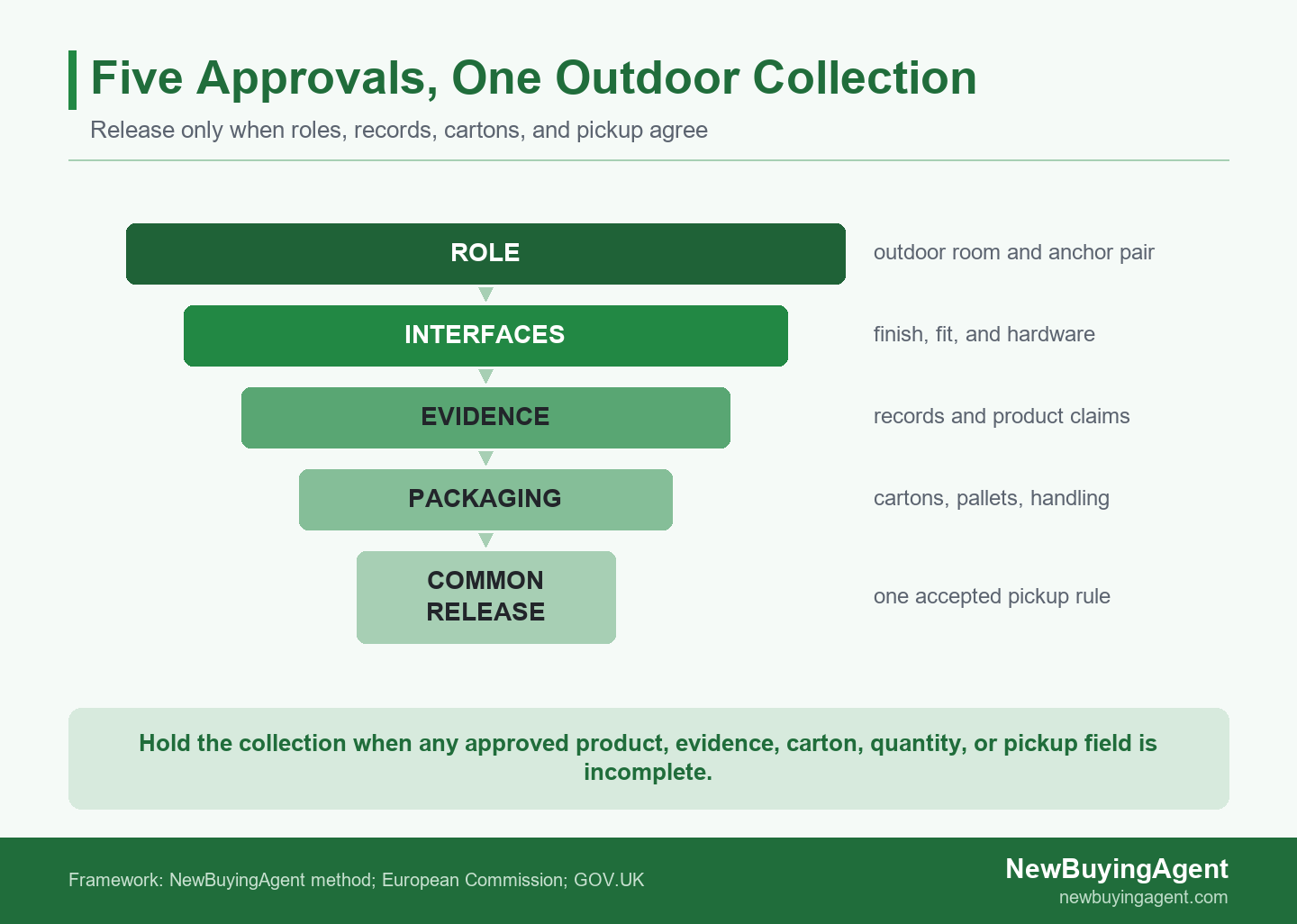
Approval funnel showing five controls narrowing to a common outdoor collection release
A product, process, component, finish, or carton change should reopen the relevant collection record before the buyer confirms release. The question is not whether a factory can still make the item. The question is whether the collection’s approved product, packing, evidence, and delivery assumptions still describe the item that will be collected.
Run the release meeting around exceptions. Review each product family against the accepted version, remaining evidence, carton data, confirmed quantity, pickup window, and impact on the other families. Then record one of three buyer choices: release the complete collection, hold it while a defined record is corrected, or split it after weighing the commercial and freight effect. A split shipment can be sensible; it should be a conscious range decision, not the result of the first ready factory setting the timetable.
Where the buyer already works with China factories, the same structure can be used without moving the commercial decision outside the buyer’s team. Buyers can see how NewBuyingAgent manages existing China factories when they need China-side follow-up around requirements, records, completion, and pickup readiness.
Illustrative Scenario: A Four-Factory Terrace Collection
In the illustrative four-factory terrace collection, a changed umbrella-base finish and carton height remain collection dependencies even though the other product families are ready. This is the point where a collection record matters more than four separate completion notices.
A retailer is preparing 1,200 terrace sets for a seasonal launch: 4,800 sellable items across aluminum dining furniture, cantilever umbrellas, resin storage benches, and cushion-and-accessory kits from four China factories. The furniture, storage, and accessory factories have approved samples and carton records. The shade factory reports that its base finish has changed and the packed height has increased.
The situation is not automatically a product failure. It is a collection decision. The new base no longer matches the approved warm-gray hardware direction. Its taller carton changes the pallet pattern and combined pickup calculation. The shared record still shows the older finish and carton version, so the buyer cannot yet say that the visible products and handling plan describe the version that will be collected.
Hold the Collection When the Shade Base Changes
The illustrated collection should remain on hold until the physical shade-base finish, revised carton data, and shared collection record agree on the accepted version. The buyer asks for a corrected finish sample or explicit approval of the substitute, new carton dimensions, packing photographs, and a release-sheet update for all four factories.
A retailer is preparing a terrace collection for a seasonal outdoor-living launch. The illustrative program covers 1,200 terrace sets, or 4,800 sellable items, made up of aluminum dining furniture, cantilever umbrellas, resin storage benches, and cushion-and-accessory kits from four China factories. The furniture, storage, and accessory factories have approved samples and carton records; the shade factory has changed the umbrella base finish and increased the packed height.
The changed umbrella base no longer matches the collection's approved warm-gray hardware direction. Its revised carton height changes the planned pallet pattern and combined pickup calculation. The shared collection record still carries the earlier finish and carton version.
The umbrella factory is close to complete, but the change affects both the visual interface and the packaging plan for the collection rather than one isolated SKU. Hold the combined release until the base finish is approved or corrected, the new carton is measured, and the collection record shows the accepted version.
The buyer requests a corrected finish sample, revised carton dimensions, new packing photographs, and one updated release sheet for all four factories. Release only when the physical base, approved finish reference, carton data, and collection pickup record agree. This is an illustrative scenario. A buyer may select a split shipment if its commercial deadline, stock plan, and freight effect justify it.
Turn the Approved Collection Into a China Supply Brief
Buyers evaluating a China sourcing partner can use public success stories as category context. They can review NewBuyingAgent success stories for category context.
Public examples help frame a partner conversation, but each product, destination, and collection requirement still needs its own assessment.
NewBuyingAgent supports global buyers who need China-sourced products to move through one defined collection brief. For a new outdoor living range, name the target market, anchor product concepts, finish references, key dimensions, target price bands, carton requirements, quantities, delivery window, and what may or may not change. That lets product and factory conversations begin from a shared version rather than four independent quote requests.
Before requesting a quote path, separate the product facts from the commercial choices. Product facts include the current model or sample version, drawings or photographs, exact finish reference, open and packed size, planned carton, quantity, product information owner, and delivery window. Commercial choices include which item anchors the room, whether a substitute is acceptable, the preferred retail position, and whether one delayed product family can move separately. A coordinator can keep these inputs current across China factories, while the buyer retains the decisions that affect the range and customer promise.
This distinction prevents a collection brief from becoming a long email with no release logic. It tells every factory which version to work from, tells the team what a change affects, and creates a clean exception path when something cannot meet the original brief. It also makes a deliberate split shipment easier to evaluate: the buyer can see whether the open issue touches the visible collection, the delivery date, freight utilization, or only an optional supporting item. The brief does not guarantee a production result; it gives the buyer a more usable basis for discussion and follow-up.
If the approved collection needs a China sourcing discussion after those inputs are ready, send an outdoor living collection brief to NewBuyingAgent.
Frequently Asked Questions
Which products should define an outdoor living collection first?
The seating-and-shade pair should normally define an outdoor living collection first because it sets the use occasion, footprint, visual direction, and practical safety assumptions for supporting products. Confirm seating capacity, key dimensions, visible metal and fabric direction, shade coverage, base placement, and retail position before asking storage and accessories to fit the range. This does not make every collection identical; it establishes the items that other decisions must respect.
Can different China factories produce one outdoor collection?
Different China factories can produce one outdoor collection when every factory follows the same approved interfaces, packaging records, and common release rule rather than isolated sample approvals. The buyer needs one current record for product versions, finishes, labels, carton data, evidence owners, quantities, and pickup assumptions. Separate factories are not the issue by themselves; unrecorded changes are.
What should be on an outdoor collection interface record?
An outdoor collection interface record should identify the shared finish, dimensions, hardware, accessory fit, carton data, instructions, labels, and approval owner for every product family. It should also show the current model or sample version, change date, target market, evidence status, quantity, and collection-release status. Keep it concise enough for decisions, while linking each row to the product materials that contain the underlying detail.
When should a buyer split an outdoor collection shipment?
A buyer should split an outdoor collection shipment only after comparing the commercial date, freight effect, inventory consequences, and exact incomplete dependency against the value of keeping the range together. If the open item does not affect the usable or visible core of the collection, a split can be reasonable. Record the version, carton, evidence, quantity, and customer-facing effect so the shipment is a buyer decision rather than an accidental response to one factory finishing early.
NewBuyingAgent
Related Resources

Начните сегодня
Давайте превратим ваши цели по закупкам в реальностьWeChat:+86 15157124615
WhatsApp:+86 15157124615
Адрес: Здание 10 #39 Xiangyuan Road, Ханчжоу, Китай
