

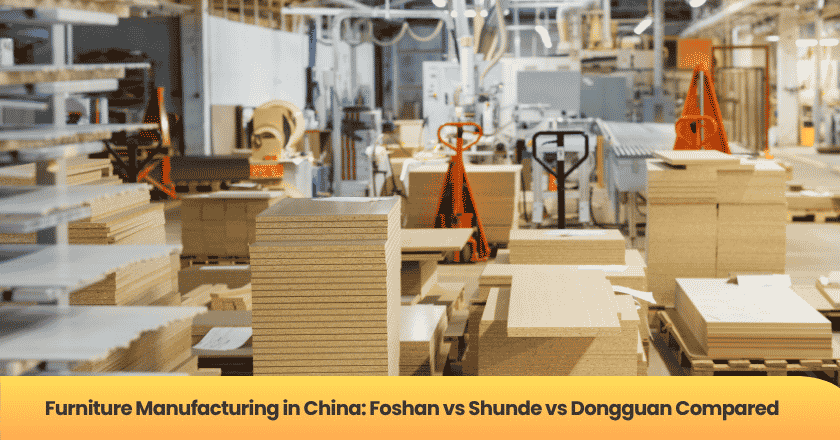
Three Chinese furniture clusters within 100km of each other dominate global wood, residential, and office furniture exports. Each does something different well — and buyers who treat them interchangeably end up with mismatched suppliers and disappointed margins.
Key Takeaways
- Three Chinese furniture clusters dominate global production: Foshan (residential and decorative furniture), Shunde (kitchen/cabinetry/upholstery, technically part of Foshan municipality), and Dongguan (office furniture and upscale residential). Each has distinct strengths, MOQ profiles, and quality tiers.
- Foshan is the largest furniture cluster globally — over 8,000 furniture factories around Lecong town's furniture market. Best for residential furniture across price tiers, decorative pieces, and high-volume commodity products. MOQs typically 50–500 units.
- Shunde dominates kitchen cabinetry, upholstered furniture (sofas, beds), and home appliances integrated with furniture (built-in fridges, etc.). Generally higher unit prices than Foshan but better quality consistency. MOQs typically 50–200 units for finished pieces.
- Dongguan is the office furniture capital and increasingly important for upscale residential. Higher price point, better engineering, dominant for ergonomic chairs and modular office systems. MOQs typically 100–500 units for office; higher for residential premium.
- US import duties on Chinese furniture in 2026: typically 35% effective (0% MFN + 10% Section 122 + 25% Section 301 List 3). Compare to Vietnam at 10% effective — a 25-point gap that has driven significant production migration since 2018.
- E1 (or stricter E0) formaldehyde emission standards are essential for any furniture going into US/EU markets. Chinese factories vary widely; specifying E1 minimum and verifying with third-party testing is critical.
- Container loading efficiency is the dominant freight variable. A 40' container holds approximately 60–70 m³ of furniture; products that pack flat (RTA furniture) achieve much higher container utilization than fully assembled pieces.
For US and European furniture buyers, Chinese sourcing has been the global default for two decades. Around 50% of all furniture imported into the US comes from China (or did, before the 2018 trade war began shifting volume to Vietnam). The major Chinese furniture industry concentrates in three clusters in Guangdong province within 100 kilometers of each other: Foshan (specifically Lecong town and surrounding districts), Shunde (technically a Foshan district but operates as a distinct cluster), and Dongguan. Together these three account for the vast majority of Chinese furniture exports.
Each cluster does something different well. Foshan is the volume residential and decorative furniture capital, with the famous Lecong furniture market serving as the world's largest furniture trading hub. Shunde dominates kitchen cabinetry and upholstered furniture. Dongguan is the office furniture capital and increasingly important for upscale residential and ergonomic products. Buyers who pick the wrong cluster for their product end up with factories that aren't structurally equipped for what they're trying to build — wrong MOQs, wrong specialization, wrong price point.
This guide walks through what each cluster does, how to evaluate factories within each, the realistic MOQ and pricing differences, the formaldehyde emission and quality standards that matter, and the freight economics that often determine whether a Chinese furniture sourcing program actually delivers the cost advantages buyers expect.
Part 1: The Three Clusters and What Each Does Best
Foshan (specifically Lecong town) — residential and decorative furniture at scale
Foshan municipality is the largest furniture manufacturing cluster in the world. The center of gravity is Lecong town in Shunde district (yes, the geography is confusing — Shunde is administratively part of Foshan municipality but operates as a distinct sub-cluster, which we'll cover separately). Lecong's main furniture markets — the Lecong International Furniture Mall, the China Lecong International Furniture Exhibition Center — span millions of square meters of showroom and house tens of thousands of furniture vendors and factories.
What Foshan does best:
Residential furniture across price tiers. Beds, dressers, dining tables, chairs, accent furniture, decorative pieces. From budget to mid-premium.
Solid wood furniture. Several Foshan sub-clusters specialize in solid wood (typically rubberwood, oak, ash, walnut depending on price tier).
Reproduction and traditional styles. European antique reproduction, classical Chinese, French country, transitional — Foshan has the artisans for ornamental detail at scale.
Decorative pieces and accent furniture. Mirrors, console tables, sideboards, decorative cabinets — often at small-batch MOQs.
High-volume commodity furniture. Folding tables, basic chairs, simple dressers — produced at very large scale and competitive unit costs.
MOQ profile: 50–500 units for most categories. Stock-equivalent decorative pieces sometimes available at 10–50 units. Custom OEM with significant tooling investment requires 1,000+.
Quality tier: variable. Foshan covers the entire range from very low-end (cheap MDF construction with thin veneer) to high-end (solid wood with traditional joinery). Buyer responsibility to specify quality tier and verify through samples.
Shunde (Foshan district) — kitchen, upholstery, and integrated home
Shunde is officially a Foshan district but operates as a distinct cluster with different specializations. The center is around Longjiang and Beijiao towns.
What Shunde does best:
Kitchen cabinetry. Modular kitchen systems, custom cabinetry, kitchen islands. Most major Western kitchen brands have Shunde supplier relationships.
Upholstered furniture. Sofas, sectionals, upholstered beds, accent chairs. Established cluster with significant capability for custom upholstery, leather work, and frame construction.
Home appliance integration. Built-in refrigerators, dishwashers integrated into cabinetry, range hoods. Shunde is a dominant cluster for both major home appliances and the cabinetry that integrates them.
Mid-to-upper price tier. Generally Shunde factories serve somewhat higher price points than Foshan-Lecong volume residential.
MOQ profile: 50–200 units for finished pieces (sofas, kitchen sets), 500+ for components or commodity items. Custom kitchen orders often quoted per-project rather than per-unit MOQ.
Quality tier: generally consistent and quality-focused. Lower variance than Foshan-Lecong on average. Better-suited for brands that need quality predictability.
Dongguan — office furniture and upscale residential
Dongguan is the office furniture capital of China and increasingly important for upscale residential and ergonomic products. The center spans multiple districts but heavy industrial concentration in Houjie, Dalingshan, and surrounding areas.
What Dongguan does best:
Office furniture systems. Modular workstations, conference tables, executive desks. Major Western office furniture brands (Steelcase, Herman Miller, Knoll competitors) have Dongguan supplier relationships.
Ergonomic chairs. Office chairs at all price points — from budget task chairs to high-end ergonomic. Dongguan is the dominant global cluster for office seating.
Upscale residential furniture. Higher price tier than Foshan-Lecong residential. Better engineering, better materials sourcing, more quality-focused production.
Hospitality furniture. Hotel furniture programs at scale (FF&E for major hotel chains).
MOQ profile: 100–500 units for office chairs and modular components, 500+ for hotel/contract furniture. Custom OEM with significant tooling: 1,000+.
Quality tier: generally higher than Foshan-Lecong, comparable to Shunde. More engineering depth than either. Higher unit costs (often 20–40% above Foshan-Lecong for comparable categories).
Side-by-side comparison
| Dimension | Foshan-Lecong | Shunde | Dongguan |
|---|---|---|---|
| Strongest category | Residential, decorative | Kitchen, upholstery | Office, upscale residential |
| Typical price tier | Budget to mid | Mid to upper | Upper |
| Typical MOQ | 50–500 | 50–200 | 100–500 |
| Quality consistency | Variable | Good | Good to excellent |
| Best for | High-volume commodity, residential variety | Kitchen programs, upholstery, integrated home | Office systems, ergonomic, hospitality |
| Visit destination | Lecong International Furniture Mall | Longjiang town factory cluster | Houjie/Dalingshan industrial parks |
Common Mistake: Buyers visit Foshan-Lecong, see the massive furniture mall, and assume they can find any furniture category there. They can find samples of nearly anything, but the actual production capability for office furniture or specialized upholstery is concentrated in Dongguan and Shunde respectively. The mall serves as a global trading hub — products on display may be sourced from any of the three clusters (and sometimes from outside Guangdong). Buyers who want office furniture specifically should evaluate Dongguan factories directly rather than working through Foshan trading companies who margin up Dongguan production.
Part 2: Realistic Quality Tiers and What They Actually Mean
Chinese furniture covers an enormous quality range. Buyers who don't specify carefully end up with whatever the factory's default tier is, which is rarely what the buyer wanted.
Tier 1: Budget commodity furniture
Construction: particleboard or MDF core, paper/melamine surface (sometimes thin veneer), basic hardware, screw-and-glue assembly.
Materials: cheapest available — often Chinese-domestic particleboard, basic Chinese hardware.
Typical Foshan-Lecong factory price: $30–80 for a small dresser, $40–100 for a basic dining chair set.
Lifespan: 3–5 years of typical residential use.
Best for: budget retail (IKEA-comparable price points), short-term use furniture (rental properties, dorm rooms), markets where price dominates.
Tier 2: Mid-market residential
Construction: better particleboard or MDF with proper edge banding, higher-quality veneer, real wood frames in load-bearing structures, better hardware (German or Japanese hinges, slides).
Materials: E1 or better particleboard, real wood veneers, sometimes solid wood for frames and structural components.
Typical factory price: $80–200 for a small dresser, $150–400 for a sectional sofa frame (before upholstery).
Lifespan: 7–12 years of typical use.
Best for: most US/EU mid-market residential furniture brands. Pottery Barn, West Elm, Crate & Barrel competitors operate in this tier.
Tier 3: Upscale residential and contract
Construction: solid wood throughout (rubberwood for budget within tier, oak/walnut/ash for premium), traditional joinery (mortise-and-tenon), high-end hardware, hand-finished surfaces.
Materials: E0 (lower formaldehyde) particleboard if any, FSC-certified wood, real veneers on solid wood substrates.
Typical factory price: $200–600 for a small dresser, $400–1,200 for a sectional sofa frame.
Lifespan: 15+ years of use.
Best for: premium residential brands, hospitality, contract office furniture.
Tier 4: True luxury
Construction: solid hardwoods, traditional joinery, hand-applied finishes, premium materials throughout.
Best for: very high-end residential, luxury hospitality. Most luxury furniture is made in smaller specialty workshops rather than the major Guangdong clusters.
Expert Tip: When specifying furniture quality to a Chinese factory, never use subjective words like "good quality" or "high quality." These map to the factory's default tier, which is usually Tier 1 or Tier 2. Use specific construction terms: "solid rubberwood frame, mortise-and-tenon joinery on stress points, dovetail drawer construction, German Blum hinges." Specific construction language gets specific construction. Vague language gets vague results. Commission-free sourcing agents who handle category-by-category factory matching can usually translate buyer intent into the technical specifications that produce the right tier — the factory invoices that come back are then comparable apples-to-apples.
Part 3: Formaldehyde Emission Standards (E1, E0, E2)
Formaldehyde emissions from particleboard, MDF, and plywood are a regulated quality issue in US and EU markets. Chinese factories produce furniture at multiple emission grades; buyers must specify which grade they require.
The grades
E2 (≤ 30 mg/100g formaldehyde emission): China's basic industrial standard. Not legal for furniture sale in US, EU, Japan, or other regulated markets. Some Chinese factories will quote E2-grade boards by default unless specified otherwise.
E1 (≤ 8 mg/100g): The minimum standard for US (CARB Phase 2), EU (E1), and most regulated markets. Required for any furniture going into these markets.
E0 (≤ 5 mg/100g): Higher standard, sometimes required for upscale residential or for products marketed to children. CARB ULEF (Ultra Low Emitting Formaldehyde) is roughly equivalent.
No Added Formaldehyde (NAF): Highest standard. Particleboard and MDF without urea-formaldehyde resin. More expensive and less widely available.
What buyers should do
For any furniture going into US, EU, Japan, or Korea:
Specify E1 minimum (or stricter) in the purchase order.
Require third-party test certificates from accredited labs (CARB-certified labs for US sales; TÜV or SGS for EU).
Verify test certificates by occasionally requesting independent testing on production samples.
The cost differential between E1 and E2 boards is typically 5–15% on the board cost (which translates to 1–3% on finished furniture cost). The cost of selling non-compliant furniture is much higher: forced recall, regulatory penalties, brand damage.
Common Mistake: Buyers rely on the factory's claim that boards are "E1 grade" without requiring test documentation. The factory may genuinely use E1 boards in samples but switch to cheaper E2 boards in production runs. Or the factory may use legitimate E1 boards but apply finishes that themselves emit formaldehyde. Independent testing on production samples is the only reliable verification. Budget USD 200–500 per product test as ongoing quality assurance cost.
Part 4: The Container Loading Reality
For furniture sourcing, container loading efficiency is the dominant freight variable — often more important than per-unit factory price.
The basic math
A 40' high-cube container has approximately 76 m³ of internal volume. After accounting for packaging and loading inefficiency, expect 60–70 m³ of usable cargo space.
For furniture:
- Fully assembled bulky items (sofas, beds, cabinets): typically 0.5–2 m³ per unit. Container holds 30–140 units.
- Ready-to-assemble (RTA) flat-pack: typically 0.05–0.2 m³ per unit. Container holds 300–1,400 units.
- Smaller decorative items (lamps, chairs, side tables): 0.1–0.5 m³ per unit.
Container freight cost from China to US West Coast in 2026: approximately $2,800–4,500 per 40' container.
The per-unit freight cost difference between fully assembled and RTA furniture can be dramatic: $100+ per assembled chair vs $5 per RTA chair. This is why nearly all volume residential furniture (especially case goods and seating) ships flat-pack.
Container utilization optimization
Best-practice furniture sourcing optimizes container utilization through:
- Flat-pack engineering. Designing products so they ship disassembled. Adds engineering work but dramatically improves freight economics.
- Mixed loading. Combining bulky and small items in the same container to use space efficiently.
- Component shipment with destination assembly. For sofas and other large upholstered pieces, shipping frames separately from cushions and assembling at destination warehouse.
- Consolidation across multiple SKUs. Filling a container with 20 different SKUs from one factory rather than running multiple half-empty containers.
For buyers running diverse furniture SKU programs, consolidation alone often delivers 15–25% freight cost reduction vs single-SKU shipping.
Part 5: AQF and Quality Control for Furniture
Furniture quality control has product-specific dimensions that general consumer goods QC doesn't always cover.
Pre-shipment inspection (PSI) for furniture
Standard furniture PSI follows AQL 2.5 / 4.0 standards (the same statistical sampling used across consumer goods inspections) but adds furniture-specific check categories:
- Dimensions and tolerance. Critical for assembled fit, drawer/door alignment, hardware integration.
- Surface finish quality. Scratches, dents, finish defects, color consistency, veneer matching.
- Structural integrity. Joint strength, drawer slide function, hardware tightness.
- Hardware testing. Hinges, drawer slides, knobs/pulls — tested for proper installation and function.
- Packaging quality. Critical for furniture which is highly damage-prone in transit.
- Assembly verification. Sample units assembled at factory to verify all components are present and instructions are accurate (essential for RTA furniture).
AQF (Asia Quality Focus) and category-specialized inspection firms
For furniture specifically, generalist inspection firms (SGS,TradeAider, BV) provide adequate coverage for standard programs. For high-stakes furniture programs, category-specialized firms (AQF — Asia Quality Focus, several Chinese furniture-focused inspection firms) provide deeper category expertise.
Inspection cost: USD 250–450 per inspection day for generalist; USD 350–550 for category-specialized.
In-line inspection
For first orders or for large orders ($30,000+), in-line inspection during production is recommended in addition to PSI. Catching quality issues during production is much cheaper than catching them after the goods are packed and ready to ship.
Expert Tip: When evaluating sourcing agents for furniture programs, ask specifically about their furniture inspection process. Generalist agents who use generic AQL 2.5/4.0 without furniture-specific check categories will miss issues that are obvious to category specialists. Look for agents who can describe their inspection checklist in furniture-specific terms — finish quality categories, hardware testing protocols, packaging verification standards. Commission-free sourcing agents typically include comprehensive inspection in their service fee; commission-based agents sometimes offer "basic inspection" included with extra-cost premium inspection. The premium inspection is what most furniture programs actually need.
Part 6: The 2026 Tariff Math on Chinese Furniture
US import duties on Chinese furniture in 2026:
| Furniture category | MFN | Section 122 | Section 301 | Effective rate |
|---|---|---|---|---|
| Wood furniture (HTS 9403.60) | 0% | 10% | 25% (List 3) | 35% |
| Upholstered furniture (HTS 9401.61) | 0% | 10% | 25% (List 3) | 35% |
| Office furniture (HTS 9403.30) | 0% | 10% | 25% (List 3) | 35% |
| Mattresses (HTS 9404.21) | 3% | 10% | 25% (List 3) | 38% (plus AD/CVD on some) |
| Decorative items (HTS 9403.90) | 0–4% | 10% | 25% (List 3) | 35–39% |
The Bottom Line
Chinese furniture sourcing in 2026 is concentrated in three Guangdong clusters within 100km of each other. Foshan (especially Lecong) is the volume residential and decorative capital. Shunde dominates kitchen cabinetry and upholstery. Dongguan leads in office furniture and upscale residential. Choosing the right cluster for your product is the foundation of a successful Chinese furniture sourcing program.
Within each cluster, quality tiers vary enormously. Specifying construction details (board grade, joinery, hardware) is essential — vague specifications produce factory-default quality, which is rarely what buyers want. E1 formaldehyde minimum is non-negotiable for US/EU markets; E0 is increasingly important for upscale residential. Container loading efficiency often dominates per-unit factory price as a determinant of landed cost.
The 2026 tariff environment has made Vietnamese furniture 25 points cheaper than Chinese on most categories, driving significant production migration. China retains advantages in decorative pieces, office furniture, and very high-volume commodity items, but mid-market residential furniture has heavily shifted to Vietnam. Most successful furniture programs now run dual-source: Vietnam for categories where it competes, China for categories where Chinese capability or scale dominates.
FAQ
Should I buy from a factory directly or through a Foshan trading company?
For first-time buyers or for buyers needing capability across multiple categories, Foshan trading companies provide convenient one-stop sourcing — though usually with a 5–15% margin layer. For buyers with established product programs and direct relationships, factory-direct sourcing is more cost-effective. Many mature buyers run a hybrid: trading company for accessory and decorative pieces (where the variety justifies the agent), factory-direct for hero SKUs (where the volume justifies relationship investment).
How important is visiting Foshan in person?
For furniture sourcing, in-person visits are particularly valuable. Furniture is a highly tactile category — surface finish, materials feel, structural solidity all need to be evaluated physically. The Lecong furniture market is also dramatically more useful in person than through online sourcing tools. We recommend an annual visit minimum for active furniture programs.
Can I really verify formaldehyde grade without specialized testing?
No. Formaldehyde emissions are not visible or smell-detectable at the levels that distinguish E0 from E1 from E2. The only verification is laboratory testing — either CARB-certified labs for US-bound goods or TÜV/SGS for EU. Build periodic independent testing into your QC budget; don't rely solely on factory-provided test certificates.
Is the AD/CVD on Chinese wooden bedroom furniture still in effect?
Yes, with widely varying rates by exporter (some at 0%, others at 200%+). Before sourcing wooden bedroom furniture from any Chinese supplier, verify the supplier's specific AD/CVD rate through CBP's AD/CVD database. Some Chinese wooden bedroom furniture manufacturers have been excluded entirely from the order; others face prohibitive duties.
What's the realistic timeline for a new furniture OEM program?
For Tier 2 mid-market residential furniture: 12–18 weeks from spec sign-off to first production-ready samples; 18–24 weeks to first production order shipped. For Tier 3 upscale: typically 4–8 weeks longer due to material sourcing and finish refinement. For office furniture systems: 6–9 months for full system development.
How does container utilization affect actual landed cost?
Significantly. A poorly utilized container running at 40% capacity essentially doubles your per-unit freight cost. Working with suppliers who design products for flat-pack shipping, understanding cube-per-unit metrics, and consolidating shipments across SKUs all materially improve landed cost. For high-volume programs, container utilization optimization can reduce landed cost by 5–15%.
Should I buy upholstered furniture (sofas, sectionals) from China or Vietnam?
China retains advantages in highly custom or traditional-style upholstered furniture, and in markets where Chinese cluster scale produces dominant unit costs. The default 2026 answer for volume upholstery is Vietnam; exceptions are case-by-case.
NewBuyingAgent
Related Resources



Get Started Today
Let's Turn Your Sourcing Goals into RealityWeChat:+86 15157124615
WhatsApp:+86 15157124615
Address:Building 10 #39 Xiangyuan Road, Hangzhou, China
