

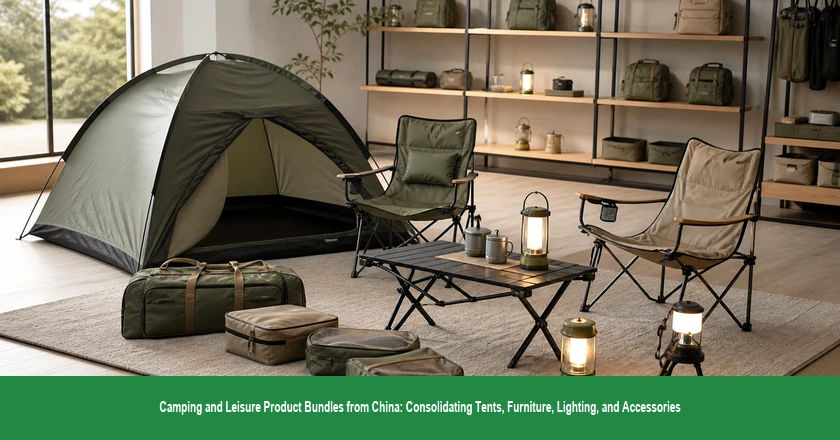
A camping range becomes difficult to source when each factory is allowed to optimize its own product in isolation. A tent may be ready, a chair may look right, and a lantern may have an appealing price, yet the collection can still fail as a retail offer if the products do not serve the same trip, fit the same packing logic, or arrive with records that describe the shipped versions. The practical unit of work is the collection, not the container.
For buyers using China sourcing for camping leisure products, the reliable sequence is to define one campsite occasion, lock the products that set the constraints, make interfaces visible across suppliers, and release the set only when every dependency is ready. This approach is useful for private-label launches, seasonal assortments, retail promotions, and established outdoor ranges alike; it does not require all products to come from one factory.
The Four Gates That Keep a Camping Bundle Coherent
A camping product bundle is a collection-level sourcing decision, not a list of products that happen to fit in the same container. The four gates below keep commercial choices, product details, evidence, and pickup decisions connected while different factories work at different speeds.
- Map the occasion: define the trip, user, selling channel, price position, and the few products that make the set credible.
- Align the interfaces: give every factory the same approved reference for colour, dimensions, power, packaging, labels, and accessory fit.
- Check release evidence: request the product-specific documents and instructions that matter for the target market before a booking creates pressure.
- Consolidate by readiness: set one release rule that covers every planned SKU, carton record, quantity, and pickup window.
These gates are deliberately simple. They do not turn a sourcing team into a product laboratory or replace destination-specific advice. They create a shared way to notice when a local supplier change has become a collection-level issue. That distinction matters most when a range combines soft goods, folding furniture, rechargeable lighting, and low-value accessories that may be purchased from different specialist factories.
Start With One Campsite Occasion and Clear Product Roles
A useful camping assortment begins with one use occasion, because that occasion determines which product must carry comfort, shelter, light, storage, or portability. “Weekend family campsite with car access” produces a different product hierarchy from “compact festival overnight kit,” even when both contain a tent, chairs, lights, and small accessories.
Write the occasion as a buying brief rather than a mood board. Name the expected number of users, weather assumptions, transport method, target retail price band, and the single promise the customer should recognise. Then assign each proposed SKU a job. The tent may establish shelter and the visual centre of the range. Furniture may establish seated comfort and packed volume. Lighting may establish evening use and a transport dependency. A mat, cup, storage pouch, or repair kit should have a visible contribution to the same trip rather than merely filling an accessory slot.
A role map also prevents an early quotation from becoming an accidental specification. A factory can quote its standard item quickly, but the buyer still needs to decide whether that standard item belongs with the other products. The map gives the buyer a useful question for every candidate: does this item strengthen the campsite occasion, or does it create a new size, finish, safety, packaging, or price problem for the rest of the collection?
Lock the Anchor Products Before Adding Attachments
Lock the tent and core furniture constraints before approving accessories, because the anchors set the practical limits for footprint, carrying weight, visual direction, and price architecture. An accessory may be inexpensive on its own, but it can undermine the offer if it forces a different colour family, creates a second power format, or makes the packed set less believable.
For each anchor, record the buyer-facing details that other suppliers must respect: intended users, open and packed dimensions, fabric or frame direction, maximum packed weight, colour standard, retail packaging concept, and any non-negotiable instructions or labels. The purpose is not to prescribe one factory’s production method. It is to stop cross-factory decisions from drifting after samples are approved. If the folding-chair carton grows, for example, the impact is not limited to the chair factory; pallet assumptions, container planning, and the perceived compactness of the set may all need review.
Anchor choices should also be made in the order of commercial consequence. A buyer can usually replace a lantern colour late in development more easily than a tent footprint or a chair load concept. Put the decisions that would force other factories to rework first. This makes the project faster because later conversations become constrained choices, not repeated debates about the entire collection.
Test Accessories Against the Locked Anchors
An accessory earns its place in the bundle when it improves the same use occasion without breaking the approved size, weight, finish, power, or packing assumptions. The test is practical: a buyer should be able to explain what the item helps the user do at the campsite and what approved interface it relies on.
Use a short keep-or-drop review for every accessory. First, identify the job: comfort, organisation, weather protection, nighttime use, or repair. Next, identify the interface: a shared colour, a usable pocket size, a compatible charging method, a defined space in retail packaging, or a pre-agreed carton layout. Finally, identify the cost of failure. A carabiner set that does not match the product’s attachment points may be harmless as a separate item; a lantern that requires an unplanned battery format can alter freight planning and customer instructions.
This discipline does not ban assortment breadth. It makes breadth intentional. A buyer may keep a standalone picnic blanket, a cooking utensil roll, or a premium lamp as a separate range extension when it has its own occasion and commercial story. What should not happen is calling several unrelated goods a “bundle” after they have already been sourced independently.
Make Compatibility Visible Before You Approve Individual SKUs
A master SKU sheet is one controlled record that holds the approved product, packaging, and release details for every item in the collection. It is not a replacement for each factory’s drawings or compliance records; it is the buyer’s cross-factory reference for deciding whether the parts still belong together.
European Commission guidance says technical documentation should include product identification, a product description, a risk assessment, applicable rules and standards, component or material information, and relevant labels or user instructions. A buying sheet can use that logic without pretending to be the formal technical file: put stable product identifiers, version dates, key dimensions, packaging details, target-market evidence needs, and the owner of each missing item in one view.
Give every SKU an approved status as well as a product description. “Quoted” and “sample accepted” are not the same as “ready for combined pickup.” A useful sheet has columns that reveal the dependency before it becomes a last-minute message: current model number, photo or sample version, carton dimensions, gross weight, label artwork status, manual status, evidence owner, confirmed quantity, and pickup readiness. A change to any of those fields should be dated and communicated to the people who use the rest of the row.
| Collection field | Why it crosses factories | Release question |
|---|---|---|
| Model and version | Sample, label, manual, and evidence must describe the same sellable item | Does the record match what will ship? |
| Packed size and carton data | Pallet, container, retail display, and consolidation plans use the same dimensions | Has a carton revision changed the shipment plan? |
| Colour and finish | The tent, chair textile, lamp trim, and accessory packaging form one offer | Does the approved reference still govern each item? |
| Evidence and instructions | Product records and customer information can affect the release window | What remains open for the intended market? |
A China-side partner can help preserve this shared record while communicating with multiple suppliers. Buyers developing a new range can use NewBuyingAgent's product-supply service for a coordinated camping collection, then keep the commercial choices and final approvals with their own team. The value is coordination around a defined requirement, not an unstructured search for camping products.
Hold Product Evidence at the Same Gate as Design Approval
HMRC's customs checklist calls for correct marking and labelling, including country of origin, and for packaging that meets ISPM 15 where required. Treat that as a planning reminder, not as a universal import checklist: the intended destination should be known before packaging and product information are treated as final.
For consumer products placed on the EU market, the GPSR requires manufacturers to prepare technical documentation and to provide a type, batch, serial, or other product identifier where the rule applies. This does not make every camping product identical. It does mean that a range sold into the EU needs a disciplined way to match each planned product version with the records and identifying information that apply to it.
European Commission guidance says importers should verify technical documentation, required markings and labels, plus relevant instructions and safety information. Put the evidence request next to the product approval, not in a separate email trail after production starts. For a collection, that means a tent, folding chair, lantern, and accessory kit can each have different requirements while still sharing one visible release status.
UK Maritime and Coastguard Agency guidance says lithium-ion batteries should be tested according to UN transportation test requirements for UN3480 and UN3481 shipments. For a rechargeable lantern, confirm the actual battery and model before relying on an older file; classification, packaging, documents, and carrier acceptance can vary with the product and route.
Evidence should change a decision, not decorate a folder. At the collection level, each missing item needs an owner, a due date, the product version it covers, and a clear consequence: can the range move forward, can only that SKU pause, or does the missing item change the consolidated pickup plan? This keeps product information, shipping preparation, and commercial timing in the same conversation.
Consolidate by Release Readiness, Not by Which Factory Finishes First
UK government guidance says solid wood packaging material entering Great Britain must meet ISPM 15 requirements, and non-compliant material may be rejected, destroyed, or treated. The broader operating lesson is to confirm the destination-specific packing conditions before the warehouse assumes that every pallet, crate, or piece of dunnage is acceptable.
A consolidated camping collection should be released when every planned SKU has an approved product record, accepted carton data, required evidence, confirmed quantity, and a shared pickup window. That rule protects the buyer from treating the fastest supplier as the decision-maker for an assortment that will be sold and shipped as one offer.
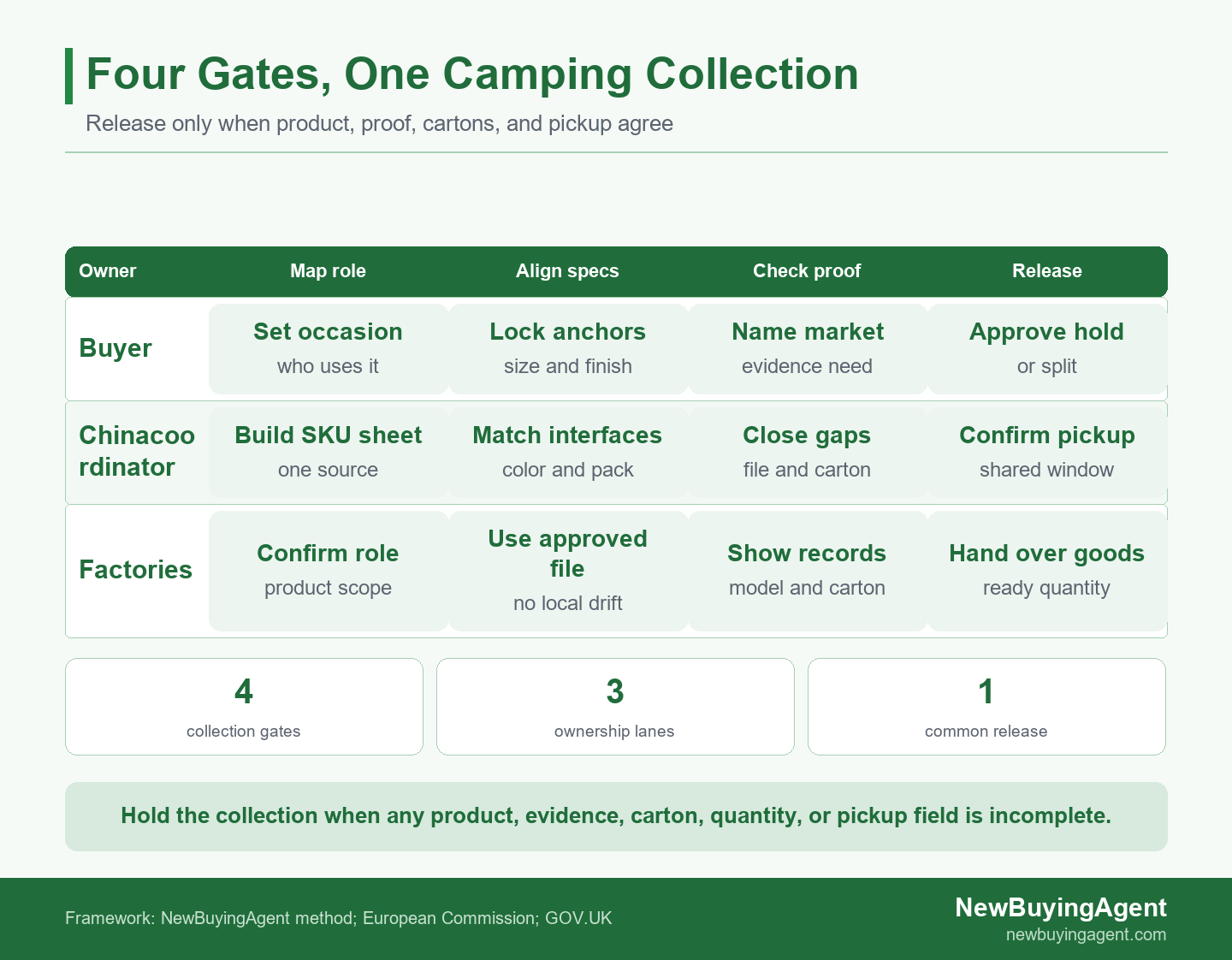
Swimlane diagram showing buyer, China-side coordinator, and factories completing four camping collection release gates
Set the release meeting around exceptions, not routine status updates. The buyer needs to know which SKU is blocked, what record is missing or changed, whether the issue affects the retail promise or transport plan, and what a split shipment would cost in timing and margin. A supplier that has completed production can still be ready for pickup only conditionally if another factory’s revised carton dimensions would change the consolidation layout.
When the project also involves factories the buyer already uses, follow-up should preserve the same release sheet and decision rights. Buyers can see how NewBuyingAgent manages existing China factories when the task is to connect requirements, delivery follow-up, and shipment readiness rather than start the supplier search again.
Illustrative Scenario: A Four-Factory Weekend Campsite Set
In the illustrative four-factory set, the lantern model mismatch and the revised chair carton height both remain collection dependencies even though the tent and accessory factories are ready for pickup. The right response is to protect the shared record before deciding whether speed justifies a deliberate split shipment.
Correct the Record Before You Book the Combined Pickup
The buyer should correct the lantern record, remeasure the chair carton, and then decide between a documented hold and a deliberate split shipment. This is a commercial decision supported by the collection record, not a rule that every late item must stop every shipment.
An outdoor retailer is planning a weekend campsite set for a spring promotion. The illustrative order covers 2,400 tent sets, 2,400 folding-chair pairs, 2,400 rechargeable lanterns, and 2,400 accessory kits from four China factories. Together, the order represents 9,600 sellable units. Three factories have approved samples and carton data; the lantern supplier has sent a new battery specification and the chair factory has changed carton height after the original packing plan was created.
The lantern model number on the battery file does not match the current sample label. The chair carton height increases the planned pallet and container calculation. The tent and accessory factories are ready for pickup but their pickup date would not solve the two unresolved collection records. Neither finding proves that the goods are unusable, but both break the buyer’s ability to say that the product record and shipment plan describe what will actually be collected.
The products are individually close to ready, but the battery evidence and carton data are collection dependencies because they affect the approved product record and consolidation plan. Hold the single consolidated release, validate the lantern model evidence, remeasure the revised chair carton, and update the master SKU sheet before confirming pickup. If the promotion date makes delay more expensive than the additional freight and handling, the buyer can compare a split shipment against that documented hold rather than improvising after a booking.
The buyer asks for the corrected lighting document, updated carton measurements, and a refreshed release sheet with all four factories’ quantities and pickup status. Release only when the lantern record matches the shipped model and the revised carton data is accepted in the shipment plan. The scenario is illustrative, not a client result. A buyer may choose a split shipment if the commercial deadline and shipping cost justify it, but the decision should be recorded with the remaining collection dependencies.
Turn the Collection Brief Into a Coordinated China Sourcing Request
Buyers evaluating a China sourcing partner can review NewBuyingAgent success stories across consumer product categories for broader sourcing context.
NewBuyingAgent works as a one-stop China sourcing agent for global buyers, with local factory resources and product-development and quality-control capability. A coordinated collection brief gives NewBuyingAgent the context to connect China-sourced product requirements, factory communication, and collection-level release planning. The buyer still owns the assortment, target market, commercial range, and final ship-or-hold decision. For a camping collection, the useful input is a concise brief that names the occasion, anchor products, technical or packing constraints, target market, expected evidence, quantities, and desired release date. That allows factory conversations to begin with comparable requirements instead of unrelated individual quotes.
The relevant test is whether the operating rhythm can keep separate suppliers aligned to one approved product and consolidation record. Public examples provide context, but the buyer should judge the specific category, requirement, and destination on its own merits.
That coordination starts by separating decisions that belong to the buyer from actions that can be followed up in China. The buyer sets the target consumer, intended use, price architecture, destination, product priorities, and acceptable compromise if the range misses its original date. The China-side coordinator can then maintain version control, request missing files, compare cartons against the release sheet, and ask each supplier the same practical questions. This protects the buyer from receiving several “ready” messages that refer to different samples, dates, or packing assumptions.
A collection brief is most useful when it states what cannot change and what may be traded. For example, a buyer may protect a launch date but accept a later accessory delivery, or protect a single combined delivery but allow a colour choice to move. Recording those boundaries early makes supplier follow-up more direct. It also makes an exception visible: the team can decide whether it affects customer use, freight, cash tied up in stock, or only a minor optional item.
Before outreach, attach the product list, anchor constraints, target destination, current factories if known, required evidence, carton targets, and the desired delivery window. Add one decision owner for questions that no supplier can answer. That packet gives every party the same reference and reduces the risk that a new quotation, revised sample, or early pickup request quietly changes the collection promise.
If a camping or leisure range needs China-side coordination, share a coordinated camping collection brief with NewBuyingAgent after those inputs are ready. A useful first conversation can then focus on the right sourcing and follow-up path rather than asking each supplier to solve a different version of the project.
Frequently Asked Questions
Which camping products should be chosen before accessories?
Choose the products that set the campsite promise and the hardest constraints first, usually the tent and core furniture. Confirm their intended users, packed size, carrying expectation, colour direction, and retail price position before treating accessories as approved. Then ask whether each light, storage item, or repair kit improves the same occasion without creating a new packing, power, or visual conflict for the range.
Can tents, lights, and chairs use separate factories in China?
Yes, separate specialist factories can supply one camping collection when the buyer controls the interfaces between their products. Give each supplier the current SKU version, agreed dimensions and finish references, packaging expectations, quantity, evidence needs, and the same release date logic. Separate factories are not the risk by themselves; unrecorded changes and disconnected approvals create the risk.
What paperwork matters for rechargeable camping lights?
Start with the product version, target market, battery configuration, and intended shipping route. The required product information, markings, instructions, and transport documents depend on those details. For battery-powered lights, the buyer should confirm that the file describes the actual shipped model and then check the applicable carrier and destination requirements. Do not treat an earlier model’s document as automatic approval for a revised lantern.
When should a buyer consolidate camping goods for shipment?
Consolidate only after every planned SKU has passed the collection’s agreed product, carton, evidence, quantity, and pickup-window checks. This does not mean a split shipment is never sensible. It means the buyer should compare the commercial cost of splitting against the missing dependency, record the choice, and avoid letting one factory’s early completion create an unexamined shipment decision for the whole range.
NewBuyingAgent
Related Resources


Начните сегодня
Давайте превратим ваши цели по закупкам в реальностьWeChat:+86 15157124615
WhatsApp:+86 15157124615
Адрес: Здание 10 #39 Xiangyuan Road, Ханчжоу, Китай
