Introduction
You quoted a sneaker at $8 a pair, agreed on 500 units, and then the factory came back asking for 2,000 minimum and an eight-week lead time you didn't budget for. Footwear sourcing has more moving parts than apparel — molds, lasts, multiple material suppliers — and each one quietly shapes the MOQ, the timeline, and what "quality" even means for your product. Buyers who treat shoes like t-shirts get surprised at exactly the wrong moment.
Shoe manufacturing in China is mature, deep, and clustered, which is good news once you understand how it works. The hard part is that the three things you most need to pin down — minimum order quantity, lead time, and quality expectations — are interlocked, and a change in one moves the other two. The pattern is consistent: get these three right up front and the rest of the order tends to follow.
Key Takeaways
• Footwear MOQs are driven by molds and material minimums, not just labor, so expect higher minimums than apparel.
• Lead times run longer than most buyers plan for, especially when custom molds or new lasts are involved.0
• Quality in shoes is about durability and construction, judged through wear testing, not just appearance.
• A confirmed pre-production sample on your final materials is the only reliable quality reference.
• Matching your order to a factory's specialty matters more in footwear than in almost any other category.
Understanding MOQ in Footwear
Why shoe MOQs run higher
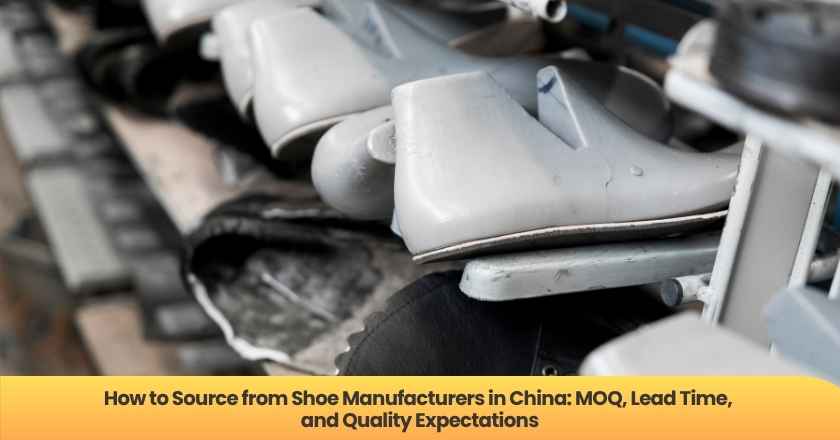
A clothing factory can cut a small run from a fabric roll it already has. A shoe factory often can't start until a mold or last is made and a material order clears its own minimum. A last (the foot-shaped form a shoe is built around) and an outsole mold are one-time tooling costs, and they only make economic sense spread across enough pairs. That's why footwear MOQs commonly land at 500–1,000 pairs per style and color, and sometimes higher for technical or molded designs.
Material minimums stack on top. Outsole compound, specialty leather, foam, and hardware each carry their own order floors from the suppliers feeding the factory. A shoe is an assembly of components, and the MOQ is really the highest minimum among all of them — not a single number the factory invents.
Levers that move the minimum
You have more room than the first quote suggests. Sharing a color across sizes, accepting an existing stock outsole instead of a custom mold, or choosing a material the factory already runs in volume can all pull the MOQ down. A factory quoting 2,000 on a custom sole might quote 500 on a stock one. Asking "what would lower the minimum?" usually surfaces options the sales rep didn't volunteer.
Expert Tip: Ask the factory which components on your design force the MOQ up, then decide case by case whether the custom version is worth it. A custom outsole mold might add a 1,000-pair minimum and a mold fee, while a stock sole that's 90% as good carries no tooling cost and a far lower floor. For a first order testing the market, stock components keep your risk small; save the custom tooling for the styles you've proven sell.
The mold fee question
Beyond the MOQ, custom tooling carries a one-time mold fee that buyers often overlook until it appears on the invoice. A custom outsole mold can run several hundred to a few thousand dollars depending on complexity, and that cost sits on top of the per-pair price. The fee is amortized across the run, so it stings far more on a 500-pair order than a 5,000-pair one. Worth knowing: some factories will waive or discount the mold fee if you commit to a larger volume or a reorder, treating it as a relationship investment. Negotiating the mold fee separately from the unit price often gives you a clearer picture of what your first order actually costs, and where the real negotiating room sits. Who owns the mold afterward matters too — clarify in writing whether you keep the tooling if you move factories, since a mold you paid for but don't control leaves you tied to one supplier.
Lead Time: Plan for the Full Timeline
The stages buyers forget to count
"Lead time" to a factory usually means production days after everything is approved — but your real timeline starts much earlier. Development and sampling can run three to six weeks, especially if a new last or mold is involved. Mold making alone adds one to three weeks. Then material sourcing, then production, then quality inspection and packing. The honest total from "go" to "goods ready" on a new style is often eight to fourteen weeks, not the four the production quote implies.
Reorders of an existing style are faster, since tooling and approved samples already exist — frequently four to six weeks. The big gap is always the first run, so budget the calendar around development, not just production.
Seasonal congestion is real
Chinese footwear lines run tight before Western peak seasons and shut down for two to three weeks around Chinese New Year, typically late January or February. An order placed six weeks before the holiday can slip well past its quoted date because the factory simply stops. Through 2026, buyers are increasingly placing footwear orders earlier in the year and building in buffer, partly because freight schedules have stayed less predictable than they were pre-2020.
Common Mistake to Avoid: Treating the factory's production lead time as your total timeline. Buyers commit to a retail launch date based on "six weeks production," forgetting the four-to-eight weeks of development, mold making, and material sourcing that come first. The result is a launch that slips a month and air freight that eats the margin. Always build your timeline backward from the ship date, counting every stage, and add a buffer for the round of sampling that runs long.
Quality Expectations: Construction Over Appearance
What footwear quality actually means
A shoe can photograph perfectly and fall apart in a month. Footwear quality lives in places a glance won't catch: bond strength between the upper and the sole, stitch integrity, last accuracy so sizing is consistent, and material durability under flexing. The industry uses standardized wear and stress tests — flex testing, bond-strength pulls, abrasion checks — because appearance tells you almost nothing about how a shoe holds up.
This is where independent quality control earns its place. A factory's own QC is motivated to ship; an inspection team working for you checks construction against a standard and catches the bonding or sizing issues that only show up under stress. A real QC bench exists so footwear matches its spec and survives real use, rather than passing a visual check and failing in the customer's hands.
Sizing and last consistency
Footwear has a quality dimension apparel doesn't: a size 9 must be a size 9 across the whole run, and across reorders. That consistency comes from the last and from disciplined grading. A factory that cuts corners on last quality produces shoes that fit differently batch to batch, generating returns you won't see until customers complain. Confirming last accuracy on your pre-production sample, and locking that sample as the reference, is the single most important footwear quality step.
Expert Tip: Request a wear-tested sample, not just a look-and-feel sample. Ask the factory to flex-test a pair and show you the bond line afterward, or commission a short third-party wear test before bulk. A shoe that survives several thousand flex cycles without the sole separating tells you more than any photo. Factories that do real footwear take this in stride; ones that hesitate are telling you their construction won't survive scrutiny.
Materials and the season ahead
Footwear quality also depends on materials behaving as specified, and that's harder to verify than it sounds. Outsole compounds vary in abrasion resistance, leather varies in thickness and finish, and foam densities affect both comfort and durability. A factory that substitutes a cheaper compound to protect its margin produces a shoe that looks identical but wears out faster — a problem you discover only through returns. Specify materials precisely in your tech pack, and have your pre-production sample tested against those specs, not just inspected by eye. Heading into 2026, material costs for footwear have stayed volatile, and buyers report more pressure from factories to accept substitutions mid-order. The defense is the same as always: a locked, tested sample as the reference, and an inspection that checks the bulk against it rather than against an optimistic description.
Choosing the Right Footwear Factory
Specialization is everything
Footwear factories specialize hard. A vulcanized canvas sneaker, a cemented leather dress shoe, an injection-molded sandal, and a Goodyear-welted boot are made on different equipment by differently skilled teams. A factory that's brilliant at one is often mediocre at another. Sending your leather boot to a sneaker specialist gets you a quote, an order, and a disappointing result. Match the factory's core product to yours before anything else.
China's footwear production also clusters geographically — sports shoes around Jinjiang in Fujian, leather and dress shoes around Wenzhou and Guangzhou, for example. A factory in the right cluster has the material suppliers and skilled labor for your product on its doorstep, which shows up as better pricing and shorter lead times. Reaching the right specialist, though, is harder than it sounds, since the factory built for your exact construction is often not the one that markets hardest in English.
The cost picture
Going direct looks cheapest until the failed samples, mold remakes, and a bad first order get counted. In footwear, where tooling mistakes are expensive and specialization errors are common, the cost of getting the factory match wrong often dwarfs any saving from chasing the lowest quote. Pricing the full cost of a failed order, not just the unit price, is what makes careful sourcing pay for itself.
How NewBuyingAgent Helps You Source Footwear
Shoe factories are highly specialized, and reaching the one built for your exact construction from a distance is hard, which is why many buyers work through a sourcing partner. NewBuyingAgent is your perfect partner for global sourcing from China, backed by 30 years of expertise in trade, manufacturing and quality control.
When the challenge is reaching the right factory, the network does the work: with 100% Access to China's Factories, you use their 50,000+ cooperated partner factories—no language/region/time zone barriers. Their local reputation gets you full factory cooperation. That wider reach also brings a cost advantage: with Lower Prices Than Direct Sourcing, their wide factory network lets us pick low-cost, high-cooperation suppliers. Even with their margin included, they cut your costs by 5%-10%. And on quality — which in footwear means surviving real wear — it is built in: NewBuyingAgent's 20,000+ product development & QC experts ensure your products match market needs and stay high-quality. Contact now.
Frequently Asked Questions
What's a typical MOQ for shoe manufacturers in China?
Most factories want 500–1,000 pairs per style and color, higher for designs needing custom molds or specialty materials. The minimum is set by the highest component minimum — outsole, leather, hardware — not by labor. Using stock components instead of custom tooling can lower it significantly.
How long does it take to produce shoes in China?
For a new style, plan eight to fourteen weeks from start to finished goods, including development, mold making, sampling, material sourcing, and production. Reorders of an existing style are faster, often four to six weeks, since tooling and approved samples already exist.
How do I check shoe quality before shipment?
Approve a pre-production sample in your final materials, then book a pre-shipment inspection against it using construction and wear standards — bond strength, stitch integrity, sizing accuracy — not just appearance. A visual check alone misses the durability issues that drive returns.
Can I order custom-designed shoes with a low MOQ?
Custom designs that need new molds or lasts carry higher minimums because of tooling economics. To keep your first order small, use stock outsoles and materials the factory already runs, and reserve custom tooling for styles you've proven in the market.
Why do shoe factories specialize so narrowly?
Different shoe constructions — vulcanized, cemented, injection-molded, welted — require different machinery and skills. A factory invests in equipment for its core product, so it excels there and struggles elsewhere. Matching your construction type to the factory's specialty is essential for good results.
Conclusion
Footwear rewards buyers who plan around its real mechanics: minimums set by tooling and materials, timelines that start at development rather than production, and quality measured by how a shoe wears rather than how it photographs. Pin those three down before you commit, match your design to a factory built for it, and most of the costly surprises never arrive. When lining up the right specialist factory and a real quality regime from a distance feels daunting, it's worth having someone match your construction to the right maker and put footwear-specific QC behind your first order.
NewBuyingAgent
Related Resources
Get Started Today
Let's Turn Your Sourcing Goals into RealityWeChat:+86 15157124615
WhatsApp:+86 15157124615
Address:Building 10 #39 Xiangyuan Road, Hangzhou, China