

Key Takeaways
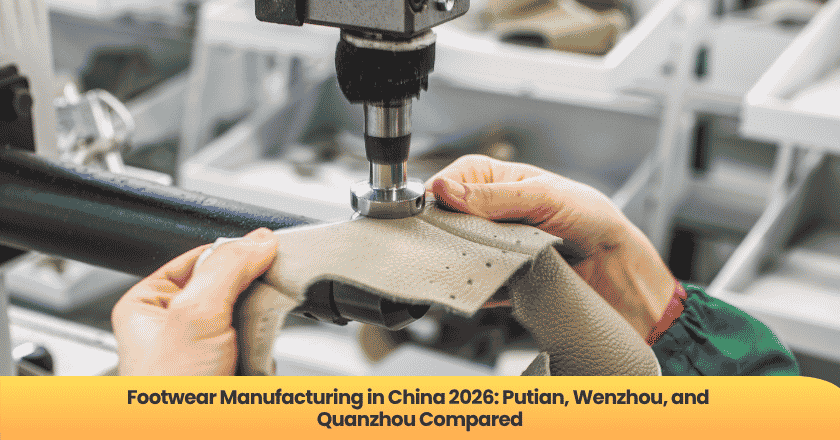
- Three Chinese footwear clusters dominate global production in their respective categories: Putian (athletic shoes, particularly basketball and lifestyle sneakers), Wenzhou (women's fashion shoes, leather goods), and Quanzhou/Jinjiang (athletic shoes at scale, sportswear-adjacent).
- Putian has a complex reputation — historically associated with Nike/Jordan replicas, the cluster has substantial legitimate OEM capability for niche athletic and basketball brands. Distinguishing legitimate manufacturers from gray-market is critical.
- Wenzhou's women's shoe cluster offers small-batch flexibility (200–500 units typical) and strong fashion-cycle responsiveness — best fit for DTC fashion brands and indie women's footwear lines.
- Jinjiang (in Quanzhou) hosts most Chinese athletic shoe domestic brands (Anta, 361°, Xtep) and serves significant Western brand OEM volume. Best for athletic brands at scale.
This guide walks through the three major Chinese footwear clusters, what each does well in 2026, the realistic MOQ and pricing differences, the compliance requirements that affect this category, and how to make the China-vs-Vietnam decision at the SKU level.
Part 1: Putian — Athletic Shoes, Basketball, and the Replica Question
Putian, in Fujian province, has a distinctive position in global footwear manufacturing. Putian also has substantial legitimate OEM capability for niche athletic and basketball brands, and several Chinese domestic athletic brands have meaningful Putian production.
What Putian does well
Athletic shoes, particularly basketball and lifestyle sneakers. Decades of capability building around shoe construction techniques (cement construction, vulcanized rubber, sock-liner systems, midsole technologies) that translate to legitimate brand work.
Mid-volume athletic OEM. For brands ordering 1,000–10,000 pairs per style, Putian factories often quote competitively against Vietnamese alternatives — particularly for products with complex construction or high pattern cutting requirements.
Sample and prototype work. Putian's depth of construction expertise makes it a strong location for sample development and small-batch testing, even for brands that ultimately produce at scale elsewhere.
MOQ and pricing
Athletic shoe OEM at legitimate Putian factories: 500–2,000 pairs per style minimum. Custom development with new mold work: 2,000+ pairs.
Pricing: $5–12 per pair for budget athletic shoes; $10–25 for mid-tier basketball and lifestyle shoes; $20–50 for premium construction with technical materials.
Part 2: Wenzhou — Women's Fashion Shoes and Leather Goods
Wenzhou, in southern Zhejiang province, has been a global center for women's shoes and leather goods for over 30 years. The cluster spans multiple districts within Wenzhou municipality, with concentration around Lucheng, Ouhai, and Longwan.
What Wenzhou does well
Women's fashion shoes. The cluster's primary specialty. Pumps, flats, sandals, boots, dress shoes, casual fashion footwear — across price tiers from budget to premium. Extensive pattern-making and last-development capability.
Leather goods integration. Wenzhou has integrated leather supply chain — leather processing, pattern cutting, shoe upper construction — that supports both shoe and adjacent leather products (handbags, small leather goods).
Small-batch fashion responsiveness. Wenzhou's structural advantage for fashion brands: the cluster handles small batches (200–500 pairs) at reasonable economics, and lead times are short enough (typically 30–45 days) to follow fashion cycles.
Brand OEM and contract manufacturing. Many established Western shoe brands have Wenzhou supplier relationships, particularly for fashion-cycle products where the small-batch flexibility matters more than absolute scale.
MOQ and pricing
Stock or near-stock products with light customization: 200–500 pairs. Custom OEM with new pattern development: 500–2,000 pairs. Custom design with new last development: 2,000+ pairs.
Pricing: $4–10 per pair for budget fashion shoes; $8–25 for mid-tier; $25–60 for premium leather construction.
What Wenzhou doesn't do well
Athletic shoes. Wenzhou has minimal athletic shoe capability. Athletic brands should look at Putian, Jinjiang alternatives.
Volume basics at lowest cost. For commodity volume basics, lower-cost clusters (and Vietnamese alternatives) typically win. Wenzhou's strength is mid-tier quality and fashion responsiveness, not commodity pricing.
Men's dress shoes at premium tier. Some capability exists but Italy and Spain still dominate the premium men's dress shoe market.
Part 3: Quanzhou and Jinjiang — Athletic Shoes at Scale
Quanzhou municipality (also in Fujian province) and its sub-district Jinjiang together form China's largest athletic footwear cluster. Jinjiang specifically is home to most major Chinese domestic athletic brands (Anta, 361 Degrees, Xtep, Peak, Hongxing Erke) and produces significant volume for international brand OEM.
What Jinjiang does well
- High-volume athletic OEM. Factories built for scale production of athletic shoes — typical production runs of 10,000–50,000+ pairs per style. Mature engineering capability for athletic shoe construction.
- Integrated sportswear programs. Many Jinjiang factories produce athletic shoes alongside sportswear apparel through related-company structures. For brands wanting integrated shoe-and-apparel programs from a single region, Jinjiang offers operational simplicity.
- Domestic Chinese brand sophistication. The Chinese domestic athletic brands (Anta, Li-Ning) have built world-class design and engineering capability. International brands working with their OEM partners benefit from this sophistication.
- Mid-market athletic shoes. For brands targeting mid-market athletic positioning (think entry-level athletic at retail prices below premium athletic brands), Jinjiang's combination of scale, capability, and pricing is competitive.
MOQ and pricing
OEM athletic shoes: 1,000–3,000 pairs per style minimum at established factories. Custom development with new mold/last: 3,000+ pairs.
Pricing: $6–15 per pair for budget athletic; $12–30 for mid-tier; $25–60 for premium athletic with technical materials.
Part 4: Compliance Requirements for Footwear
Footwear has fewer regulated compliance requirements than many consumer categories but several still matter.
CPSIA (children's footwear)
For shoes marketed to children under 12: lead and phthalate testing required. Cost: USD 500–1,500 per product. Particularly important for shoes with painted or printed components, dyes, or plastic details.
California Proposition 65
Recurring issue for footwear with certain leathers, dyes, or chemical-treated materials. Required warning labels for products containing listed chemicals; non-compliance triggers private litigation.
Material composition labeling (US, EU)
Required country-of-origin labeling and material composition disclosure (upper material, lining material, sole material). Specific rules per market.
REACH (EU)
Chemical content compliance for products sold in EU. Particularly relevant for leather treatments, adhesives, and chemical-treated materials.
Specific market certifications
Some specialty footwear requires additional certifications: safety footwear (ASTM F2413 for US, EN ISO 20345 for EU), athletic footwear sometimes requires specific testing for marketing claims (cushioning, stability), medical/diabetic footwear has additional requirements.
Part 5: Putian's Reputation Problem — How to Source Ethically
Five practices for ethical Putian sourcing.
1. Verify factory portfolio explicitly
Ask directly: "Do you produce any unauthorized replicas of branded athletic shoes? Have you in the past 5 years?" Reputable factories answer no without hesitation. Factories that hedge or claim "we used to but stopped" are higher risk.
2. Reference check thoroughly
Get references from 3+ Western brands the factory has worked with. Speak to those references about IP practices, supplier confidentiality, and any IP-related incidents. Factories with clean reputations have references willing to discuss this openly.
3. Audit the production floor
A site visit reveals a lot. Look for: legitimate finished products in storage, proper supplier confidentiality (other clients' products not openly displayed), branded materials handled appropriately. Replica-active factories often have telltale evidence visible to attentive observers.
4. Sign comprehensive NNN agreements
Use NNN agreements drafted under Chinese law that include strong confidentiality and non-circumvention clauses, with liquidated damages provisions. Generic English-language NDAs are insufficient.
5. Work through established sourcing agents with Putian relationships
A sourcing agent who has worked in Putian for years can identify legitimate vs gray-market factories with much greater accuracy than direct buyers can. The agent's reputation is at stake on supplier recommendations, which aligns their incentives with the buyer's.
Expert Tip: When working with sourcing agents in Putian or any Chinese footwear cluster, ask specifically how they verify supplier IP practices. Vague answers ("we work with reputable factories") are weaker than specific answers ("we've audited the factory's portfolio quarterly for 5 years and verified no replica production"). Commission-free sourcing agents have aligned incentives on supplier reputation — bad supplier recommendations cost them client relationships, not just per-order commissions. Commission-based agents may have reasons to recommend factories with hidden margin opportunities even if IP track records are weaker.
Part 6: How to Decide — Cluster Selection Framework
Six questions that determine which Chinese footwear cluster (or Vietnam alternative) fits your program.
1. What category is the product? Athletic basketball/lifestyle → Putian. Women's fashion → Wenzhou. Volume athletic → Jinjiang or Vietnam. Premium leather → Wenzhou or Italy/Spain. Children's → various clusters depending on style.
2. What's your annual unit volume? Below 5,000 pairs → Wenzhou small-batch is structural advantage. 5,000–20,000 pairs → multiple clusters viable, depends on category. 20,000+ pairs → Jinjiang or Vietnam typically favored for athletic; Wenzhou or specialty clusters for fashion.
3. How fashion-cyclical is the product? High fashion responsiveness needed → Wenzhou's small-batch flexibility wins. Stable product with annual updates → multiple options.
4. Do you need integrated apparel programs? Yes → Jinjiang's integrated sportswear ecosystem is structural advantage. No → other clusters viable.
5. What's your IP risk tolerance? Lower risk tolerance → established Wenzhou or Jinjiang factories with clean reputations; avoid Putian without significant vetting investment. Higher risk tolerance with proper protection → all clusters viable.
The Bottom Line
Chinese footwear sourcing in 2026 is a category-by-category decision. The mass-market athletic shoe migration to Vietnam is largely complete; for new athletic brands launching at scale, Vietnam is typically the right answer. Chinese clusters retain structural advantages in specific niches: Putian for basketball and high-end sneakers (with required IP vetting), Wenzhou for women's fashion shoes (small-batch flexibility unmatched elsewhere), Jinjiang for integrated athletic-and-apparel programs.
The 2026 tariff environment puts Chinese footwear at 30–55% effective duty depending on category. Vietnam offers 15–25 point savings — large enough to drive sourcing decisions for new programs, but not always large enough to override category-specific Chinese advantages for existing programs.
Putian's reputation issues require active management. Legitimate OEM is available from many Putian factories, but vetting matters more than in most clusters. Working with established sourcing agents who have verified Putian factory portfolios reduces risk substantially.
For most footwear brands, the right 2026 sourcing strategy is hybrid: Vietnam for mass-market athletic, China for specialty categories where Chinese cluster strengths justify the tariff cost. Pure single-country sourcing leaves either tariff savings or capability advantages on the table.
FAQ
What's the realistic MOQ for women's fashion shoes from Wenzhou?
For light customization on existing styles (color, branding, material variants): 200–500 pairs. For custom OEM with new pattern development: 500–2,000 pairs. For full custom design with new last development: 2,000+ pairs. Wenzhou's small-batch flexibility is a structural advantage that other clusters and Vietnamese factories rarely match.
What's the typical timeline for an OEM footwear program?
For Putian or Jinjiang athletic shoe OEM: 6–9 months from spec to first production-ready samples. For Wenzhou women's fashion shoes (small-batch, less custom): 3–6 months. For full custom design with new last development: 9–14 months. Add 1–2 months for first production beyond samples. Last development is the longest pole in any custom footwear program.
What's the freight situation Fujian to US?
Good. Fujian province has multiple major ports (Xiamen, Fuzhou, Quanzhou) with regular vessel service to all major US ports. Container availability is generally good. Per-container rates from Xiamen to US West Coast: similar to Shanghai or Ningbo rates. Lead time: 18–24 days transit to LA, 28–32 to East Coast.
How do compliance requirements differ between US and EU footwear?
US has CPSIA for children's footwear, California Prop 65 for chemical content, and standard country-of-origin labeling. EU has REACH for chemical compliance, more detailed material composition labeling requirements, and CE marking for safety footwear. For brands selling both markets, EU requirements are typically more comprehensive — products meeting EU standards usually meet US requirements with minor additions.
NewBuyingAgent
Related Resources


Get Started Today
Let's Turn Your Sourcing Goals into RealityWeChat:+86 15157124615
WhatsApp:+86 15157124615
Address:Building 10 #39 Xiangyuan Road, Hangzhou, China
