

The right payment channel is the one that matches the order's control task.
For a China sourcing order, “how should we pay?” is usually the wrong first question. Start with the decision that needs proof. Do you need to confirm that a payment route is available? Match a beneficiary account to an approved invoice? Set a release trigger around documents? Or reduce the effort involved in a straightforward repeat purchase? Wise, a bank wire, PayPal, and a documentary letter of credit (L/C) help with different parts of that job.
That distinction matters because a familiar payment method can still be a poor fit. A transfer can reach the right account but be released against the wrong commercial file. A document-heavy instrument can make payment conditions explicit but still say nothing about the physical quality of the goods. A platform workflow can look convenient yet have route, currency, review, or eligibility conditions that change the practical answer.
The payment answer: match the channel to the control you need
Use a simple order of operations. First identify the payment milestone: sample, deposit, pre-shipment balance, or a final document-triggered release. Then identify the control that must be true before funds move: the route is eligible, the beneficiary is verified, the purchase order and invoice match, or a defined set of documents has been presented. Only then compare channels.
This creates a useful payment-control map. Wise is often considered when the business route and recipient requirements fit. A bank wire is a conventional payment rail when the bank instructions and commercial records are settled. PayPal may fit a limited, clearly documented commercial transaction, subject to current account terms. An L/C is for a different problem: it structures a bank payment undertaking around compliant documents. None of the four replaces supplier due diligence, product inspection, or a buyer's own approval process.
The practical verdict is conditional, not universal. For a repeat order with a verified beneficiary and a clean invoice trail, a wire may be the least complicated way to keep a conventional bank record. For a route that meets Wise's current conditions, Wise can be a workable business-payment option. For a new or higher-risk commercial relationship where specific documents must govern payment, an L/C may justify its heavier administration. For a small, bounded transaction, PayPal can be considered only after the buyer checks the applicable terms and transaction fit.
Four payment decisions before you send funds
- Route: confirm the currency, recipient account, and channel are currently eligible.
- Identity: match the beneficiary account to the approved commercial file.
- Trigger: define the document or production evidence needed for this milestone.
- Approval: pause any changed instruction until an independent check resolves it.
Compare the four channels by what they control
Think of the comparison as a control matrix rather than a ranking. The better choice is the one that proves the condition your order actually needs.
| Channel | What it can help control | Best fit | What it does not solve |
|---|---|---|---|
| Wise | Route and recipient eligibility for a supported business transfer | A business-to-business route that meets current currency, account, and document conditions | Beneficiary verification, product quality, or universal fee certainty |
| Bank wire | A conventional bank payment trail tied to the invoice and beneficiary | A verified supplier account and a settled commercial file | An independent check that a changed instruction is genuine |
| PayPal | A platform transaction record under the applicable account terms | A limited, clearly documented commercial transaction | A universal production-deposit solution or unconditional availability |
| Documentary L/C | A bank undertaking conditioned on compliant documents | A higher-risk or newer relationship with precise document conditions | Physical inspection of every product detail |
Wise Business CNY payments to China have recipient-account, currency, bank, and route conditions. Its published guidance says the recipient must be a Mainland China business account denominated in CNY and connected to a supported bank route; details such as the beneficiary name, bank information, address, and transfer reason also matter. Check the current Wise China business-transfer requirements before treating it as an available option. Wise also explains that transfer cost varies with the amount, funding method, and exchange rate, so compare its live transfer-cost explanation rather than relying on a fixed-fee claim from an old article.
A wire transfer is usually the clearer choice when the supplier's beneficiary details, invoice currency, and contract are already aligned and the buyer wants a conventional bank record. It is not automatically safer merely because it is familiar. A wire moves money based on the payment instruction; it does not independently establish that a late email, amended invoice, or replacement account is legitimate. The control sits in the buyer's release file and approval process.
PayPal terms can involve currency conversion spread and payment review for higher-risk transactions. The cited agreement is for US accounts, and local account terms can differ, so a buyer should read the applicable PayPal user agreement before using it for a production deposit. Treat it as a channel with terms and operational boundaries, not as a blanket guarantee for a goods order.
A documentary L/C is a bank undertaking to pay against compliant documents rather than a physical quality inspection. The International Chamber of Commerce defines documentary credit around compliant presentation, while the US Export-Import Bank's trade-finance guide describes L/Cs as document-conditioned and comparatively labor intensive. That is why the ICC definition and the EXIM trade-finance guide point to the same buyer lesson: write the required documents around the real risk, and keep inspection or quality controls separate.
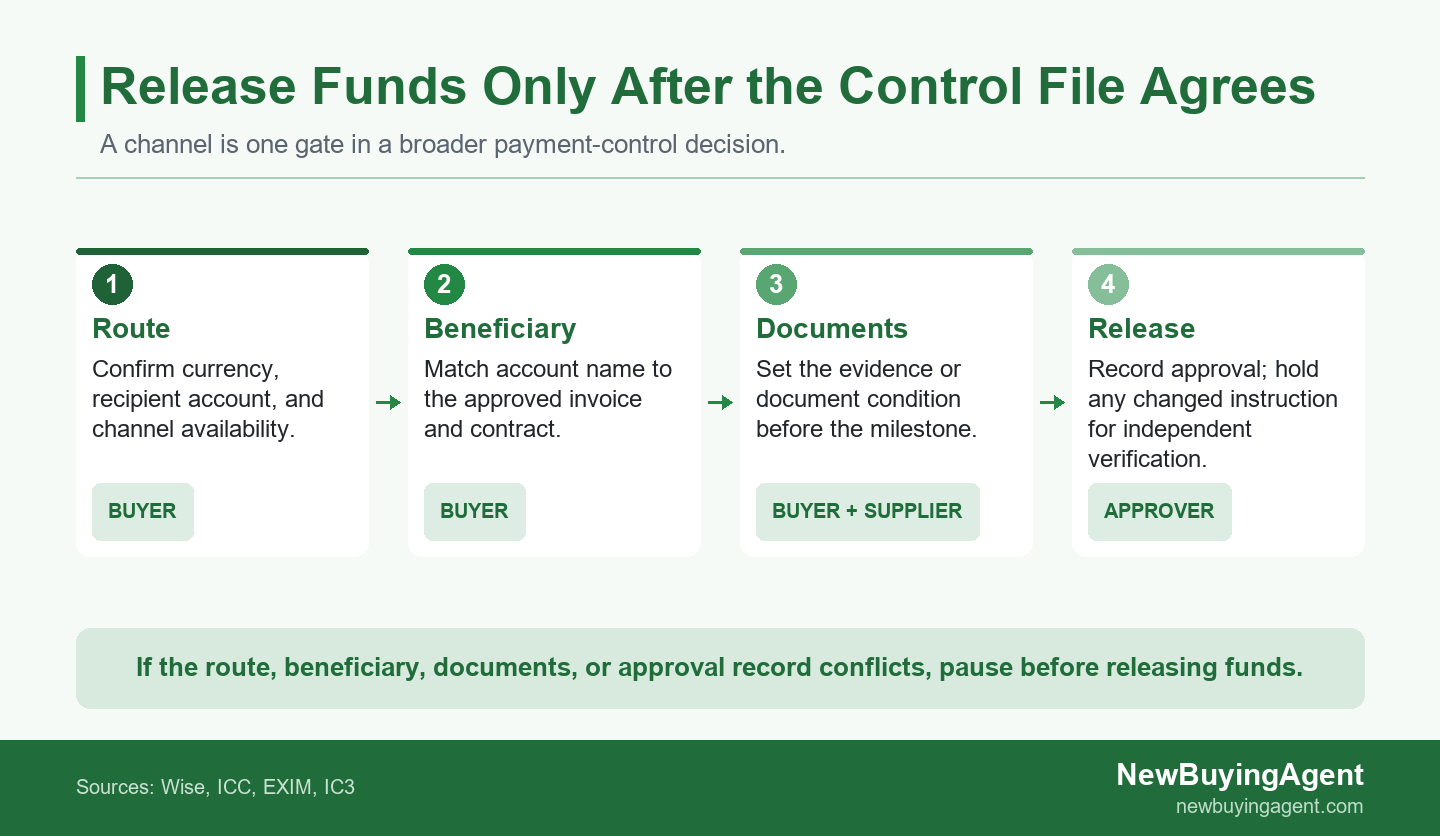
Choose the channel after the release file agrees; no channel replaces beneficiary verification or document control.
When the purchasing need is defined but the China supply conversation needs a quote-ready brief, use NewBuyingAgent's product-supply service for a documented China quote before committing funds or payment terms.
Use the Payment-Control Match before releasing funds
Trade-payment documentation should be consistent enough for a bank to review the transaction background. China's State Administration of Foreign Exchange explains that banks review relevant trade-payment documents and, in applicable cases, verify transaction authenticity. The point for a buyer is practical: keep the contract, invoice, payment purpose, currency, and approval record coherent before the release request reaches a bank or payment provider.
Build one short release file for each payment milestone. It does not need to be elaborate, but it should make a disagreement visible before money moves:
- Order reference: purchase order, product version, quantity, and milestone being funded.
- Commercial match: invoice version, currency, amount, and payment purpose aligned with the order.
- Beneficiary match: account name, bank details, and any change record matched to the approved file.
- Release trigger: the sample acceptance, production evidence, inspection evidence, or document condition that justifies this milestone.
- Approver record: who checked the file, what changed, and when the release was approved.
A changed account instruction should be verified independently before payment is released. The FBI's Internet Crime Complaint Center recommends a secondary channel or multi-factor verification for account-information changes; use a phone number or contact route that was already verified, not the one supplied in the change request. Read the IC3 account-change guidance as a control principle, not as a reason to assume that every mismatch is fraud.
The Payment-Control Match turns channel choice into a sequence. First, can this route pay the verified recipient in the intended currency? Second, do the beneficiary and commercial documents agree? Third, what evidence must exist before this payment stage? Fourth, is there an approval record that explains the release? A “no” or a conflict at any stage means pause, clarify, and update the file. Changing from Wise to a wire, or from a wire to PayPal, does not remove that pause.
Worked scenario: a changed beneficiary is a hold signal
The illustrative USD 48,000 beneficiary-change case should be held until documents and an independent confirmation agree. The channel is not the decisive issue; the conflict inside the commercial file is.
The document conflict that stops the release
IC3 advises using a secondary channel to verify requests that change account information. Its account-change control guidance gives a buyer a clear action when a bank instruction changes at the same time as a payment milestone.
Illustrative scenario: a global home-goods buyer is placing a repeat China order with a supplier the team has used before. The relationship is established, but the release control still belongs to the buyer.
The purchase order is USD 48,000 across 6 SKUs and has 2 payment milestones: a 30% deposit and a 70% balance after agreed pre-shipment evidence. The first release is material even though it is not the final payment.
Before the deposit request, the buyer has a signed purchase order, approved sample record, invoice, and previously approved beneficiary bank details. The release file is complete enough to compare any amendment against the original record.
A new email asks the buyer to send the deposit to a different account because the supplier says its usual account is temporarily unavailable.
The revised account name does not match the beneficiary named in the approved invoice, and the email does not include a reissued document set or a traceable approval history.
The immediate question is account identity, not whether a wire or PayPal feels more convenient. Sending through a different channel would not resolve the mismatch between the invoice and the new beneficiary.
The buyer holds the payment. It does not reject the supplier or diagnose fraud; it simply treats the inconsistency as a release blocker until independent confirmation and revised commercial documents agree.
The buyer records the verified beneficiary, the stated reason for the change, the approved invoice version, and the approver. If the supplier changes an account legitimately, the commercial record now shows how and why.
The final verification uses a phone number or contact channel that was previously verified. The buyer then reconciles the contract, invoice, beneficiary name, currency, and amount before authorizing the payment.
This is an illustrative control scenario, not a finding about any supplier. Its purpose is to show why an account-change request deserves a hold even when the buyer plans to use a familiar payment channel.
Use payment milestones differently for an existing supplier
For an existing supplier, payment milestones can be matched to documented production and quality evidence. The goal is not to turn every repeat order into a bank instrument. It is to make each material release correspond to a visible commercial event: an approved sample, production readiness, pre-shipment evidence, or a shipping-document condition that the buyer has already agreed.
For example, a buyer might use a deposit once product specifications, packaging artwork, and beneficiary details are settled; reserve the balance for an agreed pre-shipment evidence point; and keep any final document condition separate if the shipping route requires it. The exact percentages are commercial terms, not a universal formula. The useful discipline is linking the milestone to evidence that the buyer can actually review.
If the buyer already has a China supplier and needs local production follow-up around these milestones, use factory-management support when an existing supplier needs local follow-up before the balance moves. That support complements, rather than replaces, the buyer's own authorization of the payment.
Bring payment terms into the product-supply brief
Payment requirements should be recorded in the commercial brief that supports the transaction. The same SAFE trade-payment guidance that stresses transaction documentation supports keeping the payment purpose and commercial record coherent.
Buyers tell NewBuyingAgent their purchasing needs, and it quotes and supplies products from China across categories. This supply-first path keeps payment expectations inside the purchasing brief, because currency, order size, delivery destination, and milestone needs affect how a buyer should prepare the commercial conversation.
For a new product request, describe the product, quantity, target price, destination, required standards, and timing. Add the payment constraints that matter to your organization: approved currency, preferred release stages, document needs, and the names or roles allowed to change beneficiary information. This is more useful than asking for a generic “safe payment method,” because it gives the quote and supply discussion a concrete operating frame.
Where product selection is still uncertain, use a bestseller market analysis to test the product decision first before defining a replenishment payment schedule for the next cycle. The purpose is to avoid adding payment complexity to a product decision that has not yet been examined.
Need to align a real product request with its commercial details? contact NewBuyingAgent with the purchasing brief when the product and commercial details are ready. Include the product category, quantity, destination, target timing, and any payment-control requirement that should shape the quote.
Frequently Asked Questions
The frequently asked questions apply the comparison boundaries without declaring a universal safest payment method. The correct answer depends on the live route, the commercial file, and the control the buyer still needs.
Is Wise safe for paying a China supplier?
Wise can be a workable business-payment route when the payer, currency route, recipient account, and required information meet its current requirements. It does not confirm that a supplier's bank instruction is genuine or that goods meet the agreed specification. Verify the beneficiary independently, compare the live route and fee details at the time of payment, and retain a clear approval record for the transfer.
When is a wire transfer better than Wise?
A bank wire is often the clearer option when the supplier's bank instructions, invoice currency, and contract are already aligned and the buyer needs a conventional bank payment record. It is not automatically better on price or speed. Compare current bank and provider terms, then choose the route that fits the verified recipient and the payment milestone.
Does an L/C guarantee product quality?
No. A documentary L/C governs bank payment against the documents specified in the credit. It can make document conditions more explicit, but it does not inspect the goods for the buyer. Keep product specifications, sample approval, production evidence, and inspection arrangements in their own quality-control process.
Should a buyer use PayPal for a production deposit?
PayPal can suit a limited, clearly documented commercial transaction, but the buyer should check current eligibility, fees, currency conversion, and payment-review risk under the applicable account terms. For a large or staged production order, first decide what documentary and beneficiary controls the deposit needs; then test whether PayPal actually supports that route.
NewBuyingAgent
Related Resources

Get Started Today
Let's Turn Your Sourcing Goals into RealityWeChat:+86 15157124615
WhatsApp:+86 15157124615
Address:Building 10 #39 Xiangyuan Road, Hangzhou, China
