

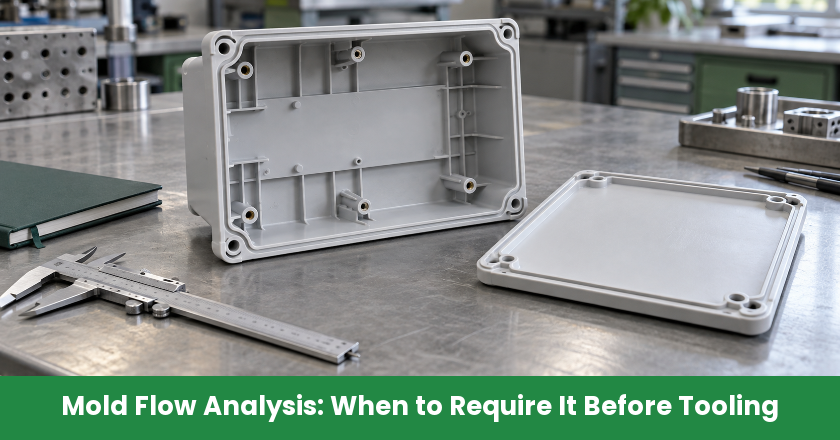
A successful filling study can still be the wrong evidence for releasing a mold. The buyer should require mold flow analysis before tooling when an unresolved molding risk could force an expensive design change, and the study can still influence that choice.
Mold flow analysis is computer simulation of how plastic fills an injection mold and, depending on the study, packs, cools and distorts. Its conclusions depend on the geometry, material data, process assumptions and physical effects included.
The purchasing question is therefore specific: what decision will this analysis support before steel is committed?
Require a Decision, Not Just a Simulation Report
Require analysis when a consequential molding risk remains unresolved and the results can change the tooling decision. A simple, familiar part may justify experienced design review without a detailed simulation, while a sealing surface or critical load-bearing feature may warrant deeper work. The scope should follow the product requirement, rather than the number of pages offered by the supplier.
- Start with the consequence: identify what failure would mean for fit, function, appearance or delivery.
- Check the model: confirm the actual resin, current geometry and relevant tool assumptions.
- Approve a bounded decision: connect each conclusion to a named design choice.
- Keep physical proof: simulation does not replace molded-part trials and product acceptance.
Require Analysis Where Failure Would Force a Tool Change
Prioritize unresolved filling, weld-line and distortion risks when a late correction could require changing gates, part geometry or cooling. A gate is the entry point through which molten plastic enters the cavity, so its location can become a costly constraint once the tool is built. The strongest case for analysis combines a meaningful failure consequence with a design choice that remains open.
A long, thin flow path raises a different purchasing question from a broad sealing flange. The first calls attention to filling feasibility; the second may require understanding distortion after cooling. A visible front panel adds an appearance constraint, while a heavily loaded clip makes the location and quality of joining flow fronts important. These are reasons to ask an analyst a focused question, not automatic instructions to buy the most extensive package.
| Product concern | Decision still open | Requested comparison |
|---|---|---|
| Incomplete filling | Gate position or wall design | Feasible fill under realistic process assumptions |
| Critical weld-line location | Gate arrangement or geometry | Flow-front meeting locations and associated risk |
| Flange distortion | Cooling layout or part stiffness | Dimensional behavior with relevant cooling effects |
| Uneven cavity filling | Runner and cavity arrangement | Balance across the proposed mold layout |
Skipping a detailed study can be reasonable when a competent review finds low consequence, familiar geometry and convincing evidence from a genuinely comparable process. That decision should state what makes the comparison valid. Conversely, a low order quantity does not make a leak, broken fastening feature or unusable assembly acceptable; volume alone is a poor screening rule.
For a buyer sourcing a molded household product, NewBuyingAgent’s local factory resources and product-development/QC capability can connect the drawing’s critical features with the supply brief. Its product-supply service provides a route to source the product against those requirements, with any specialist analysis scope and responsibility agreed for the project.
The study earns its place by changing a decision before tooling. A report that arrives after the relevant detail has been machined may still help troubleshooting, but it has lost that opportunity to avoid the initial commitment.
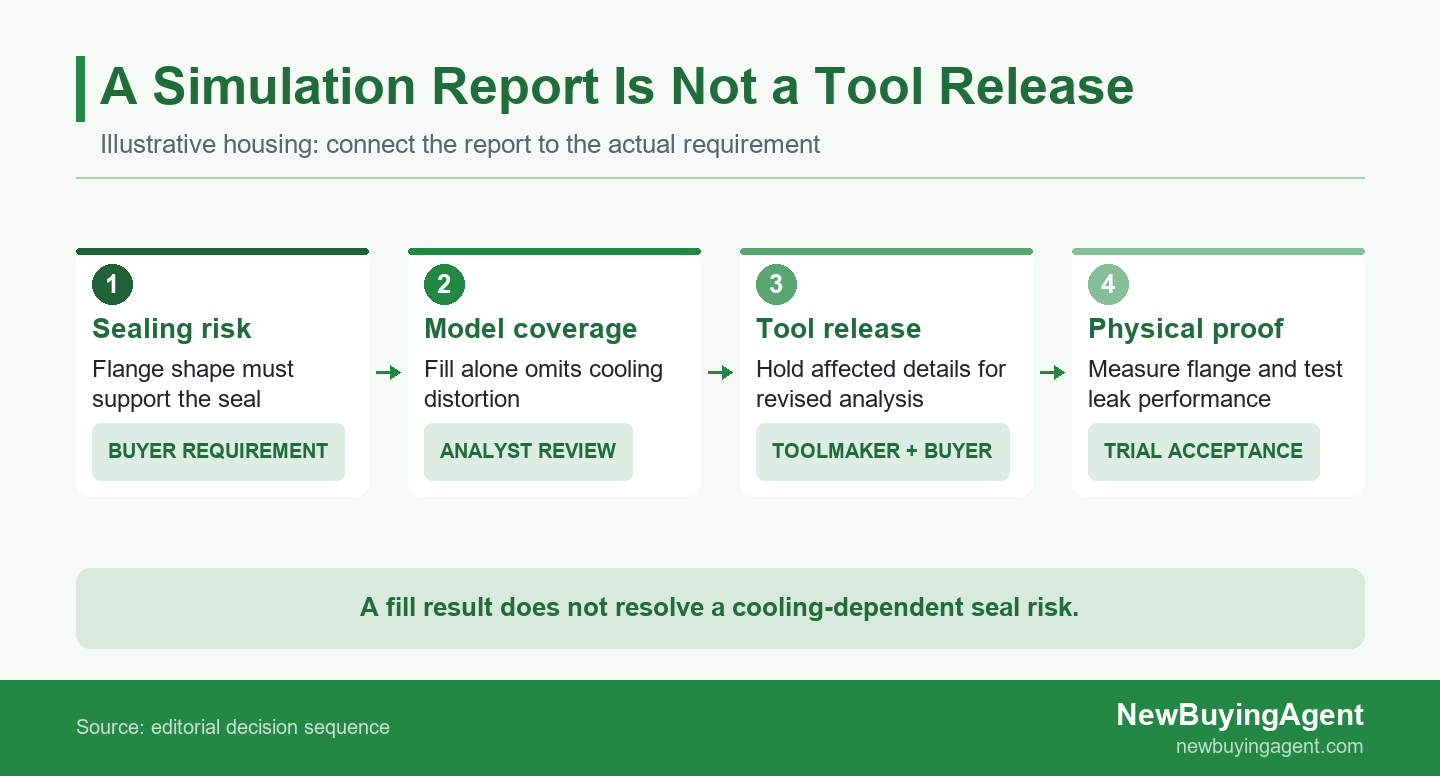
Four-stage sequence linking sealing risk and model coverage to tooling release and physical-part verification
Confirm the Inputs Before Accepting the Analysis Scope
Bind the analysis to the current CAD revision, intended resin grade, proposed tool layout and credible processing conditions. The buyer need not operate the software, but should be able to identify what product and manufacturing proposal the report represents. Missing information should be visible as an assumption, with its effect on the decision explained before the study is accepted.
Match the CAD Revision and Material Data
The analyst should use the intended resin and geometry, and disclose substitute material data or incomplete characterization. A model based on an earlier wall thickness or a different filled grade may be useful for exploration, but it should not silently become the evidence for releasing the production design.
A resin name is not the whole input. The public scope of ISO 11443 on melt fluidity explains that flow behavior depends on temperature as well as shear rate and shear stress. This is why the buyer should ask which material data support the proposed processing range, rather than accepting a matching polymer family as sufficient.
Laboratory measurement also needs careful interpretation. ISO 17744 on specific-volume measurement covers behavior with temperature and pressure, but its abstract explicitly warns that the measurement result cannot be used directly for injection-moulding simulation. The analyst must establish that the software-ready material card is suitable; a reference to a test standard alone does not establish that suitability.
The input record should identify the material-card source, any substituted grade, and assumptions about reinforcement or conditioning that matter to the product. Where reliable data are unavailable, the report should describe the resulting uncertainty and whether further characterization or a different verification route is needed. These standards explain material-data boundaries; they are not a blanket certification requirement for every mold order.
Choose Fill, Pack, Cooling and Warpage Work to Match the Risk
Select the analysis sequence and mesh for the question being decided. A mesh divides the model into calculation elements; warpage describes distortion from uneven shrinkage. A filling study may compare gate options, but a positive fill result alone does not establish the finished part’s dimensional performance.
Autodesk’s Moldflow mesh-selection guidance associates thin, simple parts with Dual Domain meshes and thick, chunky parts with 3D meshes, while also considering the required results and available material data. The useful buyer request is an explanation of method suitability, not a rule that every project must use the most computationally demanding option.
For dimensional questions, ask which cooling effects are included. Autodesk’s Moldflow Insight guidance on preparing Warp analysis states that omitting Cool analysis excludes differential cooling effects from the Warp calculations. That software-specific instruction illustrates an important purchasing boundary: the report cannot resolve a cooling-dependent risk through a model that leaves those effects out.
Ask the toolmaker and analyst to agree the proposed gates, feed system, cavity arrangement, packing conditions, cooling layout and production-machine assumptions relevant to the study. If only a preliminary cooling concept exists, distinguish an early option comparison from final design verification. More analysis is justified when it closes an important uncertainty; adding every available result to the report is not the same as answering that uncertainty.
Read the Report as a Comparison of Tooling Choices
Compare feasible tooling options against the product’s requirements, then record the selected change, remaining uncertainty and physical trial checks. A useful report makes the cause of the recommendation understandable without requiring the buyer to interpret every contour plot. The reviewer should be able to explain what changed between options, why that change matters and which requirement remains unresolved.
Different results answer different questions. Autodesk Fusion’s standard-result documentation separates Fill + Pack information about flow and solidification from Warp information about shrinkage and distortion. A buyer reviewing a fit problem should therefore locate the relevant dimensional evidence, rather than treating an attractive filling animation as an overall pass.
Request an annotated view of critical regions, readable units and the scale used to display deformation. Compare gate or cooling options using consistent assumptions, or have the analyst explain any deliberate change. If the favored option reduces one risk but creates another, the recommendation should show that trade-off: for example, moving a flow-front meeting point away from a stressed feature may place a gate mark on a visible surface.
A weld-line plot also has limits. Autodesk’s technical explanation of weld lines identifies material, filler, pressure and temperature as influences on quality, and notes that a coarse mesh may not show all weld lines. Absence of a displayed line is consequently not proof that a critical feature has no joining-flow risk.
Close the review with a named design revision and a short decision record: selected option, engineering rationale, required modification, owner and verification condition. Where an assumption controls the recommendation, ask whether plausible changes to that assumption alter the preferred option. A result that is highly sensitive to uncertain inputs deserves a narrower approval than one supported across the relevant operating conditions.
Hold the Unresolved Tool Detail, Not Every Project Activity
Separate reversible preparation from the mold detail affected by missing evidence, and define the condition for releasing that detail. This allows the project team to preserve useful progress without treating an incomplete report as approval to machine everything. The boundary must be agreed with the toolmaker because a change to one feature can affect neighboring features, cooling or the overall mold layout.
Illustrative Example: A Housing Report Cannot Clear an Unmodelled Seal Risk
In this illustrative example, a consumer brand plans to buy 30,000 units of a household housing from China using a two-cavity mold. Each housing has 1 sealing flange. The CAD revision and resin grade are selected, but the proposed cooling layout is incomplete; the buyer’s requirement includes flange dimensions and leak performance after assembly.
The supplier submits a filling-only report showing no incomplete fill and asks for permission to start the affected cavity work. The report does not evaluate the cooling layout or flange distortion. The buyer can acknowledge the filling comparison, but the missing cooling model leaves the sealing risk unresolved: plastic reaching the end of the cavity does not demonstrate that the flange will retain the required shape.
The project decision is to hold the affected cavity and cooling details while allowing reversible procurement preparation that the toolmaker confirms will remain usable. The analyst and toolmaker complete the cooling proposal and compare the relevant warpage behavior against the flange requirement. If the preferred change affects adjacent details, the held scope expands accordingly; purchasing does not assume that every apparently unrelated component is safe to order.
Before releasing the affected steel details, the team reviews the revised model, selected design and remaining uncertainty. After tool construction, physical trials must verify flange dimensions and leak performance under the agreed conditions before production acceptance. This example ends with a scoped tooling-release decision; flange dimensions and assembled leak performance remain unverified until physical trials are completed.
Keep Physical Trials Separate From Simulation Approval
Use simulation to guide the tool design, then verify actual molded parts and the manufacturing process before production acceptance. Physical trials reveal whether the built tool, actual material and operating conditions deliver the required product. A signed analysis review should identify the decisions it supports and the trial evidence still needed, rather than being reused as a blanket production authorization.
When predicted and actual deflection disagree, Autodesk’s guidance on opposite warpage trends calls for checking actual cooling, process settings, material properties and geometry, among other causes. The practical response is to reconcile the model with the built process and investigate the discrepancy, not to dismiss either the measurements or the simulation automatically.
The trial plan should identify the features to measure, the measurement condition and the functional tests that matter to the application. For multi-cavity tooling, retain cavity identity so a favorable sample from one position does not conceal a different result elsewhere. Record the molding conditions with the samples; later changes to resin, cooling or processing may require reassessing whether earlier evidence remains applicable.
For buyers retaining an existing Chinese factory, the challenge often shifts from selecting a design to following its agreed changes through samples and production. NewBuyingAgent’s existing-factory management service connects local follow-up and quality-control capability with that ongoing supply work. Engineering conclusions and product acceptance criteria still need clear responsible owners within the project.
Put the Analysis Requirement Into the Product RFQ
Request the analysis scope, responsibility for design changes and physical trial plan alongside the molded-product quotation. The request should identify the risk to resolve, the decisions still open and the input files available. This gives competing suppliers a common basis for explaining what their offer includes, rather than letting an undefined “mold flow report” conceal different levels of work.
Specify who prepares the model, who reviews it, which alternative designs are included and what happens if the first study recommends changes. Clarify whether a revised study after a material or geometry change is included, and whether the schedule allows that iteration before machining the affected detail. These are commercial scope questions; they do not transfer the analyst’s technical judgement to the purchasing team.
For a molded product entering China sourcing, prepare the CAD and drawing revision, resin requirements, critical fit or function, order quantity, target price, destination and delivery timing. NewBuyingAgent can use its local factory resources and product/QC capability to develop a product quotation aligned with those quality and supply requirements. With that brief ready, request a product quote from NewBuyingAgent.
Frequently Asked Questions
Can a supplier reuse an analysis from a similar product?
Only after demonstrating that the old model remains relevant to the new product and decision. Ask for a comparison of geometry, resin grade, gates, cavity arrangement and process assumptions, plus an explanation of which conclusions remain valid. An earlier study can reduce duplicated work, but similarity in appearance does not prove equivalent flow or distortion behavior. Material changes and critical dimensional changes deserve particular attention.
Who should perform the mold flow analysis?
A qualified molding analyst should perform it, with toolmaker and buyer responsibilities agreed in advance. The analyst may work for the supplier or an external specialist; software ownership alone does not establish competence. Ask who selects the material data, checks the model and explains recommendations. The toolmaker must confirm that proposed changes are buildable, while the buyer’s responsible technical team defines the product requirements and acceptance basis.
Should analysis wait until every CAD detail is frozen?
An early study can compare concepts, but tooling approval needs analysis tied to the released design. Identify which features are still changing and whether they affect the question being studied. Early results may guide a gate or wall-thickness choice without settling the final mold design. Before machining the affected details, have the analyst assess the released revision and state whether changed geometry requires an updated run.
Does every predicted weld line mean the design must change?
No; the consequence depends on location, appearance and functional requirements. A line on a hidden, lightly loaded area may be acceptable under the product specification, while one across a critical fastening feature may require redesign or targeted testing. Agree the acceptance criterion before interpreting the plot. The analysis helps locate and investigate the risk; the finished part still needs the relevant appearance or performance verification.
NewBuyingAgent
Related Resources


Get Started Today
Let's Turn Your Sourcing Goals into RealityWeChat:+86 15157124615
WhatsApp:+86 15157124615
Address:Building 10 #39 Xiangyuan Road, Hangzhou, China
