

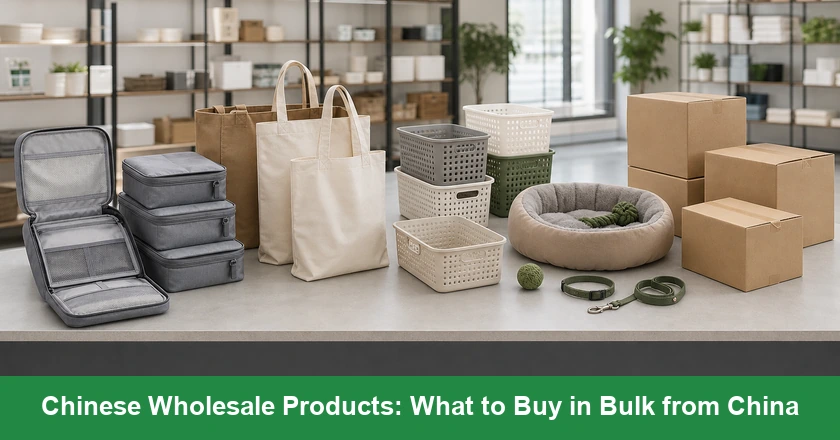
Buyers should start bulk buying with product readiness rather than a popularity list. The useful question is not “Which product is cheap in China?” It is “Which product can be reordered, specified, documented, and carried at depth without turning inventory into a surprise?”
The bulk answer: choose products that are ready for depth
Chinese wholesale products work best in bulk when the buyer can make four clear decisions before price negotiation: there is a believable reorder signal; the physical version can stay the same; the destination-market file is understood; and the buyer can concentrate money in a manageable number of SKUs. A product may be inexpensive and still fail this test.
- Buy deeper: repeatable products with stable materials, simple variants, and evidence that matches the sales market.
- Buy at test depth: products with plausible demand but uncertain colors, packaging, claims, or return behavior.
- Hold: products whose listing, sample, material record, label, or destination route do not agree.
The point is not to avoid every difficult category. It is to make the product risk visible before a bulk discount persuades the buyer to commit too much cash.
Use a four-gate bulk-readiness screen
A product deserves bulk depth only when reorder signal, version control, destination evidence, and inventory concentration agree. Bulk readiness means demand is visible, the version can stay fixed, the destination route is clear, and inventory is concentrated in a manageable number of SKUs. It helps a buyer choose what to deepen rather than assuming any low price will create margin.
A lower unit price can increase risk when it encourages depth before demand or product control is proven. The relevant comparison is landed cost—the delivered cost after product, freight, duties, and other buying costs—against the cash that could be trapped in weak variants, returns, rework, or slow replenishment.
Gate 1: Reorder signal. Look for repeat sales, replenishment behavior, a known use case, or a clear buyer need. Likes, clicks, and a competitor’s product page can be useful clues, but they are not enough on their own. A useful first allocation favors the few SKUs that already have a reason to come back.
Gate 2: Version control. A buyer should be able to write down the material, dimensions, finish, color standard, logo position, packaging, and carton information that matter. If the sample, listing, and factory record use different descriptions, a lower quote is not a resolution. It is a reason to pause.
Gate 3: Destination evidence. The market can change what “ready” means. Documentation and product requirements vary by country and may include testing, labeling, or licensing requirements. The U.S. International Trade Administration notes that the destination check belongs before the bulk promise, not after cartons are printed.
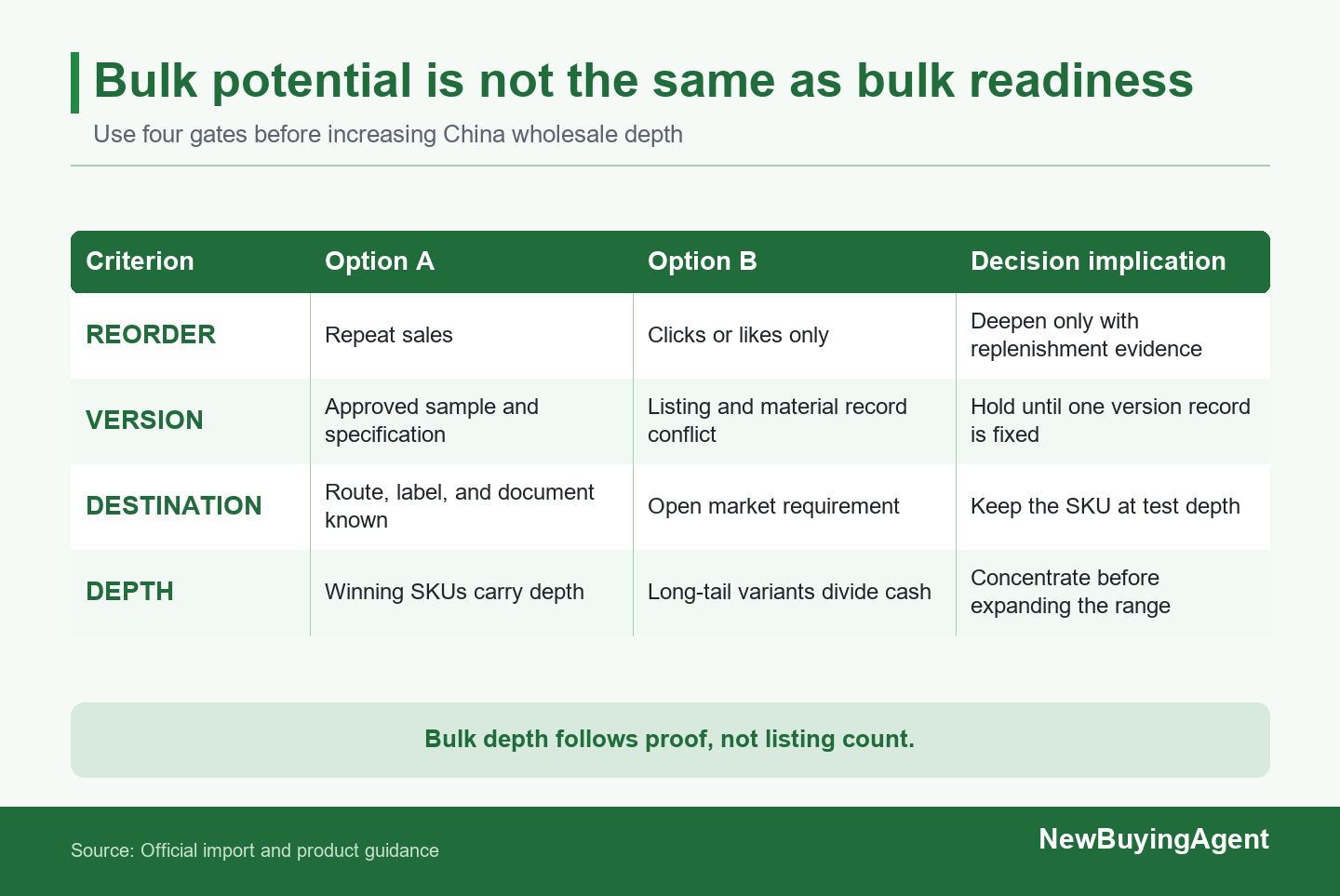
Bulk depth belongs in products with repeat demand, a controlled version, a clear destination file, and disciplined SKU concentration.
Gate 4: Inventory concentration. More colors and styles feel like more opportunity, yet each one divides sell-through proof, packaging control, and working capital. Give depth to the variants that pass the first three gates; keep the long tail at a small test level until it earns a reorder.
When uncertainty is market fit rather than factory capability, NewBuyingAgent can bring AI-driven hot-product analysis to the question of whether a product direction deserves a buying brief. Buyers can use its market-fit product analysis to judge whether a product version is worth developing, then keep the decision tied to a controlled specification and replenishment path.
What product types can deserve bulk depth
There is no universal “best product” list because a product’s readiness depends on the buyer’s channel, destination, claim set, and ability to keep its version fixed. The table below compares useful product patterns, not guaranteed winners. A category can move from “buy deeper” to “hold” as soon as a material claim, label, or safety route becomes unclear.
| Product pattern | Why bulk can work | Proof to lock first | When not to deepen |
|---|---|---|---|
| Home organization and simple storage | Repeat use, low technical complexity, and straightforward assortment logic. | Dimensions, material, load expectation, nesting, color, and carton pack. | Returns are driven by unexplained size, breakage, or a changing material. |
| Travel organizers and basic bags | Clear use case and room for a focused color or size range. | Fabric composition, zipper and seam standard, dimensions, label artwork, and packing method. | The product description and material record tell different stories. |
| Reusable accessories and simple pet essentials | Can be replenishable when the fit, material, and packaging are consistent. | Intended use, key dimensions, material, break-point risk, and retail claim copy. | A comfort, safety, or durability claim is vague or cannot be checked against the product. |
| Food-contact kitchen products | Potentially repeatable, but the product claim and intended use carry more responsibility. | Exact material, intended food-contact use, packaging, and market-specific route. | “Food safe” is merely a listing phrase without a product-specific record. |
| Higher-responsibility consumer products | Bulk can work after the buyer has identified the applicable safety and evidence path. | Product category, intended user, safety route, documents, labels, and sales channel requirements. | The buyer is treating a regulatory question as a later paperwork task. |
Food-contact substances include cookware and packaging components, and food-contact substances that are food additives require authorization for intended US use. The FDA's overview of food-contact substances is a useful reminder that a kitchen-product label is too broad a purchasing specification. Buyers should lock the exact material and intended use before they deepen a line.
EU textile labels generally identify fibre composition. The European Commission explains that textile products marketed in the EU must be labeled or marked to show their fibre composition, with requirements that can also affect language and presentation. That is why a tote bag, packing cube, or laundry bag should have a controlled composition record before the buyer approves the label artwork.
EU general product safety guidance confirms that Regulation (EU) 2023/988 applies from 13 December 2024, so a buyer should identify the category-specific safety route before treating a consumer product as a simple bulk item. The Commission’s general product safety page supports the boundary; it does not replace product-specific assessment.
Build the destination file before making the bulk promise
Before a buyer fixes quantity, cartons, and retail packaging, create a short destination file for each bulk candidate. It should name the destination market, expected sales channel, product use, material and claim set, label copy, packaging files, and the unresolved classification or document questions. This is a working file, not a substitute for legal or customs advice.
EU importers of products from non-EU countries must check applicable safety, health, and environmental requirements before placing products on the market. The European Commission’s importer guidance makes the timing clear: the destination check is part of choosing the product path, not a last-minute freight task.
The Harmonized System is a standardized numerical method used to classify traded products. The U.S. trade overview explains that the first six digits provide the shared HS subheading while importing countries can extend classification further. Treat an HS code as a classification question tied to the actual product, not as a keyword copied from a wholesale listing.
CBP notes that import requirements can depend on product classification and other agency rules, so classification is not a post-order administrative detail. Its guidance on importing specific goods into the United States also points buyers toward origin marking and commodity-specific requirements. For a bulk buyer, the action is simple: write down what must be confirmed before the final purchase order version is released.
If a buyer keeps an existing Chinese factory for a proven line but needs local production, quality, and logistics follow-up, buyers can ask NewBuyingAgent to manage an existing China supplier.
Worked scenario: choose depth after the records agree
A worked allocation scenario shows why a product record can change where bulk depth belongs. The following composite illustrates a decision pattern, not a reported customer result or a determination of EU legal requirements.
Hold the conflicting tote SKU; do not hold the entire assortment
In the illustrative 1,500-piece textile-organizer scenario, depth is concentrated in proven SKUs while a composition conflict is held for correction. The buyer is preparing an EU-facing home-and-travel range, not trying to purchase every style at the same depth.
The buyer wants a tight first range of packing cubes, laundry bags, reusable totes, and cosmetic pouches. The aim is to learn from a manageable assortment while still receiving a meaningful China wholesale quote.
A 1,500-piece purchase across 4 product families and 8 color or style variants. The proposed range is still awaiting its allocation decision, with quantity not yet assigned to each SKU.
Two packing-cube variants have repeat signal; the tote-bag composition record is conflicted.
The low-risk move is not to cancel the whole assortment. The two packing-cube colorways have a usable reorder signal and a stable product definition, so they can carry most of the initial depth.
A tote-bag listing says 100% cotton canvas, but the material sheet identifies a 65% polyester and 35% cotton blend. That conflict can flow into label artwork, product description, customer expectations, and the destination file.
The buyer separates product families by evidence instead of splitting quantity evenly. That keeps the weak information contained in one SKU rather than letting it affect every carton and every customer-facing claim.
The tote SKU is fully held until its material record, label artwork, approved sample, and carton information agree. The buyer directs deeper quantity to the two proven packing-cube variants and keeps the remaining styles at test depth.
The corrective step is to freeze one material-and-label record for each textile SKU before retail packaging is approved. The record should be easy to compare against the sample and packing list later.
Before release, the buyer checks the approved composition record against the sewn or attached label, the production sample, and the final carton documentation. The affected tote is not released on the strength of a generic listing claim.
This example illustrates allocation discipline. Exact textile, product-safety, and market obligations depend on the product and destination, so the buyer should verify the applicable route before sale.
Turn the winning list into a bulk-product brief
A bulk-product brief should connect the chosen SKU, fixed product version, quantity, target price, destination, timing, and evidence needs. It prevents the buyer from asking for “the same product” when the product still has several possible materials, sizes, or retail claims.
The World Customs Organization describes the HS as an international product nomenclature with more than 5,000 commodity groups identified by six-digit codes. That structure is a useful reason to flag classification early, while leaving the final product-specific answer to the relevant customs and professional channels.
A practical brief for each winning line can include:
- Product photos, dimensions, materials, finish, and non-negotiable features.
- The selected colors or variants, with a clear distinction between deeper and test-depth lines.
- Expected quantity, target price, destination, planned sales channel, and required delivery timing.
- Packaging, label, claim, document, and classification questions that must be resolved before final release.
For a narrowed assortment, the buyer should use the brief to request a quote-to-supply path built around the product version and evidence they want to scale.
Where NewBuyingAgent fits in a bulk-product decision
Buyers tell NewBuyingAgent their purchasing needs and NewBuyingAgent quotes and supplies products from China across categories. When a buyer has a narrowed assortment, buyers can ask NewBuyingAgent to supply the selected products after sharing those needs. This is relevant when a buyer needs China-side product development, quality-control support, or local factory resources to turn the list into a more defensible bulk decision.
The useful preparation is not a generic request for best sellers. It is a short list of the SKUs that passed the four gates, the approved version for each one, the proposed depth, and the questions that still need evidence. That framing helps separate a product that is ready for a quotation from one that should remain a test, hold, or specification exercise.
Before requesting a quote, compare the working sample, material record, packaging direction, and planned market claim against the same SKU name. Then state the intended destination, sales channel, quantity range, target price, and timing in one brief. A clear file gives the buyer a practical basis for comparing offers and deciding which issues must be resolved before a purchase order is released.
For a mixed bulk order, keep a short decision log beside the brief. Mark which SKUs are approved for depth, which are tests, and which are on hold; record the reason, the open evidence item, and the person responsible for closing it. That record makes later quote comparisons clearer and prevents a provisional product version from quietly becoming the final one. It also gives procurement, merchandising, and quality teams a shared reference when packaging, approvals, or delivery timing changes after the first quotation. It makes each next approval easier to trace.
Buyers can send a bulk-product brief to NewBuyingAgent.
Frequently Asked Questions
The FAQ applies the bulk-readiness rule to narrow first-order questions. It does not replace product-specific market, customs, safety, or legal checks.
Which Chinese wholesale products are safest to buy in bulk first?
The safest first bulk products are repeatable, low-variation items whose material, label, and destination requirements are already clear. Home organization, travel organizers, and basic reusable accessories can be workable patterns when the buyer can define the product version and has evidence for the intended market. The category name alone is never enough; the product must still pass the four gates.
Should buyers start with many SKUs or deeper quantities?
Start with a narrower set of proven SKUs before adding depth across a long tail of styles or colors. A wide assortment may be sensible for discovery, but each additional variant makes demand, packaging, labels, and replenishment harder to control. Put meaningful depth into the few lines with a clear reorder case and use test depth for the rest.
Do samples prove that a product is ready for bulk buying?
A sample proves only the sample unless its materials, label copy, packaging, and production version are controlled for the bulk order. Treat the sample as one part of the evidence. The buyer still needs the written product version, the retail or carton information, and any destination-specific questions resolved before approving a deeper commitment.
What should a buyer include in a China bulk-product inquiry?
A useful China bulk-product inquiry names the chosen SKU, specification, quantity, target price, destination, and required delivery timing. It should also identify which variants are for deeper purchase, which are still tests, and which labels, claims, materials, or documents need confirmation. That keeps the quote focused on a product path the buyer can actually approve and replenish.
NewBuyingAgent
Related Resources
Get Started Today
Let's Turn Your Sourcing Goals into RealityWeChat:+86 15157124615
WhatsApp:+86 15157124615
Address:Building 10 #39 Xiangyuan Road, Hangzhou, China
