


Smart pet electronics look simple in a catalogue: a feeder with scheduling, a fountain with a filter reminder, a GPS tracker, a camera, or a litter device with an app. The wholesale risk is rarely the feature list. It is whether the physical product, charger, wireless function, app behavior, package, and destination evidence still describe the same item when the order moves from a sample to production. A useful sourcing decision therefore starts with a testable product definition, then compares quotes against the work required to release that definition.
That approach helps a buyer avoid two expensive shortcuts. The first is choosing a device because its demo looks polished while its everyday failure condition is unclear. The second is treating a low FOB price as a finished cost even though the quote leaves version checks, app readiness, packaging evidence, or release reserve outside the scope. The framework below is a buying tool, not legal advice: confirm the requirements for the precise product, destination, and selling route with the appropriate qualified professionals.
Source a Smart Pet Device as One Product System
Wholesale smart pet electronics should be sourced as a controlled product system, not as a feature list. A production version is the exact hardware, software, labels, and packaging that will be supplied. The system includes the pet-facing physical function, its safe everyday use, the power path, the connected function where applicable, the app or account experience, and the marks and records that travel with that version. A product brief that covers only “Wi-Fi feeder with app” leaves too much room for different assumptions in the sample, quotation, and packed cartons.
When a physical product, power path, connectivity, app, and market evidence do not name the same production version, the buyer has a concept rather than a stable wholesale SKU. Make the working version visible in the brief: product model, radio module where used, battery or power configuration, charger, firmware or app build, packaging artwork, and the intended destination. This does not turn a buyer into an engineer; it gives everyone a shared way to ask whether the product that was priced is also the product that was tested and packed.
- Choose the daily pet-care function and its offline failure condition before selecting connected features.
- Quote the named hardware, power path, app behavior, packaging, and destination as one controlled version.
- Release production only when the sample record, product identity, and market-evidence request point to that same version.
A practical system view changes the first conversation with a China supplier. Instead of asking only for a catalogue and MOQ, ask what happens when food runs low, the network drops, the device loses power, a pet blocks a moving part, a filter reaches its service point, or the app account cannot connect. These are customer experiences, but they are also acceptance conditions. Buyers who need a new product supplied from China can see how NewBuyingAgent supplies products from China around a complete purchasing requirement, rather than treating the product choice as a detached supplier-list exercise.
Build a Wholesale Brief That Can Be Tested
A wholesale brief becomes testable when it names the product platform and observable conditions at each interface. The goal is not a giant specification document on day one. It is a concise statement of what the device must do, what must happen when a normal condition fails, which version is being quoted, and what evidence will show that the delivered product still matches that statement.
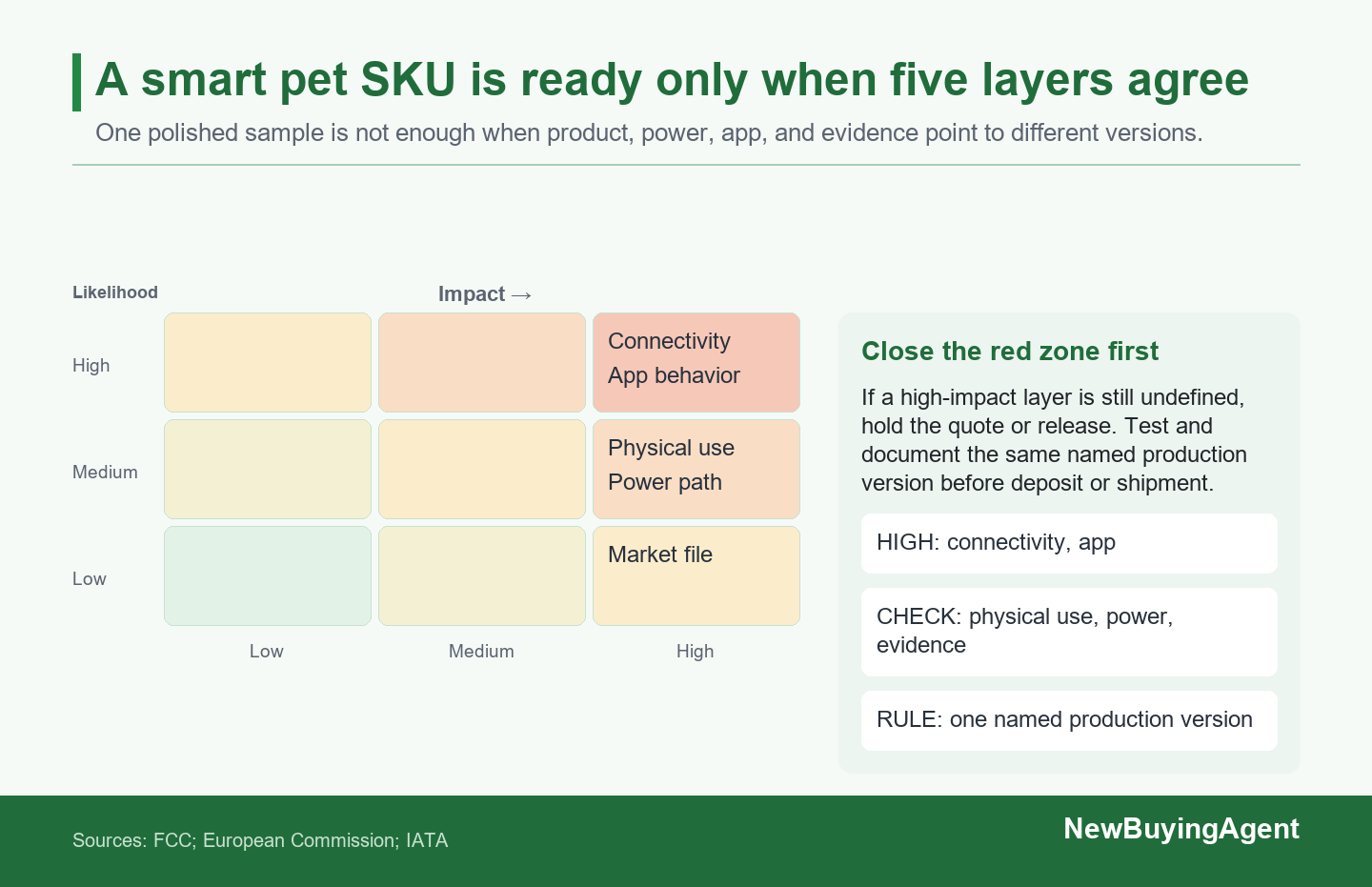
Treat the highest unresolved readiness layer as a quote or release hold until the named production version has evidence for it.
Choose the Daily Function Before Adding Smart Features
The first product choice is the daily physical function and offline failure condition, because an app cannot rescue an unclear mechanical or hygiene promise. For a feeder, define portion size, food compatibility, jam behavior, bowl access, cleaning steps, and what happens during a power or connection interruption. For a fountain, define flow, filter replacement, cleaning access, low-water behavior, pump noise, and whether the unit can still be used safely while offline. A connected notification is valuable only after the core device function is clear.
Start with the use case that the buyer can verify in a real room, not the screen that looks most impressive in a sales video. A retailer selling to apartment dwellers may put cleaning effort and noise before camera functions. A brand selling travel-oriented feeders may rank battery backup, portion repeatability, and offline schedule retention higher. Those choices influence tooling, component scope, packing, and support content. They should be part of the quote request before a supplier selects a showcase model.
Write Acceptance Conditions at Every Interface
A quote-ready smart pet brief names an observable pass condition for each interface instead of treating app control as a single feature. “Works with an app” is a marketing phrase. “Pairs after reset, retains the agreed schedule after a network interruption, displays the approved device name, and records the firmware version tested” can be checked on a production sample.
| Interface to define | Question for the brief | Example of an observable pass condition |
|---|---|---|
| Daily product function | What must the feeder, fountain, tracker, or camera do every day? | The agreed food type dispenses at the scheduled setting without an unplanned jam during the sample test. |
| Power and charging | Which battery, charger, cable, and backup behavior are quoted? | The production sample charges with the named charger and shows the agreed low-power behavior. |
| Connectivity | Which radio function and reset path are included? | The named version pairs, reconnects after the agreed interruption, and can be reset as shown in the instructions. |
| App behavior | Which account, language, alert, and firmware behavior will the buyer test? | The test record identifies the app build and firmware version that show the agreed schedule and alert behavior. |
| Product identity and pack | How will the supplied version be recognized in a carton? | Unit label, manual, charger, carton mark, and version reference point to the same quoted configuration. |
Acceptance conditions should be proportionate to the product. A basic timer feeder does not need the same connected-function test as a cloud camera, but it still needs an agreed product identity and power configuration. Keep the language customer-facing: write what the buyer should be able to see, operate, clean, charge, or confirm. That makes supplier questions, sample review, and later inspection more comparable.
Treat Market Evidence as a Design Input
For an electrical consumer product, destination, selling route, software, and product identity can change the evidence the buyer needs before production. The EU’s general product-safety guidance illustrates why a consumer device and its information route cannot be separated casually. The practical order is destination first, product configuration second, document request third. That is more reliable than asking for a generic “certificate pack” after the carton artwork and components have already been decided.
A buyer does not need to predict every regulatory conclusion alone. The useful sourcing task is to identify the questions that affect the purchase: Will this version use Wi-Fi or Bluetooth? Is it sold under the buyer’s brand? Does it include a rechargeable battery? Is an app or online product listing part of the offer? Which country receives the first shipment? Record the answers against the same version identifier used for the sample. Then validate the required route with the appropriate compliance specialists and market authorities.
Connected Functions Change the Evidence Request
A Wi-Fi or Bluetooth product can create radio-equipment evidence questions that a non-connected timer does not. Radio equipment is a product that uses Wi-Fi or Bluetooth to communicate. For a United States route, the FCC equipment-authorization information is a useful starting point for understanding why connected devices are treated differently. For an EU route, the Radio Equipment Directive text helps frame the documentation, marking, and conformity questions that have to be checked for the actual equipment.
For a private-label route into the EU, documentation and product identity must be considered before the buyer treats the device as a finished market-ready SKU. The European Commission’s guidance for importers and distributors explains why a business placing a non-EU product on the market needs to consider documentation and the responsibilities connected to selling under its own name or trade mark. Put the proposed brand, model, destination, and version reference into the evidence request rather than relying on a file named only after a generic product family.
For EU consumer products, hardware, software, and online selling information can belong to the same product-safety conversation. The EU’s general product-safety guidance is a reminder to consider how an app or online offer relates to the consumer product. A separate RoHS information page addresses restricted substances in electrical and electronic equipment. These are planning signals, not a substitute for destination-specific advice.
Power and Shipment Records Belong in the Same Brief
For rechargeable smart pet devices, the charger, battery configuration, packaging, and lithium transport record should be controlled together before shipment is booked. IATA explains in its lithium battery shipping guidance that manufacturers and later distributors must make available a test summary showing the battery type met UN 38.3 requirements. This UN 38.3 test summary is a lithium-battery transport test record used in the supply chain. For an EU destination, the Batteries Regulation is another reason to avoid treating the battery as a minor accessory after the device itself has been specified.
At quotation stage, state whether the unit is rechargeable, the proposed battery type and capacity, the supplied charger and cable, whether a spare battery is included, and the intended shipping mode. At release stage, confirm that the product sample, packaging, labels, and shipment file identify the same battery configuration. A last-minute charger substitution can affect the buyer’s test record, packing decision, and destination review even when the outer shape of the pet device looks unchanged.
Compare Launch-Ready Cost, Not FOB Alone
Launch-ready unit cost is FOB plus the allocated cost of validation, app readiness, battery/packaging evidence, and a realistic release reserve. This is an internal buying comparison, not a universal market-price formula. It makes a lower hardware offer easier to assess when one quote includes a defined production version and the other leaves important release work unnamed.
In the illustrative 1,200-unit example, a US$1.40 FOB saving per unit is smaller than the US$4,380 readiness gap created when the lower quote excludes validation and version-control work. Quote A is US$24.80 FOB per unit, or US$29,760 for 1,200 units. Add US$900 for validation, US$360 for app readiness, US$240 for battery and packaging evidence, and US$300 as a release reserve: US$31,560 in launch-ready cost. Quote B is US$23.40 FOB per unit, or US$28,080. Its unpriced readiness work later totals US$2,200, US$1,400, US$960, and US$1,620 respectively, for US$34,260. The FOB saving is US$1,680; the readiness gap is US$4,380; the apparent low quote costs US$2,700 more in this illustration.
Use the calculation to ask better questions, not to impose these figures on another product. Put each item beside the quote line: Who provides the production sample? Which app build is included? Which test record is expected? What is the carton and battery evidence scope? What change would require a new approval? A transparent answer may reveal that two suppliers are offering different products rather than different prices for the same one.
Verify the Production Version Instead of the Demo
A passed sample does not prove a changed production version when the radio module, charger, firmware, app behavior, labels, or carton marks have changed. The release question is not whether the new component seems equivalent. It is whether the buyer can tie the production hardware, software reference, product identity, and requested evidence to one configuration that has actually been reviewed.
Set a small change-control rule before the deposit: a change to the power path, radio module, firmware, app behavior, product label, or carton mark triggers a comparison against the approved version. The outcome might be “no effect,” a focused retest, or a new destination-evidence question. What matters is that the decision and its basis are recorded before the factory produces the full order. This keeps a reassuring sample video from becoming the only proof available for an altered production run.
Businesses selling electrical and electronic equipment in EU countries can face registration, reporting, and end-of-life responsibilities that depend on where the equipment is distributed or sold. For a private-label route, record the organisation responsible for the applicable end-of-life work in the release file before you approve production. The EU’s WEEE responsibilities guide gives the buyer a reason to resolve that ownership before handoff.
When a buyer already has a China smart-device supplier, NewBuyingAgent's factory-management service can support local production progress and quality evidence around the supplied product outcome. In that situation, the buyer can use NewBuyingAgent factory management for an existing China supplier while keeping the version brief and release conditions visible.
Hold, Correct, and Reverify the Changed Version
Illustrative example; not a NewBuyingAgent client case.
The changed configuration should remain on hold until the production sample, software reference, labels, carton marks, and evidence request identify the same version. Consider a retailer planning a 1,200-unit private-label Wi-Fi feeder for one EU destination. The original sample has demonstrated its function, but the supplier proposes a new Wi-Fi module and revised charger for production. The app build shown during the sample test does not display the firmware version planned for the production units.
The retailer needs the supplied product to match the stated feeding function, app behavior, and market route rather than simply resemble the demonstration sample.
The planned order is 1,200 private-label Wi-Fi feeders for one EU destination.
The sample function has been demonstrated, but the planned production radio module, charger, firmware or app build, labels, and carton marks are not yet tied to a single version identifier.
The production supplier proposes a new Wi-Fi module and a revised charger after the sample is approved.
The test app build also differs from the firmware reference intended for production.
The product is no longer one verified configuration. The module, charger, and firmware change can affect the evidence request and the customer experience that the buyer thought had been approved.
Hold the changed variant; do not release the 1,200 units on the basis of the original sample demonstration.
Before using a single sample demonstration as the whole decision record, buyers evaluating the breadth of China-side sourcing support can review NewBuyingAgent sourcing case examples.
Assign one production-version identifier, rebuild the evidence pack around the revised module and charger, repeat the agreed physical and connected-function tests, and approve the app behavior tied to that version.
Release only after the production sample, firmware or build reference, app test record, label artwork, carton marks, and market-evidence request all name the same version.
This illustrative example demonstrates control logic only. Destination-specific requirements should be checked with qualified compliance professionals.
Before relying on the sample alone, compare the agreed unit label, charger reference, app test record, and carton mark against the release file. This small check creates a clear conversation when a supplier proposes a replacement part or revised software build. It also helps the buyer distinguish a cosmetic artwork update from a change that may alter the functioning device, its customer instructions, or the records needed for the intended market route.
Turn the Framework Into a Quote-Ready Brief
A smart pet electronics sourcing brief should state the daily function, target use, quantity, destination, power method, connectivity, app requirement, and required arrival date. Add the working product version, expected packaging language, and the buyer’s non-negotiable acceptance conditions. This turns a request for “a smart feeder” into a purchasing requirement that can be priced, sampled, and checked consistently.
- Choose the physical platform and state the normal use and offline failure condition.
- Record the proposed power path, radio function, app behavior, and product identity as one version.
- Name the first destination and selling route before asking for market evidence.
- Compare quotations against launch-ready scope, then define what version change puts the order on hold.
For a new product program, NewBuyingAgent can use this full purchasing requirement to quote and supply China-sourced products around price, quality, market fit, and delivery needs. If the requirement is still only a product idea, add the items above before requesting a quote; that gives the China-side product and QC work a clearer commercial target. When the brief is ready, buyers can request a complete smart pet electronics sourcing brief from NewBuyingAgent.
FAQs
The buyer should treat the exact destination, production version, and evidence route as part of the wholesale decision before a deposit is paid. The questions below help turn that principle into a practical first-order conversation.
Which smart pet product is best for a first wholesale order?
For a first order, choose the platform whose daily physical function and failure conditions you can test without relying on an unfinished app. A feeder, fountain, or simple tracker may all be suitable if the buyer can define its everyday use, clean it, test its power behavior, and recognize the approved version. A complicated feature set is not automatically a stronger first product. Start with the one whose customer promise, sample test, packing scope, and destination route can be stated clearly. If support content or replacement parts will matter, include those practical needs in the first brief as well.
Do Wi-Fi pet feeders need different evidence from timer feeders?
Usually yes, because a Wi-Fi feeder adds radio, app, account, and software-version questions beyond the timed dispensing function. The required evidence depends on the exact device and destination, so do not assume that a record for a non-connected timer applies unchanged. In the sourcing brief, distinguish the physical feeder from the connected configuration, identify the radio and app version, and ask qualified specialists to confirm the market route before production is released. The buyer should also confirm which reset, pairing, and account steps a customer can actually perform after delivery.
Can a sample prove a smart pet device is ready to wholesale?
No, a sample proves only the configuration you tested unless the production hardware, firmware, app behavior, labels, and pack remain controlled. It can be a strong piece of evidence when its model, components, app build, test conditions, and packaging references are recorded. If the supplier changes a charger, radio module, firmware, or carton mark, compare the new version against the approved record and decide whether the change requires a focused retest or a refreshed market-evidence request. Keep the signed-off test record and the approved product identity together so the production comparison remains quick and factual.
What should a buyer request before paying a deposit?
Request a version-specific product brief, quote scope, physical and connected-function tests, destination evidence list, and a production-sample control plan before paying a deposit. Include quantity, required arrival date, power configuration, app requirement, packaging identity, and the change-control rule. This does not guarantee that every issue is solved before production, but it gives the buyer a visible baseline for deciding what was quoted, what was tested, and what must be rechecked if the product changes. It also reduces the chance that a late component swap becomes a surprise after cartons are already packed.
NewBuyingAgent
Related Resources


Get Started Today
Let's Turn Your Sourcing Goals into RealityWeChat:+86 15157124615
WhatsApp:+86 15157124615
Address:Building 10 #39 Xiangyuan Road, Hangzhou, China
