

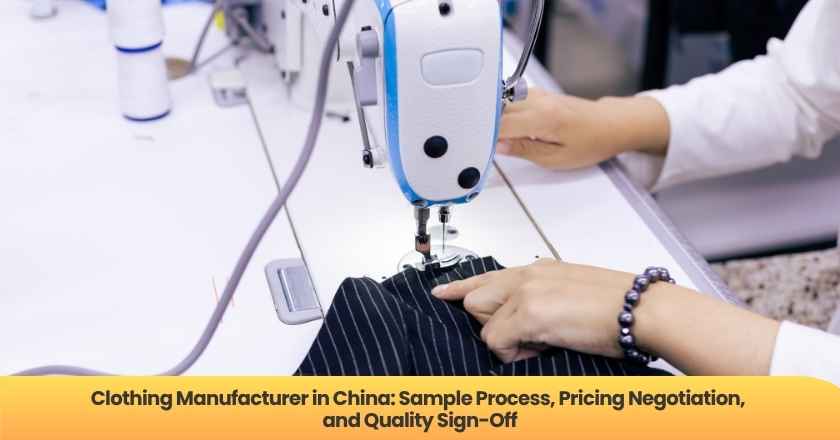
Introduction
The order goes wrong in one of three places, almost always: a sample you approved too fast, a price you negotiated without understanding what was in it, or a quality sign-off you waved through to hit a ship date. Each feels minor in the moment. Each is where the gap between "what I ordered" and "what arrived" gets built.
Getting these three stages right is most of what separates a clean apparel order from a costly one. They're sequential, they build on each other, and rushing any one of them undermines the next two. The failure points are predictable, which means they're avoidable if you handle each stage deliberately.
The order matters as much as the steps. A locked sample makes pricing negotiable against a fixed standard; a documented price and spec give the final inspection something objective to check against. Skip ahead — negotiate before the sample is right, or pay before the inspection — and you knock out the foundation the later stages stand on. Treat the three as one connected sequence rather than three errands, and the order tends to arrive as planned.
Key Takeaways
• Approve a pre-production sample in your final fabric and trims before any deposit — not a generic showroom sample.
• Negotiate the full cost breakdown, not just the headline unit price; the line items are where real savings live.
• Tie your balance payment to a pre-shipment inspection against a signed sample-approval sheet.
• Pay for samples; free samples often come from a different source than your bulk production.
• Document every approval in writing so your quality sign-off has an objective reference point.
Stage One: The Sample Process
Why the first sample isn't the one that matters
The sample that wins your order is often a showroom or counter sample — made to impress, sometimes not even in your final fabric. The sample that protects your order is the pre-production sample (PPS — a sample made with the exact materials, trims, and methods of your bulk run). Approving a PPS, not a showroom piece, is what locks the factory to what you'll actually receive.
Expect to pay for sampling, and expect a few rounds. A first sample rarely nails fit, color, and construction at once. Each round should resolve specific, written feedback — "shorten the sleeve 1.5cm, match the pantone on the placket" — not vague impressions. Budget two to four weeks for sampling on a new style; rushing it just pushes the errors downstream into bulk.
Locking the approved sample
Once a PPS passes, seal it. Sign a sample-approval sheet, photograph the garment from multiple angles, and keep one physical copy. This becomes the objective standard for your final inspection — the answer to "does the bulk match what I approved?" Without it, quality sign-off becomes one person's memory against another's, and memory loses.
Expert Tip: Send written, numbered feedback on every sample round and require the factory to confirm each point before remaking. Photos with annotations beat paragraphs — circle the seam, mark the measurement, name the pantone. A factory that confirms your numbered list point by point understands the changes; one that says "ok no problem" to everything is the one that returns a sample missing half your edits. Make them acknowledge each item, and the next round arrives right.
The types of samples and when each matters
Sampling has stages, and conflating them causes confusion. A proto or fit sample comes first — it tests pattern and fit, often in a substitute fabric, and isn't meant to be production-accurate. A salesman or counter sample is built to look perfect for photography or buyer presentation. Only the pre-production sample uses your exact fabric, trims, and methods, which is why it alone can anchor your bulk order. Buyers get burned by approving a beautiful salesman sample and assuming bulk will match, then receiving goods made to a looser standard. Know which sample you're holding at each stage, and reserve final approval for the PPS. The earlier samples are tools for refining the design; the PPS is the contract for what gets made.
Stage Two: Pricing Negotiation
Negotiate the breakdown, not the number
A headline price of "$6.20 a piece" tells you nothing about where it can move. Ask for the cost breakdown: fabric, trims, labor, packaging, and the factory's margin. Now you can negotiate intelligently — maybe the fabric line is high because they quoted a premium mill you don't need, or the packaging is gold-plated for a budget product. The line items are where real, defensible savings sit; haggling the total just invites the factory to cut quality quietly to hit your number.
Volume, payment terms, and timing all move price legitimately. A larger order, a faster payment, or production in the factory's slow season each shift the price in your favor. Asking for a lower price with nothing offered in return usually gets you a worse product at the same cost.
It also helps to know the factory's perspective. A garment factory runs on thin margins and tight scheduling, so what it values most isn't always a higher price — it's a filled production slot, a reliable payer, and a customer who won't generate endless sample rounds. Offering something the factory actually wants — committing to a reorder, paying the deposit promptly, or slotting your order into a quiet week — often unlocks a better price than pressure ever will. Negotiation works best as a trade, not a tug-of-war: find what's cheap for you to give and valuable for them to receive, and the number moves without quality quietly eroding to compensate.
The bargaining-power reality
A single buyer negotiating one order has limited pull against a factory's standard pricing. Aggregated buying power changes the equation, because bargaining position and supplier selection do work a lone first-time buyer can't replicate — which is where much of any real cost advantage actually comes from.
Common Mistake to Avoid: Pushing the unit price down without specifying that quality stays fixed. The factory agrees, then quietly substitutes a lighter fabric, a cheaper trim, or a faster stitch count to protect its margin — and you find out at delivery. The consequence is a "cheaper" order that fails inspection. Always negotiate against a locked spec: the approved sample defines quality, and the price moves around it, never the reverse.
Understanding what moves with order size
Price isn't fixed against volume in a straight line — it steps. Fabric mills price in minimum dye lots, so ordering just above a lot threshold can drop your per-meter cost sharply, while ordering just below it pays a premium for a partial lot. The same logic applies to setup costs: pattern grading, screen-printing screens, and embroidery digitizing are one-time charges spread across your run, so doubling the order can nearly halve their per-unit impact. Before settling a price, ask the factory where the next cost break sits. Sometimes nudging an order from 800 to 1,000 pieces lowers the per-unit cost enough that the larger order costs barely more in total — a lever you can only pull if you know where the thresholds are.
Stage Three: Quality Sign-Off
The inspection that protects your balance
The pre-shipment inspection is your last checkpoint before the balance payment leaves your hands. An inspector checks a statistical sample of the finished order against your approved sample and an AQL standard (Acceptable Quality Limit — the agreed maximum defect rate the order can contain), reviewing measurements, construction, color, labeling, and packing. A clean report releases the balance; a failed one triggers rework before you pay.
The AQL standard deserves a moment, because it's where many buyers' expectations and reality diverge. AQL doesn't promise zero defects — it sets an agreed ceiling on minor, major, and critical defects per a sampled quantity. A common setup accepts a small percentage of minor flaws while allowing almost no critical ones. Agreeing the AQL level before production means you and the factory share the same definition of "passing," rather than discovering at inspection that the factory considered a loose thread acceptable and you didn't. Set the standard in writing alongside the approved sample, and the inspection becomes a clear pass/fail against numbers you both signed, not a judgment call open to argument.
This is why the payment structure matters so much. With 30% down and 70% against a passing inspection, your money stays in play until the goods are verified. Pay the balance before inspection and you've handed away the only pressure that gets defects fixed.
Independent eyes, not the factory's
A factory's own QC report comes from the party that wants to ship. An independent inspection — experts working for you — catches what the factory's team is motivated to pass. Depth matters here: a real QC bench exists so that finished goods actually match the approved spec rather than the factory's optimistic self-assessment. Remote and digital inspection has also matured through 2026, so buyers can now review high-resolution inspection evidence in near real time rather than waiting on a shipped report.
What a sign-off actually covers
A thorough quality sign-off isn't just "do the garments look right." A proper pre-shipment inspection runs through a defined checklist: measurements against the approved spec at key points of measure, construction and stitching quality, color consistency across the lot, correct labeling and care instructions, accurate packing and carton counts, and a functional check of zippers, buttons, and other hardware. Each category has its own pass threshold under the AQL standard. Knowing what the inspection covers lets you confirm nothing important was skipped — and lets you specify any product-specific check that matters for your garment, like a wash test or a stretch-recovery check on activewear. A sign-off is only as good as the checklist behind it, so agree on that checklist before the inspector ever shows up.
Expert Tip: Book your pre-shipment inspection for when the order is 100% produced and at least 80% packed — not earlier. Inspect too early and the inspector sees a partial run that doesn't represent the finished order; the last 20% is often where rushed defects hide. Timing the inspection to near-complete packing, against your signed sample-approval sheet, gives the report real authority and leaves the factory no "the rest will be better" excuse.
How NewBuyingAgent Helps You Manage Samples, Pricing, and Sign-Off
Managing samples, pricing, and quality sign-off well across a time zone is hard, which is why many buyers run the sequence through a sourcing partner. NewBuyingAgent is your perfect partner for global sourcing from China, backed by 30 years of expertise in trade, manufacturing and quality control.
On the pricing stage, the buying power does the work: with Lower Prices Than Direct Sourcing, their wide factory network lets us pick low-cost, high-cooperation suppliers. Even with their margin included, they cut your costs by 5%-10%. And on the sign-off stage, the quality is built in: NewBuyingAgent's 20,000+ product development & QC experts ensure your products match market needs and stay high-quality. Contact now.
Frequently Asked Questions
Should I pay for samples from a clothing manufacturer?
Yes. Paying for samples is standard and protects you — free samples are sometimes made elsewhere or rushed to win the order, and may not reflect your actual production. Pay for a pre-production sample in your final fabric and trims, which becomes your quality reference.
How many sample rounds should I expect?
Usually two to four for a new style. The first rarely gets fit, color, and construction right together. Each round should resolve specific written feedback. Budget two to four weeks; rushing sampling just moves the errors into bulk production where they cost far more.
How do I negotiate price without sacrificing quality?
Negotiate against a locked spec defined by your approved sample, and ask for a full cost breakdown. Move price using real levers — volume, faster payment, off-season timing — rather than just demanding a lower number, which pressures the factory to cut quality quietly.
What happens if the pre-shipment inspection fails?
A failed inspection means the order doesn't meet your AQL standard, so you withhold the balance payment and require rework or a discount before shipment. This is exactly why the balance is tied to inspection — it's your pressure to get defects fixed before you pay.
Can I do quality sign-off remotely?
Yes. Independent third-party inspectors conduct the check on-site and now share detailed photo and video evidence digitally, often in near real time. You review the report against your signed sample-approval sheet and release the balance only on a clean result.
Conclusion
Samples, pricing, and sign-off aren't three separate tasks — they're one chain, and each link holds the next. Approve a real pre-production sample, negotiate against a locked spec rather than a bare number, and tie your final payment to an independent inspection, and the order that arrives matches the one you placed. Skip a step and the gap reappears, usually at the most expensive moment. When managing all three stages across a time zone isn't realistic for you, it's worth having someone run the sequence end to end so the goods that ship are the goods you signed off on.
NewBuyingAgent
Related Resources
Get Started Today
Let's Turn Your Sourcing Goals into RealityWeChat:+86 15157124615
WhatsApp:+86 15157124615
Address:Building 10 #39 Xiangyuan Road, Hangzhou, China
