

China Factory Sourcing
Definition and Scope
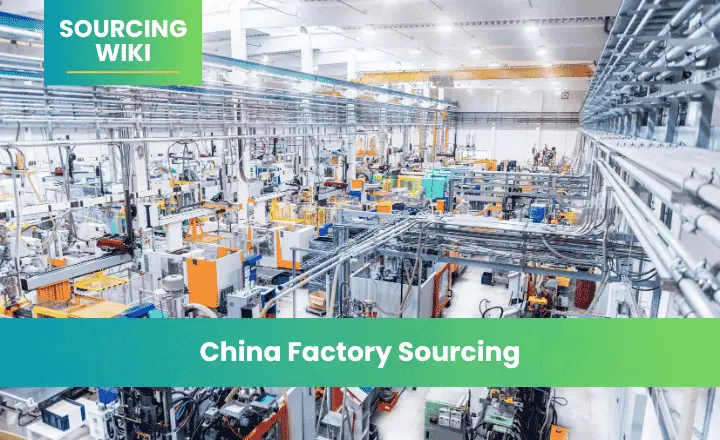
China factory sourcing is the process of identifying and qualifying manufacturers in China for a specific purchasing requirement. Unlike general supplier sourcing, which may include wholesalers and trading companies, factory sourcing focuses on finding production facilities capable of making the required goods.
The objective is not simply to locate a factory that produces a similar product. A suitable factory must also match the buyer's specifications, expected quantity, quality level, customization requirements, lead time, and commercial conditions. Factory sourcing is therefore a selection process as much as a search process.
For overseas buyers without an established manufacturing network in China, the main challenge is usually not finding names. It is determining which factories are genuinely capable of producing the required product and whether their operating model fits the order.
What Factory Sourcing Involves
A practical factory-sourcing process normally moves through several stages.
| Stage | Main Objective |
|---|---|
| Requirement definition | Establish product specifications, quantity, quality, and target conditions |
| Factory identification | Find manufacturers with relevant product and process capabilities |
| Initial screening | Compare product range, MOQ, location, capacity, and experience |
| Capability verification | Establish whether production is genuinely performed in-house |
| Sample evaluation | Check whether the factory can achieve the required product standard |
| Commercial comparison | Compare quotations, tooling, payment terms, and lead times |
| Qualification | Select factories suitable for trial or production orders |
The depth of each stage should reflect the order's value and risk. A standard product purchased in small quantities may require limited qualification, while customized or technically demanding products justify deeper factory assessment.
How to Identify Suitable Chinese Factories
Factory identification can begin through B2B platforms, trade fairs, industry networks, referrals, and existing supplier relationships. Online listings can provide a broad candidate pool, but a listing alone does not establish that the seller operates the relevant production facilities.
The first filter should therefore be product fit. Buyers should ask what the factory actually manufactures, what processes it controls, what quantities it normally produces, and whether it has experience with comparable products.
Location can also be useful when production depends on regional supply chains or specialized processes. However, proximity to a known manufacturing cluster should be treated as a search advantage rather than proof of capability.
Factory Verification and Qualification
A factory's stated capability should be tested against evidence. Buyers can compare the company's registered information with its stated business activities and then examine production facilities, machinery, workforce, quality systems, and subcontracting arrangements where appropriate.
An on-site factory audit provides stronger evidence of physical capability than online information alone. The audit can establish whether the factory has the equipment and processes required for the buyer's product and whether production is performed internally or relies significantly on third parties.
Samples provide another important checkpoint. A factory that claims to produce a particular product should be able to demonstrate that capability through a sample or controlled development process.
Comparing Factory Quotations
Factory sourcing should not be reduced to finding the lowest quotation. Buyers should compare quotations on an equivalent specification and quantity basis, including materials, packaging, tooling, MOQ, payment terms, production lead time, and delivery conditions.
Incoterms® rules can also affect the commercial meaning of a quotation because they allocate specific costs, responsibilities, and risks between buyer and seller.[1] Two factories offering apparently similar prices may therefore present different total purchasing costs depending on the agreed delivery terms.
A slightly higher quotation may be commercially preferable when it comes with stronger quality control, more reliable capacity, better communication, or lower expected defect costs.
From Factory Selection to Production
Once a factory has been selected, the sourcing process becomes supplier management. Buyers should document the final specification, approve samples, confirm commercial terms, and establish how changes will be handled before production begins.
Trial orders are useful for testing actual performance before committing larger volumes. Production follow-up and appropriate inspection can then provide additional control over whether the finished goods match the approved requirements.
Factory qualification should also be revisited when circumstances change significantly, such as a relocation, ownership change, major expansion, or substantial shift in production arrangements.
Frequently Asked Questions
What is China factory sourcing?
China factory sourcing is the process of finding and qualifying Chinese manufacturers that can produce a buyer's required products under suitable quality, quantity, price, and delivery conditions.
How can I tell whether a Chinese supplier is actually a factory?
Ask about the production location, machinery, workforce, manufacturing processes, capacity, and subcontracting. Documentary checks can establish the company's identity, while an on-site audit provides stronger evidence of actual factory operations.
Is buying directly from a factory always cheaper?
No. Factory-direct purchasing can remove some intermediary layers, but the lowest overall cost depends on quantity, product complexity, MOQ, quality, payment terms, logistics, and other commercial factors.
Should I visit a Chinese factory before placing an order?
A visit can be useful for a significant or strategic supplier, but it is not always necessary for smaller or lower-risk purchases. Buyers can combine documentary verification, samples, third-party audits, and trial orders according to the level of exposure.
How many factories should I compare?
There is no universal number. The objective is to obtain enough qualified alternatives to make a meaningful comparison without creating unnecessary evaluation work. Product complexity and order value should determine the depth of the search.
Sources & References
[1] International Chamber of Commerce — Incoterms® Rules The ICC Incoterms® rules establish standardised terms used in sales contracts to clarify buyer and seller obligations, costs, and risks in the delivery of goods. Accessed August 20 2026.
Related Knowledge Base
Sourcing Practices & Insights: China Factory Sourcing
Latest Sourcing Guides

Comece hoje
Vamos transformar seus objetivos de compras em realidadeWeChat:+86 15157124615
WhatsApp:+86 15157124615
Endereço: Edifício 10 #39 Xiangyuan Road, Hangzhou, China
