

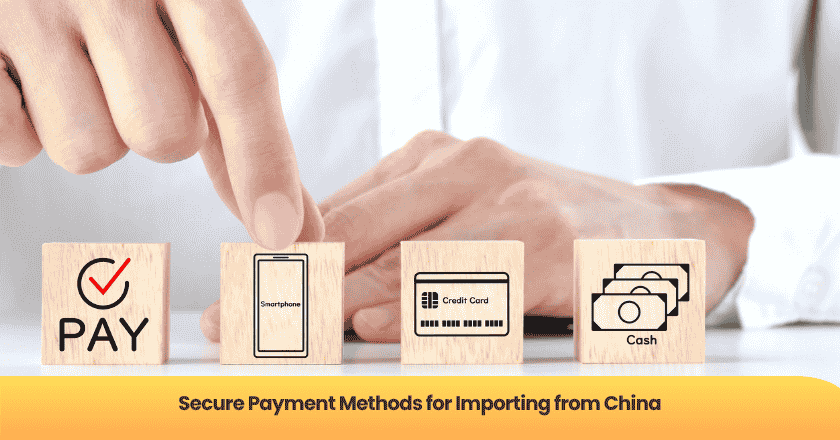
Introduction: Why Payment Strategy Matters Now More Than Ever
Importing goods from China in 2026 isn't just about finding the right supplier—it's about structuring payments in ways that protect your capital while maintaining supplier relationships. The landscape has shifted considerably since 2020. Real-time payment tracking, blockchain settlement options, and enhanced regulatory scrutiny around cross-border transactions have fundamentally changed how informed importers operate.
The stakes are simple: choose wrong, and you're funding someone else's production at your own risk. Choose strategically, and you transform a vulnerability into competitive advantage.
This guide walks through the payment methods that actually work in 2026, what's changed, and how to deploy them without getting tangled in regulatory complications or scam traps.
Key Takeaways: What You Need to Know
The optimal payment structure isn't one-size-fits-all, but several principles cut across all successful transactions. Splitting payments—typically 30% upfront, 70% on verified completion—remains industry standard because it creates mutual accountability. Both you and your supplier have skin in the game.
Documentary payment methods (Letters of Credit, bank guarantees) offer maximum security but carry processing costs that smaller orders can't absorb. For orders under $10,000 USD, the overhead often exceeds the protection benefit. For orders above $50,000 USD, skipping documentary methods is genuinely risky.
The fintech wave has legitimately disrupted traditional banking in international trade. New players like Wise, plus cryptocurrency-adjacent solutions gaining mainstream acceptance, have finally made "cheaper than wire transfer" a realistic option—not a scam vector. Blockchain-based settlement, which was theoretical five years ago, is now handling real volumes for established suppliers.
Most importantly: supplier verification and payment method selection are inseparable decisions. No payment method protects you from a fundamentally dishonest counterparty.
Understanding the 2026 Payment Ecosystem
What's Changed Since 2020
The Chinese government substantially tightened SAFE (State Administration of Foreign Exchange) regulations around 2021-2022. By 2026, these aren't coming down—they're becoming more sophisticated. Suppliers now routinely need to document the legitimacy of incoming payments, not just verify they received them. You'll occasionally encounter requests for commercial invoices, purchase orders, or contract scans before funds can be released to the supplier's account.
This is actually protective for you. It means the bank is confirming that both parties agree on what's being purchased. It slows things down—sometimes adding 48 hours to transfers—but it's a feature, not a bug.
Digital payment rails that didn't exist in 2020 now dominate for smaller transactions. Most suppliers under 40 years old actively prefer payment apps over traditional banking. Cross-border Alipay transfers, WeChat Pay merchant accounts, and remittance-optimized platforms have chipped away at Western Union's market share, which is now honestly in terminal decline for B2B trade.
Expert Tip: When negotiating initial terms, ask about the supplier's preferred payment method before proposing anything. What works for a multi-generational factory in Ningbo is different from what works for a five-year-old startup in Shenzhen. Showing flexibility here builds trust immediately.
Traditional Methods: Wire Transfers and Letters of Credit
Telegraphic Transfer (T/T) Wire Transfers
Wire transfers remain the volume leader in cross-border China trade, but their risk profile hasn't actually improved. What's changed is that fraudulent invoices now come with better counterfeits. Scammers don't just change bank numbers anymore—they're compromising supplier email accounts or intercepting Gmail to modify proforma invoices before you see them.
How T/T currently works: You initiate a wire through your bank, providing the supplier's bank details. Processing takes 2-4 business days for USD transfers to China, sometimes longer depending on your bank's scrutiny of the destination. Fees hover between $30-60 USD on the sending side, plus any fees your supplier's bank charges for receipt (usually $5-15 USD).
The critical vulnerability: you have zero recourse after the wire clears. Even if the goods never arrive or are defective, your bank will tell you the money is gone. This isn't a T/T problem per se—it's a you-decided-to-pay-before-delivery problem. Standard practice splits this risk: send 30% upfront with the purchase order and samples, then the remaining 70% after you've inspected production samples and confirmed timing with the factory.
Many importers still insist on T/T because it's the fastest method and offers no middleman. If your supplier is established and you've done business before, this makes sense. If you're onboarding a new factory, it's genuinely risky.
Common Mistake to Avoid: Don't send "30% as a gesture of good faith" without a written terms agreement. That deposit legally exists in limbo. When disputes happen—and they do—you'll struggle to prove the factory owes you anything. A one-page purchase agreement specifying delivery timeline, quality standards, and payment schedule prevents catastrophic confusion later.
Letter of Credit (L/C): The Documentary Approach
An L/C is essentially your bank promising the supplier's bank: "We'll release funds only when your customer receives confirmed proof that your factory shipped goods matching the agreed specifications." The bank acts as referee, not stakeholder.
For large orders (typically $50,000 USD and up), this is still the gold standard. It eliminates the supplier's risk of non-payment and eliminates your risk of paying for goods that don't ship. Both sides know the finish line is documented completion, not trust.
How it actually works in 2026: You instruct your bank to issue an L/C specifying conditions—usually a bill of lading proving shipment, a quality inspection certificate, and sometimes lab test reports. The supplier's bank verifies these documents exist, and only then releases your money. Processing takes 5-10 business days longer than a wire, and bank fees run $500-2,000 USD per transaction, split roughly 50-50 between buyer and seller banks.
That cost structure means L/Cs are only rational for orders where the goods' value justifies the fee. A $30,000 order can't really absorb a $1,500 L/C fee. A $150,000 order can.
The other barrier is sophistication. Drafting an L/C correctly—specifying terms precisely enough that a bank won't reject documents, but loosely enough that your supplier can actually fulfill them—requires experience. Most first-time users either over-specify (leading to rejected documents and delays) or under-specify (defeating the whole purpose).
Expert Tip: If you're considering an L/C, hire a trade finance consultant for the first one ($300-500 consultation fee). They'll draft your terms properly, walk you through what documents to request, and explain what "discrepancy" errors will actually kill your payment. This is cheap insurance on a large transaction.
Modern Alternatives Reshaping Trade Finance
Alibaba Trade Assurance and similar platforms fundamentally solved a problem that Letters of Credit addressed expensively: how do we ensure both parties perform?
Trade Assurance holds your payment in escrow until confirmed delivery. If goods arrive defective, Alibaba mediates the dispute and can refund you. It's cheaper than an L/C (2-3% fee), faster (payment clears instantly to a holding account), and more transparent (you can track the entire sequence).
The catch is that Trade Assurance only works if your supplier is registered on Alibaba and willing to use it. Many established factories—especially those supplying directly rather than through marketplaces—don't bother. But the trend is shifting. Younger suppliers increasingly offer Trade Assurance because it expands their accessible buyer pool.
For orders under $20,000 USD, Trade Assurance is genuinely your best security bet. You get documented protection, low fees, and fast processing. Yes, Alibaba's dispute resolution sometimes favors the platform itself, but for straightforward cases (goods don't arrive, or arrive completely wrong), it's reliable.
Common Mistake to Avoid: Don't assume Trade Assurance covers everything. If your dispute involves "goods are lower quality than expected" rather than "goods never arrived," you're now in gray territory. Quality assessments are subjective, and Alibaba won't automatically side with you. Get detailed specifications in writing before you pay. Photos of samples, dimension specs, material certifications—things that can't be argued about later.
Selecting Your Payment Strategy: A Decision Framework
The right method depends on four factors working together.
- Order size: Orders under $5,000 USD favor speed and simplicity (Wise, PayPal, trade platforms). Orders $5,000-50,000 USD work with escrow or wire + inspection verification. Orders above $50,000 USD warrant documentary methods if you're onboarding a new supplier.
- Supplier track record: First-time suppliers get maximum security measures regardless of order size. Repeat suppliers with flawless delivery history can negotiate faster, cheaper payment structures. This is the only way to build truly strategic supplier relationships—performance eventually earns trust.
- Regulatory environment: Some countries restrict how funds can leave. Some restrict how funds can enter. Check both your country's regulations and China's SAFE rules before committing to a method. A payment method that works perfectly in Canada might trigger review holds in the UAE.
- Supplier preference: Genuinely ask. If the factory has clear preferences and they're not unreasonable, accommodating them builds goodwill and removes friction points. Most problems arise when one party is working with a payment method that frustrates them.
Combine these factors and the optimal method usually becomes obvious.
Common Mistake to Avoid: Don't let payment method choices drive supplier selection. If the best factory for your product uses wire transfer exclusively, you negotiate wire transfer security (maybe reduced deposits, maybe inspection before payment) rather than switching to an inferior supplier who accepts escrow. Bad sourcing decisions made for payment convenience are expensive.
Fraud Prevention: What Actually Works in 2026
Payment scams have evolved significantly. Simple bank detail changes on invoices still happen, but they're now often paired with email compromise—scammers hijack supplier accounts, modify invoices, and intercept the buyer's verification email asking "did you send this?" The response comes from the scammer's compromised account, looking completely legitimate.
Sophisticated attacks also use social engineering. A fake supplier "calling" you might sound professional and have basic details correct about your order, lowering your guard before they request a wire.
The reliable prevention methods remain un-fancy:
Verify bank details through phone or video call with a supplier contact you found independently (not through email). Call the number on their website, or ask for a video meeting on LinkedIn. A five-minute conversation catches 99% of spoofs because a real person with real knowledge of your transaction is on the line.
Request documentation of anything unusual. If a supplier suddenly requests T/T payment after previously accepting escrow, or if they change bank details mid-transaction, ask why and request official explanation. Legitimate factories understand this paranoia and don't get offended.
Use wire transfers with explicit payment verification requirements. Many factories now confirm receipt of wire funds through a separate channel (WhatsApp message, email, phone call) within minutes of payment. This confirms the money reached the right account before you commit to anything.
Expert Tip: Create a payment verification checklist and make it routine, not reactive:
- Supplier name on banking documents matches company registration
- Bank details match previously confirmed information
- Payment timing aligns with agreed production schedule
- Amount matches contract totals (no surprise charges)
- Verification of receipt through secondary contact method
This takes ten minutes and prevents catastrophic fraud.
Currency Considerations for 2026 Trade
The USD/CNY exchange rate has stabilized somewhat since 2023 volatility, but it's definitely not "fixed." Most importers now build a currency buffer into cost estimates—3-5% cushion—to account for minor fluctuations between purchase order and payment.
Suppliers increasingly offer pricing in USD specifically to eliminate their currency risk. This is actually good for you—it means they're confident enough to accept exchange rate risk themselves. It also simplifies negotiations because there's no ambiguity about what price you agreed to.
Some suppliers still demand RMB payment, which requires you to convert USD to RMB and eat the conversion spread (usually 0.5-1.5% of transaction value). This isn't a dealbreaker for most orders, but it's a small negotiating point. A supplier that needs RMB for specific reasons (local tax filing, payroll, etc.) usually can't change this. A supplier that insists on RMB just because it's easier for them might shift if you push gently.
FAQ: Real Questions Importers Ask
Q: What's the minimum deposit I should demand for a first order?
A: 30% is standard, but you can sometimes negotiate lower (20%) with established suppliers or higher (50%) with brand new suppliers that worry about order cancellations. Never accept full payment upfront unless you're ordering off-the-shelf goods that don't require tooling or customization.
Q: If I use an L/C and documents get rejected, what happens?
A: The funds don't get released to your supplier. You have a set time (usually 10 days) to either correct the documents or request the L/C be canceled. If canceled, your money returns to your account. This is why documentation matters—rejected L/Cs are expensive frustrations, not financial catastrophes.
Q: Can I use PayPal for large orders?
A: Technically yes, but the fees (3.4-4.4%) make it irrational for anything over $5,000 USD. At that point, Wise or a wire transfer becomes cheaper. PayPal's real advantage is for suppliers who want credit card purchase protection on small samples or first-time orders.
Q: How do I know if a stablecoin payment is safe?
A: The same way you know if any payment is safe—verify the supplier knows and wants to receive it. Ask them to send you written confirmation of their stablecoin wallet address before you send anything. Confirm they've successfully received previous stablecoin payments. If they haven't, you're doing experimental finance together, and those always carry extra risk.
Q: What if my bank refuses to send a wire to China?
A: Some banks do get nervous about China transactions. Document your supplier relationship (correspondence, contracts) and provide it to your bank's compliance department. If your bank still refuses, switch banks. This is their job, and some banks are just more conservative than others.
Final Recommendations for 2026 Importers
Payment security and supplier development are the same conversation. Fast, cheap payment methods work for suppliers you trust completely. Maximum-security methods work for suppliers you're still evaluating. The goal is always to move suppliers from "high security, low speed" into "high trust, reasonable efficiency" over multiple transactions.
Start conservatively with any new supplier. Use escrow, split payments, inspection verification—whatever friction you're willing to absorb for peace of mind. As the relationship strengthens and they've repeatedly delivered quality goods on time, you can gradually shift to faster methods.
The payment method itself is less important than having clear agreements about what happens if something goes wrong. A wire transfer with a detailed purchase agreement and inspection protocol is safer than Trade Assurance with vague specifications.
And genuinely: ask your suppliers what works for them. Show flexibility. The importers who maintain cost advantages are often those who've built enough supplier loyalty that they negotiate favorable terms not because they're tough negotiators, but because the factory prefers their business.
NewBuyingAgent
Related Resources
Comece hoje
Vamos transformar seus objetivos de compras em realidadeWeChat:+86 15157124615
WhatsApp:+86 15157124615
Endereço: Edifício 10 #39 Xiangyuan Road, Hangzhou, China
