

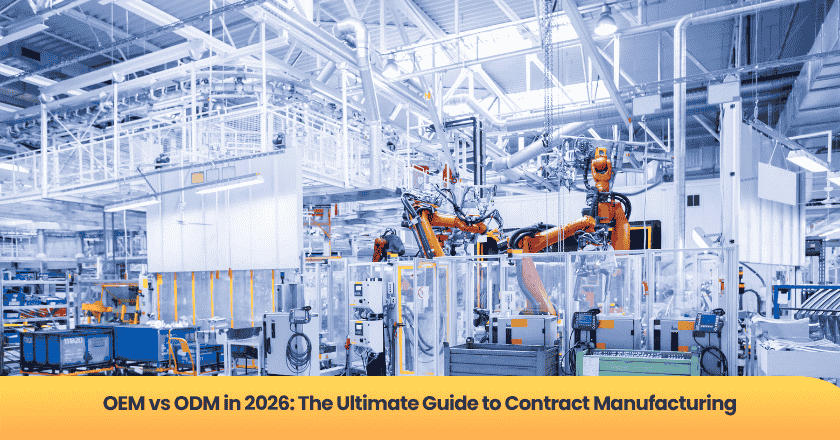
The global manufacturing landscape is undergoing a violent restructuring. Relying on outdated sourcing playbooks from even two years ago guarantees burned capital and compressed profit margins. Smart brands are tearing down their production pipelines today. They are actively hunting for the exact balance between cost efficiency and geopolitical supply chain resilience.
Deciding between an Original Equipment Manufacturer and an Original Design Manufacturer is no longer just a purchasing choice. It is a fundamental business strategy. This decision dictates your intellectual property boundaries, your speed to market, and your ultimate capital burn rate. Building a resilient hardware brand in 2026 requires looking past the glossy Alibaba storefronts. You need to understand the dark currents of contract manufacturing. This blueprint breaks down the modern sourcing ecosystem, handing you the exact frameworks needed to scale a global operation without stepping on landmines.
Key Takeaways
- Strategic Control vs. Speed: The OEM model gives you absolute authority over intellectual property and product architecture. The ODM model sacrifices that control to drastically compress your go-to-market timeline.
- Deep-Tier Compliance: Vetting a supplier means looking past the final assembly warehouse. True supply chain resilience requires auditing the tier-two factories providing the core raw materials.
- Front-Loaded Logistics: Integrating precise HTS codes and DDP shipping agreements during the initial factory negotiation prevents massive margin erosion at the customs border.
- The China Plus One Reality: Diversifying your manufacturing base across multiple regions is no longer optional. It is the absolute baseline for protecting inventory continuity against localized disruptions.
Chapter 1: Deconstructing the Modern Manufacturing Divide
Casual business conversations often blur the lines between different factory types. The legal and operational realities on the factory floor are entirely different. An Original Equipment Manufacturer (OEM) represents a heavy-customization model. You hand the factory your proprietary CAD drawings, your precise material requirements, and your industrial design files. They build it from scratch. You own the intellectual property. You own the pricing power.
An Original Design Manufacturer (ODM) operates on a completely different frequency. They offer a catalog of pre-engineered, market-tested products. You select a base model and layer your brand identity on top. You might request a different colorway or a tweaked button layout. The core patents and the underlying engineering remain the property of the factory.
Think of it like buying a house. Using an OEM is hiring a general contractor with your architect's blueprints. You decide the exact angle of the roof and the material of the floorboards. Using an ODM is buying a pre-built condo in a new development. You can paint the walls and bring your own furniture, but you cannot knock down the load-bearing pillars.
This operational divide hits your balance sheet immediately. The OEM route demands aggressive upfront capital. You pay for the Research and Development (R&D). You cover the injection molds. You fund the tooling. The ODM route dodges those massive upfront expenditures. Startups often lean on the ODM model to learn the business ropes without huge risks. They validate market demand with minimal cash burn.
The harsh reality of the ODM path is product commoditization. Your competitor can fly to the exact same industrial park, find the exact same factory, and buy the exact same core product. When your underlying hardware is identical to five other brands on Amazon, your only remaining weapon is an expensive marketing war. You are forced to compete entirely on Customer Acquisition Cost (CAC).
Expert Tip: Lock down a strict "Geographic Exclusivity Clause" before signing any ODM contract. This legal mechanism prevents the factory from selling the identical base model to direct competitors operating within your primary sales territories.
Chapter 2: Auditing Your Procurement Bandwidth
Jumping into cross-border manufacturing without a dialed-in internal operations team is a fast track to bankruptcy. You have to audit your financial runway and your technical capabilities. Modern corporate purchasing is divided into two distinct buckets: Direct Procurement and Indirect Procurement.
Direct Procurement involves acquiring the physical raw materials and electronic components that actually go into your final product. Indirect Procurement covers the operational supplies your company needs to survive—the warehouse management software, the office laptops, the marketing agency retainers.
Mastering Direct Procurement is a life-or-death skill for hardware brands. You need visibility into the sub-tier supply network. Finding a phenomenal assembly plant is useless if they source their lithium batteries from a volatile, unregulated shadow factory. You are adopting their hidden risks.
You also have to map your Procurement Cycle meticulously. The Procurement Cycle is the total lifespan of a purchasing event. It starts the second you draft a Request for Quotation (RFQ) and ends when the final inspected goods hit your loading dock.
In plain terms, the Procurement Cycle is your cash flow freeze period. It calculates exactly how many days your working capital is trapped inside factory assembly lines and ocean freight containers before a retail customer finally buys the product.
An OEM cycle can easily drag out for six to eight months during the initial run. An ODM cycle might be compressed into four weeks. Your treasury team must align your capital reserves with these physical timelines. Do not run out of oxygen while waiting for a cargo ship.
Common Mistake to Avoid: Ignoring the Total Landed Cost metric. Amateurs obsess over the Ex Works (EXW) factory floor price. They forget to calculate the ocean freight spikes, the marine insurance, the customs duties, and the final-mile warehouse transfer fees. That cheap unit cost vanishes quickly at the border.
Chapter 3: Global Sourcing in the New Geographic Reality
Digital B2B directories create the illusion of a flat sourcing world. Finding a manufacturer who actually aligns with your strategic goals requires piercing through polished online marketing. The most effective sourcing playbooks in 2026 combine aggressive digital forensics with boots-on-the-ground reality checks.
Relying entirely on a factory's website claims is dangerous. You have to cross-reference their stated capacity with hard export data. The geographical layout of manufacturing clusters also dictates your sourcing strategy. You have to match your product category to the correct industrial hub.
Cluster Alignment: Sourcing fast-moving consumer goods or small impulse-buy items requires the extreme agility of the Yiwu wholesale markets. Sourcing complex consumer electronics requires the deep component ecosystems found in Shenzhen or Dongguan.
Customs Data Interrogation: Use global trade intelligence tools to pull the actual Bill of Lading records for your prospective factories. Verify their primary export destinations and their true shipment volumes.
Third-Party Verification: Never wire tooling deposits without sending an independent auditing firm to the facility. They must verify the ISO quality management systems and check for strict labor compliance.
Digital communication creates a false sense of security. Face-to-face friction solves engineering bottlenecks. If you cannot fly out and get your hands dirty on the factory floor, hiring a localized sourcing agent with a hard engineering background is the best money you will spend. They stand next to the injection molding machines and ensure your CAD files translate perfectly into physical plastic.
Expert Tip: Establish a "Defect Range Board" alongside your Golden Sample. The Golden Sample represents the perfect, ideal product. The Defect Range Board is a physical display of acceptable micro-flaws—like a half-millimeter scratch on the bottom plate. This eliminates subjective arguments during the final cargo inspection.
Chapter 4: Freight Logistics, Customs, and Border Survival
Getting the product off the assembly line is only half the battle. Moving physical atoms across global logistics networks introduces massive volatility. The 2026 trade environment punishes brands that lack a defensive logistics strategy.
The "China Plus One" strategy has moved from corporate boardrooms to mid-market standard operating procedures. You keep your highly efficient primary manufacturing hub operational, but you actively spin up secondary production lines in places like Vietnam, Mexico, or India.
In simple terms, "China Plus One" is an insurance policy for your inventory. You are paying slightly higher unit costs in a new country to guarantee you still have products to sell if a major port shuts down or sudden tariffs hit your primary hub.
Understanding your Incoterms is mandatory. Many new importers default to Delivered Duty Paid (DDP) shipping. Under DDP, the supplier handles every single logistics hurdle from their factory floor straight to your warehouse door. It feels incredibly easy. It is also a massive margin trap. Factories embed heavy premium markups into DDP quotes to protect themselves against fluctuating ocean rates and sudden customs audits.
Your Harmonized Tariff Schedule (HTS) codes are equally critical. These internationally recognized digits tell customs officials exactly what you are importing. They dictate your tax burden.
Think of an HTS code as a universal barcode for border patrol. It translates your complex product into a specific number so the government knows exactly how much tax to charge you.
Common Mistake to Avoid: Letting the factory choose your HTS code. Suppliers often pick codes that maximize their local export tax rebates. Those same codes might trigger aggressive, punitive tariffs when the container lands in your country. Always hire a licensed customs broker to classify your catalog.
Chapter 5: Fortifying IP and Enforcing Quality Control
A rigorous Quality Management System (QMS) separates the professionals from the amateurs. Quality control is not a rushed visual check two hours before the container doors close. It is a persistent, structural loop.
Pre-Production Inspection (PPI): Verify the raw materials before the machines turn on.
During Production Inspection (DUPRO): Catch systemic assembly errors when the first batch comes off the line.
Pre-Shipment Inspection (PSI): Confirm the final defect rate aligns with your contract limits.
Intellectual property theft is the ghost haunting every hardware founder. Sending a standard Western Non-Disclosure Agreement (NDA) to an overseas factory is functionally useless. You need a hyper-localized NNN Agreement.
An NNN Agreement stands for Non-Use, Non-Disclosure, and Non-Circumvention. In simple terms, this legal document stops the factory from using your design for themselves, stops them from leaking your files to other factories, and legally bans them from bypassing you to sell directly to your customers.
Expert Tip: Your quality control checklists must be highly visual. Ambiguous text destroys quality. A high-resolution photograph with a red circle around an unacceptable weld joint is infinitely more powerful than three paragraphs of engineering text.
Executive FAQ
What is the realistic minimum order quantity (MOQ) difference between the two models?
OEM projects demand aggressive MOQs. You are asking a factory to retool machines, buy non-standard raw materials, and halt their standard operations. Expect a baseline of 1,000 to 5,000 units just to start the conversation. ODM projects are incredibly flexible. The factory is utilizing existing molds and idle line capacity. You can often secure a trial run of just 100 to 300 units.
Can I smoothly transition a successful product from an ODM to a strict OEM contract later?
Transitioning is a brutal process. The original factory owns the CAD files and the physical steel molds for that ODM product. If you want to take that exact design exclusive, you have to reverse-engineer the hardware, draw completely new schematics, and pay thousands of dollars to cut brand new molds at a different facility. It is not a smooth upgrade; it is an expensive reboot.
How do I protect my market share if I am forced to use an ODM supplier?
When hardware patents are off the table, you must build moats around your brand equity. Register your trademarks in both your manufacturing country and your target sales countries immediately. Invest heavy capital into custom, anti-counterfeit unboxing experiences. Finally, negotiate brutal geographic exclusivity clauses in your initial purchasing contract to keep your immediate competitors locked out of that specific factory's catalog.
NewBuyingAgent
Related Resources
Comece hoje
Vamos transformar seus objetivos de compras em realidadeWeChat:+86 15157124615
WhatsApp:+86 15157124615
Endereço: Edifício 10 #39 Xiangyuan Road, Hangzhou, China
