

Introduction
The dream of launching a clothing brand dies most often at a single number, namely the minimum order quantity. A first-time founder finds a promising factory, falls for the samples, and then hears that the minimum is a thousand pieces per style per color, ten times what they can afford to buy or store. For a small brand wanting its own private label, that MOQ wall is the biggest barrier in apparel, and it turns away countless founders who assumed the hard part would be design, not quantity.
Yet low-MOQ private label in China is genuinely possible, if you understand why minimums are high and where to look for factories willing to work small. The key is knowing that MOQ is not a fixed law but a reflection of costs, and that a whole layer of the apparel world, namely smaller factories, blank-garment customizers, and specialists in small brands, exists precisely to serve buyers ordering hundreds rather than thousands. Finding them, and structuring your order to fit, is a learnable skill rather than a matter of luck.
This guide is for the small brand determined to launch its own private label without a giant first order. Why MOQs run high for private label, what private label really involves, where to find apparel factories in China open to low minimums, and the strategies that let a small brand start small and grow. The aim is to get you past the MOQ wall that stops most founders, and into production of a brand that is genuinely yours.
Key Takeaways
• The minimum order quantity is the biggest barrier for small private-label brands, since many factories set minimums far beyond what a first-time founder can afford, turning away buyers who could otherwise launch.
• MOQs are high mainly because of setup and fabric costs, so understanding that the fabric minimum often drives the floor points a small brand toward the choices that lower it.
• Private label ranges from customizing a factory's existing blanks with your label and print, which allows very low minimums, to fully custom garments with your own patterns and fabric, which raise the MOQ sharply.
• Low-MOQ factories do exist, namely smaller operations, blank-garment customizers, and specialists in small brands, so the search is about finding the right kind of factory rather than pressuring a large one to shrink its minimum.
• Small brands launch successfully by working within constraints, namely using stock fabrics, limiting colors and styles, accepting a higher unit cost, and growing into fuller customization as their volume rises.
Why Low MOQ Is the Hardest Part of Private Label
For a small brand, the MOQ is where ambition meets arithmetic. Understanding why minimums exist, and why private label pushes them higher, is the first step to getting around them rather than being stopped cold.
Where the MOQ Wall Comes From
Minimums are not arbitrary. Setting up a production line, sourcing and dyeing fabric, and configuring machinery all carry fixed costs that a factory can only justify across enough units, so a minimum is the point below which your order is not worth the disruption. For private label especially, the fabric is usually the culprit, since a mill will not weave or dye a custom material in tiny quantities, and that fabric minimum, not the sewing, is often what sets your real floor. The short answer is that a high MOQ is usually a fabric problem wearing a factory's name.
Private label raises the bar further because customization adds setup. Your own patterns, your custom fabric, your specific colors, and your labels each add a cost that only spreads sensibly over volume, which is why a fully bespoke private-label garment carries a far higher minimum than buying something a factory already makes. The more of the garment that is uniquely yours, the higher the minimum climbs, which is the central tension a small private-label brand has to navigate.
Why Big Factories Say No
Large factories are built for large orders, so a small private-label run is simply not their business. A plant running tens of thousands of units for established brands has no incentive to disrupt its lines for a few hundred pieces, and its minimums reflect the clients it wants. Worth knowing: chasing a big, impressive factory for a small order is the most common way a founder wastes weeks, since the answer was always going to be a minimum they cannot meet, no matter how well the first conversation goes.
Common Mistake: Approaching large, well-known factories for a small first order and taking their high MOQ as proof that low-MOQ production is impossible. It only proves that factory is wrong for you. Low minimums live at a different kind of factory entirely, so a wall of high MOQs usually means you are knocking on the wrong doors, not that the door does not exist.
Understanding Private Label and Its MOQ Reality
Private label is not one thing, and where your order sits on its spectrum largely determines the minimum you will face. Knowing the trade-off between customization and MOQ is what lets a small brand choose an achievable path.
The Spectrum of Private Label
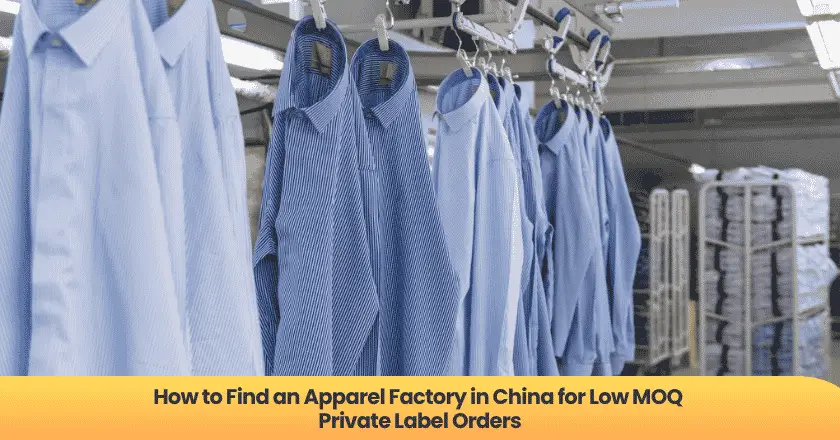
Private label spans a wide range. At one end, you take a factory's existing blank garment, namely a stock tee, hoodie, or dress it already produces, and add your label, print, or embroidery, which keeps minimums low because the garment and fabric already exist. At the other end, you design a fully custom garment with your own patterns, fabric, and construction, which is truly your own but carries a high MOQ because everything must be made from scratch. Most private-label routes sit somewhere between these two, and the more custom the garment, the higher the floor.
For a small brand, this spectrum is the key strategic choice. Starting near the blank-customization end, with your branding on quality stock garments, lets you launch a real private-label line at low volume and cost, while full customization is something to grow into once you have the sales to justify the minimums. Real talk: many successful clothing brands started by branding blanks and only moved to fully custom production once volume made it viable, so beginning simple is a proven path, not a compromise.
The Cost Trade-Off
Low MOQ usually comes at a higher unit price, and accepting that is part of starting small. A factory doing a short run cannot spread its setup over many units, so each piece costs more than it would at scale, and a buyer demanding both tiny quantities and rock-bottom pricing is asking for something that does not exist. The honest expectation is that a small first order pays a premium per unit, which is simply the cost of testing a brand before committing to volume, and a reasonable price to prove an idea before scaling it.
Expert Tip: Treat a low-MOQ first run as paid market research, not as your efficient production model. The higher per-unit cost buys you real customer feedback and proof of demand at low risk, and once sales justify a larger order, your unit cost drops. Judge the small run by what it teaches you, not by the margin it makes.
Where to Find Low-MOQ Apparel Factories
Low-minimum factories are a distinct part of the apparel world, and finding them means searching for the right kind of operation rather than the biggest name. Several routes lead to factories that welcome small brands.
The Right Kind of Factory
Look for factories built to serve small orders. Smaller factories often accept lower minimums because a few hundred pieces is meaningful business to them, unlike a giant. Blank-garment customizers and factories offering print or embroidery on stock pieces specialize in exactly the low-MOQ private label a starting brand needs. Some factories explicitly market themselves to startups and small brands, and print-on-demand or made-to-order services can go even lower, sometimes to single units, though at a higher price. The right factory for a small order is a different animal from the right factory for a large one.
Search the channels that surface these factories. B2B marketplaces let you filter for lower minimums, though you must vet heavily, while apparel-focused suppliers and directories that cater to small brands narrow the field. Referrals from other small brands are especially valuable, since a founder who has already found a good low-MOQ factory can point you straight to it. Combining these beats relying on one, and a search aimed specifically at low-MOQ and small-brand-friendly factories saves the wasted weeks of approaching the wrong ones.
Working With an Agent
An agent or sourcing partner can be especially valuable for a small brand. A good agent knows which factories accept low minimums, can sometimes pool your order with others to reach a threshold, and has the relationships to secure flexibility a lone founder cannot. For a first-time brand without the time or contacts to find a low-MOQ factory alone, the right partner turns a frustrating search into a match, and the fee is often worth it for getting to production at all rather than stalling at the MOQ wall.
Expert Tip: When you contact a factory, ask directly whether it works with small brands and what its lowest minimum is on a stock-based order, not just its standard MOQ. Factories often quote a high default minimum but have a lower floor for blank-based private label they never advertise, so the specific question can reveal a workable option the sales pitch hid.
Strategies to Launch Small and Grow
Beyond finding the right factory, a set of practical strategies lets a small brand fit its order to a low minimum and grow from there. These are the moves that turn an impossible MOQ into a workable first run, and 2026 adds new options.
Making a Small Order Work
Several tactics lower the effective minimum. Using stock fabrics the mill already runs sidesteps the fabric MOQ that usually sets the floor. Limiting your range to a few colors and styles keeps you above per-variation minimums with less total volume. Branding quality blanks rather than building from scratch collapses the minimum dramatically. And accepting a higher unit price for a low-MOQ run, or paying a small premium some factories charge for short runs, buys you the small order outright. Each tactic trades a little customization or margin for the ability to start small, which is exactly the trade a launching brand should make.
Plan to grow into customization. Launch with an achievable order, prove your demand, and reinvest into larger, more custom runs as your sales justify them, moving up the private-label spectrum over time. This staged path lets a brand start within its means and expand its customization and volume together, rather than betting everything on a large custom order before it knows the product will sell. Growing deliberately from a small, smart first order is how most durable clothing brands are actually built.
Launching Small in 2026
The options for small private-label brands keep widening. Through 2026, AI-assisted matching helps a founder find factories that genuinely accept low minimums rather than sifting through unsuitable ones, digital sampling lowers the cost of developing a first product, and print-on-demand and made-to-order services make ultra-low-volume launches more viable than ever. These make it easier for a small brand to start with less risk and capital than the MOQ wall once demanded.
The fundamentals still hold, though. Finding a factory that truly welcomes small orders, structuring the order to fit a workable minimum, and growing customization with volume remain the core moves no tool replaces. The strongest small brands in 2026 use the new options to launch leaner and lean on experienced help to find the right low-MOQ factory, turning the minimum that stops most founders into a hurdle they simply plan around.
Making Low-MOQ Private Label Work With NewBuyingAgent
Finding the rare factory that welcomes a small private-label order is exactly where a partner with wide reach changes the odds for a young brand. NewBuyingAgent is a strong partner for global sourcing from China, backed by 30 years of expertise in trade, manufacturing and quality control. On reaching factories open to low minimums, the breadth is what makes a match possible: it draws on its 50,000+ cooperated partner factories—with no language, region, or time zone barriers—and its local reputation gets you full factory cooperation. Even at small volumes, choosing from that network still works in your favor on cost, since its wide factory network lets it pick low-cost, high-cooperation suppliers, and even with its margin included, it cuts your costs by 5%-10%. And the search and coordination a small team cannot spare time for are carried for you: NewBuyingAgent handles all factory communication—ideal for multi-category buyers—freeing up your time to focus on expanding your local market sales. Contact us.
Frequently Asked Questions
Why do apparel factories have high MOQs for private label?
Because setup and fabric carry fixed costs a factory only justifies across enough units. For private label especially, the fabric minimum is usually the culprit, since a mill will not weave or dye a custom material in tiny quantities. Customization adds more setup, so your own patterns, fabric, and colors each raise the floor. The more of a garment that is uniquely yours, the higher the minimum climbs.
What is the difference between private-label options for MOQ?
Private label spans a spectrum. Customizing a factory's existing blank garment with your label and print keeps minimums low because the garment and fabric already exist. Designing a fully custom garment with your own patterns and fabric raises the MOQ sharply since everything is made from scratch. Most routes sit between, and the more custom the garment, the higher the minimum you will face.
Where do I find low-MOQ apparel factories in China?
Look for the right kind of factory, namely smaller operations, blank-garment customizers, factories offering print or embroidery on stock pieces, and specialists marketing to startups. Print-on-demand services go even lower at a higher price. Search B2B marketplaces filtered for low minimums, small-brand-focused suppliers, and referrals from other founders, and consider an agent who knows low-MOQ factories or can pool orders.
Is low-MOQ private label more expensive per unit?
Usually yes. A factory doing a short run cannot spread its setup over many units, so each piece costs more than at scale. Demanding both tiny quantities and rock-bottom pricing asks for something that does not exist. Treat the higher per-unit cost as paid market research, since it buys real demand proof at low risk, and your unit cost drops once sales justify a larger order.
How can a small brand launch without a huge first order?
Work within constraints. Use stock fabrics to sidestep the fabric MOQ, limit colors and styles to stay above per-variation minimums, and brand quality blanks rather than building from scratch. Accept a higher unit price for the small run. Then grow into customization, launching with an achievable order, proving demand, and reinvesting into larger, more custom runs as sales justify them.
Can an agent help with low-MOQ private label orders?
Yes, and often significantly. A good agent knows which factories accept low minimums, can sometimes pool your order with others to reach a threshold, and has relationships that secure flexibility a lone founder cannot. For a first-time brand without the time or contacts to find a low-MOQ factory alone, a partner turns a frustrating search into a match and gets you to production rather than stalling at the MOQ wall.
Conclusion
The minimum order quantity stops more clothing brands than any other single factor, but it stops them mainly because they misunderstand it. A high MOQ is not a law of apparel manufacturing but a reflection of setup and fabric costs, highest where customization is greatest and lowest where a garment and its fabric already exist. Knowing this reframes the whole challenge, since the goal is not to force a large factory to shrink its minimum but to find the right kind of factory and structure an order it can happily make. Low-MOQ private label is not a myth, only a niche you have to know how to reach.
Small brands launch by working with the reality rather than against it, namely branding quality blanks, using stock fabrics, limiting variation, accepting a fair premium on a small run, and growing into fuller customization as volume rises. Find the factories built to serve small orders, lean on partners whose reach turns a hard search into a match, and treat the first small run as the market research that earns the right to scale. Do that, and the MOQ wall that turns most founders away becomes, for you, simply the first thing you learned to plan around on the way to building a brand that is genuinely your own.
NewBuyingAgent
Related Resources
Comece hoje
Vamos transformar seus objetivos de compras em realidadeWeChat:+86 15157124615
WhatsApp:+86 15157124615
Endereço: Edifício 10 #39 Xiangyuan Road, Hangzhou, China
