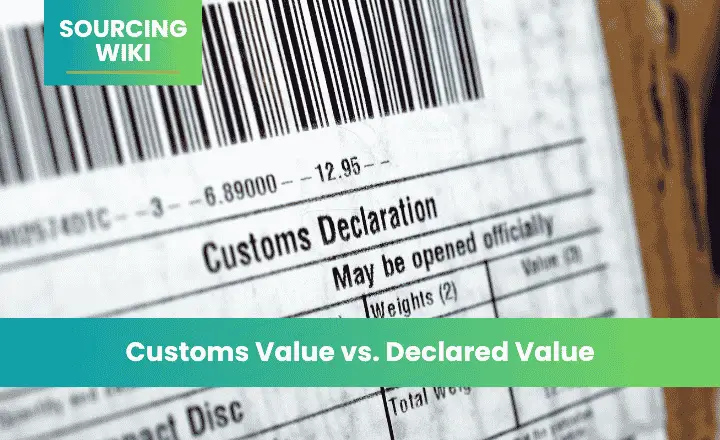
Customs Value vs. Declared Value
When importing products internationally, the value declared to customs can directly affect the amount of import duty payable. However, the amount shown on a commercial invoice does not always equal the final customs value used by the importing country's customs authority.
Understanding customs valuation helps importers estimate landed costs, prepare accurate declarations, and reduce the risk of delays or penalties caused by incorrect values. This is particularly important when importing goods from China, where product prices, tooling costs, packaging, international freight, and other charges may be documented separately.
The exact valuation rules depend on the destination country. This guide explains the main international principles and uses a U.S. import example to demonstrate how customs value and import duties are calculated. [1][2]
What Is Customs Value?
Customs value is the value assigned to imported goods for customs purposes. It is commonly used as the basis for calculating ad valorem customs duties, which are duties charged as a percentage of a product's value.
Under the World Trade Organization (WTO) Agreement on Customs Valuation, the primary method is generally the transaction value: the price actually paid or payable for the goods when sold for export to the importing country, subject to applicable conditions and adjustments. [1]
For example, a U.S. importer purchases 1,000 kitchen organizers from a supplier in China for US$10,000. The customs value may begin with that transaction price, but the final value depends on applicable U.S. valuation rules and whether any required adjustments apply.
Customs authorities do not necessarily accept every invoice amount automatically. They may request supporting documents or review the declared value if information is incomplete, inconsistent, or raises questions about the transaction.
Customs Value vs. Declared Value vs. Invoice Value
These terms are related, but they do not always mean the same thing.
- Customs value: The value determined under the importing country's customs valuation rules and used for customs purposes.
- Declared value: The value reported to customs in an import declaration. It should be based on the applicable valuation rules and supported by appropriate records.
- Invoice value: The amount shown on the seller's commercial invoice. Depending on the transaction and the destination country's rules, this may be the starting point for determining customs value, but adjustments may be necessary.
- Commercial or retail value: The price at which goods are sold, or expected to be sold, in the destination market. This is not automatically the correct customs value.
For example, a product purchased from a Chinese supplier for US$10 per unit might later retail for US$30 in the United States. The retail price does not automatically become the customs value simply because it is higher.
Similarly, a discount does not automatically make an invoice value unacceptable. Customs valuation generally aims to reflect the actual transaction under the applicable rules, rather than an arbitrary or fictitious value. However, the importer must be able to substantiate the price and satisfy the relevant valuation requirements. [1][2]
What Costs May Be Included in Customs Value?
The treatment of individual costs depends on the destination country's rules, the transaction terms, and whether the costs are already included in the price.
Under the WTO valuation framework, certain additions may be required when they are not already included in the transaction price and the applicable conditions are met. These can include packing costs, certain selling commissions, assists, qualifying royalties or license fees, and proceeds from subsequent resale that accrue to the seller. [1][3]
An assist is generally an item or service provided by the buyer, directly or indirectly, free of charge or at a reduced cost, for use in producing or selling the imported goods. Depending on the rules, examples can include molds, tooling, materials, components, or certain design and development work.
International freight and insurance require particular attention. Their treatment is not identical in every jurisdiction. For example, U.S. customs valuation generally excludes international freight and insurance from the customs value when the charges qualify for exclusion and are properly distinguished, while other countries may include transportation and insurance costs up to a specified point. [3][4][5]
Before calculating customs value, importers should identify:
- The actual price paid or payable for the imported goods.
- Whether packing costs or other required additions are already included.
- Whether buyer-provided tooling, molds, materials, or design work need to be considered.
- Whether royalties, license fees, or resale proceeds are relevant.
- How the destination country treats international freight, insurance, commissions, and other charges.
- Whether any claimed deductions are permitted and adequately documented.
Do not assume that every charge on a supplier's quotation must be added to customs value, or that every charge listed separately can be excluded. The applicable customs rules determine the treatment.
How to Calculate Customs Value and Import Duties
For goods subject to an ad valorem duty rate, the basic calculation is:
Import duty = Customs value × Applicable duty rate
This formula covers the customs duty component only. Other taxes, fees, trade remedies, or product-specific charges may also apply.
The customs value must first be determined according to the importing country's valuation rules. The duty rate must then be identified using the correct tariff classification and any applicable origin-based or preferential treatment.
Example: Importing Products from China into the United States
Suppose a U.S. importer purchases kitchen organizers from a supplier in China. For illustration, assume the transaction and costs are documented as follows:
- Price paid for the goods: US$10,000
- Additional packing cost incurred by the buyer and not already included in the price: US$300
- Qualifying buyer-provided tooling cost allocated to the imported goods: US$200
- Separately identified international freight and insurance: US$1,200
- Illustrative ad valorem duty rate: 5%
Assume the US$300 packing cost and US$200 tooling allocation are required additions under the applicable rules, the tooling allocation is properly supported, and the freight and insurance qualify for exclusion under U.S. rules.
The illustrative calculation would be:
Step 1: Determine customs value
US$10,000 + US$300 + US$200 = US$10,500
Step 2: Calculate the basic import duty
US$10,500 × 5% = US$525
The illustrative customs duty is US$525.
The freight and insurance amount of US$1,200 is not added in this example because it is assumed to qualify for exclusion under the applicable U.S. rules. In another country, or under different transaction arrangements, the treatment may differ.
The 5% duty rate is hypothetical, not a verified tariff rate for kitchen organizers. Actual rates depend on the product's correct tariff classification, country of origin, applicable trade measures, and the rules in force when the goods are imported. Additional U.S. tariffs or other charges may apply.
What Happens If the Transaction Value Cannot Be Used?
Transaction value is the primary method under the WTO Customs Valuation Agreement, but it cannot be used in every situation. For example, the transaction may not meet the relevant conditions, or the information needed to determine the value may be insufficient.
When transaction value cannot be accepted, the Agreement provides for alternative valuation methods in a prescribed order:
- Transaction value of identical goods.
- Transaction value of similar goods.
- Deductive value method.
- Computed value method.
- Fall-back method.
These methods are subject to the Agreement's rules, including the applicable conditions for moving from one method to another. The precise procedures and permitted choices should be checked against the destination country's legislation. [1][2]
Customs authorities should not simply replace a declared transaction value with an arbitrary amount. Valuation decisions must follow the applicable legal framework and use the permitted methods.
Common Customs Valuation Mistakes
Declaring a lower value to reduce duty
Intentionally declaring a value below the amount required under the applicable rules can lead to reassessment, additional duties, penalties, shipment delays, or other enforcement action. Importers should declare the correct value rather than choosing a figure based on a desired duty cost.
Using the retail selling price instead of the relevant transaction value
The destination-market retail price is not automatically the correct customs value. Importers should determine value using the applicable customs valuation method and the actual circumstances of the transaction.
Assuming freight and insurance are always excluded
The treatment of freight and insurance varies by jurisdiction. Importers should confirm whether the destination country includes these costs and whether separate identification or other evidence is required.
Overlooking buyer-provided tooling or other assists
When the buyer supplies molds, tooling, materials, components, or qualifying design work for use in producing imported goods, the value may require an appropriate allocation and adjustment. Keep records of the costs, ownership, usage, and allocation method.
Treating every discount as unacceptable
A genuine commercial discount does not automatically invalidate the transaction price. However, the importer should retain evidence showing the agreed price, the discount terms, and the amount actually paid or payable.
Providing inconsistent documents
The commercial invoice, purchase order, sales contract, payment records, packing list, and customs declaration should describe the transaction consistently. Differences in quantities, currencies, unit prices, or payment terms can trigger questions and additional review.
Documents Importers Should Keep
To support customs valuation, importers should maintain records that explain how the declared value was determined. Depending on the transaction and the destination country's requirements, relevant documents may include:
- Commercial invoice and purchase order.
- Sales contract or other evidence of the agreed transaction.
- Payment records and credit notes for discounts or adjustments.
- Packing and tooling cost records.
- Agreements and allocation calculations for buyer-provided assists.
- Royalty or license agreements, where relevant.
- Freight and insurance invoices.
- Records explaining any related-party pricing or other special circumstances.
Keep the records for the period required by the importing country's laws. If customs authorities question the declared value, clear supporting documentation can help explain the transaction and the basis of the calculation.
Customs Value and Import Planning
Customs valuation should be considered when estimating the total cost of importing products, not only when preparing the final declaration.
Before placing an order, buyers can ask suppliers to provide a clear breakdown of product prices, packing, tooling, and other charges. Buyers should also confirm the likely tariff classification, country of origin, applicable duty rate, and any additional trade measures with a qualified customs professional or the relevant customs authority.
When comparing quotations from different suppliers, make sure the quoted prices use comparable terms. One quotation may include packing or tooling while another lists those costs separately. This can affect the overall purchase cost and may affect customs valuation depending on the applicable rules.
NewBuyingAgent helps global buyers source products from China based on their purchasing needs. Clear product specifications and transparent quotation details can support better purchasing decisions. Importers should separately confirm customs classification, valuation, duties, and import requirements for their destination market.
Frequently Asked Questions
1. Is customs value always the same as the commercial invoice value?
No. The invoice value may be the starting point, but customs value must be determined under the importing country's rules. Required additions or permitted deductions may change the final amount.
2. Is customs duty calculated on the retail price?
Generally, customs duty is not calculated automatically on the destination-market retail price. The applicable valuation rules determine the customs value, often starting with the transaction value when the conditions are met.
3. Are shipping and insurance costs included in customs value?
It depends on the destination country and the applicable rules. Some jurisdictions include certain transportation and insurance costs; U.S. customs valuation generally excludes qualifying international freight and insurance when the amounts are properly identified.
4. Can an importer declare a lower value because the supplier offered a discount?
A genuine discount may be reflected in the transaction price if it meets the applicable requirements and is properly documented. Importers must not arbitrarily reduce the declared value to avoid duties.
5. What if customs rejects the declared value?
Customs may request additional documents or determine value using another method permitted by law. Importers should respond with accurate records and consult a qualified customs broker or the responsible customs authority if the issue is complex.
References
[1] World Customs Organization (WCO). What Is Customs Valuation? https://www.wcoomd.org/en/topics/valuation/overview/what-is-customs-valuation.aspx
[2] World Customs Organization (WCO). Frequently Asked Questions (FAQ) About Customs Valuation. https://www.wcoomd.org/en/topics/valuation/overview/faq-valuation.aspx?p=1
[3] United States Code, Title 19, Section 1401a. Value. https://www.govinfo.gov/content/pkg/USCODE-2024-title19/html/USCODE-2024-title19-chap4-subtitleIII-partI-subparta-sec1401a.htm
[4] U.S. Customs and Border Protection (CBP). What Value Should Be on the Commercial Invoice Submitted to U.S. Customs and Border Protection? https://www.help.cbp.gov/s/article/Article-1162?language=en_US
[5] U.S. Customs and Border Protection (CBP). Duty – Cost Insurance and Freight (CIF). https://www.help.cbp.gov/s/article/Article1126
Disclaimer: This article is for general educational purposes and does not constitute legal, tax, or customs advice. Customs valuation rules and duty rates vary by jurisdiction, product, origin, and transaction. Confirm the requirements applicable to your shipment with the relevant customs authority or a qualified customs professional.
Related Knowledge Base
Sourcing Practices & Insights: Customs Value vs. Declared Value
Latest Sourcing Guides




Get Started Today
Let's Turn Your Sourcing Goals into RealityWeChat:+86 15157124615
WhatsApp:+86 15157124615
Address:Building 10 #39 Xiangyuan Road, Hangzhou, China