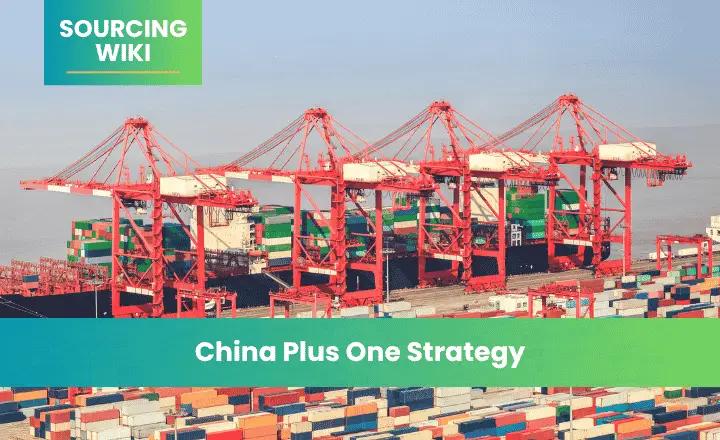
China Plus One Strategy
Definition and Scope
China Plus One (also written China+1 or C+1) is a supply chain strategy in which a company keeps China as the core of its manufacturing base while building genuine secondary production capacity in at least one additional country[1]. The strategy is often misread as a plan to leave China; in practice, it is closer to the opposite. The goal is not relocation but risk reduction — ensuring that a tariff change, a regulatory shift, or a disruption in one country cannot bring an entire supply chain to a halt, while still relying on China for the bulk of production where its advantages are hardest to replace[2]. Companies running mature China Plus One strategies typically continue to source the majority of their volume from China, particularly for complex products where China's manufacturing depth is genuinely difficult to replicate elsewhere.
Why China Remains the Core, Not the Problem
The case for keeping China as the anchor of a sourcing strategy rests on advantages that a "plus one" location generally cannot offer on day one, and sometimes cannot offer at all. China's manufacturing ecosystem has decades of accumulated depth: a dense network of component suppliers, tooling and mold-making capability, and engineers experienced in solving production problems that newer manufacturing hubs simply haven't encountered yet. Newly diversified locations rarely have China's depth of upstream supply-chain support, and total operating cost in these markets is often higher than headline labor-rate comparisons suggest once quality management, on-the-ground coordination, and factory qualification are factored in[3]. Properly qualifying a new factory in an alternative country — validating capacity and aligning quality systems — typically takes a year or more, and compressing that timeline is the most common cause of diversification efforts going wrong[4]. For genuinely complex, engineering-intensive products, the practical approach many companies land on is keeping core production and component sourcing in China, where the ecosystem is strongest, while shifting only the more labor-intensive, lower-complexity final steps to a secondary location.
China vs. Common "Plus One" Destinations
| China (core) | Vietnam | India | Mexico | |
|---|---|---|---|---|
| Supply chain depth / component ecosystem | Extensive — mature, dense upstream network | Developing — often still imports key components from China | Growing but uneven across sectors | Strong for North America-bound goods, thinner for global components |
| Engineering & tooling capability | Deep, decades of accumulated expertise | Limited for complex, precision manufacturing | Strong in select sectors (e.g., auto components) | Moderate, concentrated in specific industries |
| Factory qualification timeline for a new site | N/A — established base | Typically a year or more to validate capacity and quality systems | Similarly long qualification cycles | Similarly long qualification cycles |
| Best fit today | Complex, high-mix, engineering-heavy products | Labor-intensive assembly, simpler final-stage production[5] | Sectors like auto components, especially amid new EU carbon-reporting demands | Products bound for North America needing shorter transit and reduced tariff exposure |
| Primary reason companies still add it as "Plus One" rather than switch entirely | — | Lower labor cost, reduced US tariff exposure | Large domestic market, government incentives | Proximity to US market, USMCA-related tariff treatment |
What "Plus One" Is Actually For
Framed this way, China Plus One is less a verdict on China's manufacturing quality and more a hedge against single-country concentration risk — geopolitical tension, a sudden tariff change, or a capacity crunch in one location. Done well, it is an additive strategy: qualifying a secondary location in parallel while current China production keeps running, rather than shifting volume abruptly in a way that creates quality gaps and timeline risk of its own. Done poorly, it produces two underperforming factories and a supply chain that is more complex without being meaningfully more resilient. The decision of what to diversify matters as much as where: for many companies, the more defensible split is keeping core production and the component ecosystem in China while diversifying only the portion of output where cost or tariff exposure is most acute[5].
FAQ
Does China Plus One mean moving production out of China?
No. It means keeping China as the primary manufacturing base while adding at least one secondary location for backup capacity — the objective is reducing concentration risk, not replacing China.
Why do companies still keep the bulk of production in China under this strategy?
Because China's supply chain depth, tooling capability, and engineering experience are difficult to replicate elsewhere, especially for complex, high-mix products — newer manufacturing hubs typically lack the same density of upstream component suppliers.
How long does it take to qualify a "plus one" factory?
Properly validating a new factory's capacity and aligning its quality systems typically takes a year or more; compressing this timeline is the most common reason diversification efforts run into quality or delivery problems
Which products make the most sense to diversify away from China first?
Simpler, more labor-intensive, lower-complexity products are generally easier to shift to a secondary location, while components and products requiring deep engineering or precision manufacturing are usually best kept in China.
Is China Plus One only relevant for companies affected by tariffs?
No. While tariff exposure is a major driver in some markets, other companies pursue it for reasons like geopolitical risk management, regulatory compliance requirements, and general supply chain resilience rather than cost alone.
Sources & References
- DHL —The China Plus One Strategy: A Simple Guide to Your 2026 Supply Chain:dhl.com. Accessed August 28, 2026.
- Sourcify —China+1 Strategy: How to Diversify Manufacturing in 2026:sourcify.com. Accessed August 28, 2026.
- SVI Global —China Plus One Strategy: Reduce Risk and Diversify Supply:svigloballtd.com. Accessed August 28, 2026.
- Novex Global —Is the China Plus One Strategy Still Worth It in 2026?:novexglobal.com. Accessed August 28, 2026.
- Fanxstar —China Plus One Strategy: Supply Chain Diversification Guide:fanxstar.com. Accessed August 28, 2026.
Related Knowledge Base
Sourcing Practices & Insights: China Plus One Strategy
Latest Sourcing Guides

Get Started Today
Let's Turn Your Sourcing Goals into RealityWeChat:+86 15157124615
WhatsApp:+86 15157124615
Address:Building 10 #39 Xiangyuan Road, Hangzhou, China