

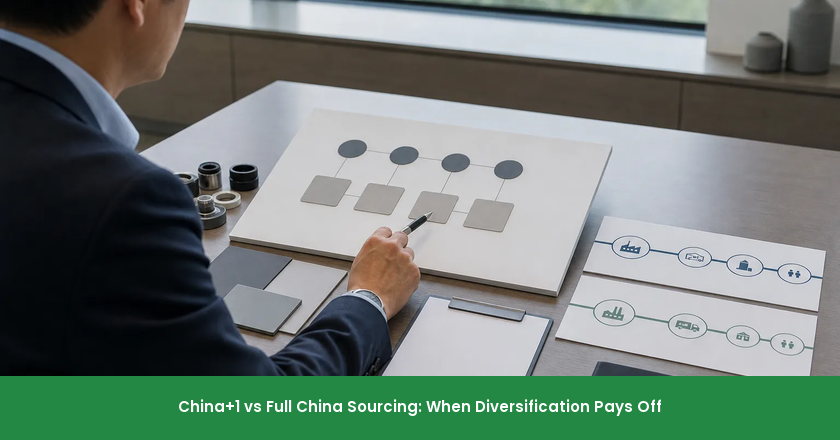
A buyer should diversify only when a real continuity exposure cannot be managed more effectively inside the existing China route. The second lane must then prove a defined operating role before it receives core volume.
The Four Decisions That Keep China+1 Grounded
- China+1 is worth testing when it protects a named continuity exposure with a genuinely independent second operating lane.
- Full China sourcing can be lower risk when its product, factory, quality, and release controls are already stronger than an unproven alternative.
- Country-of-origin treatment is product-specific. A new assembly location or shipping route does not create an automatic origin result.
- Use a bounded pilot to prove product control, release evidence, lead-time behavior, and economics before moving core volume.
Choose a Sourcing Structure by Exposure, Not by Fashion
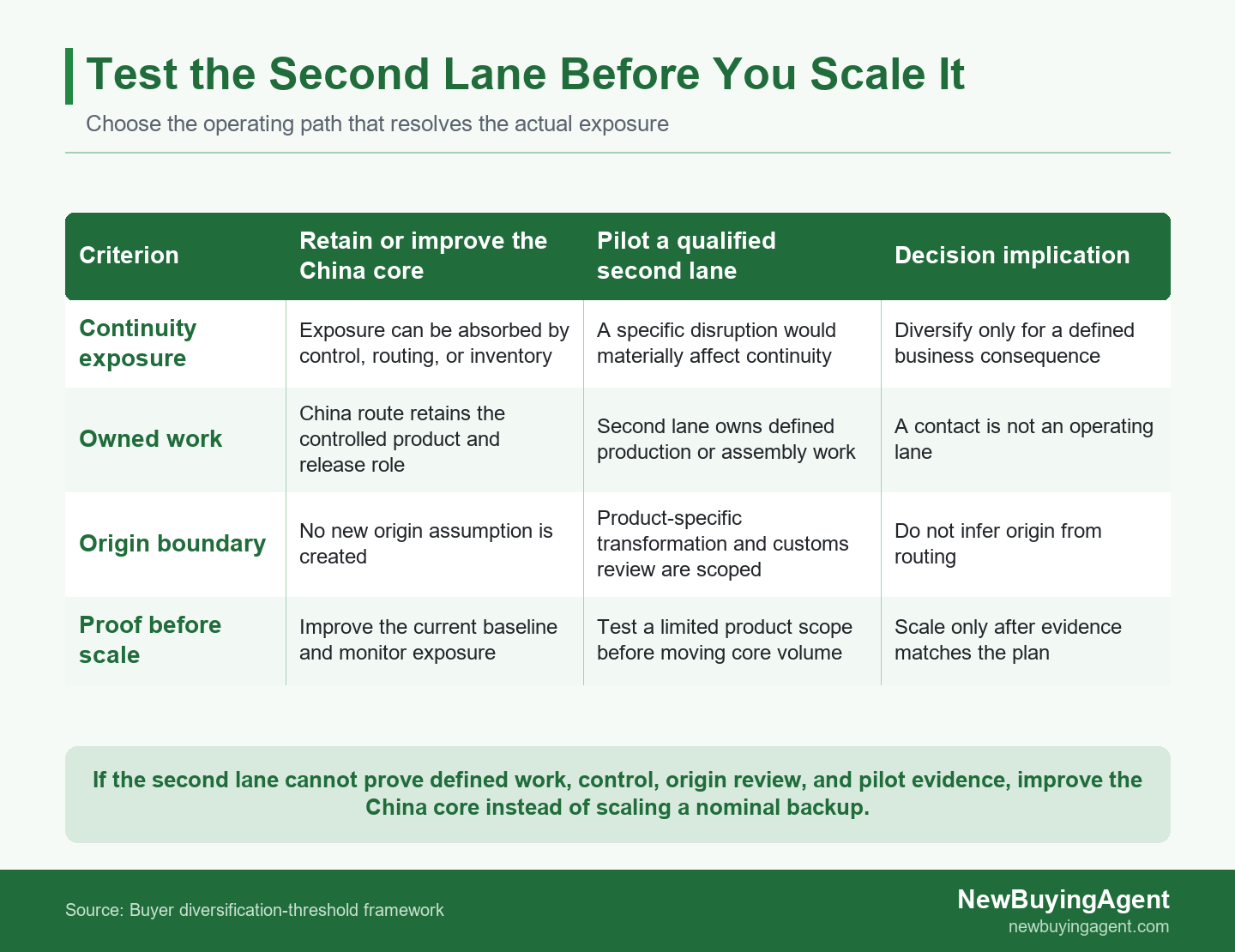
Do not scale a China+1 lane because it exists. Scale it only after the defined exposure, owned work, origin boundary, and pilot evidence are clear.
China+1 pays off only when the continuity benefit of a genuine second operating lane exceeds its added control burden. That is a harder test than opening a conversation in another country or placing a small backup order. A sourcing structure should make a defined disruption less damaging. If the alternate route still depends on the original supplier for technical decisions, product release, critical inputs, or recovery, the buyer has added another handoff without gaining a reliable second lane.
Start with the exposure rather than the geography. Is the concern a production interruption, a component bottleneck, a delivery-time problem, a destination-market requirement, or simply a need for more capacity? Each calls for a different response. A China-centered route may need stronger factory control. A seasonal product may need an inventory buffer. A repeated production exposure may justify a second manufacturing lane. The useful question is not “Which country wins?” but “What must this structure be able to recover?”
This comparison therefore does not rank countries, factories, or tariff outcomes. It gives a buyer a decision sequence: define the exposure, establish the current China baseline, test whether the alternate route owns real work, then scale only what the evidence supports.
China+1 Is a Second Operating Lane, Not a Second Purchase Order
A second operating lane must own defined work, controls, and release evidence to count as diversification. In practical terms, the buyer can name what the lane produces or assembles, which inputs it controls, who approves the current product revision, what quality evidence releases it, and how it reconnects to the commercial and delivery plan. A supplier contact, a warehouse handoff, or a quotation with no controlled scope is not enough.
Current reporting on Vietnam examines real production diversification alongside transshipment concerns. The World Bank’s Vietnam analysis is a useful reminder that visible trade movement is not, by itself, proof of a buyer’s production independence. Treat market-level change as context. Your own project still needs a controlled product, a named operating role, and a release plan.
A full China route and a China+1 route can also coexist. The question is not whether China disappears. It is which work stays in the China core, which work gains a second lane, and what evidence must be true before that split carries more value than its added coordination cost.
To make that baseline concrete, buyers can review the China manufacturing and product guide before deciding which work should remain in the China core.
The Diversification Threshold: Four Conditions to Test in Order
Four conditions must be tested before a China+1 proposal is treated as scalable. They are ranked by disqualification order: if the first one is not true, the rest of the planning exercise is premature. This is not a country ranking. It is a way to prevent a buyer from funding a second route before that route can solve a stated problem.
#1 Protect a Real Continuity Exposure
Vietnam’s official market overview supplies context, not a buyer-specific diversification verdict. A current U.S. government market overview of Vietnam can help a team understand the commercial setting, but it cannot tell the team whether its own product needs a second lane. Write the exposure in operational language: “If this component family stops for six weeks, these launch windows are affected,” or “If this production site cannot release the range, there is no qualified recovery path.”
That statement should include the affected product family, timing, destination, and consequence. If the concern can be reduced by better planning, safety stock, a revised delivery design, or stronger control of the China route, a new manufacturing lane may be an unnecessarily expensive answer. Diversification begins to earn its cost when the remaining exposure is material and cannot be managed by a smaller intervention.
#2 Create a Lane That Can Own Defined Work
Vietnam’s official market-challenges guide identifies administrative and regulatory execution considerations. The official market-challenges guide is not a reason to avoid a second lane; it is a reason to include execution work in the plan. Qualification, sample approval, material availability, local process control, documentation, and escalation paths consume time before a new route can protect continuity.
Ask five ownership questions. What exact operation occurs in the second lane? Which bill of materials and product revision is it using? Who owns the quality checkpoints and release decision? Which records prove that the output matches the approved product? If the China core is still answering all five questions, the alternate location is an extension of the old route, not a true recovery option.
#3 Treat Origin as a Product-Specific Boundary
Rules of origin determine a product’s country of origin and vary by country. The World Trade Organization’s definition explains that origin is determined under applicable laws, regulations, and administrative procedures. A final-assembly proposal can be commercially useful, but it should never be described as an origin outcome until the buyer has reviewed the actual transformation, inputs, destination-market rules, and evidence required for that product.
This boundary improves the sourcing brief. Instead of asking a supplier whether a country “works for origin,” ask for the complete process flow, component sources, production steps, test points, and documents that the relevant advisor or customs authority would need to review. That makes the question specific enough to investigate and prevents commercial assumptions from entering an origin statement.
#4 Prove the Pilot Before You Scale It
A pilot should test product release, operating behavior, and economics before scale. The objective is not to discover a universal minimum volume or a guaranteed saving. It is to compare the actual China baseline with an alternate lane using the same product revision and a defined commercial scope. Record the added tooling, engineering changes, freight path, quality activity, working-capital effect, lead-time behavior, and recovery value that the pilot reveals.
A useful pilot has an exit rule as well as a scale rule. If the alternate lane cannot hold the approved specification, release a reliable lot, meet its stated timing, or explain the commercial difference, correct the failed condition before more volume moves. Keeping the China core intact while the pilot proves itself is often the most disciplined form of diversification.
When Full China Sourcing Is the Lower-Risk Structure
A controlled China route may be lower risk when the alternative lane lacks separate proof. This is especially true when the current route has a stable product revision, component coordination, quality release method, and named delivery responsibility. Fragmenting a route before the new one can own those records may spread accountability instead of reducing concentration.
China’s official selling-factors guide provides market and logistics context for a retained China route. Use the official China selling-factors guide as a reminder to assess the route that actually exists, including its industrial-cluster, supplier, and logistics realities, rather than treating China as a generic exposure. A control baseline is the documented starting picture of the current route’s product, suppliers, quality checks, and delivery responsibility.
NewBuyingAgent presents China factory and supply-chain management support. When the exposure is weak factory follow-up or unclear production control rather than unavoidable country concentration, a buyer can assess China factory management support before paying to duplicate the production route. The aim is not to preserve China at all costs; it is to fix the actual control gap with the smallest credible operating change.
Compare the Structure That Solves the Actual Exposure
Choose the smallest operating structure that directly resolves the real exposure. Compare each option against the same dimensions: the exposure it addresses, the control it creates, the origin or document boundary it introduces, and the capital or management burden it adds. Do not use the table to declare a universal winner.
| Operating structure | What it can solve | Control burden | Poor fit when |
|---|---|---|---|
| Full China sourcing | A controlled core route needs stronger execution, not duplication | Maintain one product and release system | A material continuity exposure has no credible recovery path |
| Qualified China+1 production | A defined product family needs an independent recovery lane | Build separate scope, quality, and release proof | The alternate route still relies on the China core for every critical decision |
| China inputs plus second-country assembly | A specific operation can be separated without rebuilding every input source | Map transformation, testing, records, and origin questions | The plan is based on a presumed origin result |
| Regional inventory buffer | Delivery-timing exposure with a proven production route | Fund stock and distribution control | The buyer needs a genuine manufacturing recovery option |
Vietnam’s trade-agreement context includes RCEP and CPTPP, subject to product-specific review. The official Vietnam trade-agreements guide is useful background, not a product-treatment conclusion. Based on this comparison, the data shows that agreement context, production location, and continuity value solve different questions. Keep the structure that solves the question you actually have, then obtain product-specific origin and eligibility advice where it matters.
Worked Scenario: A Seasonal Range That Does Not Yet Clear the Threshold
In this illustrative scenario, a 15% one-SKU pilot protects the core route while testing the alternate lane. It is a composite example, not a client result, a benchmark volume, or a country recommendation.
Hold the Core Route, Then Test One Defined SKU
The illustrative pilot is limited to one SKU and a staged release gate. A global home-goods buyer has an established China route for a seasonal three-SKU range. The annual plan is 480,000 units. China currently coordinates components, assembly, quality release, and export preparation through one controlled rhythm. The team sees a potential continuity exposure and considers moving the range to a second country.
The buyer sells a seasonal range into several destination markets and needs a recovery option without destabilizing the launch calendar. The illustrative scope is 480,000 annual units across 3 SKUs, with a 15% pilot limited to one SKU. The China baseline has controlled specifications and current supplier relationships; the alternate proposal has preliminary interest but no complete release record.
The China route can identify the approved product revision, critical inputs, quality checkpoints, and release owner for the existing range. The alternate route can discuss final assembly but has not yet shown who controls the current revision, test plan, or release decision for all three SKUs. Moving all three SKUs would turn one continuity concern into a simultaneous experiment in product control, process ownership, and economics. The buyer therefore keeps the China core and tests one defined SKU with mapped inputs and a destination-specific origin review.
The decision is a staged release: China remains the core route while the alternate lane proves its specified work, samples, quality evidence, timing, and commercial assumptions. The team freezes the pilot revision, maps China-supplied inputs, names the second-site work, sets sample and release checks, and records the pilot’s added cost and timing before expanding volume. Volume expands only if the pilot matches the agreed revision, release evidence, lead-time behavior, and commercial assumptions; otherwise the buyer corrects the failed condition and keeps the China core intact. This illustrative composite does not state that a given country, factory, route, or pilot percentage will create savings, capacity, or an origin outcome.
Build a Brief That Can Test China+1 Instead of Advertising It
A useful feasibility brief starts with the route you already have, not a generic request for “another country.” Include these five inputs:
- Controlled product: the current specification, bill of materials, packaging, acceptance points, and approved revision.
- China baseline: the existing suppliers, production role, quality release, delivery handoff, and the exact exposure that remains open.
- Pilot scope: which SKU, component, or assembly step could move first, and which work stays in the China core.
- Destination boundary: the destination markets, sales timing, documents, and product-specific origin questions that require review.
- Scale decision: the evidence that permits expansion and the conditions that stop the pilot.
NewBuyingAgent presents China product sourcing support. For buyers that need to formalize the China-side starting point before they compare a pilot, they can structure a China product-sourcing brief. The value of that step is clarity: the product, China baseline, and decision boundary should be stable enough that a second-lane conversation is comparing work rather than assumptions.
Decide the Pilot Scope Before You Ask for a Quote
A decision-led feasibility review requires the current route and proposed pilot inputs. If the team can provide the current product specification, China baseline, proposed pilot scope, destination market, and the exposure it wants to reduce, it is ready for a useful feasibility conversation. The output should be a view of what the China route should retain and what the pilot must prove—not a premature promise that diversification is the answer.
Bring the live records to the conversation, including the product revision, current release method, and the decision that would justify a change in volume. When those inputs are available, a buyer can request a China-plus-one feasibility review.
Frequently Asked Questions
China+1 does not require leaving China and does not remove the need for product-specific origin review. The questions below clarify those boundaries without turning a general sourcing framework into legal or tariff advice.
Does China+1 mean I should leave China?
No—China+1 is useful when a defined second operating lane reduces a real exposure more than it adds control and management burden. China can remain the core for a product family, components, development work, or a proven production rhythm while a second lane handles a specified scope. Leave the China route only when the evidence for that decision is stronger than the value of preserving its controlled capabilities. A named country is not a reason by itself.
Can final assembly in another country change origin?
Potentially, but origin is determined under the applicable rules and the actual transformation, not by a routing label or a country name alone. The buyer should map the inputs, production steps, transformation, records, and destination before treating an assembly proposal as an origin strategy. Obtain product-specific customs, legal, or trade advice where origin affects duty, preference, labeling, or market access. That keeps a commercial sourcing choice separate from a customs determination.
How much volume should move into a China+1 pilot?
Move only enough volume to test the defined product scope, quality release, lead-time behavior, and economics without putting the core route at risk. The right level depends on the product, demand exposure, launch timing, current inventory, and what the alternate lane must prove. Rather than using a universal percentage, define the smallest scope that tests the intended operating role. Increase volume only after the agreed product, release, timing, and commercial checks have held together.
When is full China sourcing the better choice?
Full China sourcing is often the better choice when the existing route is controlled and an alternative cannot yet prove separate capacity, product control, and practical economics. It can also be the better design when the true problem is delivery timing, weak factory management, or an undefined product revision rather than manufacturing concentration. First strengthen the baseline and state the remaining exposure. If a second lane still solves a material problem after that work, it has earned a bounded pilot.
NewBuyingAgent
Related Resources
Get Started Today
Let's Turn Your Sourcing Goals into RealityWeChat:+86 15157124615
WhatsApp:+86 15157124615
Address:Building 10 #39 Xiangyuan Road, Hangzhou, China
