

China Supplier Comparison
Definition and Scope
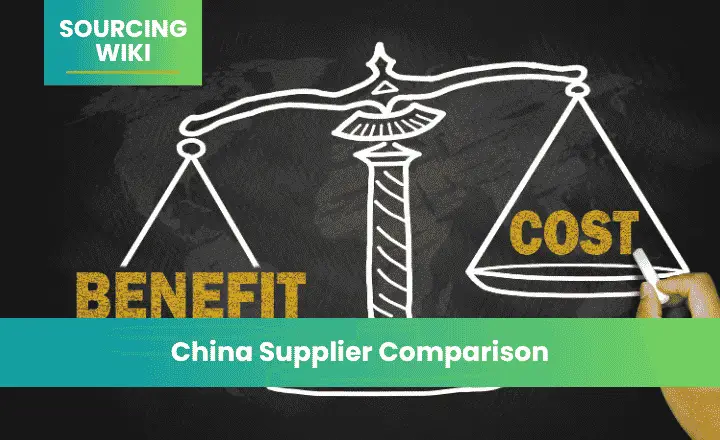
China supplier comparison is the process of evaluating multiple Chinese suppliers against the same purchasing requirements to determine which one offers the best overall fit. The comparison may involve manufacturers, wholesalers, trading companies, or other suppliers, depending on the product and sourcing model.
The purpose is not simply to identify the supplier with the lowest quotation. A meaningful comparison considers whether each supplier can provide the required product at the required quality, quantity, lead time, and commercial conditions. Two suppliers quoting different prices may also be offering different materials, packaging, production processes, or delivery terms.
For buyers sourcing from China, supplier comparison is therefore a decision-making exercise rather than a price-ranking exercise.
What Should Be Compared
A useful comparison starts by putting suppliers against the same specification. Otherwise, apparent price differences may simply reflect differences in what each supplier has included.
| Comparison Factor | What to Check |
|---|---|
| Product specification | Materials, dimensions, functions, appearance |
| Unit price | Price at the buyer's actual order quantity |
| MOQ | Minimum quantity and pricing tiers |
| Quality | Sample quality and production capability |
| Production capacity | Ability to handle the expected volume |
| Lead time | Sample and mass-production timelines |
| Customization | Available modifications and development capability |
| Payment terms | Deposit, balance, and other conditions |
| Packaging | Included packaging and customization costs |
| Delivery terms | EXW, FOB, CIF, DAP, or other agreed terms |
| Communication | Accuracy, responsiveness, and problem handling |
| Supplier risk | Verification results and operational stability |
The comparison should use equivalent assumptions wherever possible. A supplier offering a lower unit price but requiring substantially higher MOQ may not actually be more economical for a small buyer.
Price Is Only One Part of the Comparison
Price naturally attracts attention, but it should not dominate the evaluation. A lower quotation may reflect lower-grade materials, fewer packaging components, a different production specification, or a different delivery term.
Incoterms® rules allocate specific obligations, costs, and risks between buyers and sellers, so quotations using different delivery terms should not be compared as though they represented the same commercial arrangement.[1]
The better approach is to normalize quotations first. Buyers should establish what is included in each price and then compare the expected purchasing cost under equivalent conditions.
Comparing Supplier Capability
A supplier's ability to produce the required product should be assessed separately from its willingness to quote it.
For standard products, buyers can examine existing product lines, samples, production capacity, and relevant experience. For customized products, development capability, tooling, engineering resources, and previous similar projects become more important.
Capacity should also be considered relative to the buyer's order. A large factory may have excellent production capability but give limited attention to a small order, while a smaller specialist supplier may be better suited to a niche product.
Comparing Samples and Quality
Samples provide a practical basis for comparing suppliers because they allow buyers to evaluate actual products rather than relying entirely on catalog images or descriptions.
However, the sample comparison should follow the same specification. Buyers should assess dimensions, materials, workmanship, functionality, appearance, packaging, and any product-specific requirements.
An approved sample can then become a reference for production. For higher-risk orders, buyers may also use production inspection to verify whether mass-produced goods remain consistent with the agreed requirements.
Comparing Commercial Terms
Commercial terms can materially change the attractiveness of a supplier.
Important questions include:
- Is the quoted price based on the intended quantity?
- Does the MOQ fit the buyer's actual demand?
- Are tooling or development costs separate?
- What deposit and balance terms are required?
- How long is production expected to take?
- What packaging is included?
- Which delivery term is being quoted?
- Are there additional charges that apply before shipment?
A supplier offering a slightly higher unit price may still provide better economics if it accepts a smaller MOQ, offers more favorable payment terms, has a shorter lead time, or delivers more consistent quality.
Building a Supplier Comparison Matrix
A simple comparison matrix can make the decision more objective.
For example:
| Supplier | Price | MOQ | Sample | Lead Time | Capability | Terms | Risk |
|---|---|---|---|---|---|---|---|
| A | Low | High | Good | Medium | High | Standard | Medium |
| B | Medium | Low | Very Good | Short | Medium | Flexible | Low |
| C | High | Medium | Excellent | Long | High | Standard | Low |
The scores should reflect the buyer's priorities. A price-sensitive buyer may assign more weight to cost, while a brand owner may give greater weight to quality, customization, and production consistency.
The purpose of the matrix is not to create an artificial mathematical answer. It is to make trade-offs visible before a purchasing decision is made.
When Comparing Suppliers Is More Important
Supplier comparison becomes especially important when:
- The order value is significant.
- The product is customized.
- Several qualified factories are available.
- Quality differences could affect returns or reputation.
- MOQ has a major effect on inventory.
- The buyer expects repeat orders.
- The supplier will become strategically important.
For a low-value standard purchase, extensive comparison may create more work than value. The level of evaluation should therefore match the commercial exposure.
How NewBuyingAgent Can Help
For buyers who do not have an established supplier network in China, comparing suppliers can require substantial local communication and follow-up. NewBuyingAgent can handle the sourcing process on the buyer's behalf by identifying suitable suppliers, obtaining and comparing quotations, and coordinating product sourcing across categories in China.
This is particularly useful when a buyer needs to compare several suppliers or products rather than simply purchase from one known factory. The buyer provides the purchasing requirements, and NewBuyingAgent can work through the supplier side of the process and help turn the comparison into an executable order.
Need suppliers for a product you want to source from China? Send NewBuyingAgent your requirements for a sourcing assessment and quotation.
FAQ
What is the best way to compare Chinese suppliers?
Start with the same product specification and order quantity for every supplier, then compare price, MOQ, sample quality, production capability, lead time, payment terms, delivery conditions, and supplier risk.
Should I always choose the cheapest Chinese supplier?
No. The cheapest quotation may come with a higher MOQ, lower quality, less favorable terms, or additional costs. The better choice is usually the supplier offering the strongest overall fit for the buyer's requirements.
How many Chinese suppliers should I compare?
There is no fixed number. The appropriate number depends on product complexity, order value, and how many genuinely qualified suppliers are available. The goal is meaningful comparison, not collecting the largest possible list.
Should supplier samples be compared before placing an order?
For products where quality matters, yes. Comparing physical samples gives the buyer evidence of actual product capability and helps identify differences that quotations and online listings cannot show.
What if two suppliers have the same price?
Compare the factors that affect the actual purchasing outcome: sample quality, MOQ, lead time, production capacity, payment terms, communication, packaging, and delivery conditions. The supplier with the better operational fit may be more valuable even at the same price.
Sources & References
[1] International Chamber of Commerce — Incoterms® Rules ICC explains that Incoterms® rules clarify the obligations, costs, and risks allocated between buyers and sellers in the delivery of goods. ICC — Incoterms® Rules
Accessed August 26, 2026.
Related Knowledge Base
Sourcing Practices & Insights: China Supplier Comparison
Latest Sourcing Guides



Начните сегодня
Давайте превратим ваши цели по закупкам в реальностьWeChat:+86 15157124615
WhatsApp:+86 15157124615
Адрес: Здание 10 #39 Xiangyuan Road, Ханчжоу, Китай
