


For an importer, Scope 3 readiness is usually not blocked by a missing carbon number. It is blocked by a broken link between that number and the purchase record behind it. A China supplier may send a figure that looks precise, while the buyer cannot tell which SKU it covers, which production period it represents, whether it is cradle-to-gate, or how it was calculated. That is not a reporting-ready input.
Scope 3 means indirect value-chain emissions outside a company’s direct operations and purchased electricity. For China imports, the useful objective is a traceable trail from PO to product, quantity, factory, activity record, calculation method, and data-quality note. That trail can support a customer questionnaire, an internal inventory, or a future disclosure effort without pretending that every factory can already supply a verified product footprint.
The Import Data Decisions That Make Scope 3 Readiness Useful
A useful Scope 3 program for China imports starts with traceable purchase paths, prioritizes the records that can change a decision, and keeps estimates visibly separate from supplier-specific product data.
- Set the reporting entity, year, and purchased-product boundary before asking factories for data.
- Target material SKU families and relevant tier 1 suppliers first.
- Ask for product and activity records before accepting a carbon total.
- Give every input a visible quality grade and a next improvement action.
This is an inventory-readiness method, not legal or accounting advice. Each importer should confirm which disclosure rules, assurance expectations, and materiality decisions apply to its own entity and market.
Start With the Reporting Boundary, Not a China-Supplier Mandate
For a buyer’s purchased imports, the practical starting point is often Scope 3 Category 1, which covers upstream cradle-to-gate emissions of purchased goods and services. In plain language, the buyer is tracing the product path before the purchased product leaves the supplier’s gate. That gives a China import project a practical first boundary rather than an undefined request for a supplier’s entire footprint.
IFRS S2 frames Scope 3 disclosures around the reporting entity, and ESRS E1 addresses significant Scope 3 categories for the reporting undertaking. A request to a China supplier therefore does not establish a universal disclosure obligation. It improves information where a buyer has a reporting, customer, financing, or target-setting reason to use it.
The European Commission describes sustainability reporting as requirements for companies in scope. Applicability and dates can change, so they need current jurisdiction-specific review. The controlled action here is narrower: write down the reporting entity, period, included purchase paths, unit of analysis, known exclusions, and intended use before a supplier response arrives.
Prioritize the China Import Paths That Can Change the Inventory
GHG Protocol guidance recommends engaging relevant tier 1 suppliers first and allows companies to choose suppliers based on their contribution to spend or activity. For an importer, that is permission to start narrow. The first request should go where a better record could materially change the inventory, a customer answer, a buying decision, or a product-improvement conversation.
Do not rely on spend alone. A low-value but heavy or material-intensive component may deserve attention before an expensive accessory. Rank each purchase path by purchase volume, material intensity, supplier access, evidence gap, and decision relevance. The outcome is not a supplier ranking. It is a request order: which products need direct evidence now, which need a baseline estimate, and which records should be revisited during the next buying cycle.
| Import path | First move | Decision value |
|---|---|---|
| High-volume core SKU | Request product and activity records | May materially change the inventory |
| Material-intensive component | Confirm material, mass, process, and factory | Product definition may matter more than value |
| Low-impact or unavailable path | Use an estimate and improvement log | Maintains coverage without hiding uncertainty |
Build a Supplier Request That Produces Usable Evidence
A supplier request should be built as two linked layers: first establish the product and activity record, then ask how any product figure was calculated. Asking only for “carbon emissions” invites a total that cannot be matched to the imported goods.
For existing factories, name a single owner, give a bilingual field list, specify the reporting period, and agree on the return format. Buyers that need help coordinating this kind of record collection can see how NewBuyingAgent supports management of existing China factories. The point is to make product information comparable; the reporting company retains its methodology and disclosure judgment.
Ask for Product and Activity Records Before a Carbon Total
Supplier-specific product-level data is most accurate when it relates to the specific purchased good and avoids unnecessary allocation. Begin with buyer SKU, supplier item code, product name, declared unit, quantity, factory location, and reporting period. Then ask for the activity evidence that can explain the figure: material grades and weights, production quantity, energy data, process information, or an existing product footprint.
The buyer does not need every ledger on the first request. It needs enough information to tell whether a response covers the bought product rather than the supplier’s entire factory or a different model. Keep the original return with the PO and sourcing record. A later material, factory, or process change can then trigger an informed review rather than a search through disconnected sustainability emails.
Then Ask How the Product Figure Was Calculated
A supplier data request should ask for the calculation method, data sources, emission-factor context, and whether the information was assured or verified. Add a declared lifecycle boundary, allocation approach where processes are shared, factor source, and the share of primary versus secondary data. Those fields turn a number into a record that can be evaluated.
The PACT Pathfinder Framework is voluntary guidance for more consistent exchange of supplier-specific product carbon footprint data across value chains. It can provide a common vocabulary for product-carbon-footprint exchange, but it does not replace the buyer’s chosen inventory method or reporting policy.
A useful stop rule is simple: do not divide an unbounded factory total by the last order quantity and call it kg CO2e per unit. If the period, product set, boundary, or allocation basis is unknown, log the number as an unverified lead and retain the documented estimate until the supplier can clarify it.
Grade the Data Instead of Pretending Every Number Is Equal
A Scope 3 inventory can use supplier emissions data for high-emissions suppliers and estimates for the remainder when the method and improvement path are documented. A staged approach is more credible than waiting for perfect coverage or treating every returned number as equally robust.
Technology, time, geography, completeness, and reliability are useful data-quality dimensions when deciding how much confidence to place in an emissions input. Ask whether the record matches the SKU, whether the period is current, whether it represents the actual China facility, whether it covers the relevant volume, and whether the source can be checked.
A four-grade readiness ladder is more honest than collapsing every estimate and supplier response into one apparent level of certainty.
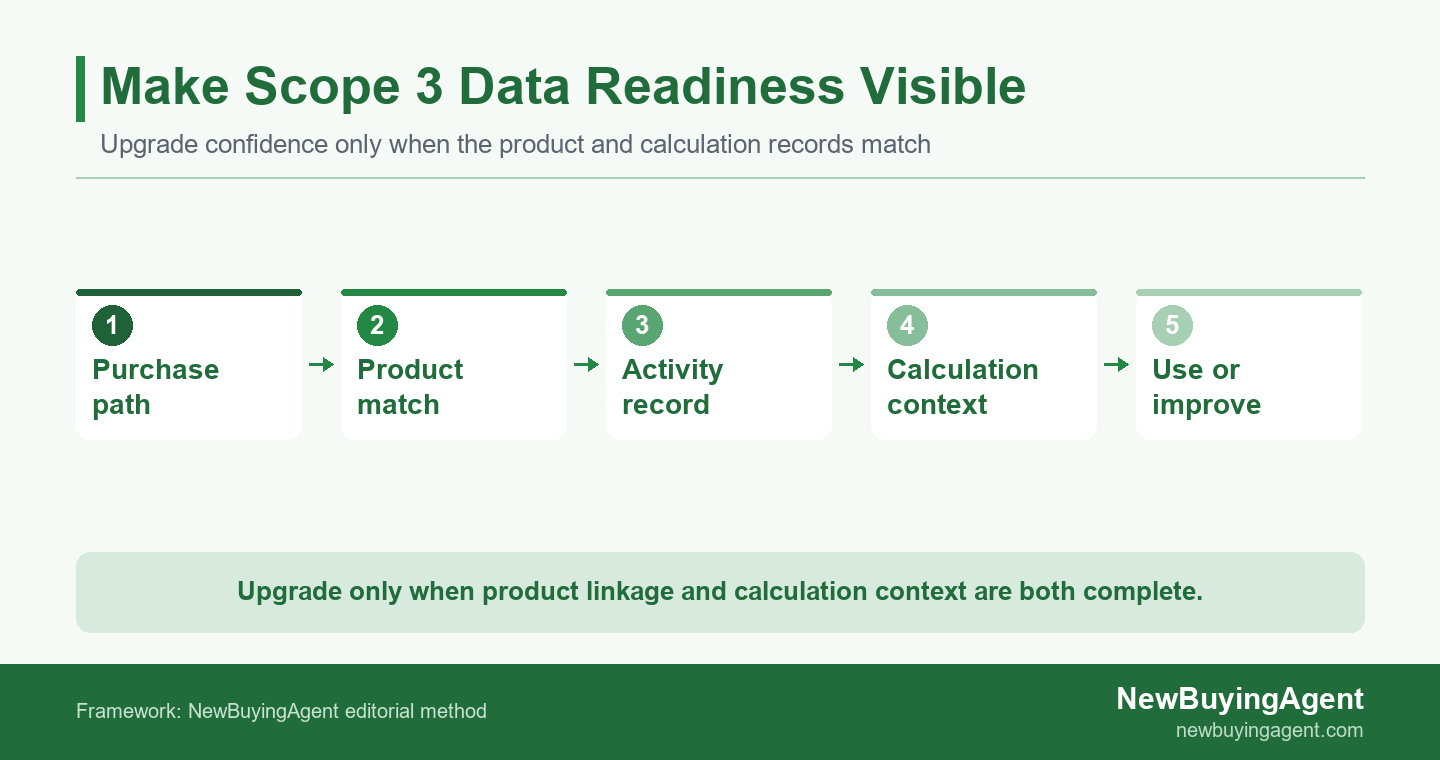
Scope 3 data readiness gates from a purchase-path estimate to supplier-specific product evidence
| Grade | Evidence | Action |
|---|---|---|
| A | SKU, unit, period, boundary, method, and quality record match | Use under the selected inventory method |
| B | Useful direct record with a known gap | Log the limitation and improvement action |
| C | Documented secondary or spend-based estimate | Keep it visible and prioritize replacement |
| D | Unscoped total or unmatched number | Do not promote it; request clarification |
Grade D is not a failed supplier relationship. It is a communication signal. The buyer can ask for the one missing field instead of broadly demanding better ESG data. That is easier for a factory to action and less likely to produce another incomparable number.
An Illustrative China Import Scenario: Keep the Boundary Visible
How the Buyer Labels the Two Data Paths
An importer should keep a documented baseline estimate for incomplete paths and seek supplier-specific records first where product-level evidence can materially change the inventory or a product decision.
A multi-channel retailer imports 30,000 cookware and storage units across three SKU families from 2 China factories. A customer asks for climate-data context. The retailer has POs and invoice values, but not a consistent product-carbon-footprint file. Factory A returns a single carbon number with no unit, reporting period, or stated cradle-to-gate boundary. Factory B can provide electricity and production records for one material-heavy SKU family, but not the complete product range.
The tempting move is to place both figures in a spreadsheet and calculate an average. That would conceal the real difference: Factory B’s record may become useful once it is tied to the SKU, quantity, period, and boundary, while Factory A’s total is still a question rather than a comparable product factor. The buyer should retain a baseline estimate for all three families and create a targeted improvement request for the two paths most likely to change the inventory.
An importer should label unmatched data as an estimate and create a supplier improvement action rather than treating a partial supplier response as a completed product footprint.
For Factory B, confirm the unit, material mass, production period, facility, allocation approach, factor sources, and verification status. For Factory A, first identify the product set and boundary. In both cases, the retailer can answer honestly: the inventory uses a documented method today, direct supplier evidence is being improved on priority product paths, and limitations remain visible. This is an illustrative planning scenario, not a statement about a client result.
Use China-Side Coordination Without Outsourcing the Reporting Judgment
China-side coordination can improve the completeness of product and activity records, while the reporting company retains ownership of methodology, consolidation, assurance, and disclosure judgments.
A sourcing partner can translate the request, confirm factory and product identifiers, follow up on missing records, and keep the reply attached to the buying file. For a new product, buyers can use NewBuyingAgent's product-supply service with a traceable product brief that states product logic, materials, quantity, destination, and reporting-period needs alongside price, quality, and delivery. Readers can also review NewBuyingAgent success stories across product categories for its cross-industry sourcing context.
NewBuyingAgent is a one-stop China sourcing agent service provider for global buyers, with local factory resources and product-development and quality-control capability. Those strengths can improve the sourcing facts that support a request; they do not promise verified Scope 3 data from every factory or replace accounting assurance.
Data readiness also improves commercial decisions. When a buyer can see that two product families have the same claimed footprint but different boundaries, it can ask the right sourcing question before treating them as equivalent. It may decide to keep the existing estimate, request a clarified factor, or change the information requirement for the next order. The important discipline is not to reward the first number returned. It is to preserve a record of what that number represents, who supplied it, and which decision it is fit to support.
Prepare a Data-Readiness Brief Before You Ask for Numbers
A prepared data-readiness brief gives the importer and supplier a shared reference for a comparable response instead of a one-off request for a carbon total.
Before contacting a factory, compile the product brief; buyer SKU and supplier item code; PO quantity and unit; factory contact; reporting period; known material or process information; chosen boundary; intended use; confidentiality expectations; and the exact requested fields. Add an owner and due date for every missing record. When data is unavailable, retain the documented estimate and log the missing field as an improvement action rather than a silent assumption.
If the buyer needs China-side support to turn that packet into consistent product and factory follow-up, it can send a supplier-data brief to NewBuyingAgent. Include the product requirement, SKU and material list, PO quantities, supplier contacts, reporting period, and intended data use.
Frequently Asked Questions
Do China importers need supplier-specific Scope 3 data immediately?
No, an importer can begin with a transparent estimate while prioritizing supplier-specific data for material purchase paths. The inventory should show which results are estimated, which use partial supplier information, and which are linked to a defined product and method. A phased request is often more useful than delaying the inventory until every factory can respond.
What should a Chinese supplier include in a product emissions request?
A useful request identifies the product, reporting period, activity data, calculation method, declared boundary, and verification status. It should also retain the buyer SKU, supplier item code, unit, quantity, factory, factor source, and allocation explanation where relevant. These fields show whether a response is a product-level input, partial evidence, or an unscoped number needing clarification.
Can spend-based estimates and supplier data appear in one inventory?
Yes, a mixed method can be appropriate when the calculation method and data quality remain visible for each purchase path. A documented estimate can provide coverage while direct supplier records improve precision for priority products. Record why each method was used, preserve comparability rules across years, and identify which estimate has the highest value as the next supplier-data project.
How should importers protect confidential supplier information?
Importers should request only decision-relevant data, document access rules, and consider verification routes that avoid unnecessary disclosure of proprietary records. A supplier may provide a bounded product factor, methodology summary, or assurance statement without exposing every operational ledger. State the intended use, limit access to the relevant team or adviser, and retain confidential records with the sourcing file.
NewBuyingAgent
Related Resources



Начните сегодня
Давайте превратим ваши цели по закупкам в реальностьWeChat:+86 15157124615
WhatsApp:+86 15157124615
Адрес: Здание 10 #39 Xiangyuan Road, Ханчжоу, Китай
