

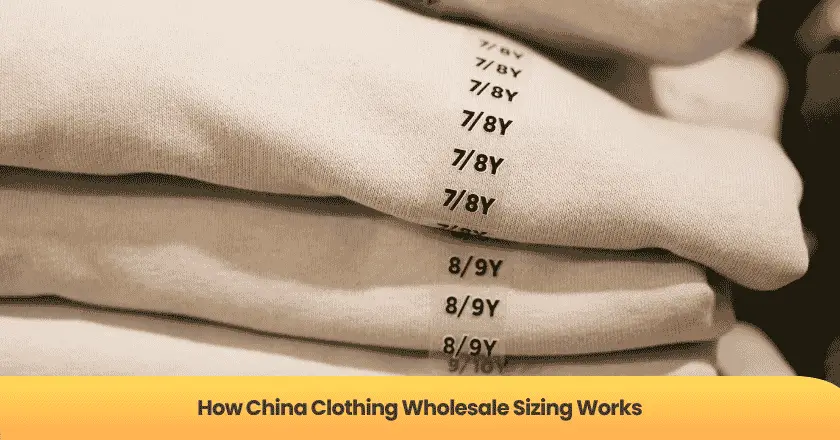
A buyer orders 1,200 shirts split evenly across S to XL and receives goods that his customers describe as running a full size small. The factory built exactly what was ordered. He specified sizes by letter, the supplier applied its own size chart, and nobody exchanged a single measurement. Both parties used the word medium and meant garments that differ by four centimetres across the chest.
Size names are labels rather than specifications. What a factory actually builds to is a measurement chart, and buyers who send one get what they expect while buyers who send a letter get whatever that supplier's letter means.
Key Takeaways
• A size letter is not a specification, and the same letter means different garments at different factories.
• The Chinese national designation encodes height, a body girth and a body type code rather than a letter.
• Body measurements and garment measurements are different things, and factories build to the second.
• Your measurement chart with points of measure and tolerances is the document that governs production.
• Grading and the size ratio per carton are separate decisions that need stating explicitly.
Two Systems, Neither of Them Letters
China has a formal size designation system, and the market also uses letters. Neither maps cleanly onto what a buyer in another market expects.
The National Designation
Chinese apparel sizing follows the GB/T 1335 series covering men, women and children, maintained through the national standards platform and administered by the national garment standardisation committee. A designation such as 170/88A encodes height in centimetres, a body girth in centimetres, and a body type code.
The letter at the end is not a size. It describes body type by the difference between chest and waist, so 170/88A and 170/88B fit the same height and chest with different waist allowance. This is a more precise system than letters and it describes the wearer rather than the garment.
Letters and Where They Come From
Market vendors and many factories also use S, M, L and XL, and these are convenience labels rather than standardised measurements. A supplier's letters reflect the body proportions of the market it usually serves, which is why goods built to a domestic chart frequently feel small to buyers in other markets.
There is no conversion table that resolves this reliably, because letters are not defined quantities. Any chart claiming to convert Asian M to US M is an approximation of two things that were never precisely defined in the first place.
Destination markets add their own conventions on top. Sizing practice differs between the US, the UK, continental Europe and Japan, and within each market between segments, so the same garment measurements carry different labels depending on where it sells. Decide what the label will say separately from what the garment measures, because those are two decisions and only one of them affects production.
Expert Tip: Never place an apparel order using size letters alone, however clear the conversation felt. I send a measurement chart with every enquiry, even for a simple product, and I ask the supplier to confirm it can build to those numbers before quoting. It takes ten minutes to produce and it converts the single largest source of apparel returns into a solved problem. Buyers who order by letter are relying on two different assumptions matching, which they rarely do.
The Document That Actually Governs
Factories do not work from size names. They work from a measurement chart, and that chart is the specification whether or not you supplied it.
Points of Measure and Tolerances
A measurement chart lists points of measure: chest at a stated position, shoulder to shoulder, sleeve length from a defined origin, body length from high point shoulder, hem width, and so on for the garment type. Each point carries a target figure per size and a tolerance.
The definitions matter as much as the numbers, since chest width can be measured at several heights and sleeve length from several origins. Include a diagram showing where each measurement is taken, because a chart of numbers without positions is still ambiguous.
Fabric behaviour belongs in the same conversation. A woven and a knit built to identical measurements fit differently, and knits vary further by stretch and recovery. Where a fabric is substituted between sample and production, measurements can be met exactly and the fit still change, which is one reason material substitution matters more in apparel than the measurement chart alone suggests.
Body Measurements Against Garment Measurements
This is the distinction that catches buyers most often. A body measurement describes the wearer. A garment measurement describes the finished item, which includes ease added by the designer, and the difference between the two is a design decision rather than an error.
Send garment measurements. A chart of body measurements leaves the factory to choose the ease, and its choice reflects the fit conventions of its usual customers rather than yours.
Common Mistake to Avoid:Approving a fit sample in one size and letting the factory grade the rest is the error that produces a saleable middle and unsaleable ends. Grading is a technical step with its own rules, and applying a uniform increment across every point of measure produces sleeves that are proportionally wrong at the extremes. Approve fit samples in the base size and at both ends of the range, put them on real bodies, and record the approval per size rather than per style. Three extra samples against a run where the top and bottom sizes may be unwearable.
Grading, Ratios and Tolerances
Three further decisions sit between an approved sample and a shipment that sells through.
How Grading Works
Grading applies increments to each point of measure across the size range, and the increments differ by point. Chest may step by four centimetres while shoulder steps by one and sleeve by one and a half. Applying one increment everywhere is fast and wrong.
Ask for the grading rules as a document rather than assuming them. A factory that produces a grade rule table has a system, and one that cannot is grading by habit, which works acceptably for its usual customers and unpredictably for a new fit.
Shrinkage is the variable buyers most often forget to specify. Wash testing after production tells you what happens in a customer's home, and a garment that measures correctly off the line and shrinks beyond tolerance after one wash is still a defect. State a wash test requirement and an acceptable shrinkage range in the specification rather than assuming the factory allowed for it.
Tolerances and Inspection
Every measurement carries a tolerance, commonly around a centimetre on major points and less on smaller ones. State them explicitly, since a factory working without stated tolerances applies its own, and a garment ten millimetres out on chest may be acceptable or a reject depending entirely on what was agreed.
Measurement checking is part of inspection rather than separate from it. Sampling schemes in ISO 2859-1 size the sample against the lot, and your inspection brief should state how many garments per size are measured and against which points, otherwise an inspector will measure whatever seems reasonable.
Expert Tip:Ask for the measurement report from the production run, not just a pass or fail. A table showing actual measurements against target for each size tells you whether a batch sat comfortably inside tolerance or scraped through at one end, and the second case predicts trouble on the reorder. I keep these reports across seasons, and the drift they reveal is usually invisible from any single inspection result.
Ratios, Labels and Reordering
The last set of decisions concerns how sizes are distributed and identified, and both are easy to leave to the factory by accident.
Size Ratio and Packing
State the ratio you want per style and per carton rather than accepting an even split. An even distribution across five sizes rarely matches how a range actually sells, and correcting the mix after arrival means handling every carton.
Decide also whether cartons are packed by single size or as assorted ratio packs. Single-size cartons suit warehouses that pick individually, ratio packs suit direct distribution to stores, and the choice affects receiving work as much as freight.
Labels, Codes and the Reorder
Each size needs its own identifier. GS1 requires a distinct Global Trade Item Number for each product variation including size and colour, as well as for case and inner-pack levels, so a range across five sizes and three colours is fifteen numbers before packaging levels are counted.
Keep the approved chart, the grading rules and the sealed fit samples together after the first order. A reorder six months later runs on those documents, and reconstructing them from memory produces a second batch that fits differently from the first, which customers notice faster than any other defect.
Expert Tip:Write your measurement chart once per garment block rather than per style. A shirt block, a tee block, a trouser block, each with agreed points of measure, grading rules and tolerances. New styles then inherit an established fit instead of starting from nothing, and suppliers quoting against a familiar block work faster and more accurately. This is how brands keep fit consistent across a range, and it costs one afternoon per block to set up.
Keeping Fit Consistent Across Orders
Everything above depends on checking measurements against an agreed size chart while production is still underway, rather than discovering inconsistencies after the goods arrive.
NewBuyingAgent's 20,000+ product development and QC experts across China provide product and quality support to help ensure that specifications are understood and followed during production.
This becomes particularly important for repeat orders. Measurements, fit requirements and approved specifications need to remain consistent across different styles, colours and production runs. Following up on these details with factories is ongoing work, not a one-time check.
NewBuyingAgent handles factory communication and purchasing coordination throughout the sourcing process. For buyers sourcing multiple products or categories from China, this means they do not have to manage every factory and every production follow-up themselves.
The result is a more consistent sourcing process: the buyer defines the required fit and specifications, while NewBuyingAgent works with the relevant factories to source and produce accordingly. Contac now.
Frequently Asked Questions
What does a size like 170/88A mean?
It follows the Chinese national designation under the GB/T 1335 series: 170 is height in centimetres, 88 is a body girth in centimetres, and the letter is a body type code based on the difference between chest and waist. It describes the intended wearer rather than the garment, so it is not a substitute for a garment measurement chart.
Do Chinese sizes run smaller than Western sizes?
Letters commonly do, since they reflect the body proportions of the market a supplier usually serves. There is no reliable conversion, because letters are not defined quantities in either system. Send garment measurements rather than trying to convert, which removes the problem instead of estimating around it.
What should a measurement chart include?
Points of measure with clear definitions and a diagram showing where each is taken, target garment measurements per size, tolerances per point, and the grading rules across the range. Garment measurements rather than body measurements, since the ease between them is a design decision that should be yours.
How many fit samples do I need?
At minimum the base size and both ends of the range, since grading problems appear at the extremes rather than in the middle. Put them on real bodies rather than judging from a table. Record approval per size, and keep the sealed samples for the reorder, when both sides will otherwise be working from memory.
How do I keep fit consistent when changing factories?
Take the measurement chart, the grading rules and a sealed approved sample with you, and require the new factory to build to those rather than to its own block. Expect one fit sample round to reconcile differences in how each factory interprets a point of measure. Buyers who move on the size names alone effectively start the fit development again.
Conclusion
Stop ordering by size name and start ordering by measurement. Send a garment chart with defined points, tolerances and grading rules, approve fit at the base size and both extremes, state your size ratio rather than accepting an even split, and keep the chart and sealed samples for the reorder. Apparel fit problems are almost entirely a documentation failure rather than a manufacturing one. For buyers keeping fit consistent across seasons and suppliers, NewBuyingAgent handles factory selection, quality control and delivery from China.
Partial Sources
1. National Public Service Platform for Standards Information, State Administration for Market Regulation — GB/T 1335 series on apparel size designation, covering men, women and children —https://std.samr.gov.cn/gb/search/gbDetailed?id=71F772D7CB09D3A7E05397BE0A0AB82A— Accessed 3 September 2026
2. International Organization for Standardization — ISO 2859-1:2026, Sampling procedures for inspection by attributes, Part 1 —https://www.iso.org/standard/85464.html— Accessed 3 September 2026
3. GS1 — Global Trade Item Numbers and barcodes, requiring a distinct number for each product variation including size and colour —https://www.gs1.org/standards/get-barcodes— Accessed 3 September 2026
NewBuyingAgent
Related Resources



Начните сегодня
Давайте превратим ваши цели по закупкам в реальностьWeChat:+86 15157124615
WhatsApp:+86 15157124615
Адрес: Здание 10 #39 Xiangyuan Road, Ханчжоу, Китай
