

A China sourcing agent, a trading company, and a direct factory can all be sensible routes. The least burdensome one is not automatically the route with the lowest first quote. It is the route that gives every critical product, proof, and delivery task a named owner before the buyer commits cash or cargo.
That is the practical meaning of hassle-free. When documents, cargo readiness, booking, and responsibility move to the next party without a clear owner, a specification change, evidence request, or missing file returns to the buyer as unplanned coordination work. The three routes should be compared by that operating burden, not by a universal winner claim.
The Best Route Is the One With No Unowned Critical Task
- Direct factory: often fits a stable SKU when one manufacturer owns the production scope and the buyer can run the remaining records, changes, and delivery decisions.
- Trading company: can simplify a ready offer when the commercial scope, evidence flow, and post-quote responsibilities are written down.
- China sourcing route: can fit when a defined product brief needs China-side coordination across product development, quality evidence, and logistics work.
- Decision rule: choose the route that closes the next ownership gap. Do not compare prices until the product version, proof, and handoff scope are comparable.
The labels are useful starting points, but real businesses can combine roles. A factory may export directly, a trader may coordinate packaging, and an agent may work only on a stated part of the order. The contract and current capability matter more than the label. A stable order can remain direct; a changing order may need one coordinating path for the work that is otherwise left between parties. A shipment handoff means the point where documents, cargo readiness, booking, and responsibility move to the next party.
What Each Commercial Route Is Actually Buying You
Compare the routes by commercial scope and buyer-owned work, not by a promised price ranking. A quote only becomes comparable when the product version, volume, packaging, delivery term, evidence requirements, and shipment handoff describe the same transaction. The route is then a decision about which party can credibly own the work that remains.
Incoterms are contract rules that allocate listed shipment tasks, cost allocation, and risk transfer between buyer and seller. They are important, but they are not a complete operating agreement. Trade.gov's Incoterms guidance explains that the rules clarify stated delivery tasks, costs, and risks while leaving other sale conditions outside their scope. A buyer still needs written owners for product changes, evidence, and document approval.
| Route | Best starting condition | Work the buyer must still test | First comparison question |
|---|---|---|---|
| China sourcing agent | A defined brief needs local execution across several parties. | Exact scope, evidence checkpoints, reporting, and delivery handoff. | Which local work will one coordinating route actually own? |
| Trading company | A ready, repeatable offer has clear commercial terms. | Product source, change control, evidence, and after-quote duties. | What stays with the seller and what returns to the buyer? |
| Direct factory | A stable SKU and capable buyer team can operate the gaps. | Records, component changes, destination checks, and freight decisions. | Can the buyer and factory name an owner for every open row? |
For a new China supply path, the buyer should ask for a single written scope that connects product decisions, production follow-up, quality checks, and delivery coordination. That makes it easier to distinguish a real local-execution route from a loose collection of introductions. Buyers can see how NewBuyingAgent can supply products from China when the purchasing brief needs one China-side operating path.
Commercial route selection is separate from market-entry requirements. Trade.gov's China standards guide illustrates that standards, conformity assessment, and certification can be product-specific in the China market. Treat that as a destination-specific example: every buyer should check the current official rules for the actual product and destination.
China Sourcing Agent: Useful When the Brief Needs Local Execution
A China sourcing route can fit when the product brief is clear but local execution crosses product, quality, packaging, and logistics boundaries. The question is not whether an agent sounds more convenient. It is whether one stated scope can coordinate the tasks the buyer cannot reliably run from abroad. The buyer should confirm the commercial scope, evidence timing, and escalation path before treating that support as owned work. It also helps to ask which activities are excluded, who approves a change, and how the China-side report will connect to the buyer's own release decision.
Trading Company: Useful When a Ready Offer Reduces Buying Friction
A trading company can be the simpler choice for a ready offer when the product, commercial terms, and downstream responsibilities are explicit. That can reduce the buyer's supplier-facing coordination, particularly for a standardized item. It does not remove the need to ask how a material change is approved, who provides current evidence, who checks the final commercial documents, and who owns the handoff. A trading-company label alone does not answer those questions. Ask whether the offer remains valid if the packaging, destination, order quantity, or delivery window changes, then compare the answer with the buyer's own capacity to close the remaining gaps.
Direct Factory: Useful When You Can Own the Gaps
Direct factory buying can work well for a stable SKU when one manufacturer owns the production scope and the buyer's team can carry the remaining records and decisions. It may offer closer production communication, but direct contact is not the same as complete control. The buyer must decide whether it can manage component changes, packaging approvals, destination checks, bookings, and document matching without becoming the fallback coordinator. Direct buying is not a blanket price, quality, or compliance advantage. It is a good operating fit only when the buyer can answer each ownership question before production and can receive useful proof before an error becomes expensive to correct.
Use a Six-Row Ownership Check Before You Compare Quotes
The useful comparison starts with six rows: product version, commercial scope, quality evidence, change control, commercial documents, and shipment handoff. For each row, name the owner, the evidence to be produced, the deadline, and the action when that evidence is missing. This is not a legal checklist. It is a pre-deposit method for exposing work that has silently fallen back to the buyer.
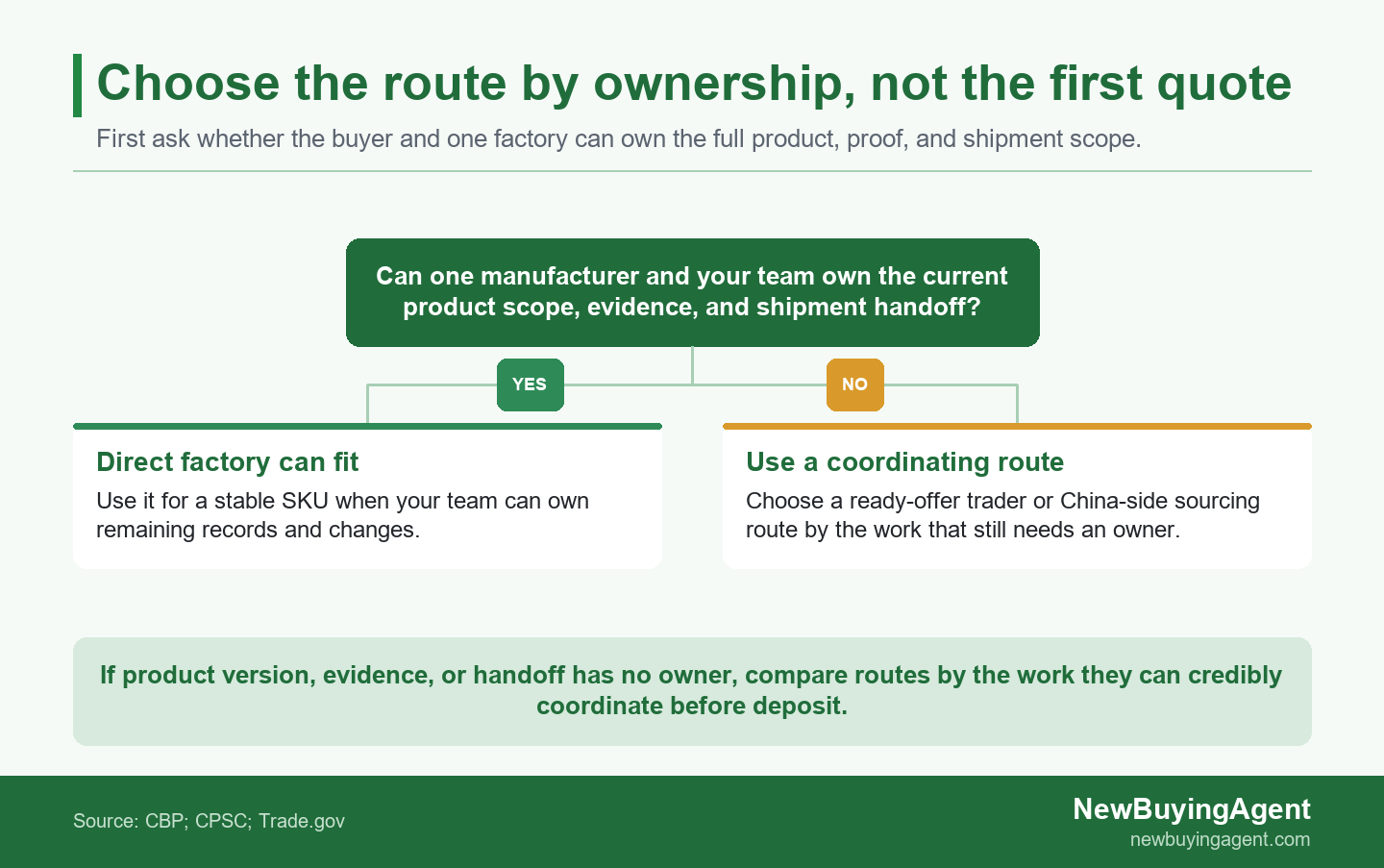
Start with the owner of the product version, evidence packet, and shipment handoff before comparing commercial models.
| Row | Owner to name | Proof before the next commitment |
|---|---|---|
| Product version | Buyer plus product owner | One approved specification, reference sample, and revision date. |
| Commercial scope | Seller and buyer | Matching quantity, packaging, price basis, exclusions, and delivery term. |
| Quality evidence | Named quality owner | Sample, test, inspection, or release record tied to the current goods. |
| Change control | Party authorized to approve changes | Versioned change record and any required recheck. |
| Commercial documents | Invoice and document owner | Documents that match product, quantity, value, and transaction. |
| Shipment handoff | Booking and release owner | Confirmed cargo readiness, booking, document packet, and next-party acceptance. |
A buying route can improve coordination, but it does not automatically replace the importer's destination-market responsibilities. In the United States, CBP explains that broker assistance does not remove the importer of record's responsibility. For covered consumer products, 15 U.S.C. 2063 assigns the certificate to the importer for imported products within its scope. A General Certificate of Conformity is a U.S. certificate for applicable rules governing consumer products. CBP's commercial-invoice guidance is another reason to give the document row a named owner. These are U.S.-specific examples, not legal advice for every market.
The choice need not be all-or-nothing. A buyer can keep an existing China factory while adding local support around production follow-up, quality management, and logistics coordination. That is relevant when the factory remains capable but evidence and handoff work keep crossing time zones. Buyers can see how existing China factories can be managed locally while preserving the existing commercial relationship.
Use the ownership check while the order can still be changed. A missing name in one row does not automatically mean the route is unsuitable. It signals a question for the buyer to close: can the factory, trader, or coordinating partner take that task under a written scope, or should the buyer retain it? The useful answer includes a deadline and a record, not only an assurance that someone will follow up. This approach also keeps a small problem contained. Instead of rewriting the entire commercial relationship, the buyer can assign the unresolved row and test whether the proposed control works on the current order.
An Illustrative First Order: When Direct Stops Feeling Direct
The following is an illustrative decision model, not a NewBuyingAgent client result, fee quote, or market average. It shows why a direct route can stop feeling direct before the factory's unit price changes. The threshold is not one inconvenience. It is repeated cross-party work that has no current owner or shared control record. Buyers who want to see how coordination needs vary by project can review NewBuyingAgent sourcing case examples.
The Route Changed When Coordination Demands Repeated
Illustrative order: a retailer is introducing 2 related kitchen-storage SKUs to a new market and initially prefers a direct factory quote.
The first order is $60,000 and 1,800 sets: 1,200 main storage sets and 600 companion sets with new carton artwork.
The main product design is settled, but the component, packaging, documentation, and booking details are still open.
The main factory owns the molded product but not the companion hardware or the carton-artwork approval.
Across 6 working days, 3 cross-party changes are spread across the factory, packaging supplier, and freight handoff contact.
The buyer receives updates in separate message threads and cannot tell which version controls the final shipment packet.
The direct route is not failing because the factory price is wrong. It is failing because repeated changes have crossed several supplier scopes and the buyer has become the default coordinator.
Keep direct factory buying only if the buyer can assign an owner and checkpoint to every open row. Otherwise, reroute the unresolved work through one China-side product-supply path before deposit.
Freeze one versioned product brief, request a single scope-confirmed quote, and name the owner for components, carton approval, compliance evidence, and booking handoff.
Before deposit, confirm that the current product version, sample reference, packaging file, destination requirements, quality evidence, and shipment-handoff owner appear in one approved packet.
This example shows that once the 2 SKUs stabilize and one capable factory can own the product scope while the buyer's team can handle the remaining records, the direct route may again be the simpler choice.
Turn the Choice Into an Operating Handoff
The right route still depends on the product brief and requested scope. The useful next step is therefore not a vague request for the best supplier. It is a concise operating handoff that lets each party state what it can own.
Prepare one brief with the current product specification, reference sample or drawings, destination market, quantity, target price, packaging, delivery constraints, timing, and existing-factory context where relevant. Add the evidence needed before production, balance payment, and booking. This does not replace product-specific customs, contract, or compliance advice. It does make route proposals and quotes easier to compare because each party responds to the same work.
Then ask four direct questions: Which product version are you quoting? Which changes can you approve? What proof will you provide before the next commitment? Who owns the shipment handoff? A clear answer can support direct buying, a ready-offer trading route, or China-side coordination. An unclear answer shows exactly where the buyer should add control.
Make the unresolved work visible so the reply can define a practical scope instead of masking it with a generic promise. When the brief is ready, buyers can request a China product quote with your product brief.
Frequently Asked Questions
Is a sourcing agent always cheaper than a trading company?
No; the lower commercial cost depends on the product, contract scope, and work that would otherwise remain with the buyer. A trading company may simplify a ready offer, while a sourcing route may be worth considering when local execution repeatedly returns to the buyer. Compare the same product version, quantity, packaging, evidence requirements, delivery term, and buyer-owned work before deciding that one route costs less.
Can a trading company still be the right choice?
Yes; a trading company can fit a ready, repeatable offer when the contract clearly covers the product, commercial terms, and handoff responsibilities you need. It can be a practical interface when the product is standardized and the post-quote work is limited. Ask what happens when a component changes, when proof is due, and who supplies the documents that travel with the shipment.
When does direct factory buying make the most sense?
Direct factory buying usually fits best when a stable SKU, one capable manufacturer, and an experienced buyer team can cover the records, changes, and shipping decisions. It is strongest when the factory owns the production scope and the buyer can handle the gaps without slow, repeated escalation. If documents, packaging, evidence, and bookings keep crossing separate parties, review the ownership rows before continuing with the same model.
Does the buying route change the importer's compliance responsibilities?
No; a sourcing route can improve evidence collection and coordination, but the importer must still confirm the rules that apply in the destination market. For covered U.S. consumer products, 16 CFR Part 1110 identifies the importer as certifier and retains legal responsibility with that certifier. Requirements vary by product and market, so confirm the current official rule for the specific shipment.
NewBuyingAgent
Related Resources



Начните сегодня
Давайте превратим ваши цели по закупкам в реальностьWeChat:+86 15157124615
WhatsApp:+86 15157124615
Адрес: Здание 10 #39 Xiangyuan Road, Ханчжоу, Китай
